
Training Session for Groups in Region 1
The FSAM (Swiss Model Aircraft Federation) has an “Infrastructure” committee within its structure, chaired by Mr. Adrian Eggenberger. The committee addresses a variety of issues, including noise concerns and frequency monitoring and management.
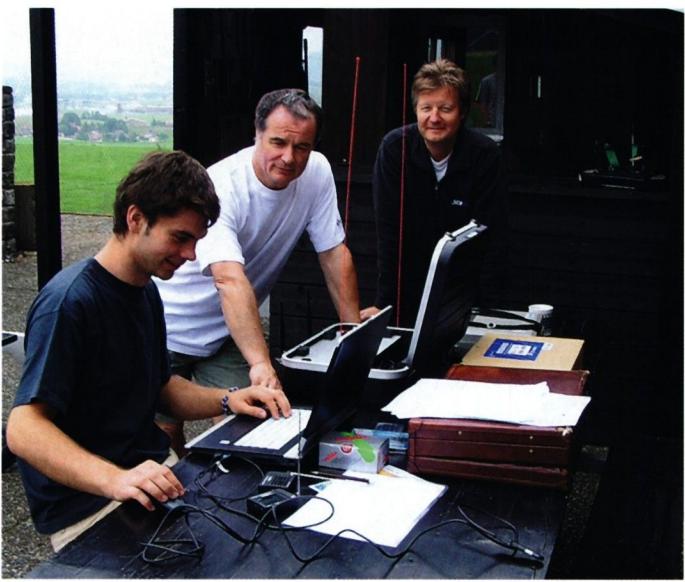
The federation’s “Infrastructure” committee has provided the regions with a high-quality sound level meter and, as of this year, a computer linked to a frequency scanner. Region 1 (French-speaking Switzerland), now equipped with this technology, organized a training course on the morning of Sunday, June 10, 2007, at the GAM site in Bulle, led by its coordinator, JG Constantin, and with the support of Adi Eggenberger, to ensure the proper use of the two pieces of equipment mentioned above. Although not all groups from French-speaking Switzerland were able to send a representative due to scheduling conflicts with various events, those present were able to familiarize themselves with the equipment and were reassured as to how easy it is to use. The training was divided into three parts: an introductory session, a practical session using the frequency monitor, and a third practical session using the noise meter.
The sound level meter is a simple-to-use, compact device. Noise measurements are taken according to well-defined criteria based on the official FSAM regulations.
The measurement is performed as follows:
- The model, with its engine running at full throttle, is placed on the ground on a grassy surface
- The measurement is taken with the device held 1 meter above the ground and 10 meters away from the model. The measurement, which is taken continuously over 360° around the model, lasts approximately 1 minute. The average value calculated by the device is used. It must not exceed 84 dB.
This device was designed using a laptop computer coupled with 35 MHz and 40 MHz frequency scanners, whose results can be viewed on an ad hoc basis or recorded continuously. In the event of an incident, it allows for the precise reconstruction of the usage history of the aforementioned frequencies and for
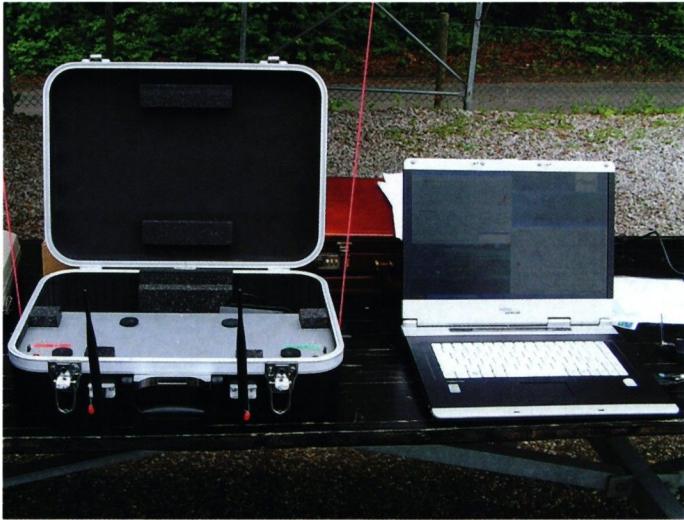
to conduct investigations, if necessary. The design, research, preparation, and adaptation of all the components of this device were carried out under the leadership of Adrian Eggenberger with technical support from companies in the industry. Stored in a case, it can be set up very quickly. It can be used with a connection to the power grid; when off the grid, it has a battery life of 2 hours for the PC and 20 hours for the scanner receivers. The software is in German, but the device’s ease of use
and the option to follow a checklist make it very easy to use.
Data is transmitted between the scanners and the computer via Bluetooth, allowing for a distance of up to 50 meters between the computer and the scanners. The purpose of this equipment is to be loaned to various groups in the relevant regions during meetings, competitions, or air shows in order to enhance safety through increased monitoring and better tracking of the frequencies in use.
Jean-Gérard Constantin


TEAM MANAGER "THIS" BOSSHARD
 Rodito Nussbaumer

YOU KNOW WHAT I MEAN? 125 YEARS OF THE SWISS AERO CLUB
 Emil Giezendanner

F3A EUROPEAN CHAMPIONSHIPS IN ST-MACAIRE, FRANCE
 Matthias Bosshard

News from HEBU

SUMMER FUN 2026 AT MG USTER
Martin Wunderli
TRY-OUT DAY AT MFV WETTINGEN
Urs Keller
52. 2026 ALPS CUP
Emil Giezendanner
BY YOUTH, FOR YOUTH
Lorena Betschen
ATOM, THE NEW DOUBLE-DECKER FROM CPLR
Matthias Bosshard
CORSAIR F4U – A WARBIRD WITH A MEMORABLE LOOK
Jürgen Rosenberger, Jürgen Prinz
SMALL, MODEL-LIKE SAILBOATS
Res Dauwalder
What's New at Leomotion.com

TWIN TOWN PARTNERSHIP
Wolfgang Voeller
EURO CONTEST GLIDER ACRO TOUR AUSTRIA 2026

INSIGHTS INTO THE HISTORY OF SEAPLANES

34th HAHNENMOOS ALPINE MODEL AIRPLANE CAMP
Res Dauwalder
HORIZON HOBBY/LEMACO NEWS: MICRO OV-10 BRONCO 645 MM BY E-FLITE

COUPE DES ALPES – OBSERVE AND LEARN
Rodito Nussbaumer
PRIDE AND GOOD IDEAS
 Markus Nussbaumer

FREE FLIGHT IN THE MIDDLE OF SUMMER
Urs Muntwyler
THE PC-21 STORY
Emil Giezendanner
WELCOME, NEW MEMBER!
Andrea Bolliger
NEWS FROM HEBU
 Julia Bucher

FROM 0 TO 100
Markus Nussbaumer
MEMORIES
Wolfgang Völler
NOS REGION – A HUB FOR ELECTRIC AVIATION
Emil Giezendanner
Have you almost forgotten about aircraft that take off and land vertically?
Emil Giezendanner
70 YEARS OF THE NIDWALDEN MODEL AIRPLANE CLUB
Martin Barmettler