
Model Aircraft vs. CTR and TMA
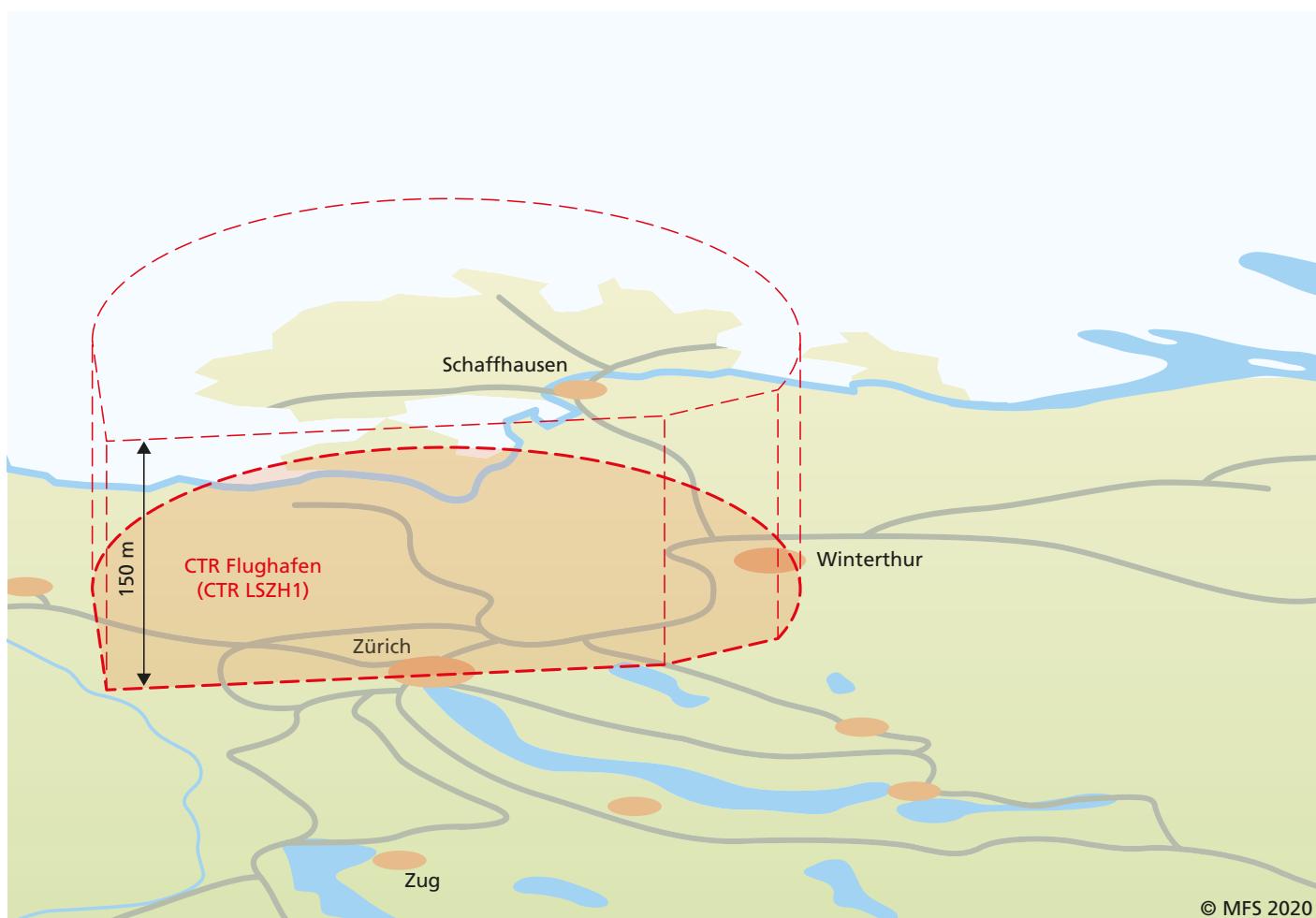
The control zone (abbreviated internationally as CTR, for “controlled traffic region”) is the airspace extending from a specified upper limit down to the ground in the immediate vicinity of an airport, where air traffic is controlled by an air traffic controller. This airspace protects arriving and departing instrument flight operations. Entry into a CTR requires an entry clearance so that the air traffic controller can establish separation between aircraft within the CTR. If the controller is unaware of an aircraft in the CTR,
they cannot establish separation because they do not know the aircraft’s flight path or altitude.
The basic rule for separation is: 5 Nm or 1,000 ft. If aircraft are at the same altitude, they must maintain a separation of 5 Nm (approx. 8 km). If they are separated by altitude, a minimum separation of 1,000 ft (approx. 300 m) is required.
The terminal area (TMA) is the immediate airspace that connects the CTR with the airways. Within the TMA, arriving and departing air traffic is routed and controlled. The TMA has defined lower and upper limits.
The lower limit is defined either in FT/AMSL or FT/AGL (feet above mean sea level or feet above ground level).
This airspace is also controlled by air traffic controllers and requires an approach clearance.
There are three CTRs in the NOS area. These are CTR1 ZRH, CTR2 ZRH, and CTR Dübendorf. The size of the CTRs is dynamic and depends on the requirements of the approach procedures. What does that mean? For Zurich, there are northern, southern, and eastern approaches. The standard procedure is the northern
approach, as long as weather and wind conditions permit. If there are severe CBs (thunderclouds) over the Black Forest, the approach plan must be changed for safety reasons.
The agreement with Germany stipulates that no northern approaches may take place in the morning hours; therefore, approaches must be made from the south. Similarly, in the evening, this regulation requires switching to the eastern approach.
Exceptions are made in the event of wind and/or weather conditions. Safety first!
Another factor affecting operations is the Dübendorf airfield. Is it operational or not? →
It has HX status and can be activated at any time. An AFIS is available for air traffic. When the airfield is not active, a recorded message is broadcast on the frequency informing VFR pilots that the Dübendorf CTR is not active and that the pilot must remain on the frequency until he has exited the CTR. In this case, the Zurich CTR1 is expanded to include the area around Dübendorf.
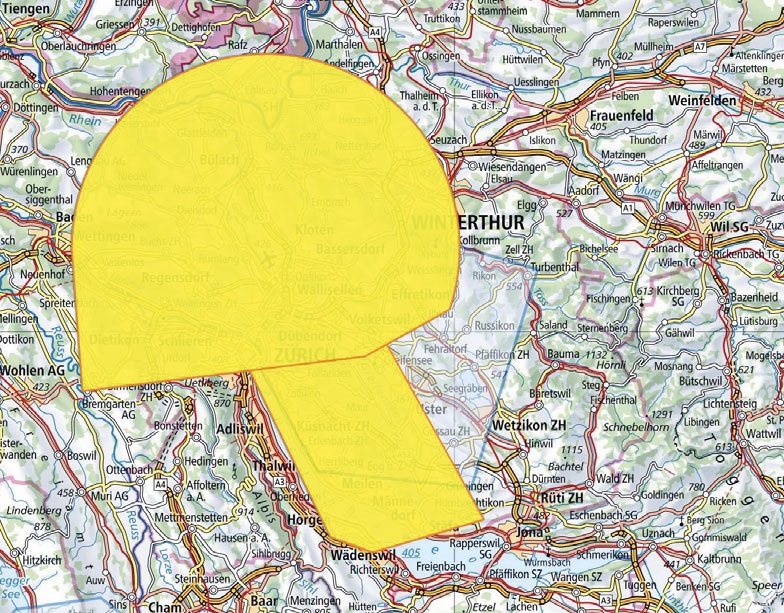
When southern approaches are in effect, a large portion of the Dübendorf CTR becomes CTR2 ZRH, and responsibility for this airspace transfers from the Dübendorf air traffic controller to the Zurich air traffic controller. Here are a few examples:
Uncontrolled air traffic is not permitted within the CTRs! For model aircraft, the DETEC Ordinance on Special Categories of Aircraft (VLK Art. 17, para. 2) applies, which sets a height limit of 150 m. This applies outside a 5-km radius around the runway thresholds of a controlled airport. For model aircraft groups within this 5-km zone, an agreement has been reached with Skyguide for each group, clearly defining the requirements for each site
. Anyone who does not have an agreement for this area is not permitted to fly there. It is a no-fly zone. This zone also applies around airfields without a CTR (Speck, Winterthur, Hausen, etc.). Here, too, exceptions can be arranged with the airfield.
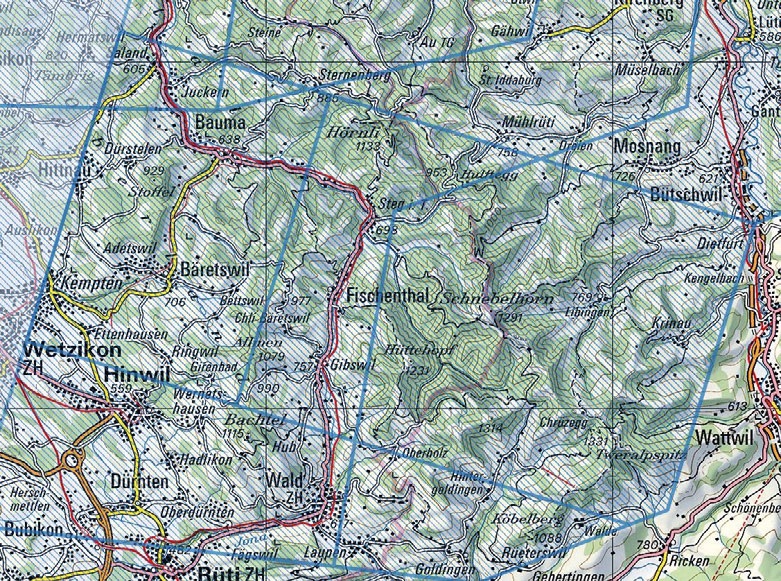
Let’s take a look at the DUB1 TMA: A model airplane is flying at Stoffel, 929 m above sea level (south of Bauma). The lower boundary of the TMA is 3,500 ft above sea level > approx. 1,050 m above sea level.
Without entering the TMA, the model can climb to a maximum
121 m above ground level. The second example is Bäretswil: Elevation of Bäretswil: 706 m above sea level; the TMA lower limit is 1,050 m above sea level, resulting in a maximum altitude of 344 m above ground level.
The same applies in the DUB2 TMA! If someone flies on the Schnebelhorn, the following situation arises: Elevation of the Schnebelhorn is 1,291 m above sea level; the lower limit of the DUB2 TMA is 5,500 ft above sea level > approx. 1,650 m above sea level. Here, the model may be flown to a maximum altitude of 359 m above ground level. There are no exceptions within the TMA. The lower limit applies. The TMA is a no-fly zone for model aircraft!
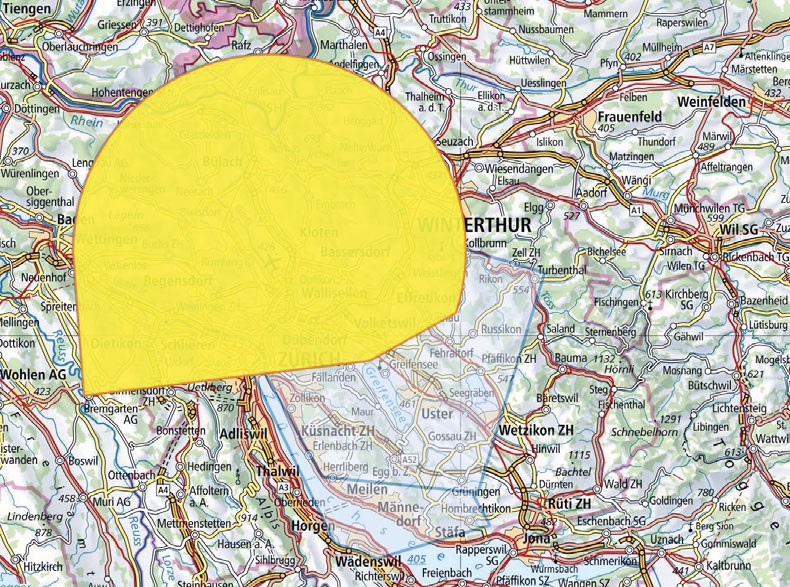
Northern approaches
(approaches to Runways 14 and 16,
takeoffs from Runways 28 and 16).
Dübendorf is active. Part of CTR1
ZRH is transferred to Dübendorf.
*More charts on the
next spread.* →
Southern approaches
(approaches to Runway 34,
departures from Runways 32 and 28)
. Dübendorf not active.
Here's an example involving the Dubendorf airfield, where HX can always be active.
TMA APRIL 1.
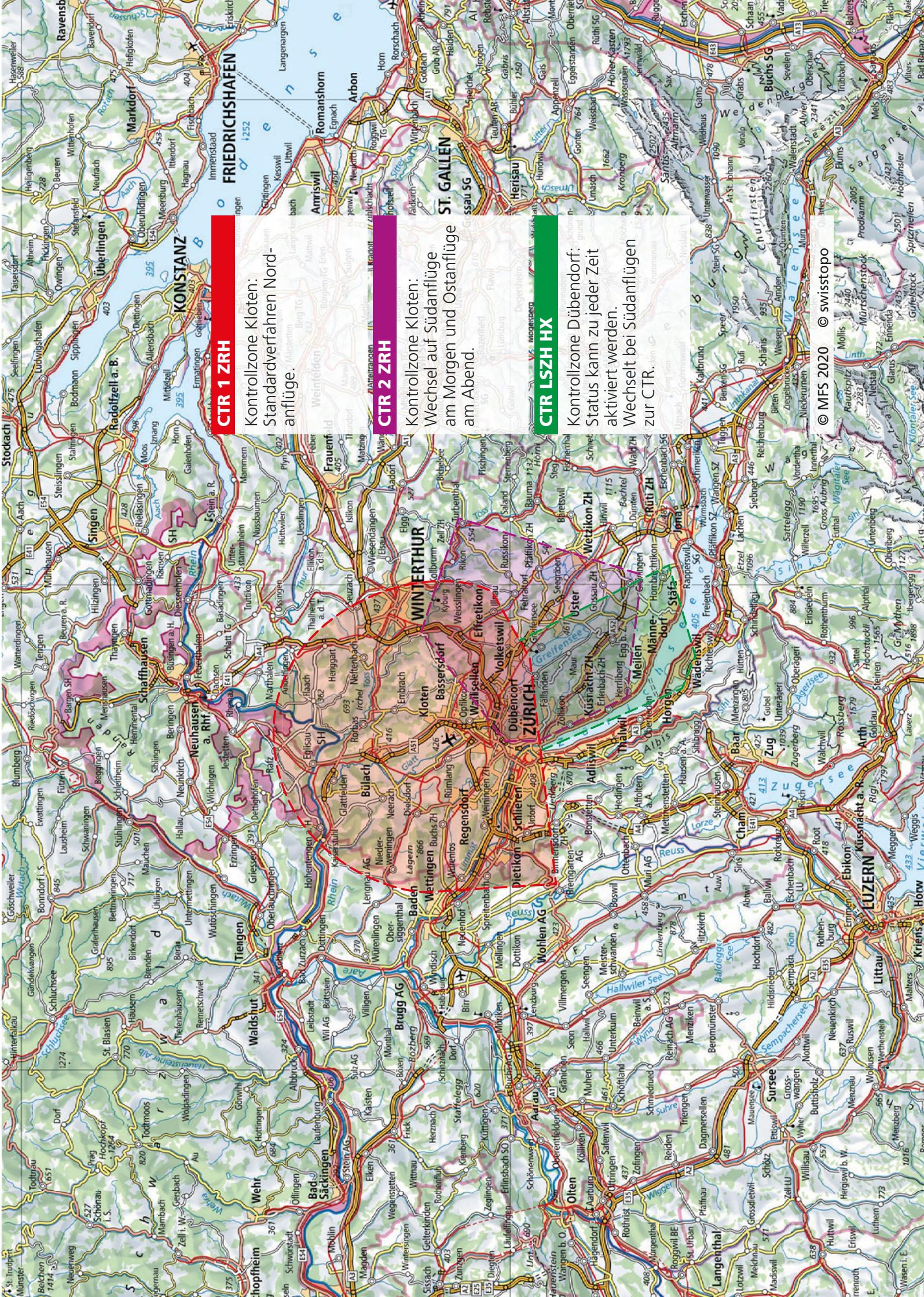
CTR 1 ZRH
Kloten Control Zone:
Standard procedures for northern
approaches.
CTR 2 ZRH
Kloten Control Zone:
Switch to southern approaches
in the morning and eastern approaches
in the evening.
CTR LSZH HX
Dübendorf Control Zone:
Status can be activated at any time
.
Switches to the CTR for southern approaches
.


TEAM MANAGER "THIS" BOSSHARD
 Rodito Nussbaumer

SUMMER FUN 2026 AT MG USTER
Martin Wunderli
TRY-OUT DAY AT MFV WETTINGEN
Urs Keller
52. 2026 ALPS CUP
 Emil Giezendanner

ATOM, THE NEW DOUBLE-DECKER FROM CPLR
 Matthias Bosshard

INSIGHTS INTO THE HISTORY OF SEAPLANES

34th HAHNENMOOS ALPINE MODEL AIRPLANE CAMP
Res Dauwalder
CORSAIR F4U – A WARBIRD WITH A MEMORABLE LOOK
Jürgen Rosenberger, Jürgen Prinz
SMALL, MODEL-LIKE SAILBOATS
Res Dauwalder
F3A EUROPEAN CHAMPIONSHIPS IN ST-MACAIRE, FRANCE
Matthias Bosshard
What's New at Leomotion.com

HORIZON HOBBY/LEMACO NEWS: MICRO OV-10 BRONCO 645 MM BY E-FLITE

PRIDE AND GOOD IDEAS
 Markus Nussbaumer

News from HEBU

BY YOUTH, FOR YOUTH
Lorena Betschen
YOU KNOW WHAT I MEAN? 125 YEARS OF THE SWISS AERO CLUB
Emil Giezendanner
FREE FLIGHT IN THE MIDDLE OF SUMMER
Urs Muntwyler
THE PC-21 STORY
Emil Giezendanner
TWIN TOWN PARTNERSHIP
Wolfgang Voeller
EURO CONTEST GLIDER ACRO TOUR AUSTRIA 2026

WELCOME, NEW MEMBER!
Andrea Bolliger
COUPE DES ALPES – OBSERVE AND LEARN
Rodito Nussbaumer
NEWS FROM HEBU
 Julia Bucher

FROM 0 TO 100
Markus Nussbaumer
MEMORIES
Wolfgang Völler
NOS REGION – A HUB FOR ELECTRIC AVIATION
Emil Giezendanner
Have you almost forgotten about aircraft that take off and land vertically?
Emil Giezendanner
70 YEARS OF THE NIDWALDEN MODEL AIRPLANE CLUB
Martin Barmettler