
Where is competitive model aircraft flying in Switzerland headed?
The international successes of our model aircraft pilots at the FAI European and World Championships—organized by the FAI (World Air Sports Federation)—are undoubtedly impressive. Last year in particular saw a veritable flood of medals and many strong finishes. However, we must not let this blind us to the fact that there is still room for improvement. Here are a few thoughts on that.
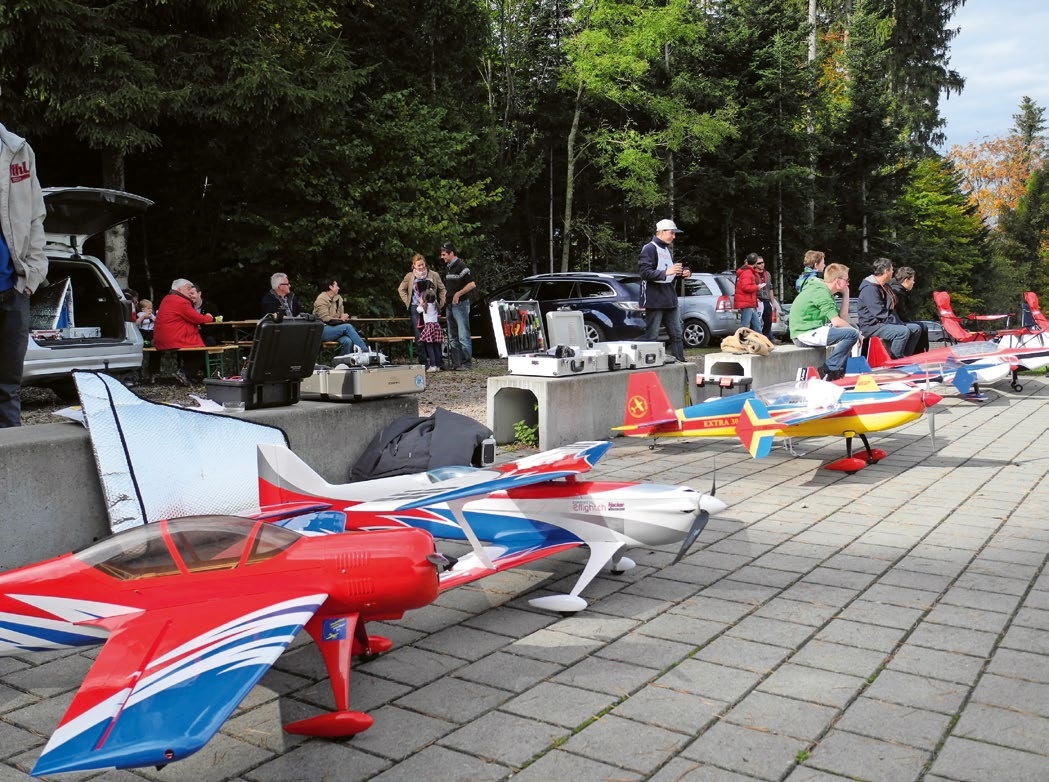
The landscape of competitive model aviation has changed significantly in recent years. In some disciplines, athletes from Eastern European countries in particular have made tremendous strides. Many are now among the absolute best in the world. In Asia as well—for example, in Korea, China, and Japan—there appears to be an inexhaustible pool of talent. Added to this is the fact that the number of FAI categories is growing every year and has already reached 28 (31 including the IJMC). This makes the targeted and consistent support of our athletes increasingly important. However, this clear need is increasingly pushing our federations (AeCS, SMV, and the regions) to their financial limits. It’s not just about cutting costs, but also about using the available resources for our national teams in a truly efficient manner.
If we continue to form a three-member team based on so-called selection rankings—no matter how far down the rankings the so-called “selected” athletes are—it may be well-intentioned. We want to give people opportunities—for example, a junior athlete. Often, however, this is simply a matter of enforcing outdated regulations, which can cost the SMV a lot of money. Anyone who looks at competitive sports in other athletic associations will see that nothing works at the top level without strict performance thresholds. For the rest, “B squads” or similar performance tiers are formed. These limits should be based, for example, on the results of the most recent world championships. A certain percentage must be achieved to qualify for the National Championships. The technical committees are tasked with this, and the sports director reviews the criteria.
Talent development can only begin at the club level and, consequently, should be supported by the regional associations. Various regions are in a position to invest more in sports promotion. Some regional, historically established centers of excellence already exist de facto. To receive targeted support from the SMV, performance agreements would need to be negotiated. Where the technical commissions are not (yet) active, these centers must be financed with funds from the technical commissions. Examples that come to mind include Italian-speaking Switzerland with its RC helicopter scene, the free-flight training in the Gürbetal valley, tethered flight in Breitenbach, F3J activities in the Fribourg region, or F4 Scale in Interlaken, etc. Cooperation with the technical commissions and regions is crucial to success, and this is already working quite well in the existing centers. The geographic concentration of the individual categories should be organized in such a way that travel time remains reasonable. Nevertheless, this will still place demands on the junior’s family.
As mentioned above, competitive sports actually begin in our local clubs. Don’t try to tell me that juniors’ talent and dedication aren’t evident from an early age. They move playfully—and often a bit cheekily—on our courts. But just hitting the ball as hard as possible is only a temporary activity—more must follow. Support them whenever possible and encourage them to take on new challenges beyond the club. Smaller competitions at the regional level are ideal for this. So are team competitions or training sessions. Please don’t forget: every club bears a great responsibility for our young players—otherwise, we’ll render ourselves unnecessary in the long run.
Already today, more than half of the membership dues go toward sports. In my opinion, we cannot maintain this ratio in the long run.
As it stands, the proliferation of new competition classes shows no signs of slowing down. We need to look for new sources of funding. Perhaps we could reintroduce the “national team franc” as part of the entry fee—this time set at 10 francs—or reinstate mandatory sports licenses starting at the SM level, etc. (It’s unclear why these were eliminated in the first place.) Competitive sports funded by the SMV need a cap. This would distribute the budget among an ever-increasing number of competition classes. Limiting the creation of new classes—or even reducing their number—would be a harsh reality. Our competitions in Switzerland cost too much. Swiss Championships with point judges cost 3,000 to 5,000 francs, which—given the current number of participants—can quickly add up to 200 francs or more per person. We’ll have to take a close look at this as well. We’re looking for ideas.


F3A EUROPEAN CHAMPIONSHIPS IN ST-MACAIRE, FRANCE
 Matthias Bosshard

News from HEBU

TEAM MANAGER "THIS" BOSSHARD
 Rodito Nussbaumer

YOU KNOW WHAT I MEAN? 125 YEARS OF THE SWISS AERO CLUB
 Emil Giezendanner

SUMMER FUN 2026 AT MG USTER
Martin Wunderli
TRY-OUT DAY AT MFV WETTINGEN
Urs Keller
52. 2026 ALPS CUP
Emil Giezendanner
BY YOUTH, FOR YOUTH
Lorena Betschen
CORSAIR F4U – A WARBIRD WITH A MEMORABLE LOOK
Jürgen Rosenberger, Jürgen Prinz
SMALL, MODEL-LIKE SAILBOATS
Res Dauwalder
What's New at Leomotion.com

ATOM, THE NEW DOUBLE-DECKER FROM CPLR
Matthias Bosshard
INSIGHTS INTO THE HISTORY OF SEAPLANES

34th HAHNENMOOS ALPINE MODEL AIRPLANE CAMP
Res Dauwalder
HORIZON HOBBY/LEMACO NEWS: MICRO OV-10 BRONCO 645 MM BY E-FLITE

COUPE DES ALPES – OBSERVE AND LEARN
Rodito Nussbaumer
PRIDE AND GOOD IDEAS
 Markus Nussbaumer

EURO CONTEST GLIDER ACRO TOUR AUSTRIA 2026

FREE FLIGHT IN THE MIDDLE OF SUMMER
Urs Muntwyler
THE PC-21 STORY
Emil Giezendanner
TWIN TOWN PARTNERSHIP
Wolfgang Voeller
WELCOME, NEW MEMBER!
Andrea Bolliger
NEWS FROM HEBU
 Julia Bucher

FROM 0 TO 100
Markus Nussbaumer
MEMORIES
Wolfgang Völler
NOS REGION – A HUB FOR ELECTRIC AVIATION
Emil Giezendanner
Have you almost forgotten about aircraft that take off and land vertically?
Emil Giezendanner
70 YEARS OF THE NIDWALDEN MODEL AIRPLANE CLUB
Martin Barmettler