
The Drone Story
The KZD-85 small-target drone was developed for training air defense troops. A total of no fewer than 60 units were produced by Farner Aviation Switzerland and the Federal Aircraft Works in Emmen. In 2022, after nearly 40 successful years of service, these aircraft were retired. By Swiss standards, the whole endeavor seems like a minor miracle today. Active model aircraft enthusiasts, in particular, played a key role in its great success.
In February of this year, the “retired” drone pilots got together. The older gentlemen lovingly examined the launch pad and a well-preserved aircraft, complete with accessories—those were the days! In addition to the impressive display of the entire target drone system, the museum itself was, of course, a feast for the eyes.
The youth riots of 1980 marked the beginning of this decade and were not the only political and social problems facing Switzerland. In sports, however, our skiers—unlike soccer players, for example—repeatedly took center stage as victorious Swiss athletes. They swept the medals in large numbers at the 1987 World Championships. In 1984, the Federal Assembly elected Elisabeth Kopp, the first woman ever, to the Federal Council
Installation of the target drone at the Oberaargau Aviation Museum at the Daetwyler company. ►
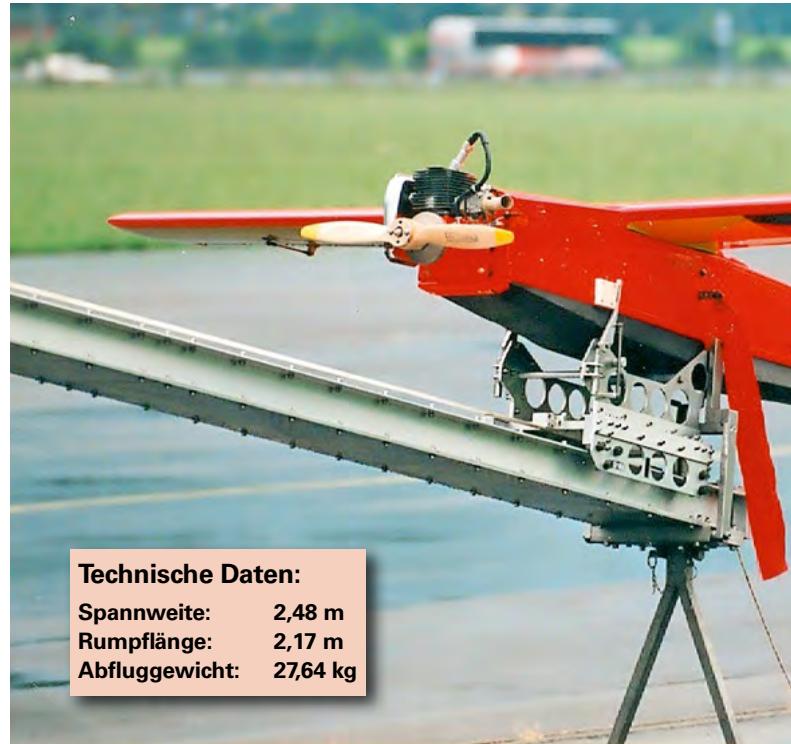
| Wingspan: | 2.48 m |
| Fuselage length: | 2.17 m |
| Takeoff weight: | 27.64 kg |
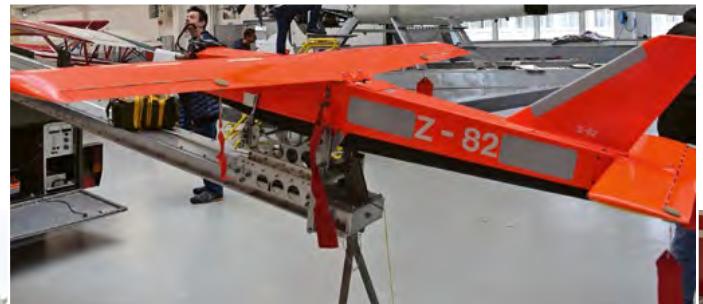
**Husqvarna single-cylinder, 2-stroke engine with approx. 11 kp of thrust, started with an electric starter.**
desrat. That same year, Pope John Paul II landed at Sion Airport for a visit. National defense came under increasing pressure during these years. The initiative to abolish the army (1989), which was rejected with 64.4% voting “no,” marked a temporary peak—
—not to mention further endless disputes—for example, regarding aircraft procurement.
To me, the whole story surrounding the drones reads like a political fairy tale today—and not just because of the relatively low procurement costs. A small team of 17 drone operators from the Federal Office for Military Airfields (BAMF) was trained without any media fanfare and served the air defense unit in all weather conditions, provided visibility permitted. This June will mark exactly 40 years since the KZD-85 drones and their operational capabilities were first publicly demonstrated in Saanen
A total of 7,350 flights with a total flight time of 3,350 hours were completed.
The demands placed on the drone pilots to provide a realistic target simulation were very high. A particular challenge was the long flight distance of up to 2,100 meters. These distances were necessary for the sighting runs of the 35-mm anti-aircraft guns. During the 30-minute missions, the highest level of concentration was required. Flights took place in rain, snow, and temperatures as low as minus 20 degrees. These were conditions under which manned target aircraft often could not be deployed. It quickly became clear that such operations would hardly have been successful without thorough training using remote-controlled model airplanes. Ernst Dällenbach, the experienced model airplane pilot responsible for (basic) training, was able to begin training as early as 1983. In the initial phase, he had a good dozen Marabu trainers at his disposal, followed later by additional, faster aerobatic models. The training culminated in the KZD-85 certificate. Even during the selection process, candidates had to perform simple but safe takeoff and landing procedures. The drone pilots were employees of the Federal Office for Military Airfields and, with one exception, were all model aircraft pilots. In the course of the training, more challenging F3A aerobatic maneuvers were also practiced. As is well known, aerobatic training has saved pilots from many a precarious situation. The drone unit was deployed at various airfields throughout Switzerland for many weeks, far from home. This was a factor that deterred many prospective candidates from joining. →
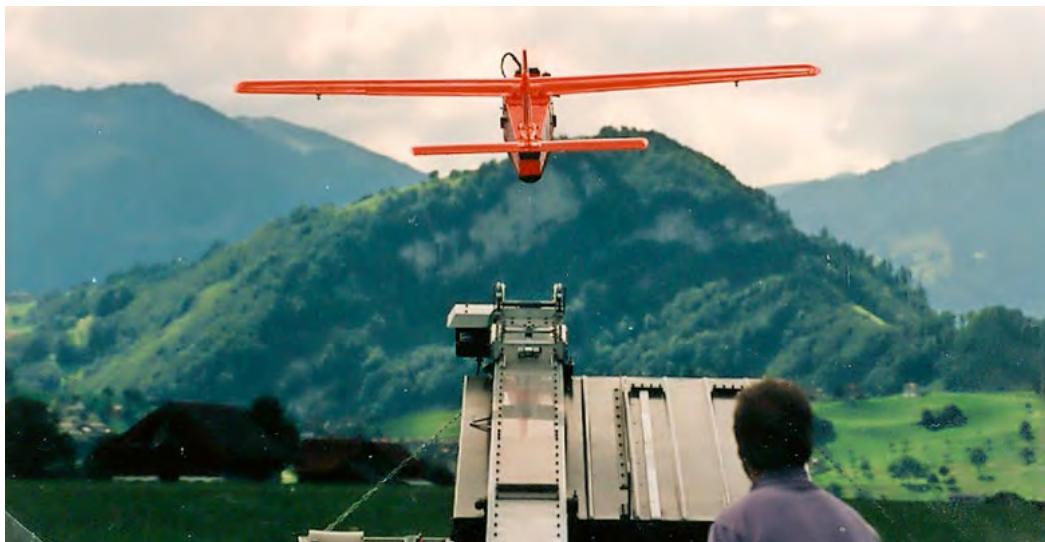
**Drone launch pad used during an anti-aircraft firing exercise by the Air Defense Unit.****The
launch pad is mounted on a material transport vehicle in a foldable configuration. The vehicle carries all essential (spare) equipment needed for operations at various locations.**
**Not all landings were successful.**
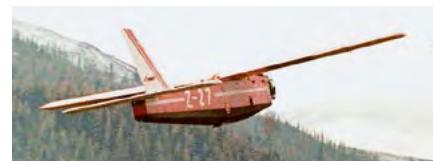
**KZD-85 in the mountains. ►**
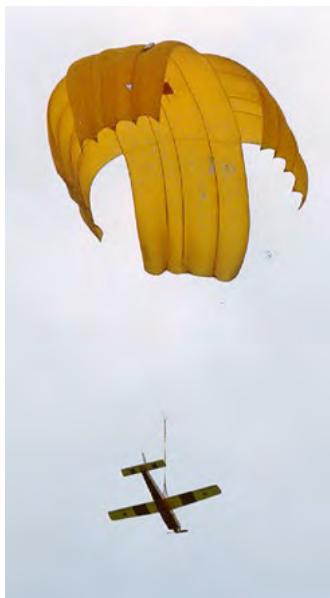
**Not all parachute landings, either.**
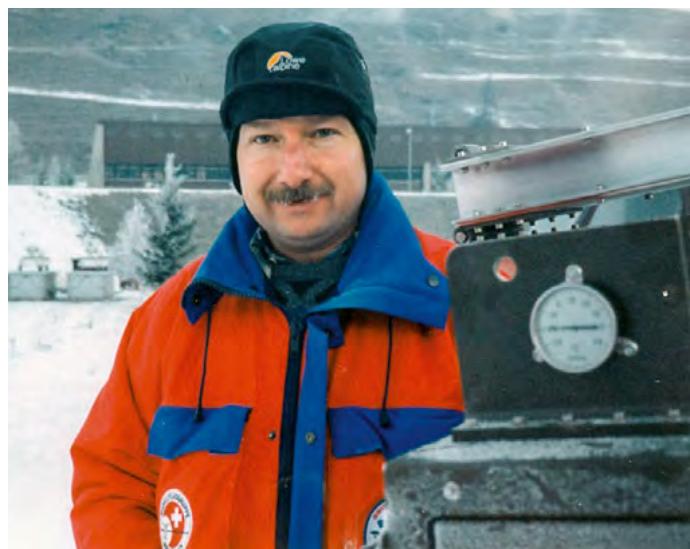
**Ernst Dällenbach—during a winter operation—was in charge of training.**
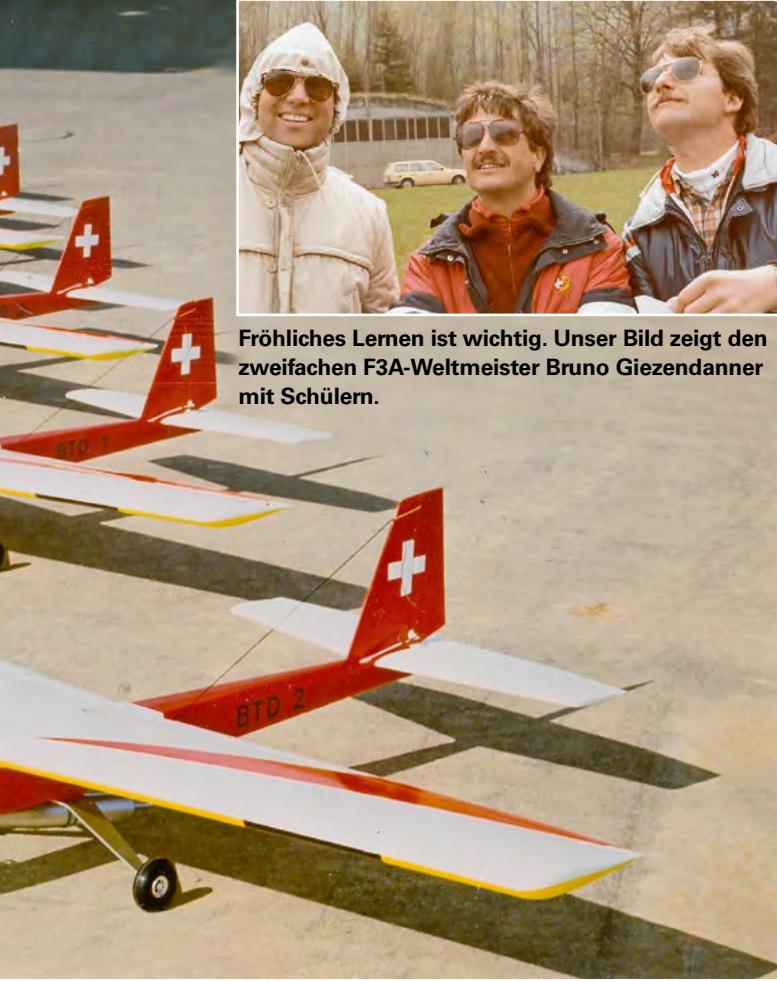
Learning should be fun. Our photo shows two-time F3A world champion Bruno Giezendanner with students.
Various media outlets, such as “Aero Revue,” “SkyNews,” and internal military reports, have likely written about model airplanes; the term “model airplane enthusiast,” however, is rarely found. Without their extensive experience and their often highly idealistic dedication, the whole endeavor would never have come to fruition. I find the article in “Aero Revue 3/1985” on model aviation—“Drones in the Service of National Defense”—somewhat thought-provoking, with its numerous technical details, including those on cruise missiles. I was unable to find any mention of the achievements of the model aviators—who were already members of the
members of the AeCS, as arguably the most important contribution to the KZD-85 story. One might almost think that the big aviation figures were a little ashamed of the “mini-pilots.” That’s why I’m certainly not alone in wanting to express my deep respect and gratitude to the drone pilots of that era for their important contribution to national defense. Especially in today’s age of bureaucracy, such examples are sorely needed.
Photos: Ueli Müller, Ernst Dällenbach, and other
sources: “SkyNews,” “Aero Revue,” and other unidentified publications
The legal experts at EASA (European Union Aviation Safety Agency)—along with most countries and, unfortunately, model aviation associations as well—could not identify any technical differences between model airplanes and drones—which actually makes sense. The easiest thing to do is to lump them all together. Officials at the Federal Office for Military Airfields were already referring to their KZD-85 aircraft as drones 40 years ago. The only correct answer to the crucial question is this: It’s not the technology of the aircraft that matters—but rather their use, their operation.
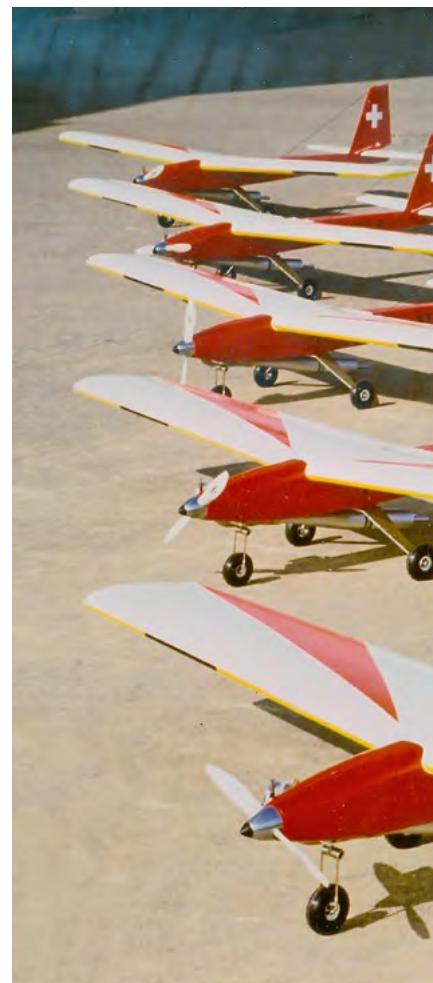
In the beginning, the legendary Marabu trainer was used as a training aircraft.


TEAM MANAGER "THIS" BOSSHARD
 Rodito Nussbaumer

YOU KNOW WHAT I MEAN? 125 YEARS OF THE SWISS AERO CLUB
 Emil Giezendanner

F3A EUROPEAN CHAMPIONSHIPS IN ST-MACAIRE, FRANCE
 Matthias Bosshard

News from HEBU

SUMMER FUN 2026 AT MG USTER
Martin Wunderli
TRY-OUT DAY AT MFV WETTINGEN
Urs Keller
52. 2026 ALPS CUP
Emil Giezendanner
BY YOUTH, FOR YOUTH
Lorena Betschen
ATOM, THE NEW DOUBLE-DECKER FROM CPLR
Matthias Bosshard
CORSAIR F4U – A WARBIRD WITH A MEMORABLE LOOK
Jürgen Rosenberger, Jürgen Prinz
SMALL, MODEL-LIKE SAILBOATS
Res Dauwalder
What's New at Leomotion.com

TWIN TOWN PARTNERSHIP
Wolfgang Voeller
EURO CONTEST GLIDER ACRO TOUR AUSTRIA 2026

INSIGHTS INTO THE HISTORY OF SEAPLANES

34th HAHNENMOOS ALPINE MODEL AIRPLANE CAMP
Res Dauwalder
HORIZON HOBBY/LEMACO NEWS: MICRO OV-10 BRONCO 645 MM BY E-FLITE

COUPE DES ALPES – OBSERVE AND LEARN
Rodito Nussbaumer
PRIDE AND GOOD IDEAS
 Markus Nussbaumer

FREE FLIGHT IN THE MIDDLE OF SUMMER
Urs Muntwyler
THE PC-21 STORY
Emil Giezendanner
WELCOME, NEW MEMBER!
Andrea Bolliger
NEWS FROM HEBU
 Julia Bucher

FROM 0 TO 100
Markus Nussbaumer
MEMORIES
Wolfgang Völler
NOS REGION – A HUB FOR ELECTRIC AVIATION
Emil Giezendanner
Have you almost forgotten about aircraft that take off and land vertically?
Emil Giezendanner
70 YEARS OF THE NIDWALDEN MODEL AIRPLANE CLUB
Martin Barmettler