
The Long Journey of the Electric Motor to F3A Aerobatics
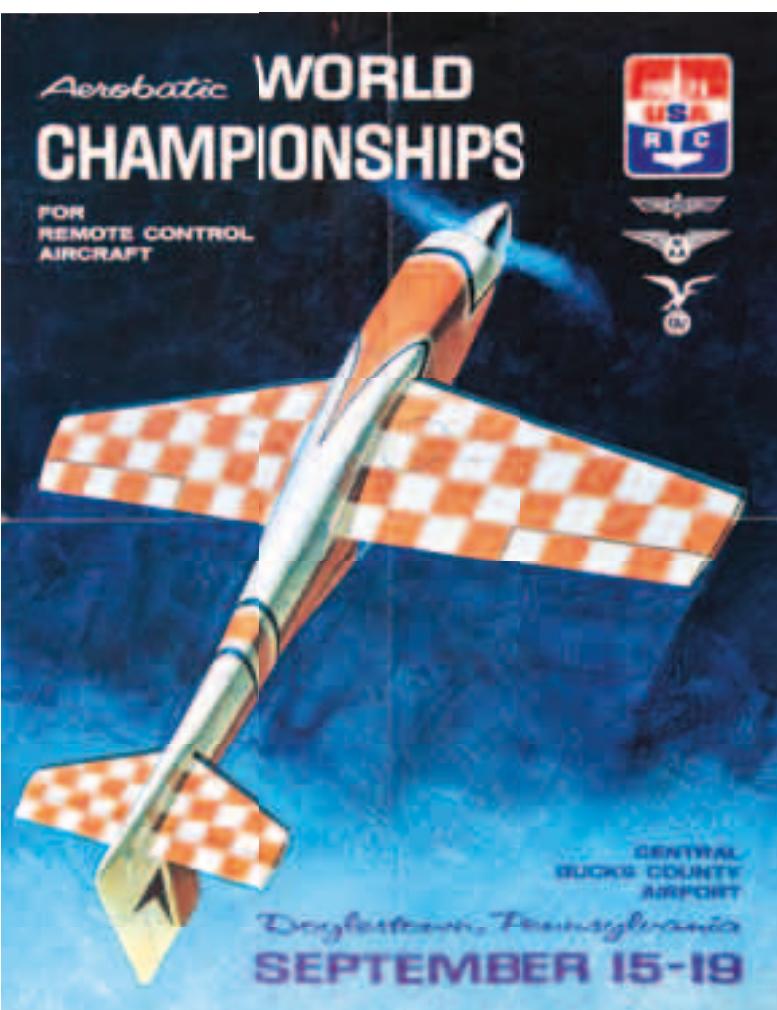
It happened during the F3A World Championship, held September 15–19, 1971, at Central Bucks County Airport in Doylestown, Pennsylvania: Fred Militky demonstrated the first remote-controlled electric glider model in front of a large crowd. That marked the true beginning of RC electric flight.
Where else could Fred Militky have showcased his SILENCER RC electric glider to a wider media audience than at what was then the only World Championship for remote-controlled models (F3A)? As early as
before 1971, experiments with remote-controlled electric model airplanes were being conducted in various locations—in England, Germany, and the U.S. Even NASA had developed several successful projects. However, the real breakthrough could only be achieved through model kits that were “accessible to the general public.” Fred Militky, head of development at the Graupner company in Germany, was well aware of this. Just one year later, the first kit hit the market: a lightweight wooden model (1.9 kg) with a 2.3-meter wingspan. The secret to its success was that all accessories
—from the powerplant to the remote-control components—were tailored to the model. This eliminated the tedious task of piecing together parts, which provided a decisive advantage, especially in the early stages of the “quiet revolution.”
At that time, the power output of electric motors was far too low to be used in F3A aerobatics. Light glider models were therefore the standard in the early days. German physicist Heinz Keller took an important step toward aerobatics with a new generation of motors.
Keller used permanent magnets made of rare earth elements, specifically samarium (SmCo) or neodymium (NdFeb). These motors were significantly more powerful and efficient. This suddenly made aerobatics possible with simpler and lighter models. Nevertheless, it still took more than 20 years for an electric F3A model to be used for the first time. At the 1993 FAI F3A World Championships in Nötsch, Austria, the young Dutch pilot Dennis van Loog flew an electric model for the first time. The very gusty winds and rather cool weather put him at a disadvantage—
Generally speaking, the model, equipped with heavy nickel-cadmium (NiCd) batteries, had no reserves left under such conditions. Nevertheless, the young aviator deserves congratulations for his courage.
Despite all these difficulties, many electric model airplane enthusiasts remained undeterred in their passion for aerobatics. The heavy batteries required a very lightweight construction—at that time largely made of wood, and still rarely of fiberglass-reinforced plastic (FRP). As a result, specific FAI rules were subsequently created for aerobatic competitions, which allowed even models with weaker powerplants to perform quite impressive maneuver sequences—
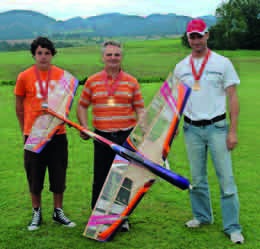
allowed me to participate. As early as the mid-1980s, numerous electric aerobatics competitions were taking place throughout Europe—including two European Championships. Later, this class was designated F5A under the FAI classification system. The models became increasingly elaborate and refined. Initially, they were hand-launched, and soon after, they were equipped with landing gear. In short, these F5A models evolved more and more toward F3A aerobatic models as time went on.
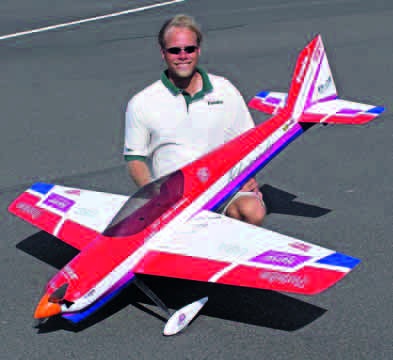
Following the less-than-successful use of an electric F3A model at the 1993 FAI F3A World Championships, electric motors were no longer considered an option for 2-meter F3A models for a long time. It wasn’t until the late 1990s that Michael Ramel of Germany revived the use of electric motors for F3A aerobatics. His “E-Factor” model consisted of an extremely lightweight wooden structure. Power for the Lehner motor was supplied by a battery pack consisting of 30 nickel-metal hydride (NiMH) cells. The model weighed 4.4 kg and was entered in various competitions in Europe—
It was used successfully. However, the E-Factor soon reached its limits in stronger winds. It wasn't until the introduction of lithium-polymer batteries that the model became more competitive.
The real breakthrough for electric propulsion in the F3A aerobatics class came in 2003
on the motors, which had become very powerful thanks to rare earth elements, though they were increasingly pushed to their limits. The drawbacks included excessive heating of the motors, which caused the glued-in magnets to come loose. Mechanical wear on the commutators caused carbon dust to spread throughout the aircraft, which could be particularly damaging to electronic components. In short,
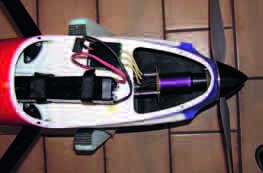
The commutators resulted in significant power losses. Nevertheless, these motors remained the standard until 1994, when, at the FAI World Championships for F5B electric gliders in Australia, American Jerry Bridgeman blew the Europeans out of the water with his brushless Aveox motor. All motor manufacturers switched to electronically commutated (brushless) motors. Mechanically
RC aerobatics programs require motors with high torque. Climbing vertically from a normal flight attitude at reduced speed—that is, without a run-up—has become an important requirement. That is why the
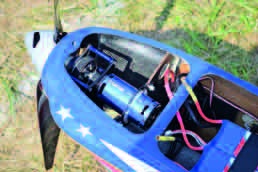
For a long time, the Hacker C50, equipped with a gearbox, was the gold standard. But it soon faced competition. Large external rotor motors achieve similar gear ratios at lower speeds. Recently, it has become apparent that the use of gearboxes is not encouraged, particularly for weight reasons. This applies especially to coaxial drives.


News from HEBU

TEAM MANAGER "THIS" BOSSHARD
 Rodito Nussbaumer

YOU KNOW WHAT I MEAN? 125 YEARS OF THE SWISS AERO CLUB
 Emil Giezendanner

PRIDE AND GOOD IDEAS
 Markus Nussbaumer

ATOM, THE NEW DOUBLE-DECKER FROM CPLR
 Matthias Bosshard

SUMMER FUN 2026 AT MG USTER
Martin Wunderli
F3A EUROPEAN CHAMPIONSHIPS IN ST-MACAIRE, FRANCE
Matthias Bosshard
52. 2026 ALPS CUP
Emil Giezendanner
HORIZON HOBBY/LEMACO NEWS: MICRO OV-10 BRONCO 645 MM BY E-FLITE

TWIN TOWN PARTNERSHIP
Wolfgang Voeller
CORSAIR F4U – A WARBIRD WITH A MEMORABLE LOOK
Jürgen Rosenberger, Jürgen Prinz
TRY-OUT DAY AT MFV WETTINGEN
Urs Keller
WELCOME, NEW MEMBER!
Andrea Bolliger
EURO CONTEST GLIDER ACRO TOUR AUSTRIA 2026

BY YOUTH, FOR YOUTH
Lorena Betschen
INSIGHTS INTO THE HISTORY OF SEAPLANES

34th HAHNENMOOS ALPINE MODEL AIRPLANE CAMP
Res Dauwalder
SMALL, MODEL-LIKE SAILBOATS
Res Dauwalder
What's New at Leomotion.com

COUPE DES ALPES – OBSERVE AND LEARN
Rodito Nussbaumer
FREE FLIGHT IN THE MIDDLE OF SUMMER
Urs Muntwyler
THE PC-21 STORY
Emil Giezendanner
NEWS FROM HEBU
 Julia Bucher

FROM 0 TO 100
Markus Nussbaumer
MEMORIES
Wolfgang Völler
NOS REGION – A HUB FOR ELECTRIC AVIATION
Emil Giezendanner
Have you almost forgotten about aircraft that take off and land vertically?
Emil Giezendanner
DO YOU KNOW WHAT I MEAN IN THE LAND OF SMILES?
Emil Giezendanner