
Fokker
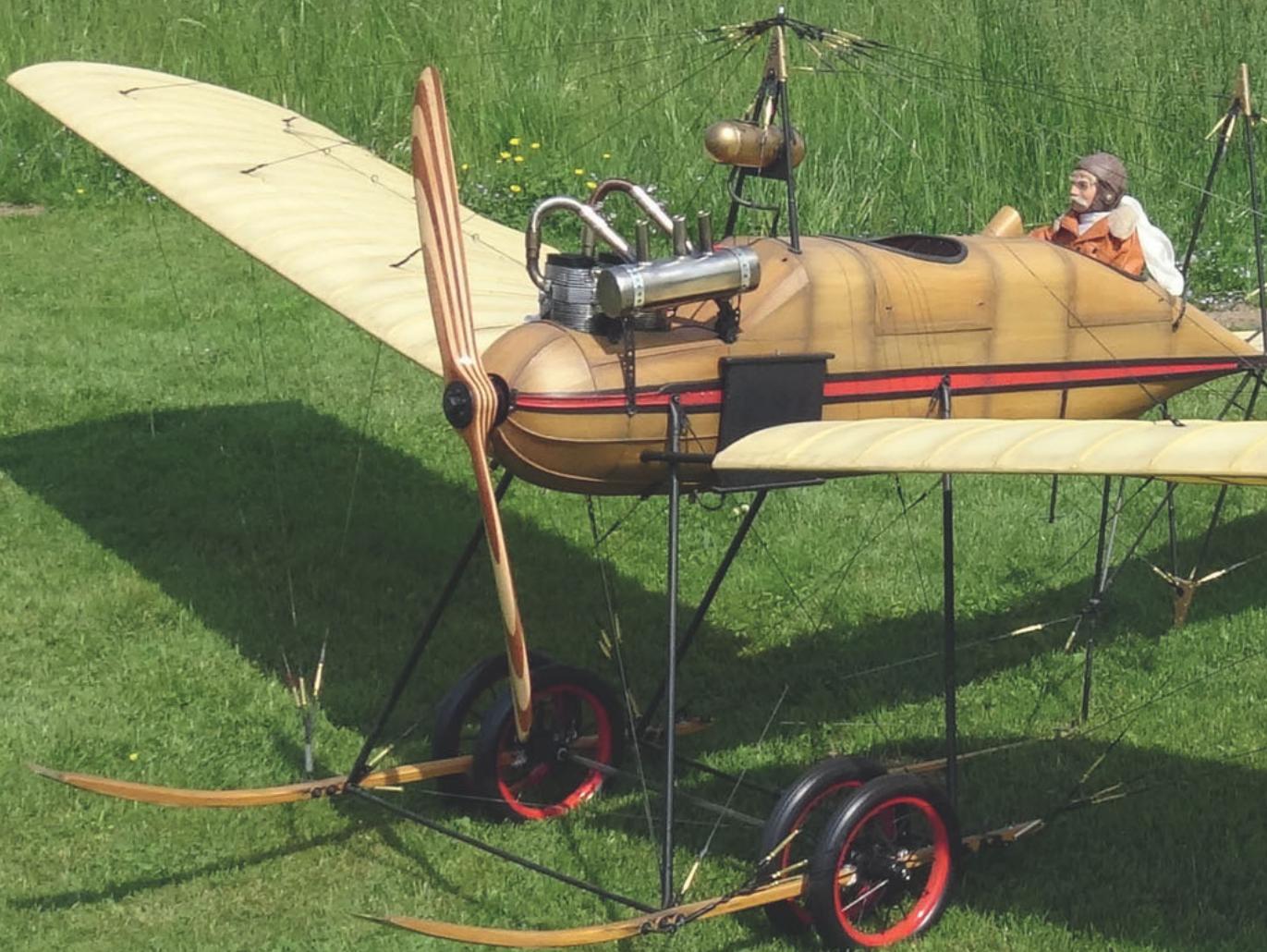
Questions for Rainer Mattle:
I'm always on the lookout for rare vintage cars. The early days of aviation have fascinated me since I was a child. A construction project made my choice easier.
A three-view drawing is enough for me. Design and construction are purely a matter of experience. You can find lots of authentic details and drawings of old airplanes online, for example at www.flying.machines.ru
I like them a little bigger. Once they reach a certain size, their flight characteristics start to mimic those of the original. I also use original airfoils from that era. This adds a special thrill when flying and makes the flight characteristics more true to the original. Of course, the motor was also a key factor in determining the size.
I had that one in stock, unused. It's very close to the original, after all.
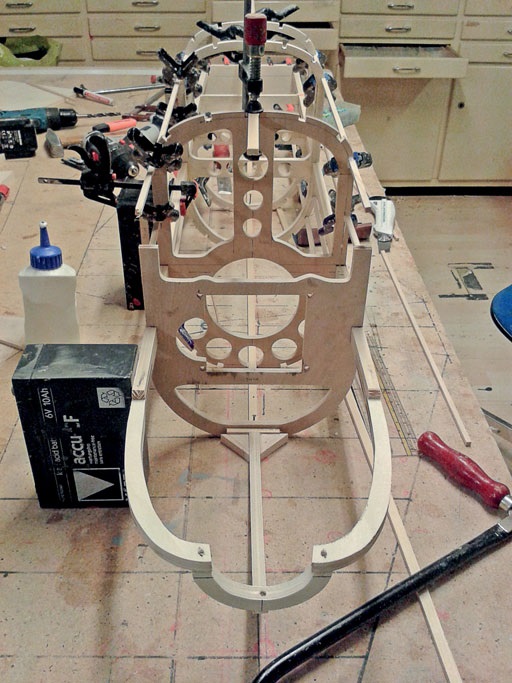
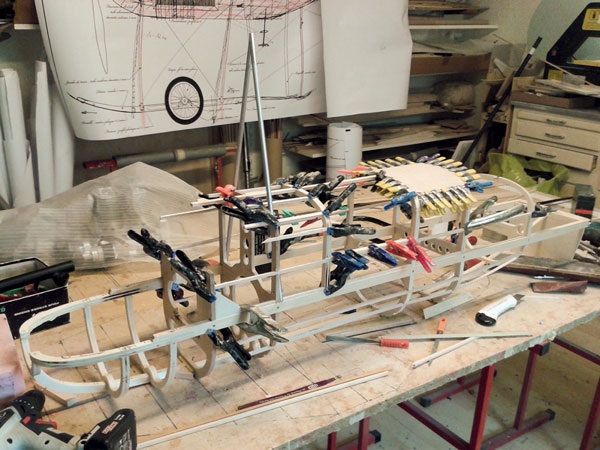
The materials are comparable to the originals. Plywood, fabric, various types of wood, and metals for the fittings are required. For weight reasons, balsa wood is, of course, used primarily.
Total of 6 servos: 1× Savöx 40 kg elevator / 5× Hitec 14 kg functions, including 2× ailerons, 2× rudder, and 1× throttle.
Of course... and always staying true to the original.
Finding the ideal center of gravity was a real challenge. This behavior is closely related to the chosen profile, the EWD, and engine power. The sweep of the wings introduces additional aerodynamic effects. Of course, much of this can be calculated. In practice, however—especially with the older “old-timers”—you gain entirely new insights. With this model, therefore, there are no definitive guidelines. As a result, the exact center of gravity had to be determined experimentally through flight testing, which requires a certain amount of perseverance. There were also a few setbacks to overcome, but these always lead to new insights. Back then, this was put into practice right away. The first “Spider” was already irreparably destroyed during taxi tests. The combination of wing sweep and airspeed makes it absolutely necessary to control the elevator in conjunction with propeller power.
After a few attempts, however, it finally worked out on September 23; you were able to complete your first full flight with a planned landing. Describe how it felt after the plane touched down safely.
Before the most recent flight, I announced that this would likely be the last attempt. The “plane” did fly, but it still had too much momentum of its own, which could no longer be logically explained. My goal, however, is to
my airplanes must fly in a stable, smooth, and, of course, controllable manner. With the “Spider,” this required some perseverance and ongoing improvements to the model. Compared to other vintage models, this full-scale model had plenty of surprises in store and was therefore challenging. But now I’ve finally managed to get it right. As the saying goes, good things take time. I’m overjoyed!
I'm still hooked on it. Right now, I have two projects in the works. Stay tuned.
One last tug on the flagellum!
Sunday, 9:30 a.m.: We drive to the MG Buttikon model airfield. When we arrive, Rainer is kneeling in front of his Fokker “Spider,” bundled up warmly, and is busy assembling the model despite the cool temperatures.
Today is the project’s last chance to fly. The thing is finicky and hasn’t really wanted to fly so far. By now, a significant amount of lead has accumulated at the rear of the model. The wing sweep has also been slightly adjusted.
Soon Dirk, a colleague of Rainer’s, arrives and steps in to help. After a short coffee break, they’re able to finish the preparations: refueling, testing the batteries, checking the controls...
Then it’s time to get serious. Rainer flips the switch, the engine starts up, and chugs along with just the right sound. One last quick check at the runway—the pilot dummy pushes the throttle, and the “Spider” rolls out, takes off, and flies...
Rainer still has to pull on the elevator control, because the “Spider” wants to nose-dive.
The trim range is almost exhausted, but Rainer can finally fly the Fokker more relaxed. The vintage plane’s handling is much more pleasant at half throttle than at full throttle. But now the “Spider” shows its best side, circling beautifully and slowly in the now-blue sky. During the first landing approaches, it becomes clear that the model needs a tow, so Rainer gently sets the “Spider” down on the grass runway.
If the weight that had been lifted from Rainer’s heart were visible, there’d be a crater on the runway right now. (There, dear Markus, I’m way too cool—I brush off a loss with a smile. It’s part of the hobby. My motto... say goodbye to the model; otherwise, never open the throttle.) The joyful realization of their success brings a beaming smile to Rainer and Dirk’s faces. Model flying is and always will be pure emotion.
Not all flights are the same... Add a little more lead,
and it takes to the skies once more. The flight characteristics continue to improve, and Rainer is getting to know his “plane” better. Slowly and true to the original, the “Spider” flies over the field. Now we can all enjoy it—the tension is gone.
Rainer executes the takeoff, flight, and landings perfectly. Another one of his projects can thus be considered a success.
As early as the fall of 1910, Anton Herman Gerard Fokker began designing and building an airplane based on his own ideas. He used the workshop at the first German automotive technical school in Mainz and also managed to convince his fellow student Franz von Daum, who was passionate about aviation, to help finance an engine. After several attempts, Fokker sought the professional assistance of an engineer.
In the spring of 1911, J. Goedecker Flugmaschinenwerke built a new aircraft for Fokker out of steel tubing, ash wood, bamboo, and a
single-sided canvas covering. With this aircraft—which the Dutch press later dubbed the “Spinne”—he earned his pilot’s license on May 16, 1911. Subsequently, Goedecker supplied the parts for about 25 aircraft of this type, which Fokker assembled in Berlin-Johannisthal beginning in 1912. They were used by recreational pilots and at the Fokker Flight School in Johannisthal and Schwerin.
| Dimensions | Fokker M. 1 “Spinne” |
| Year of manufacture | 1911 |
| Intended Use | Training and reconnaissance aircraft |
| Length | 8.00 m |
| Wingspan | 13.60 m |
| Height | 3.00 m |
| Wing area | 26.50 m² |
| Empty weight | 660 kg |
| Takeoff weight | 995 kg |
| Powertrain | Argus liquid-cooled inline four-cylinder engine |
| Takeoff power | 75 kW/100 PS |
| Top speed | 115 km/h |
| Summit elevation | 2,100 m |
| Crew | 2 people |
The fuselage was constructed of wood with only two stringers; the seats and the Mo-
were initially uncovered. Both wings consisted of two steel-tube spars, with ribs made of short steel tubes and bent bamboo rods to form the airfoil. The slightly swept wings were covered with fabric only on the upper surface and had a pronounced V-shape. They were braced by steel cables. The tail unit consisted of fabric-covered bamboo tubes; elevator control was achieved by twisting the elevator surface. Two triangular rudders were located above and below the elevator. The landing gear consisted of two wheels with balloon tires mounted on a continuous axle; a wooden skid was attached to each strut. In the center of the wheel axle was a skid with rubber damping. While the Fokker flight school used an unfaired version with a steering wheel, the M.1 used by the military had a control stick, twin wheels, and a boat-shaped fuselage.
Markus Nussbaumer


News from HEBU

TEAM MANAGER "THIS" BOSSHARD
 Rodito Nussbaumer

SUMMER FUN 2026 AT MG USTER
Martin Wunderli
TRY-OUT DAY AT MFV WETTINGEN
Urs Keller
52. 2026 ALPS CUP
 Emil Giezendanner

ATOM, THE NEW DOUBLE-DECKER FROM CPLR
 Matthias Bosshard

INSIGHTS INTO THE HISTORY OF SEAPLANES

YOU KNOW WHAT I MEAN? 125 YEARS OF THE SWISS AERO CLUB
Emil Giezendanner
34th HAHNENMOOS ALPINE MODEL AIRPLANE CAMP
Res Dauwalder
CORSAIR F4U – A WARBIRD WITH A MEMORABLE LOOK
Jürgen Rosenberger, Jürgen Prinz
SMALL, MODEL-LIKE SAILBOATS
Res Dauwalder
F3A EUROPEAN CHAMPIONSHIPS IN ST-MACAIRE, FRANCE
Matthias Bosshard
What's New at Leomotion.com

HORIZON HOBBY/LEMACO NEWS: MICRO OV-10 BRONCO 645 MM BY E-FLITE

PRIDE AND GOOD IDEAS
 Markus Nussbaumer

BY YOUTH, FOR YOUTH
Lorena Betschen
FREE FLIGHT IN THE MIDDLE OF SUMMER
Urs Muntwyler
THE PC-21 STORY
Emil Giezendanner
TWIN TOWN PARTNERSHIP
Wolfgang Voeller
EURO CONTEST GLIDER ACRO TOUR AUSTRIA 2026

WELCOME, NEW MEMBER!
Andrea Bolliger
COUPE DES ALPES – OBSERVE AND LEARN
Rodito Nussbaumer
NEWS FROM HEBU
 Julia Bucher

FROM 0 TO 100
Markus Nussbaumer
MEMORIES
Wolfgang Völler
NOS REGION – A HUB FOR ELECTRIC AVIATION
Emil Giezendanner
Have you almost forgotten about aircraft that take off and land vertically?
Emil Giezendanner
70 YEARS OF THE NIDWALDEN MODEL AIRPLANE CLUB
Martin Barmettler