
Impressive Bell 429 replica
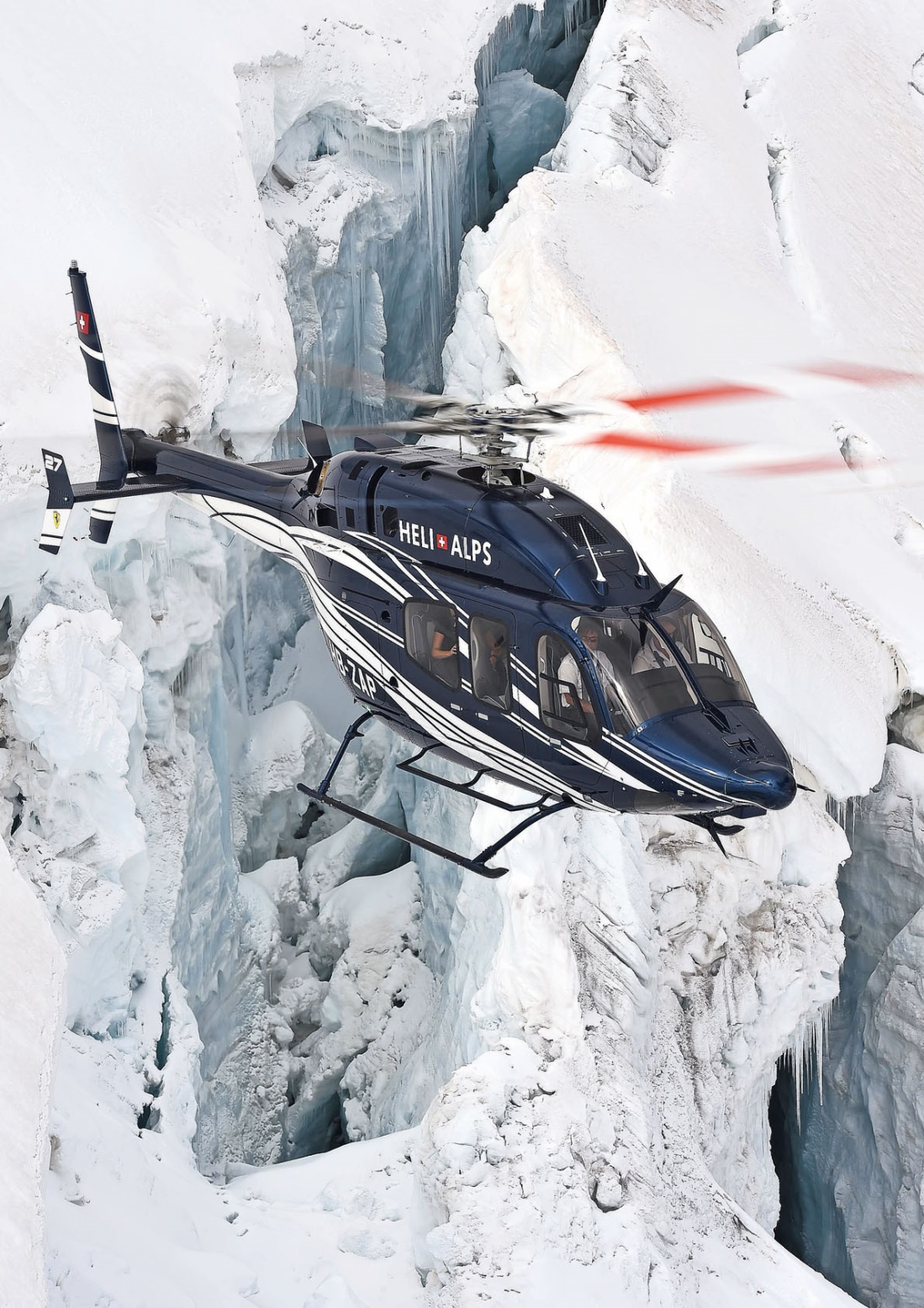
The Bell 429 is an eight-seat, twin-turbine helicopter manufactured by the U.S. company Bell Helicopter. Alterbaum Premium-Helicopter, based in Dötlingen, Lower Saxony, produces replicas of this model. With a rotor diameter of 2.5 meters, it is an impressive model—both on the ground and in the air. Alterbaum’s models are available in various levels of completion: from kits to ready-to-fly versions, and in the customer’s choice of paint scheme.
The Bell 429 made its maiden flight on February 27, 2007. Certification by the Canadian Transport Commission (TCCA) was granted on July 1, 2009, and as early as September 23, 2009, the EASA granted certification in accordance with CS-27. The Bell 429 is manufactured in Mirabel, Canada. By November 2005, Bell Helicopter had already received 136 orders, and by February 2008, that number had grown to over 260. The unit price ranged between five and six million U.S. dollars. In early 2013, the Bell 429WLG was introduced, an upgraded version featuring retractable landing gear and improved flight performance. This upgraded model is based on the Bell 427 but features a larger cabin with a flat floor, avionics that allow for single-pilot instrument flight, and a four-blade main rotor with variable pitch. A tail door for patient transport is available as an option. The helicopter is powered by two Pratt & Whitney Canada PW207D1 shaft turbines with FADED.
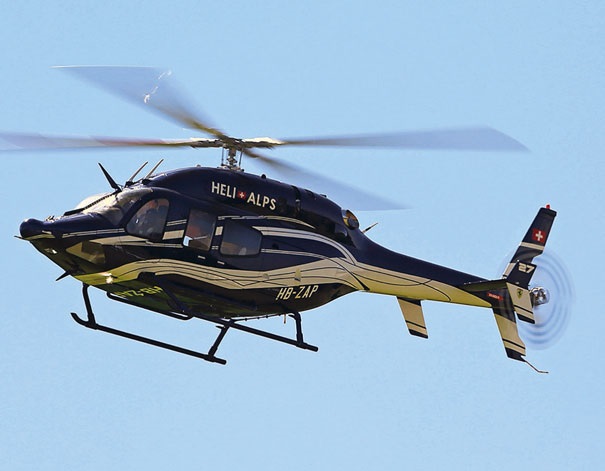
The aircraft on which this model is based is in service at Héli Alps SA in Sion, Switzerland. The brand-new Bell 429, with the registration number HB-ZAP, was entered into the Swiss Aircraft Register on April 22, 2014, and is primarily used throughout Europe for VIP, business, and air taxi flights. The owner is a French businessman. The aircraft
is operated by Héli Alps SA. As of July 1, 2018, ownership of the Bell 429 was transferred to Héli Alps SA Sion.
Alterbaum Premium-Helicopter is a company founded in 2008 by Josef Alterbaum that specializes in the construction of high-quality model helicopters.
His experience in model building and flying dates back to the 1950s. But it wasn’t until 2008 that Josef Alterbaum decided to move beyond simply collecting and flying the various helicopter models available on the market and instead began developing them himself, thereby entering the model-making business.
...said the entrepreneur, who had already achieved success in other fields, and began producing premium helicopters that had never before been available on the market in this form. Together with a friend who was a model-building enthusiast, four variants of the “Super Cobra” were designed and built over a 15-month development and construction phase.
Unlike many other models, these “new” models are not mass-produced but are precision-crafted one at a time. Using particularly high-quality materials and state-of-the-art technology, the models’ flight performance is thus optimized.
Since mid-2010, the time has come: The first models to earn the “Premium Helicopter” designation have been completed, tested in flight, and deemed excellent.
Following the Super Cobra in various versions, the Apache AH-64D Longbow model was released in 2011, and the RAH-66 Comanche in 2012. The Bell 429, which followed in 2013, was Alterbaum’s first non-military model helicopter. In the years that followed, models of the Sikorsky X2 and the Eurocopter X3 were added to the lineup. All of these models have a rotor diameter of 2.5 meters. The model lineup also includes the Bell UH-1 with a 2.7-meter rotor diameter, the Super Cobra AH 1-W with a 2.8-meter rotor diameter, and the EC145 with a 3.37-meter rotor diameter.
Like all other models from Premium-Helicopter Alterbaum, the Bell 429 model is available as a kit, a bare-frame model, or a ready-to-fly model, with or without paint. For the model described here, the owner opted for the kit version, although some parts were already pre-assembled.
The 22-piece fiberglass/carbon-fiber fuselage is vacuum-formed and weighs just under 1.2 kilograms (without the landing gear), not including the frame set. Carbon-fiber raw wings and/or aramid tape have been incorporated at all critical points for reinforcement. Details such as rivets, sheet metal joints, and access panels have already been applied to the fuselage. Clean cutting lines are marked for windows, doors, and functional access or luggage doors. So-called beads run along the edges of these cutouts for reinforcement. With these guides, everything can be milled out without much effort.
The multi-piece frame set is CNC-cut. The fit is extremely precise, so almost no fitting work was required. The frame set’s snap-fit system is also very helpful. This ensures the correct position in the fuselage, and the frames only need to be heated after precise alignment. The frames for attaching the removable tail boom and for mounting the tail rotor also fit without much rework. Thanks to these
precise assemblies and the markings on and inside the fuselage, only ten hours of work were required for the shell construction.
The Phyton-type mechanical system was designed by CAD Jung. However, manufacturing and assembly are handled by Premium-Helicopter Alterbaum. The Phyton mechanical system was already installed, and the Jakadofsky Pro 6000 turbine was flanged onto it. The four Futaba BLS 172 HV swashplate servos were also pre-installed.
After precisely measuring and positioning the mechanical assembly on the substructure—which incorporates the 5-liter fuel tank—the drive-in nuts could be installed in the platform plate. In addition, the mechanical components are supported by the upper ring frame. The pre-fabricated and ready-to-install exhaust pipe simply needs to be bolted to the turbine with a clamp. The frame set included with the fuselage for mounting the Futaba BLS 172 HV tail servo and the tail rotor in the tail boom has already been glued together so that it only needs to be attached to the corresponding
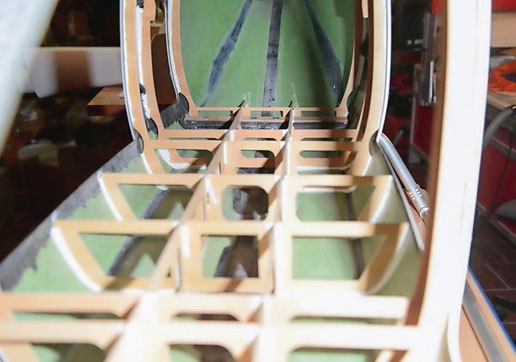
This area must be filled with resin. The aluminum tube, which is used to house the 8-mm flexible shaft for the rear drive, is already included in the kit and fits perfectly. Once the flexible shaft has been cut to length, the rear tube is simply glued to the frames. The tail boom is secured to the fuselage with an M12 Allen screw. On the mechanical side, the square coupling engages with a quick-release coupling. This allows for installation and removal without many tools and is 100% secure.
Alterbaum has developed a new tail rotor specifically for the Bell 429. It consists of two two-bladed rotors arranged one above the other on the tail rotor shaft, offset at an angle of 55°. On the real aircraft, this serves to reduce noise.
The two pilot doors and the two passenger doors fit into their respective openings without requiring much additional adjustment. Extra-strong magnets hold the doors closed. The two guide rails on each side for the sliding doors are installed at fixed positions and additionally glued in place. The guides on the sliding doors are glued in place. Various service doors are functional, and the corresponding doors can be quickly mounted in the correct locations.
Many scale parts, such as cable clamps, antennas, and boarding aids, are included with the fuselage kit. A pictorial guide helps you position the corresponding accessories correctly on the fuselage. Before painting, some of the rivets that had been removed during sanding were reattached.
After the somewhat more involved paintwork, which was carried out by a car painter specializing in models—
| Bell 429 | Prototype | Model |
|---|---|---|
| Crew | One pilot, seven passengers | – |
| Fuselage length | 12.17 m | 2.82 m |
| Fuselage width | 2.36 m | |
| Height | 4.04 m | |
| Curb weight | 1,950 kg | – |
| Payload | 1,225 kg | – |
| External load | 1,271 kg | – |
| Max. takeoff weight | 3,175 kg | Less than 30 kilograms |
| Engine | 2 × Pratt & Whitney Canada | |
| PW207D1 shaft-driven turbines | Jakadofsky PRO 6000 | |
| Takeoff power | 529 kW each for 5 min. | – |
| Continuous power | 466 kW | 6 kW |
| Max. cruising speed | 264 km/h | – |
| Hovering altitude without ground effect | 2,835 m | – |
| Hovering altitude with ground effect | 3,658 m | – |
| Range | 648 km | – |
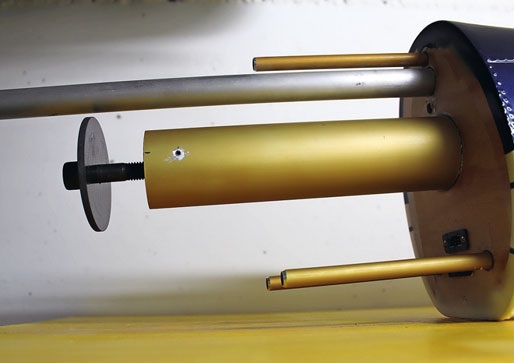
Once these were removed, the mechanical components—including the turbine, tail rotor, and exhaust pipe—could be reinstalled. A PowerBox Evolution with two 2800-mAh lithium-polymer batteries is used as the power source. The Futaba R7014 SB receiver transmits signals via S-Bus2 to the Bavarian Demon 3x.
Scale lighting is provided by an Optotronix Aurora LCU EVO2. The lights are powered by an Emcotec 2S Li-ion battery (2,600 mAh Compact 30 A). The retractable landing light is from uni-LIGHT, as are all the other lights.
The fixed spotlight below the cockpit is from A. L. K. Modellbau & Technik. It is equipped with 42 LEDs, just like the real thing. (This spotlight is also available for
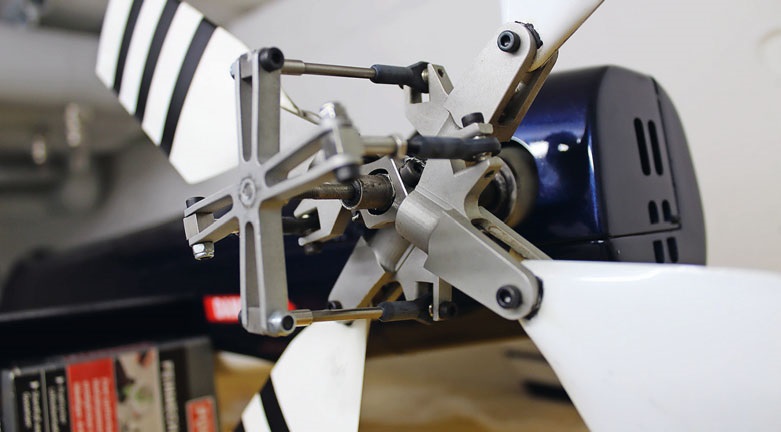
larger and smaller scales; [www.alk.ch](http://www.alk.ch).) The GRP main rotor blades are a special feature. The blade design incorporates both geometric and aerodynamic sweep. This means that both the angle of attack and the profile vary continuously along the length of the blade. The angle of attack decreases in a quadratic function toward the blade tip. A 12-mm-thick profile is used at the blade root, a 9-mm-thick profile at the blade tip, and the profile is linearly reinforced in between. Both profiles feature geometries specifically designed for rotor applications, which, thanks to a wide range of angles of attack, exhibit a neutral moment curve. This is important for the stability of the rotor. To reduce induced drag at the blade tip, the lift distribution was designed so that no lift is generated at the blade tip during hover flight. The blades are 100 mm deep and 1,050 mm long. With blades of this type, it is very important that the angles of attack are measured at the correct location; this is as close as possible
Right from the start, the Bell 429 is a real joy to fly
. With a rotor speed of 860 rpm, the model is very stable and neutral in the air. Sometimes it even feels like you’re just flying a large trainer. The only thing to keep in mind is its heavy weight.
In the fall of 2019, I had to autorotate the Bell 429 due to a turbine failure. During this unintended maneuver, which ended with a landing in an orchard, the blades struck the
tail. A major repair was necessary. On this occasion, the model was converted to a JetCat SPT10-RX-H and received a new paint job.
The Bell 429 deserves the title “premium helicopter” in every respect.
Photos: Héli Alps SA, Anton Laube


TEAM MANAGER "THIS" BOSSHARD
 Rodito Nussbaumer

ATOM, THE NEW DOUBLE-DECKER FROM CPLR
 Matthias Bosshard

INSIGHTS INTO THE HISTORY OF SEAPLANES

34th HAHNENMOOS ALPINE MODEL AIRPLANE CAMP
Res Dauwalder
CORSAIR F4U – A WARBIRD WITH A MEMORABLE LOOK
Jürgen Rosenberger, Jürgen Prinz
SUMMER FUN 2026 AT MG USTER
Martin Wunderli
F3A EUROPEAN CHAMPIONSHIPS IN ST-MACAIRE, FRANCE
Matthias Bosshard
What's New at Leomotion.com

HORIZON HOBBY/LEMACO NEWS: MICRO OV-10 BRONCO 645 MM BY E-FLITE

PRIDE AND GOOD IDEAS
 Markus Nussbaumer

News from HEBU

YOU KNOW WHAT I MEAN? 125 YEARS OF THE SWISS AERO CLUB
 Emil Giezendanner

SMALL, MODEL-LIKE SAILBOATS
Res Dauwalder
TRY-OUT DAY AT MFV WETTINGEN
Urs Keller
52. 2026 ALPS CUP
Emil Giezendanner
THE PC-21 STORY
Emil Giezendanner
TWIN TOWN PARTNERSHIP
Wolfgang Voeller
EURO CONTEST GLIDER ACRO TOUR AUSTRIA 2026

BY YOUTH, FOR YOUTH
Lorena Betschen
WELCOME, NEW MEMBER!
Andrea Bolliger
FREE FLIGHT IN THE MIDDLE OF SUMMER
Urs Muntwyler
COUPE DES ALPES – OBSERVE AND LEARN
Rodito Nussbaumer
NEWS FROM HEBU
 Julia Bucher

FROM 0 TO 100
Markus Nussbaumer
NOS REGION – A HUB FOR ELECTRIC AVIATION
Emil Giezendanner
MEMORIES
Wolfgang Völler
Have you almost forgotten about aircraft that take off and land vertically?
Emil Giezendanner
70 YEARS OF THE NIDWALDEN MODEL AIRPLANE CLUB
Martin Barmettler