
Propeller or impeller?
The Story of Delta Fever
It starts secretly with just one; soon several more follow, and once there’s a dozen, the whole town has it… These verses, inspired by Goethe’s *Faust*, offer a glimpse of what “Delta fever” has been doing in our club and elsewhere for quite some time. What’s meant is the revival of an ’80s Delta, which Siggi Schuster (Holzflieger.de) offers as a high-quality CNC-machined model at a reasonable price. Before you can enjoy flying it, there’s work to be done. The instructions use clear illustrations and concise language to ensure that even less experienced builders can successfully assemble the model.
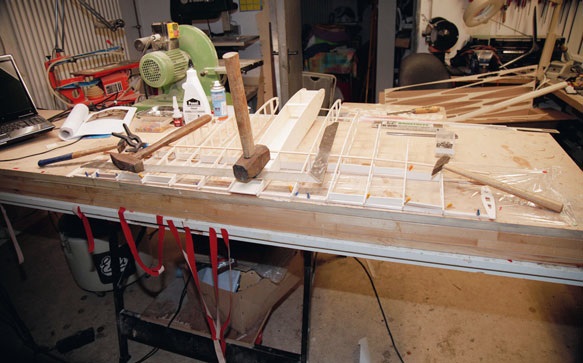
In the first step, we insert the reinforced motor frame into the left or right center rib, as well as the fuselage floor. Next, we insert the opposite rib, add three spacers at the bottom and one at the top, and the airframe is already in place. Individual components—made of high-quality poplar plywood—are glued together using the tongue-and-groove method. Next, the sides of the delta wing are formed by positioning the ribs. We start with a 1,000-mm pine spar, which, after being marked, is glued into the cutouts of both center ribs. Slightly in front of the wingtip strip—which will be attached later—we place a 6-mm strip on the workboard; this serves as a rib support and ensures that, when handled correctly, the fuselage will be free of warping. Rib by rib, we position them on the horizontal spar using the supplied spacers. Since the wing tapers toward the outer edge, a 5-mm wedge is inserted under each rib at that point. In the Impeller Delta, which is also presented here, the 5th outer ribs are intended to serve as the basis for the damping fins of the planned twin tail unit; therefore, care must be taken here to ensure careful alignment parallel to the longitudinal axis. After inserting the upper strip and reinforcing it with balsa strips, we achieve a stable connection between the resulting main spar and the ribs. In the next step, two pine strips are to be inserted at an angle in the front fifth of the Delta after first sanding down the pre-milled straight rib cuts. To assemble the three-part nose strip, slide a 5×15-mm balsa strip into the front rib slots, then glue 5×10-mm balsa strips to the top and bottom. Sand the entire assembly down to the rib contour so that the skin can be laid on smoothly. Next, install 50×2-mm balsa end strips as well as the edge strips for the ribs and spars. When designing the cockpit floor, I choose birch plywood for the front half so that the landing skid—as well as the launch hook to be used on the propeller-driven model—has a stable support. The engine compartment is designed differently for both variants presented here. For the propeller delta, the outrunner is screwed to the nose frame with 1° side pull and 2° camber. In the impeller model, we close off the nose with paneling and later use the resulting cavity as a ballast chamber. Pre-milled covers for servo placement are included in the package. Although servo arms and control horns protruding from the top aren’t exactly a visual treat, they prove practical in everyday flight because they prevent unwanted damage during landing.
Siggi proposes a framework of 5-mm balsa rods for the tail unit design, which would be attached to the balsa planking using triangular strips. That seems too “flimsy” to me. I prefer to veneer both sides of Schuster’s Mikado vertical stabilizer and glue the facing wood over a wide area to the rib underneath. The sanding work is minimal; thanks to good prep work, the steps described so far can be completed in 4–5 afternoons a week.
Finish:
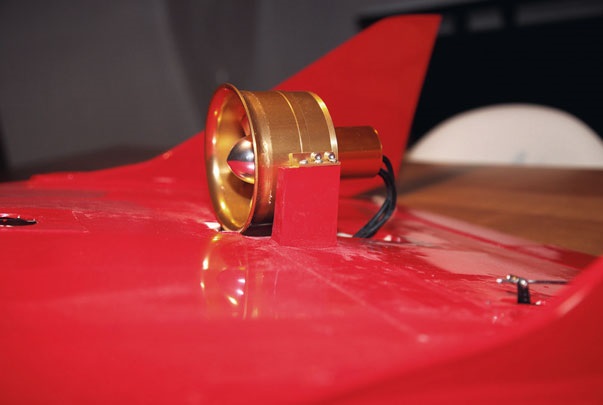
Equipping the propeller-driven model is straightforward. Outrunner motor up front, 5S 5000 mAh LiPo —4S will also work—mounted directly behind the motor bulkhead on the battery board, with a 60-A YEP ESC underneath; the model is suspended from the landing skid with a center of gravity at 350 mm, and the delta glider hovers horizontally. The situation is different with the impeller variant. A 440-gram 90-series engine with an aluminum housing sits behind the main spar on two 1-cm-thick plywood struts; just in front of it is a 130-amp Jeti ESC, servos and the receiver add up to 750 g behind the center of gravity. According to the law of levers, the 836 g of the 5S 5000 mAh battery located at the front do not provide sufficient counterbalance. The result: With the aircraft suspended from the skid, 550 g of scrap lead must be placed in the forward compartment.
Flight Testing
Siggi Schuster points out that you should initially limit the control deflections to ±5 mm and set the Expo to at least 50%. Ignoring this recommendation, I start the propeller-driven model with 1 cm deflections and no Expo. The result: a yawing, erratic model that’s highly unstable. I’m glad to get the plane back on the ground in one piece. Next, I reduce the control travel by half and set the Expo to 50%. Now the delta glider behaves like a lovable—but also boringly sedate—little lamb. Using the dual-rate button on the transmitter provides the solution. Take off in “old-timer” mode with ±5 mm of control travel, then switch to full throttle in the air with > 10 mm of control travel, depending on your preference.
The maiden flight with the Impeller version makes me uneasy due to my lack of experience. If the dihedral is set to $3^\circ$ without side draft, does the 90-drive have enough thrust? A rubber cord, pre-tensioned to 6 kg using a tension gauge, serves as a launch aid. We hook it onto the aircraft’s launch hook, which is positioned in front of the center of gravity. An additional rope extension toward the rear connects to a release mechanism operated by foot. The latch is released. As the impeller starts spinning, Delta 2 shoots off, takes off after 4–5 m, and after another 10 m, the impeller generates enough thrust for the rope to detach from the hook. Hooray—the glider is flying, the center of gravity is correct, and my concern—that the double tail planes, which are symmetrically angled inward on both sides, might impair straight-line flight—proves unfounded. The Delta handles rolls, loops, and descents with ease and is characterized by a strikingly harmonious flight profile.
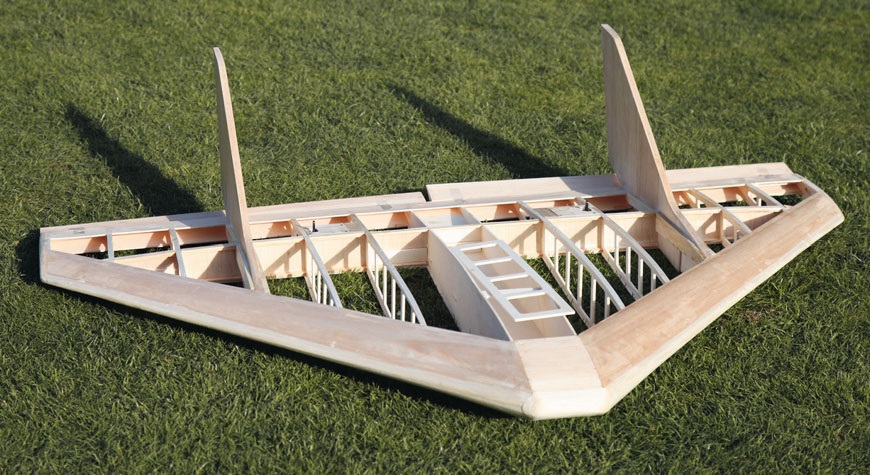
Delta 1 Propeller Version
(The manufacturer calls it the “electric model”)
| Wingspan: | 1080 mm |
| Airfoil: | Fully symmetrical |
| Center of gravity: | 350 mm |
| Outer rotors: | 2 × MG Nonym mini servos |
| Controller: | G-Power Series 36/48 DYS 900 Kv |
| Propeller: | YEP 60 A |
| 12 × 6 | |
| 5S 5000 mAh LiPo battery | |
| Only 2 servos are located behind the center of gravity; weight ~ 120 g | |
| Takeoff weight: | 2000 g |
Delta 2 Impeller Model
(The manufacturer calls it a “combustion engine model”)
| Wingspan: | 1,100 mm (the cabin is 20 mm wider) |
| Airfoil: | Fully symmetrical |
| Servo: | 2 × Savöx SH and 1250 MG, weight 130 g |
| Propeller: | 90 mm, 12 blades, weight 440 g |
| Fuselage: | Aluminum |
| Motor: | Internal-rotor brushless 1600 KV/6S |
| Thrust: | 3.8 kg |
| ESC: | Jeti Master Mezon 130 with BEC |
| Weight: 150 g | |
| Turningy 6S/5000 mAh LiPo battery | |
| Weight: 836 g | |
| Receiver: | Futaba, 21 g |
| Total weight of components behind the center of gravity ~ 750 g | |
| Battery and lead scrap in front of the center of gravity: | 1,386 g |
| Payload: | 2,136 g |
| Takeoff weight: | 3,500 g |
I was thinking of using balsa rods, which would need to be attached to the balsa planking with triangular strips. That seems too “flimsy” to me. I prefer to veneer both sides of Schuster’s Mikado vertical stabilizer and glue the deck wood over a wide area to the rib underneath. The sanding work is minimal; thanks to good preparation, the steps described so far can be completed in 4–5 afternoons per week.
Finish:
Equipping the propeller-driven model is straightforward. Outrunner motor up front, 5S 5000 mAh LiPo —4S will also work—mounted directly behind the motor bulkhead on the battery board, with a 60-A YEP ESC underneath; the model is suspended from the landing skid with a center of gravity at 350 mm, and the delta glider hovers horizontally. The situation is different with the impeller variant. A 440-gram 90-series engine with an aluminum housing sits behind the main spar on two 1-cm-thick plywood struts; just in front of it is a 130-amp Jeti ESC, servos and the receiver add up to 750 g behind the center of gravity. According to the law of levers, the 836 g of the 5S 5000 mAh battery located at the front do not provide sufficient counterbalance. The result: With the aircraft suspended from the skid, 550 g of scrap lead must be placed in the forward compartment.
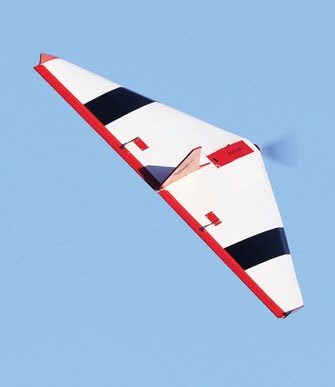
The propeller-driven aircraft weighs 2 kg, while the impeller-driven aircraft weighs 3.5 kg. In the latter, the propulsion system—located behind the center of gravity—adds significant weight, which must be offset by lead scrap in the nose. The current consumption of both aircraft on the ground is 57 amperes for the propeller drive and 88 amperes for the impeller engine. Calculated at “full throttle,” this would result in an operating time of 5.3 minutes for Delta One and 3.4 minutes for Delta Two. The current draw measured over approximately the same flight time is 850 mAh for the propeller version and 3,200 mAh for the impeller model. When comparing the two models, the efficiency of the impeller-powered aircraft is further reduced compared to the propeller variant—aside from its physically less efficient propulsion principle—by an additional weight of 1.5 kg.
The propeller delta responds more directly to control inputs in flight, offers a higher top speed, and has better climb performance. The impeller-powered aircraft flies more smoothly and, thanks to two vertical stabilizers, has better straight-line stability—which, interestingly, becomes noticeable during slow turns. The Delta 1 tends to undershoot here, while the impeller version glides along smoothly, as if pulled by a string. It’s definitely worth mentioning the whirring “pseudo-turbine noise” of the 12-blade propeller—a sound that, at least for the author, is rather jarring. Here, the less experienced pilot begins to experience a glimpse of that fascinating jet-like sensation that “real” turbine flight can only provide—but only at a high cost in terms of skill, experience, and money.
The rebirth of the ’80s Delta, manufactured using CNC technology and equipped with modern control and propulsion systems, brings the joy of flying to even the less experienced at affordable prices, whether in the form of a propeller-driven model or an impeller-driven model with jet-like characteristics.


TEAM MANAGER "THIS" BOSSHARD
 Rodito Nussbaumer

SUMMER FUN 2026 AT MG USTER
Martin Wunderli
52. 2026 ALPS CUP
 Emil Giezendanner

ATOM, THE NEW DOUBLE-DECKER FROM CPLR
 Matthias Bosshard

INSIGHTS INTO THE HISTORY OF SEAPLANES

34th HAHNENMOOS ALPINE MODEL AIRPLANE CAMP
Res Dauwalder
CORSAIR F4U – A WARBIRD WITH A MEMORABLE LOOK
Jürgen Rosenberger, Jürgen Prinz
SMALL, MODEL-LIKE SAILBOATS
Res Dauwalder
F3A EUROPEAN CHAMPIONSHIPS IN ST-MACAIRE, FRANCE
Matthias Bosshard
What's New at Leomotion.com

HORIZON HOBBY/LEMACO NEWS: MICRO OV-10 BRONCO 645 MM BY E-FLITE

PRIDE AND GOOD IDEAS
 Markus Nussbaumer

News from HEBU

BY YOUTH, FOR YOUTH
Lorena Betschen
YOU KNOW WHAT I MEAN? 125 YEARS OF THE SWISS AERO CLUB
Emil Giezendanner
TRY-OUT DAY AT MFV WETTINGEN
Urs Keller
FREE FLIGHT IN THE MIDDLE OF SUMMER
Urs Muntwyler
THE PC-21 STORY
Emil Giezendanner
TWIN TOWN PARTNERSHIP
Wolfgang Voeller
EURO CONTEST GLIDER ACRO TOUR AUSTRIA 2026

WELCOME, NEW MEMBER!
Andrea Bolliger
COUPE DES ALPES – OBSERVE AND LEARN
Rodito Nussbaumer
NEWS FROM HEBU
 Julia Bucher

FROM 0 TO 100
Markus Nussbaumer
MEMORIES
Wolfgang Völler
NOS REGION – A HUB FOR ELECTRIC AVIATION
Emil Giezendanner
Have you almost forgotten about aircraft that take off and land vertically?
Emil Giezendanner
70 YEARS OF THE NIDWALDEN MODEL AIRPLANE CLUB
Martin Barmettler