
HAPPY IS THE ONE WHO MAKES IT
Building a successful semi-scale vintage glider model can only be achieved if the entire project is well planned and prepared. The model is intended to fly later on—but during construction, it must be securely mounted on a stable base plate and a launch ramp.
Of course, the “OldGlide” kits also need some additions. That said, the kits are very reasonably priced. Gregor Hochstrasser built the entire model—including the fabric covering—in a year and a half. The result: a masterpiece that, in its understated elegance, is hardly inferior to modern “exotic” models. Builder Gregor Hochstrasser describes the “kit” as consisting of countless milled parts made of plywood and balsa.
It’s no secret that, despite the assembly instructions, these kits always require a bit of improvisation and a great deal of experience. Preparation is key: You’ll need a sturdy base plate and, on top of that, an equally sturdy support frame for the fuselage. The fuselage has a surprisingly delicate structure and must be properly stabilized to prevent it from warping. It’s better to steer around curves than to build them in. Anyone who wants to advance their skills in model aircraft construction will, sooner or later, tackle such a wonderful project. After all, the private production of fiberglass-reinforced plastic (FRP) fuselages has become a rarity these days. 3D printing is likely to be a game-changer in this area in the coming years. Unfortunately, buying ready-to-fly models alone results in a significant loss of know-how, which is likely to diminish both the social (education and training) and sporting significance of model aviation. We never learned. Good luck to anyone who manages it.
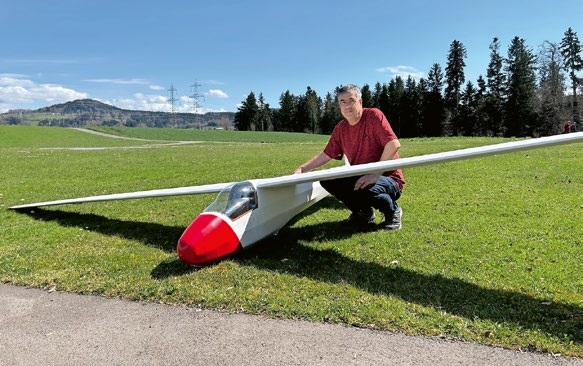
The history of the Alexander Schleicher glider factory is vibrant and rich in variety, tracing its evolution from a small artisan workshop to a medium-sized company in Poppenhausen at the foot of the Wasserkuppe. The world’s oldest glider manufacturer and the key milestones in the company’s history: Alexander Schleicher worked as an aircraft carpenter at Weltensegler GmbH on the Wasserkuppe, and later at the Martens Gliding School and the Rhön-Rossittengesellschaft. Source: Schleicher
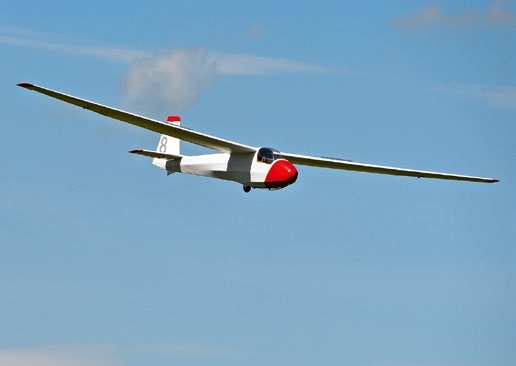
| Construction period: | 1½ years |
| Span: | 6 m |
| Length: | 2.74 m |
| Weight: | 15 kg |
| Control functions: | Ailerons, rudder, elevator, spoilers, tow hook |


News from HEBU

HORIZON HOBBY/LEMACO NEWS: MICRO OV-10 BRONCO 645 MM BY E-FLITE

PRIDE AND GOOD IDEAS
 Markus Nussbaumer

TEAM MANAGER "THIS" BOSSHARD
 Rodito Nussbaumer

YOU KNOW WHAT I MEAN? 125 YEARS OF THE SWISS AERO CLUB
 Emil Giezendanner

F3A EUROPEAN CHAMPIONSHIPS IN ST-MACAIRE, FRANCE
 Matthias Bosshard

ATOM, THE NEW DOUBLE-DECKER FROM CPLR
Matthias Bosshard
SUMMER FUN 2026 AT MG USTER
Martin Wunderli
What's New at Leomotion.com

52. 2026 ALPS CUP
Emil Giezendanner
TWIN TOWN PARTNERSHIP
Wolfgang Voeller
34th HAHNENMOOS ALPINE MODEL AIRPLANE CAMP
Res Dauwalder
CORSAIR F4U – A WARBIRD WITH A MEMORABLE LOOK
Jürgen Rosenberger, Jürgen Prinz
SMALL, MODEL-LIKE SAILBOATS
Res Dauwalder
TRY-OUT DAY AT MFV WETTINGEN
Urs Keller
WELCOME, NEW MEMBER!
Andrea Bolliger
FREE FLIGHT IN THE MIDDLE OF SUMMER
Urs Muntwyler
COUPE DES ALPES – OBSERVE AND LEARN
Rodito Nussbaumer
EURO CONTEST GLIDER ACRO TOUR AUSTRIA 2026

BY YOUTH, FOR YOUTH
Lorena Betschen
INSIGHTS INTO THE HISTORY OF SEAPLANES

THE PC-21 STORY
Emil Giezendanner
NEWS FROM HEBU
 Julia Bucher

FROM 0 TO 100
Markus Nussbaumer
MEMORIES
Wolfgang Völler
NOS REGION – A HUB FOR ELECTRIC AVIATION
Emil Giezendanner
DO YOU KNOW WHAT I MEAN IN THE LAND OF SMILES?
Emil Giezendanner
Have you almost forgotten about aircraft that take off and land vertically?
Emil Giezendanner