
Model Aircraft Engines and Their Development
Long before the legendary Braun and Kretmo engines, Ernst Thalheim’s Etha engine—which has already been described—was developed in 1927 (see the second installment). However, a few Swiss pioneers who succeeded in scaling up from a single prototype to mass production deserve mention here. They are Xaver Max Wuest, Basel; Ernst Buchmann, Zurich; Ingo Andreoli, Zurich; W. Datz, Frauenfeld; Fischer, Oftringen; Max Wächli, Röthenbach; Kolb (Eisenkolb), St. Gallen; O. Grob, Thalwil; Karl Hürlimann, Dielsdorf; Otto Volmer, Regensdorf; and a few other smaller manufacturers.
So, how did this Dyno engine come about? After talking to various veterans, it seems difficult to determine exactly how it really happened. The Dyno I miniature diesel engine, as it is called in E. Tilgenkamp’s book, was developed by K. Klemenz. Jakob Klemenz-Schenk owned a small machine shop in Aefligen near Bern that manufactured dynamos and lamps for bicycles. Mr. Klemenz, his brother, and his bookkeeper, Alwin Kuhn, were enthusiastic model airplane enthusiasts who experimented with engines. The Burgdorf Model Flying Club appears to have been a dynamic hub for enthusiasts of motorized model aircraft. In fact, there were several fantastic
engine builders in this area. To mention just the most important ones: Erwin Schwab, Herzogenbuchsee; Aeschbacher, Burgdorf; H. Bolli, Solothurn; Max Wächli, Röthenbach; but also Xaver Max Wuest and Andreoli, who helped spark a movement in model aviation through their articles in *Aerorevue*.
Jakob Klemenz was the mechanic and had already been building engines before the Dyno I. He manufactured the Dyno engine, drawing on the experience of men such as Erwin Schwab and his brother Oskar. The basic idea—and this is clear and unambiguous—came from Ernst Thalheim. Ernst Thalheim’s patent was protected until 1942 but had already expired by the end of 1939, as Mr. Thalheim had stopped paying the annual maintenance fee. Mr. Klemenz paid Ernst Thalheim 300 francs, essentially as moral support for the idea of the counterpiston, even though the patent had expired.
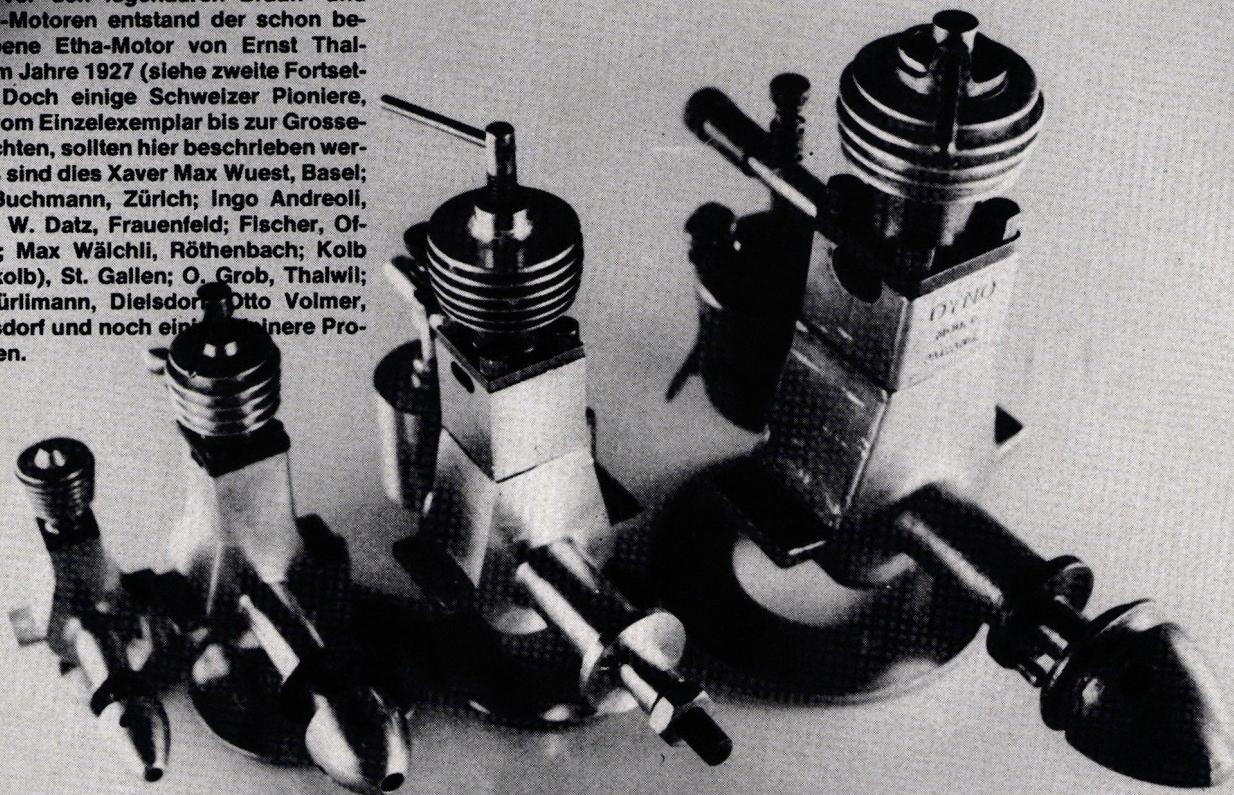
This image shows engines that are derived from the Dyno in terms of design and concept. The Dyno had its moment in the spotlight. It was tested on June 13, 1941, by the Institute for Aircraft Equipment under Prof. Gsell of the Swiss Federal Aviation Office. This move, which was used in advertising, certainly contributed to its success.
From left to right, you can see: Wächli I, Wächli II, an East German engine, and the Dyno Model I.
A Swiss design — 100 percent Swiss-made:
Manufacturer: J. Klemenz-Schenk, Aefligen (Bern)
Technical Specifications:
Engine height 100 mm — Engine width 50 mm. Engine length, including propeller shaft and fuel tank: 110 mm. Dry weight, without propeller: 190 g. Fuel consumption, depending on settings: 150–200 cm³ per hour.
The engine was tested on June 13, 1941, by the Institute for Aircraft Equipment (I. B. A. L.) of the Federal Aviation Office under the direction of Prof. Gsell. The test yielded the following results:
| Engine displacement | 2.04 cm³ |
| Bore | 12.00 mm |
| Stroke | 18.00 mm |
| Braked engine power | 0.09 PS at 7,500 rpm |
| Power-to-weight ratio | 1.97 kg/PS |
| Power per liter | 44.1 PS/liter |
| Good stability |
In all tests, the starting process proved to be considerably more reliable than was generally expected of model aircraft engines.
On May 25, 1941, the Model Aircraft Commission of the Ae. C. S. inspected the production of these engines and, on that occasion, subjected one such engine, DYNO I, to a one-hour continuous run. Without any adjustments—except for the fuel supply—the engine in question successfully passed this test as well.
Due to its light weight of only 190 g, this engine can be installed in small models with a wingspan of approximately 150 cm and a wing loading of 20–25 g/dm². A test flight with such a model resulted in a total flight time of 6 min. 42 sec. with an engine runtime of 3 min. 28 sec.
Since an ignition system is no longer required, such as:
- 1. Battery
- 2. Ignition coil
- 3. breaker
- 4. Capacitor
- 5. Spark plugs
- 6. Wiring
is the small diesel engine for model airplanes, DYNO I,
under development, because the power-to-weight ratio has been reduced to 1.97 kg/PS. This makes it possible to build small, lightweight models that significantly reduce the risk of breakage.
in terms of maintenance and operation, because there is no longer a need to purchase expensive replacement parts, such as batteries and spark plugs. As is well known, ignition systems require costly maintenance.
because the engine starts more easily and ignition problems can no longer occur. The absence of an ignition system and the exceptionally good cooling eliminate any risk of fire.
The fuel required for this is available directly from the factory.
Warranty: A written warranty is provided for verifiable manufacturing defects (material and workmanship) for a period of 1 year from the date of delivery.
Price of the state-of-the-art model aircraft engine DYNO I: 80 Swiss francs. Orders must be submitted to the Central Secretariat of the Ae. C. S., Bern, Schanzenstrasse 1, Tel. 2 79 19.
Delivery will be made cash on delivery from the factory starting August 1, 1941, following prior notification to the customer. Shipments will be processed in the order in which pre-orders were received.
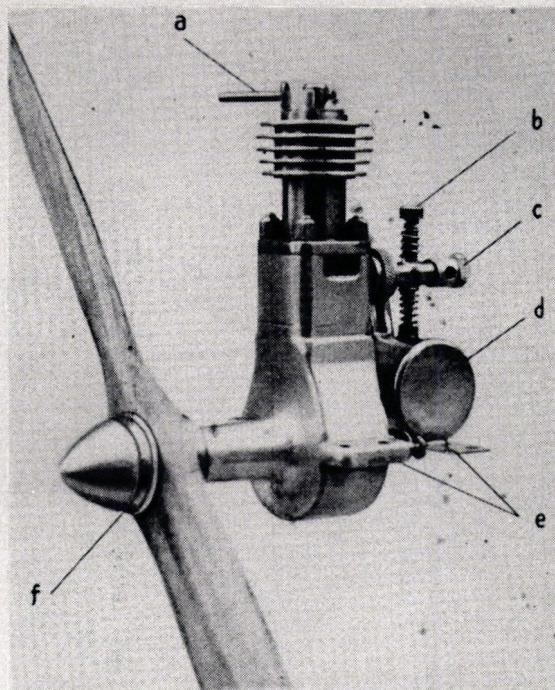
a Compression adjustment lever
b Fuel injector needle
c Air supply control
d Fuel
tank e Mounting tabs
f Starter cord groove
It was a voluntary and generous decision on Mr. Klemenz’s part to give Mr. Thalheim what was, at the time, a rather large sum of money and to help him during a difficult period. The Dyno engine was marked “Patent Pending,” which was indeed the case, but it was Thalheim’s patent. Engraving “Patent Pending” on the engine was a very useful and wise move, as it gave the Dyno a significant head start. Between 5,000 and 6,000 units were manufactured, and according to Mr. Klemenz, it was a profitable venture. The fact that the engine bore the inscription “Patent Pending” had the advantage that, throughout the entire war, only Eisfeld dared to use the counterpiston on its engine. Kratsch, Quragan (France), and Ridi used eccentric crankshafts for compression adjustment. Bonnier and Micron used fixed cylinder heads. The Mo-vo, Alluchery, Motominima, Giglio, Bedrich, and Mills engines were all developed after 1945.
The basis for these was thus Ernst Thalheim’s Etha Diesel, although Xaver M. Wuest of Basel also made contributions through his systematic research. Unfortunately, it is not known whether Gianni Andreoli of Mendrisio inspired Wuest and Klemenz through his writings on engine design in *Aerorevue*. Andreoli was a student at ETH Zurich, where he built 16 prototypes, which we will discuss later. His first prototype dates from 1937 (see the April 1940 issue of *Aerorevue* or Tilgenkamp’s book, page 263, Volume III).
THE SMALL DIESEL ENGINE FOR MODEL AIRPLANES
Winner of the National Model Aircraft Engine Competition, Belpmoos near Bern
The competition results show:
1st Place: “DYNO I” Diesel
2nd place: “DYNO I” diesel
Six aircraft equipped with “DYNO I” engines placed within the top 10.
All “DYNO I” engines that took to the air performed flawlessly in every respect.
“DYNO I,” a Swiss design, is the only model aircraft engine that guarantees outstanding performance.
“DYNO I” has been tested by the Institute for Aircraft Equipment (IBAL) of the Swiss Federal Aviation Office under the direction of Prof. Gsell.
Sources of supply:
Klemenz-Schenk, DYNO Factory, Aefligen (Bern)
or the relevant specialty stores.
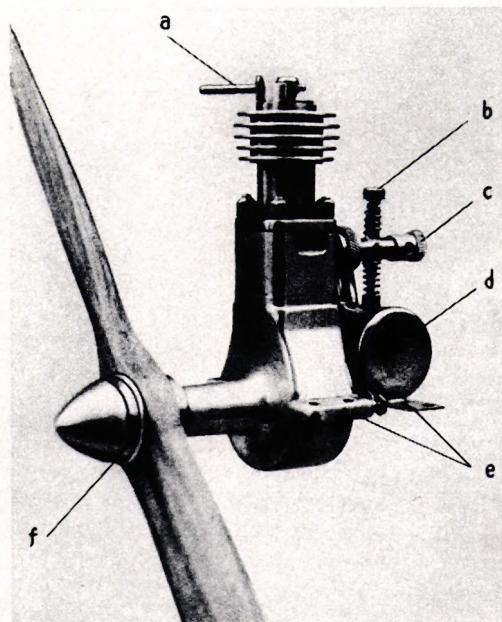
a Compression adjustment lever
b Fuel injector needle
c Air supply tube
d Tank
e Mounting tab
f Cord groove
Dry weight, without propeller and fuel tank: 185 g
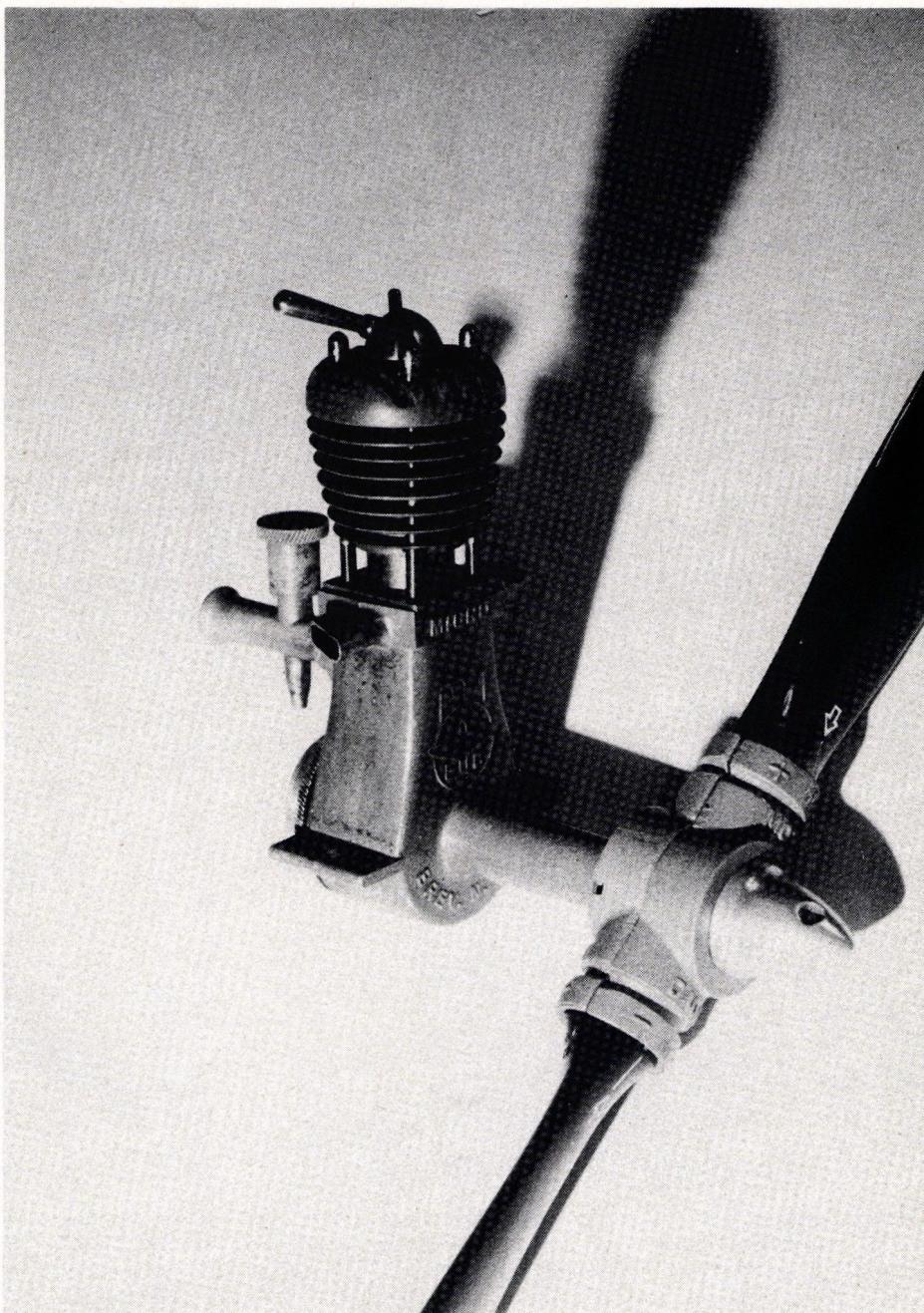
The Dyno engine, as depicted in all brochures with the fuel tank positioned crosswise, was built by Mr. J. Klemenz himself. This image also shows the prototype. In 1941, A. Kuhn also won the flight competition at Belpmoos with his Riedstern model powered by this engine. Only the prototype—as shown in the first brochure—features this horizontally mounted fuel tank. We see this prototype time and again in promotional brochures and advertisements, even as late as 1946.
The production models—of which I own No. 001—have a vertical fuel tank. Even Mr. Klemenz does not know where the original can be found. What made the Dyno a global success was its power-to-weight ratio, which was high for its time: 1.97 kg/PS or 44.1 PS per liter of displacement. Its weight—that is, its power output from a very light, high-revving engine—allowed for a lighter design and resulted in fewer landing accidents than with heavy engines.
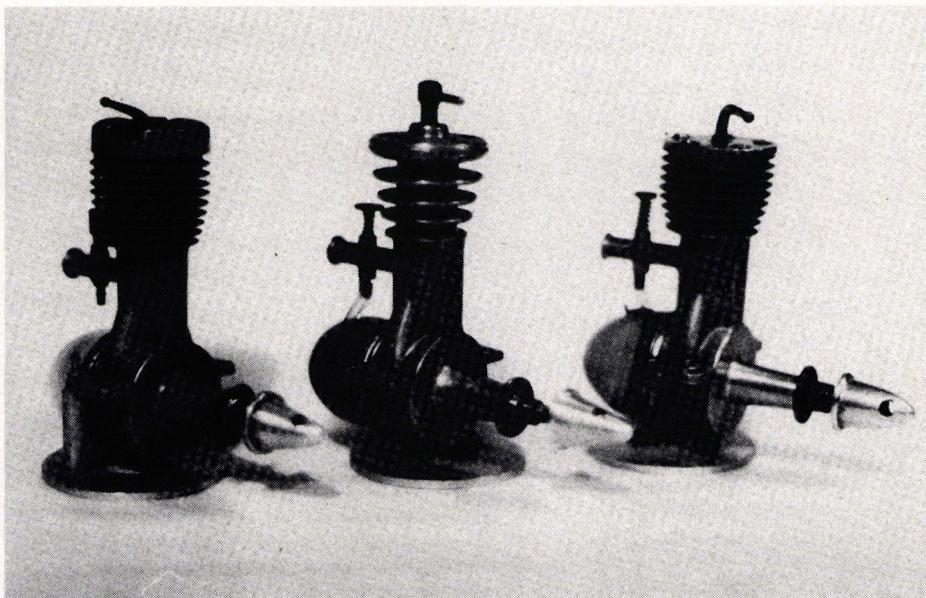
There is no Dyno II. The first engines were labeled and numbered. The prototype had no markings. The first production engines had an Allen screw on the crankcase, which was later omitted. There are a few units with a cast-on carburetor manifold featuring a very large intake cross-section (6 mm), presumably the “secret weapon” of A. Kuhn, who was a well-known model airplane enthusiast at the time (see the side view of the Dynos).
The Dyno was replicated very quickly, and its system and design were copied. Engines such as the Movo II, Delmo 2.65, Eisfeld 6 ccm, Allouchery 1.5, Mills 1.3 ccm, and Mottominima (I) Thaler are slightly modified copies, sometimes with a slightly different cylinder displacement.
Mr. Jakob Klemenz still lives in the Thun area today. Despite his age, he is still very, very active. Mr. Klemenz manufactured dynamos and lamps for bicycles under the same name. The name “Dyno” also derives from the dynamo. In total, between 5,000 and 6,000 Dyno I models were produced and shipped all over the world. The majority were exported. Despite the war, they were sold as far away as South America. The importer for the Americas later took on the Italian Movo II D, which—a well-executed copy—was somewhat more elegant, lighter, and very affordable, and thus supplanted the Dyno in South America and the United States. According to Mr. Klemenz, manufacturing the Dyno was a profitable venture until the accountant’s demands led to the cessation of production in 1947. If these disputes between the accountant Alwin Kuhn and Jakob Klemenz over the profit share from this engine had not arisen, production would have continued. But as it was, production slowly but surely declined starting in 1946.
New, more powerful diesel engines emerged as competition. Larger models should also have been added to the product line. Mr. Klemenz had the experience
and built enough engines—but as I said, the accountant's demands killed the momentum.
The diesel engine’s first known competitive use took place in 1941 at the national competition in Belp, Bern, and was considered a major sensation that spread like wildfire throughout Europe despite the war. On September 27–28, 1981, it had been 40 years since Switzerland’s first national powered flight competition took place in Bern at Belpmoos
. This unique event also marked the spectacular debut of the Dyno engine, which subsequently became world-famous. At this national competition, 30 model aircraft competed in the A category (handicap flights) and 18 in the B category (free flights), with some participants entering two models and thus appearing twice on the leaderboard. In the A category, 19 Swiss engines, seven American engines, and four German engines competed. The Dynos were represented a total of ten times. Klemenz Jakob, the manufacturer of the Dyno engine, also competed with two 18-cc gasoline-powered models. In total, he entered four models: two with Dyno engines and two with Klemenz engines. Please refer to the rankings.
A particularly clever marketing strategy was to have the engine tested by the Swiss Federal Aviation Authority and to use the positive results in advertising and sales—including through the Aero Club.
Modelers back then were highly respected, and owning a Dyno was a source of great pride. Mr. Klemenz told me that in the early days, people were practically snatching the engines right out of his hands. Despite the war, the engine found its way into all the Eastern European countries, and I never cease to be amazed when I come across Dynos in Turkey or Czechoslovakia. It was—and still is today—a highly sought-after collector’s item and prized possession.
To mark the 40th anniversary of the Dyno engine, a “replica” edition—numbered 1–100—was produced by Mr. Klemenz’s former apprentice, who is now the owner of the Dyno factory, and will soon be offered for sale. Distribution: S. Schmid, Institut ESAM, Thurgauerstrasse 40, 8050 Zurich. This allows former
Dyno owners or prospective buyers to own a fully functional Dyno. The plans for the Riedstern model are also available at the same address.
The Dynos are not rare collector’s items, but they are highly sought after because they played a major role in shaping and ushering in a significant chapter of model history. In Switzerland, there are certainly still 100 of them waiting for a collector somewhere in a shoebox or an attic. Or perhaps they’re being cherished with fond nostalgia, or sitting in a closet as a memento of a father.
The diesel engine very quickly replaced gasoline engines in Europe, but was practically unable to gain a foothold in America. In addition to approximately 200 different gasoline engines, there are a total of 6 American diesel engines that have become well-known. The diesel engine was not displaced in Europe until the late 1950s by the glow plug. The real reason why the diesel engine disappeared lies in its design. The “self-igniter,” as it should
(it is not a true diesel engine because the fuel is not injected into highly compressed air, as in a true diesel engine), suffers from knocking problems due to its high compression pressures and performs well only when it can run at high RPMs. However, starting at 3.5 ccm, the moving parts cannot withstand such high pressures and the vibrations caused by the explosion shock, which are problematic for model aircraft and radio-controlled systems. Today, with the exception of a few specialized Western designs, only Bugel, Rossi, and Supertiger engines are still manufactured in the East for circuit flying. The English ED engines and, for example, Taplin engines are now being remanufactured in India.
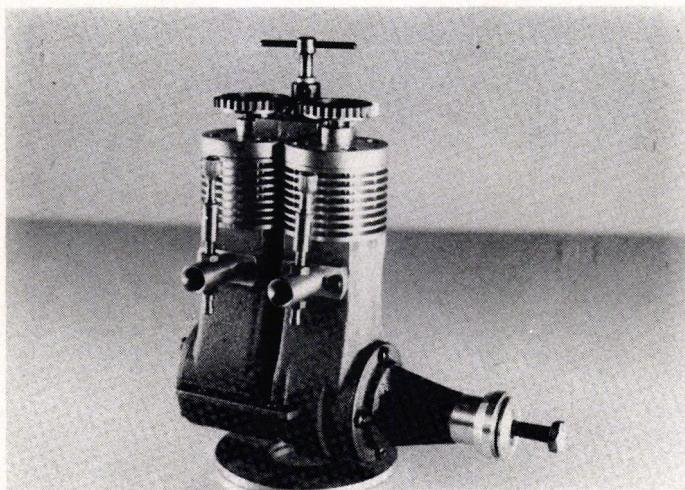
The “Dyno I” miniature diesel engine by J. Klemenz and A. Kuhn.
a Compression adjustment lever, b Fuel injector needle, c Air supply control, d Fuel tank, e Mounting tabs, starting cord groove


TEAM MANAGER "THIS" BOSSHARD
 Rodito Nussbaumer

SUMMER FUN 2026 AT MG USTER
Martin Wunderli
52. 2026 ALPS CUP
 Emil Giezendanner

ATOM, THE NEW DOUBLE-DECKER FROM CPLR
 Matthias Bosshard

INSIGHTS INTO THE HISTORY OF SEAPLANES

34th HAHNENMOOS ALPINE MODEL AIRPLANE CAMP
Res Dauwalder
CORSAIR F4U – A WARBIRD WITH A MEMORABLE LOOK
Jürgen Rosenberger, Jürgen Prinz
SMALL, MODEL-LIKE SAILBOATS
Res Dauwalder
F3A EUROPEAN CHAMPIONSHIPS IN ST-MACAIRE, FRANCE
Matthias Bosshard
What's New at Leomotion.com

HORIZON HOBBY/LEMACO NEWS: MICRO OV-10 BRONCO 645 MM BY E-FLITE

PRIDE AND GOOD IDEAS
 Markus Nussbaumer

News from HEBU

BY YOUTH, FOR YOUTH
Lorena Betschen
YOU KNOW WHAT I MEAN? 125 YEARS OF THE SWISS AERO CLUB
Emil Giezendanner
TRY-OUT DAY AT MFV WETTINGEN
Urs Keller
FREE FLIGHT IN THE MIDDLE OF SUMMER
Urs Muntwyler
THE PC-21 STORY
Emil Giezendanner
TWIN TOWN PARTNERSHIP
Wolfgang Voeller
EURO CONTEST GLIDER ACRO TOUR AUSTRIA 2026

WELCOME, NEW MEMBER!
Andrea Bolliger
COUPE DES ALPES – OBSERVE AND LEARN
Rodito Nussbaumer
NEWS FROM HEBU
 Julia Bucher

FROM 0 TO 100
Markus Nussbaumer
MEMORIES
Wolfgang Völler
NOS REGION – A HUB FOR ELECTRIC AVIATION
Emil Giezendanner
Have you almost forgotten about aircraft that take off and land vertically?
Emil Giezendanner
70 YEARS OF THE NIDWALDEN MODEL AIRPLANE CLUB
Martin Barmettler