
F5J: A Look Back at the 2022 Season
The Swiss F5J Championship was scheduled relatively early this year. On May 22, F5J enthusiasts from all over Switzerland gathered in Nods, Fribourg, at the AirCCchasseral airfield. Conditions were ideal, both in terms of the weather and the layout of the model airfield. Six qualifying rounds and three fly-offs were held. The report was published in MFS 4-2022. Detailed results, as well as statistics on launch altitudes and landing points, can be found on the SMV homepage under “Results.”
Three colleagues from French-speaking Switzerland were in attendance: driver Pierre Maquelin, his assistant François Bommottet, and Thierry Ruef. Many “fans” were able to follow Thomas Wackerlin’s video commentary and coach Pierre Bühler’s daily reports via the “F5Schweiz” Facebook account and the FSAM homepage. A big thank you to both correspondents.
What can we improve to give our pilots an even better chance on the international stage? Individual training at your local model airplane field has very clear limitations: you can practice landings, fly, and test different settings. However, that doesn’t automatically make you a winning pilot. On the other hand, we’ve noticed that fly-off participants, without exception, score 50-point landings... Conclusion: Train like crazy until you consistently score only 45 and 50 points on landings in any wind conditions! A necessary basic skill! →
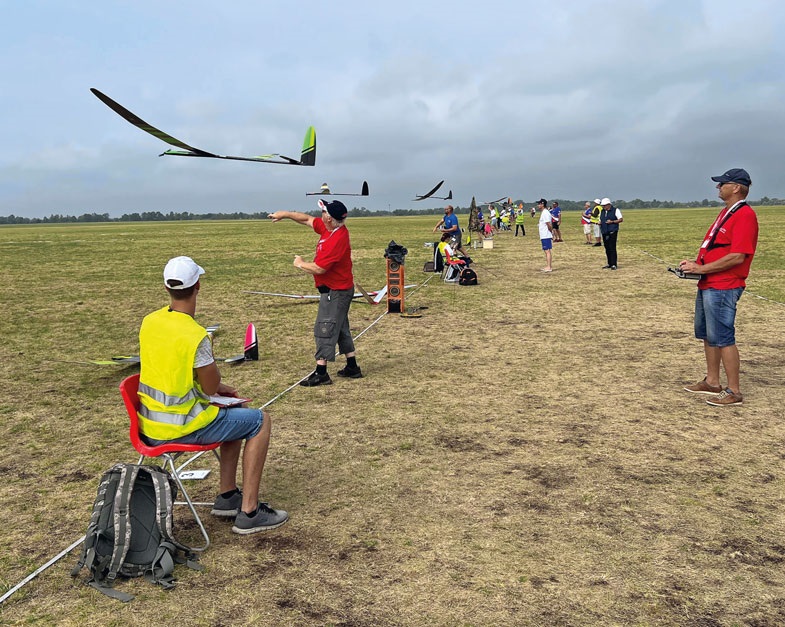
In every fly-off, you encounter a wide variety of different models, and none of them clearly stands out from the rest. But the best plane is still the one you can fly blind—the one where you can anticipate the necessary corrections before the wing or the nose of the fuselage tilts. Get to know your plane!
There’s still room for improvement here. At what altitude should you shut down the engine? What are the risks? Which group should you follow? If everyone is forced to fly in the same area—which, unfortunately, has often been the case in recent years at small, typical “Swiss” airfields— you don’t need a special “nose” for the terrain to figure out where the next thermals will form. You fly in the swarm, climb a little lower than the others, and make the difference with clean flying. At international competitions abroad, things generally seem very different, and the planes scatter in all directions after takeoff.
Where to go next, who to follow? To develop your intuition, group flights are essential. Whether training or competing with other pilots, come up with a strategy before the flight. Study the terrain. Identify variations in the terrain’s surface, observe wind directions, and prepare a Plan A and a Plan B (what if the thermal isn’t—or is no longer—where you expect it to be?). And if you find it (the thermal), then: stay in it.... An experienced pilot once told me: “Keep the glider in the thermal at all costs, even if it doesn’t look pretty!” Or, in other words, sometimes spiraling in thermals may not be very textbook!
There are pilots who always seem to succeed. You can look up to them with admiration. But there are also ways to recognize your own weaknesses and work on improving them in a targeted way. It’s helpful when detailed results (times, takeoff altitudes, and landing points) from competitions are available and analyzed. Statistics can sometimes help uncover an undetected weakness.


News from HEBU

TEAM MANAGER "THIS" BOSSHARD
 Rodito Nussbaumer

YOU KNOW WHAT I MEAN? 125 YEARS OF THE SWISS AERO CLUB
 Emil Giezendanner

F3A EUROPEAN CHAMPIONSHIPS IN ST-MACAIRE, FRANCE
 Matthias Bosshard

SUMMER FUN 2026 AT MG USTER
Martin Wunderli
TRY-OUT DAY AT MFV WETTINGEN
Urs Keller
52. 2026 ALPS CUP
Emil Giezendanner
BY YOUTH, FOR YOUTH
Lorena Betschen
ATOM, THE NEW DOUBLE-DECKER FROM CPLR
Matthias Bosshard
CORSAIR F4U – A WARBIRD WITH A MEMORABLE LOOK
Jürgen Rosenberger, Jürgen Prinz
SMALL, MODEL-LIKE SAILBOATS
Res Dauwalder
What's New at Leomotion.com

TWIN TOWN PARTNERSHIP
Wolfgang Voeller
EURO CONTEST GLIDER ACRO TOUR AUSTRIA 2026

INSIGHTS INTO THE HISTORY OF SEAPLANES

34th HAHNENMOOS ALPINE MODEL AIRPLANE CAMP
Res Dauwalder
WELCOME, NEW MEMBER!
Andrea Bolliger
HORIZON HOBBY/LEMACO NEWS: MICRO OV-10 BRONCO 645 MM BY E-FLITE

FREE FLIGHT IN THE MIDDLE OF SUMMER
Urs Muntwyler
COUPE DES ALPES – OBSERVE AND LEARN
Rodito Nussbaumer
PRIDE AND GOOD IDEAS
 Markus Nussbaumer

THE PC-21 STORY
Emil Giezendanner
NEWS FROM HEBU
 Julia Bucher

FROM 0 TO 100
Markus Nussbaumer
MEMORIES
Wolfgang Völler
NOS REGION – A HUB FOR ELECTRIC AVIATION
Emil Giezendanner
Have you almost forgotten about aircraft that take off and land vertically?
Emil Giezendanner
DO YOU KNOW WHAT I MEAN IN THE LAND OF SMILES?
Emil Giezendanner