
China's organization is hard to beat
Swiss Jet Scale Team's Success at the 2019 World Junior Championships in Rongcheng, China

The members of the Swiss Jet Scale Team traveled to China individually. Together with Chai Sonsukong and Geri Heim, we drove to Munich, then flew with Air China to Beijing and on to Yantai. From there, the event organizer picked us up by bus and drove us about 120 km to Rongcheng.
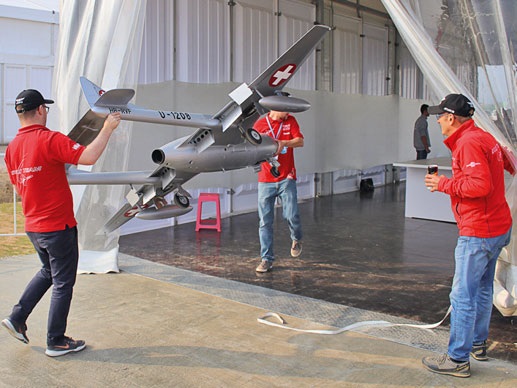
The Jiulongsheng Swan Hotel, where we were staying, is modern and luxuriously furnished. The staff here go out of their way to make us feel welcome; they really put their best foot forward. A shuttle bus, which runs almost to the second, takes us to the airfield. What we found there was not what I had expected: a huge grandstand with a large screen at the back, along with four large tent halls. The model airplanes had already arrived. However, Andreas Schär’s DH-Vampire had sustained significant damage during transport, which was reported to the organizer. Otherwise, the transport of the valuable jet models went smoothly.
Strong winds prevailed during the practice flights, originating from the tail end of Typhoon “Hagibis” over Japan. As a result, only a few pilots risked flying their models during practice.
Initially, some pilots experienced severe radio interference. This culminated in the loss of the training model belonging to the reigning Masters champion, Vitaly Robertus. The organizer reacted immediately. The numerous surveillance cameras were turned off during the flights, as was the Wi-Fi. From then on, all radio transmissions were monitored. This restored calm. The opening show by the Chinese delegation was something special. Well over 100 women drummed rhythmically on their large drums and other percussion instruments. The stands were filled to capacity. Young and old alike watched the ensuing air show with enthusiasm. It left many people speechless...
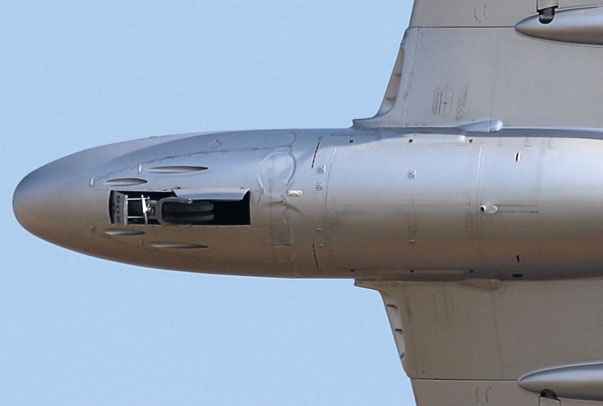
The actual flying competition began with the usual favorites. As far as the pilots’ performance was concerned, the Germans were the best. In the 13.5-kg class, young Moritz Gärtner dominated with his BAe Hawk. In the 20-kg class, Frank Westerholt and Nick Köberich were the top pilots with their Aero L-39 Albatros. Throughout the entire championship, the organizer’s camera crews were constantly on the job. Everything was broadcast live on the big screen, allowing guests outside the stadium to follow the action. At times, the JetWorld Masters were even featured on Chinese television.
The Swiss pilots had mixed starts to the competition. Chai Sonsukong, our rookie, unfortunately ran into trouble. The landing gear on his BAe Hawk would not retract. He nevertheless wanted to use the flight as practice and continued the flight with the landing gear extended. No one realized that fuel might run out so soon. The turbine cut out, and Chai tried to reach the grass strip next to the runway. Unfortunately, the jet sustained significant damage there, which meant the end of the championship for Chai. Fredy Doppelhofer, on the other hand, carried out his routine with his usual composure, his Starfighter tracing its paths across the sky above Rongcheng. The “Rütimänner”—Peter and Tim—struggled a bit with technical issues. Peter, in particular, had a landing gear cylinder that malfunctioned. With great effort, Peter managed to get both Hunters back into flying condition. Tim delivered solid flights, and Peter also managed two good flights. Adrian Senn and Andreas Schär performed some very good flights with the new DH-Vampires, both ranking in the top 10. With the Vampire’s construction evaluations still pending, everyone was eagerly awaiting the final results. The influence of our flight instructor, Martin Lüthi, is clearly evident—he’s a real stroke of luck for our team. Our pilots’ performance is on a steep upward trajectory.
Anyone who thought they’d have to bring their own food from Europe to survive was sorely mistaken. The food tasted excellent; as long as you weren’t a picky eater, you could eat very well. With the pass we received, we could get lunch and help ourselves to drinks from the fridge. Everything was superbly organized.
In a large tent where a wide variety of dishes were on display, many local specialties were offered at various booths. I wasn’t about to miss that. You could try everything first, if you dared. The prices were reasonable for us; for example, a fish fillet battered and fried in oil cost the equivalent of 30 rappen, and three of them were enough to fill you up.

The night before, there was a huge party in front of the hotel; you could even hear Western music—the atmosphere was fantastic. At exactly 9:00 p.m., everything went quiet. What was going on? The party was over! Just imagine that back home—that’s when the party would just be getting started.
Thanks to his outstanding performance, Moritz Gärtner of Team Germany finished in an excellent third place, behind the Russians Pavel Lapshov (1st) and Alexey Sidorov (2nd).
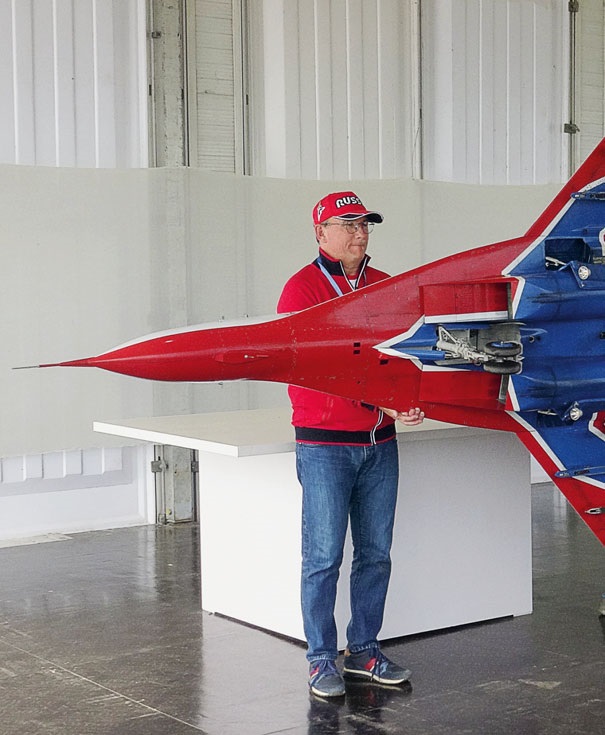
Frank Westerholt and Nick Köberich were the best pilots, but since their Aero L-39 Albatros scored too few points in the airframe evaluation—as had been feared—they fell back to 9th and 10th place in the overall standings.
Vasiliy Eikhner from Team Russia, a protégé of Vitaly Robertus, was the well-deserved winner thanks to his sensitive flying style and the YAK-130, which continues to receive outstanding ratings. He thus pushed his mentor down to second place. Vitaly hasn’t quite regained his rhythm after the crash of his training aircraft—after all, he’s not a machine either. His scale jet, the MiG-29, however, remains the gold standard. Adrian Senn secured an outstanding third place with the De Havilland Vampire and a strong flight performance. In doing so, he pushed his friend and mentor Andreas Schär down to fourth place. Overall, an excellent result for the Vampire team.
A Special Story: Andreas lost his Vampires during training in Alessandria at Easter 2019—a bitter loss! What happened next is truly remarkable. His best friend, Adrian, offered to let him use his Vampires for the championship in China. Andreas might have stayed home with his L-39 Albatros. Adrian decided, together with his father Reto—our team manager—that he would fly Reto’s Vampires in China. This team spirit is the best proof of true friendship.
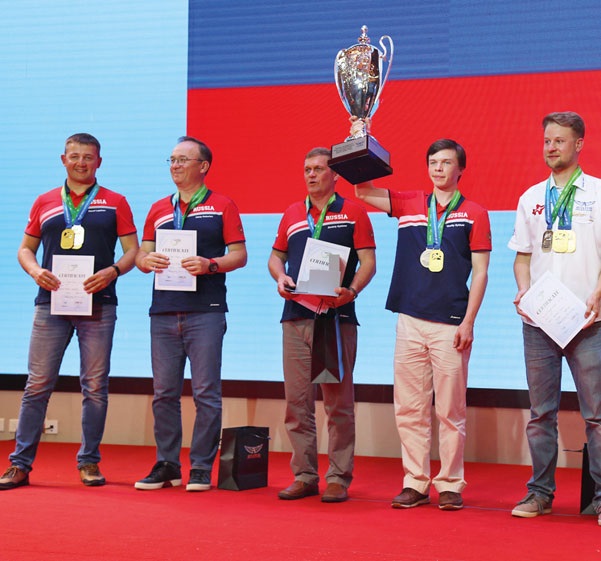
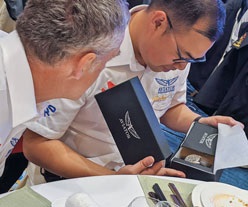
In the team standings, the Russians won by a wide margin ahead of the Swiss Jet Scale Team. We hadn’t expected to finish ahead of Team Germany again, as we had in Finland, but thanks to the strong performance by Adrian, Andreas, and the surprise contender Fredy, our team made it onto the podium. It was also a nice way for Chai to wrap up his first Masters appearance. He received a valuable Aviator watch as a consolation prize for his bad luck.
Unfortunately, the discussions then began, just as they do after almost every Jet World Masters. It’s always the same people calling for rule changes—either to end Team Russia’s dominance or to get themselves back to the very top of the rankings. They say the models are too expensive if they have to be built with such detail, that the scale jet scene has no future this way, and so on.
Comment: My personal opinion on this matter: If the rules—which currently allocate 50% to build quality and 50% to flight performance—are changed to place greater emphasis on flight performance, then the scale jet scene will lose its soul. I ask myself the following questions: Where would the best pilots be with better scale jets, such as the Vampires from our team? Andreas Schär realized in time that competing again with his L-39 Albatros would no longer give him a chance at the podium, no matter how well he flies. If the rules are changed, there is a risk that such true-to-scale jet models, as seen here, will disappear from the scene. If “run-of-the-mill models” were to take over, it would spell the end of this championship for me. →
Minor adjustments to the rules are always necessary, because every scene evolves. In my view, it’s the IJMC’s job—China, as the organizer, has set the bar very high, and the upcoming host in Niederöblarn (Austria, 2021) will hardly be able to match that. But that’s not necessary anyway, since here in Europe, an event like this has to be financed differently. I’m confident, however, that the next Jet World Masters will be a fantastic event—our neighbors led by Peter Cmyral bring passion and the necessary experience to the table.
Markus Nussbaumer


News from HEBU

TEAM MANAGER "THIS" BOSSHARD
 Rodito Nussbaumer

SUMMER FUN 2026 AT MG USTER
Martin Wunderli
BY YOUTH, FOR YOUTH
Lorena Betschen
SMALL, MODEL-LIKE SAILBOATS
Res Dauwalder
TRY-OUT DAY AT MFV WETTINGEN
Urs Keller
What's New at Leomotion.com

52. 2026 ALPS CUP
 Emil Giezendanner

ATOM, THE NEW DOUBLE-DECKER FROM CPLR
 Matthias Bosshard

INSIGHTS INTO THE HISTORY OF SEAPLANES

YOU KNOW WHAT I MEAN? 125 YEARS OF THE SWISS AERO CLUB
Emil Giezendanner
34th HAHNENMOOS ALPINE MODEL AIRPLANE CAMP
Res Dauwalder
CORSAIR F4U – A WARBIRD WITH A MEMORABLE LOOK
Jürgen Rosenberger, Jürgen Prinz
F3A EUROPEAN CHAMPIONSHIPS IN ST-MACAIRE, FRANCE
Matthias Bosshard
HORIZON HOBBY/LEMACO NEWS: MICRO OV-10 BRONCO 645 MM BY E-FLITE

PRIDE AND GOOD IDEAS
 Markus Nussbaumer

EURO CONTEST GLIDER ACRO TOUR AUSTRIA 2026

FREE FLIGHT IN THE MIDDLE OF SUMMER
Urs Muntwyler
THE PC-21 STORY
Emil Giezendanner
TWIN TOWN PARTNERSHIP
Wolfgang Voeller
WELCOME, NEW MEMBER!
Andrea Bolliger
COUPE DES ALPES – OBSERVE AND LEARN
Rodito Nussbaumer
NEWS FROM HEBU
 Julia Bucher

FROM 0 TO 100
Markus Nussbaumer
MEMORIES
Wolfgang Völler
NOS REGION – A HUB FOR ELECTRIC AVIATION
Emil Giezendanner
Have you almost forgotten about aircraft that take off and land vertically?
Emil Giezendanner
70 YEARS OF THE NIDWALDEN MODEL AIRPLANE CLUB
Martin Barmettler