
The Swiss Semi-Scale Championship in Biel
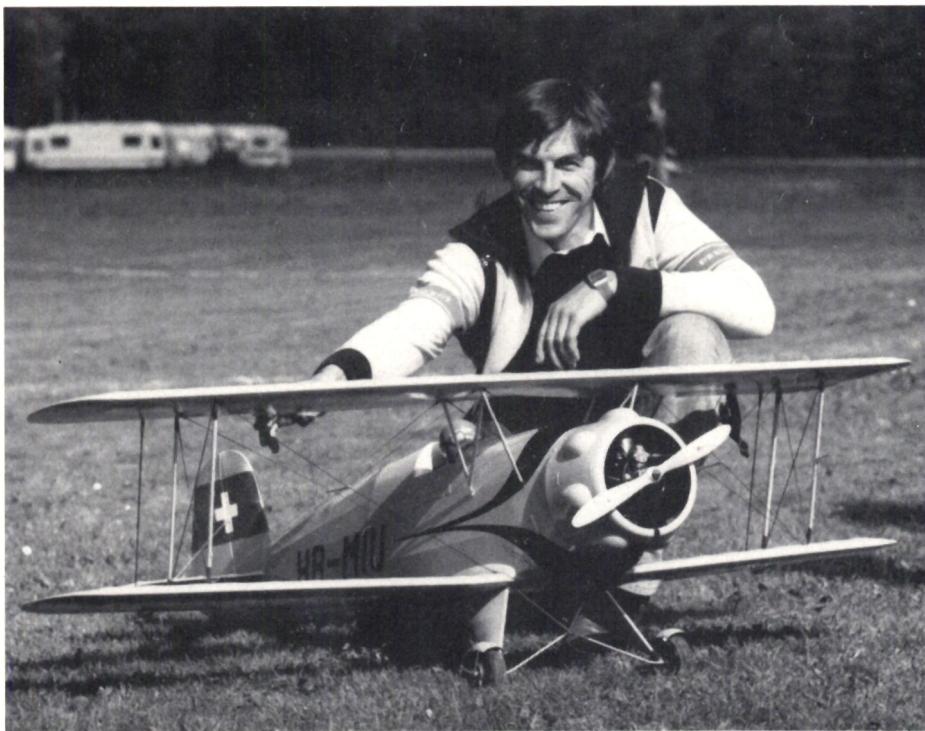
This Swiss championship took place on September 26 and 27 and was organized by the Model Air Club of Biel, in collaboration with the Scale Commission, at the magnificent site of the former Biel-Boujean airfield.
Unlike last year, when 36 participants competed in Langenthal, only 14 competitors showed up this time. What was the reason for this? It is true that in 1980, the judging for the static display was very strict, which certainly put off more than a few modelers. And yet, we (the judges, as I was one of them) believe we did our job correctly. Mr. Helmut Ziegler was the head judge in ’80 and didn’t let anything slide; the slightest imperfection in the shape compared to the original plan would lower the score, and if there were several such imperfections, the model would end up with a 2 or even a 1. That is why this year, the static judges (Messrs. Dino Boldini, Hans Stocker, and yours truly, Paul Corsenca) decided by mutual agreement to judge the models with less severity, while remaining impartial—because, let’s face it, you’d have to be a masochist to enter
a championship with a model that required many hours of construction and, above all, finishing work, only to then hear harsh criticism from the judges.
To build a semi-scale model, one must therefore have plenty of time and a great deal of patience to bring out all the numerous details that are added to a structure that is often quite complicated. The current rules have a serious shortcoming in this regard, as they do not sufficiently take into account the difficulty of the decoration, painting, and lettering. Let’s take the typical case of Gerhard Wägli’s Bucker Jungmeister and the Douglas Dauntless built by the reigning Swiss champion, Peter Müller. In the static display rankings, Müller took first place with 1,950 points, ahead of Wägli with 1,710—a difference of 240 points, or 12 percent. If we consider the number of hours Müller spent on his matte paint job—complete with traces of smoke billowing from the engine and machine guns—and the various decorations that magnificently adorned his model, compared to the Bucker, whose paint job could not be simpler— a yellow color evenly distributed across the entire surface—which struck us as far
far too glossy compared to the real thing—which is practically matte and required only a few hours to achieve that finish—it’s immediately clear that Müller comes up well short... Therefore, it would be necessary to introduce a factor in the “paint, decoration, lettering” score that takes into account the difficulty of recreating the model’s appearance based on the documents provided. The coefficient for this criterion is 20, which is significant relative to the other coefficients regarding the accuracy of reproduction based on the three-view drawing.
The difference between “scale model” (half-scale) and “full-scale” (actual-scale model) lies in the precision of the model’s dimensions relative to the original. In international scale model competitions, judges use calipers and rulers to measure absolutely every dimension of the model—down to the spacing of the rivets and the size of the instruments on the instrument panel—in addition to the model’s overall dimensions, which must strictly correspond to the scale of the actual aircraft. It goes without saying that it is the competitor’s responsibility to provide proof that the model presented is indeed faithful to the actual aircraft. To this end, it is essential that the reference plans come directly from the manufacturer or be certified as accurate by a qualified organization, such as the Lucerne Museum, for example. One of the first things the judges look at is the quality of the documentation submitted by the competitor. This has been a major shortcoming for many competitors, and I believe that before embarking on the construction of a model to participate in a championship, one must first thoroughly research the subject and obtain a set of plans showing a side view, a top view, and a front view. Some competitors submitted only a photo taken at a 45-degree angle, which makes it impossible to judge the model’s shape.
While we believe that the scale model category will evolve little and remain confined to a small circle of enthusiasts, the semi-scale category represents the logical evolution of models that resemble full-size aircraft. As the F3A category becomes increasingly difficult, many modelers are turning to this category. In fact, the construction and finish of a semi-scale model are just as challenging as those of a full-scale model, but the judging criteria are much more lenient, since semi-scale models are judged from a distance of 3 meters—yet the lines of the rivets, the cockpit interior fittings, and the various details—which the judges evaluate not with calipers and rulers, but based on how closely the semi-scale model resembles the required reference documentation.
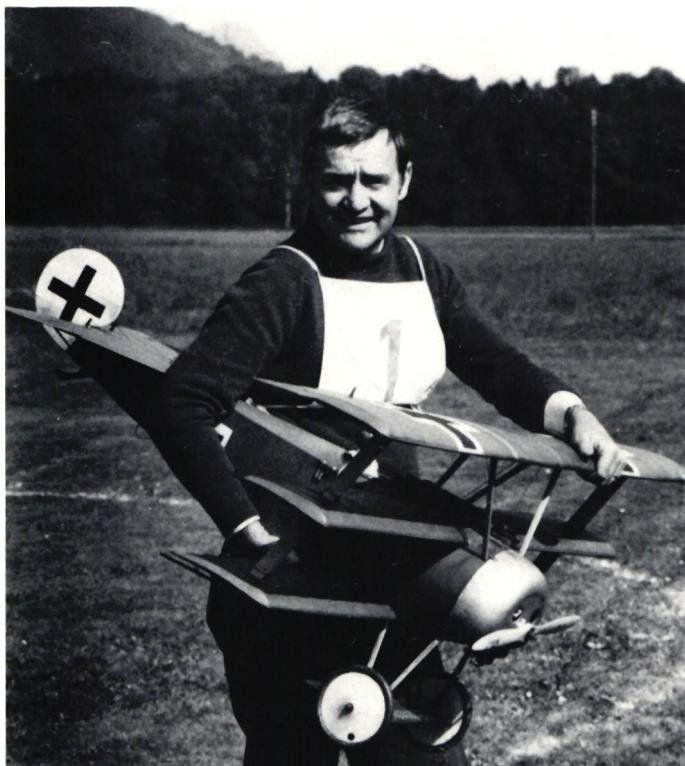
The 14 competitors completed the static display on Saturday morning, then moved on to the first flight. Rudolf Ott from Lausanne, flying his Fokker triplane, placed second in the static competition, 30 points behind Müller, but had a lot of bad luck during the flight: upon landing, the Fokker flipped onto its back, breaking both upper wings. Disheartened, he gave up until the next morning, as a good night’s sleep had given him new resolve, and on Sunday morning, a Rudolf determined to fight to the end appeared: as soon as he arrived at the airfield, he reattached his wings using Devcon, and off he went for the second and third flights. He finished in fourth place. The judges for the flight competition were Rudolf Hadorn, Jean-Claude Roulin, and Hans Kern. Competitors were required to perform a series of four compulsory aerobatic maneuvers, as well as five maneuvers chosen from a list that also included options such as
landing gear extension, flying with flaps extended, the “argage,” or other aerobatic maneuvers depending on the type of aircraft entered. As was the case last year, there was significant participation from the French-speaking Swiss, particularly from Lausanne. We can only congratulate them for coming to this Swiss championship
Championship and will certainly take home excellent memories, especially of the enjoyable evening organized by the MAC in Biel.
The organization of this Championship was flawless in every respect, and we can only congratulate the organizers. CO
Rudolf Ott, Lausanne (3rd place) with a Fokker DR 1 Triplane.
| 1. Gerhard Wägli | Thun | Bücker 133 C Junior Champion | 3300.6 |
| 2. Peter Müller | Fehraltorf | Douglas SBD-3 Dauntless | 3,293.1 |
| 3. Konrad Oetiker | Thal | Bücker 133 Jungmeister | 2,961 |
| 4. Rudolf Ott | Lausanne | Fokker DR 1 Triplane | 2,912.4 |
| 5. Andreas Gasser | Thal | North American T-28 B | 2,849.7 |
| 6. Herbert Steinemann | Schaffhausen | Piper Cub L-4B | 2,648.2 |
| 7. Willy Ferreresi | Lausanne | Rockwell Commander T 112 | 2,321 |
| 8. Paul Di Peri | Geneva | GeeBee Mod. D Sportster | 2319.1 |
| 9. Richard Simon | Zurich | T-28 B North American | 2244 |
| 10. Marc Huber | Zurich | T-28 B North American | 2179.5 |
| 11. Jean-Pierre Vallotton | Lausanne | Spinks Acro Master | 2022.1 |
| 12. François Bommottet | Lausanne | Zlin 526 | 1,660.6 |
| 13. Erich Züger | Linth | Piper Colt PA 18 | 1,403 |
| 14. Beno Zeier | Auenstein | General Electric F-16 | 1210 |
Peter Müller, Fehraltorf, took second place with a Douglas SBD-3 Dauntless.
Photos: D. Boldini


TEAM MANAGER "THIS" BOSSHARD
 Rodito Nussbaumer

ATOM, THE NEW DOUBLE-DECKER FROM CPLR
 Matthias Bosshard

INSIGHTS INTO THE HISTORY OF SEAPLANES

34th HAHNENMOOS ALPINE MODEL AIRPLANE CAMP
Res Dauwalder
CORSAIR F4U – A WARBIRD WITH A MEMORABLE LOOK
Jürgen Rosenberger, Jürgen Prinz
SUMMER FUN 2026 AT MG USTER
Martin Wunderli
F3A EUROPEAN CHAMPIONSHIPS IN ST-MACAIRE, FRANCE
Matthias Bosshard
What's New at Leomotion.com

HORIZON HOBBY/LEMACO NEWS: MICRO OV-10 BRONCO 645 MM BY E-FLITE

PRIDE AND GOOD IDEAS
 Markus Nussbaumer

News from HEBU

YOU KNOW WHAT I MEAN? 125 YEARS OF THE SWISS AERO CLUB
 Emil Giezendanner

SMALL, MODEL-LIKE SAILBOATS
Res Dauwalder
TRY-OUT DAY AT MFV WETTINGEN
Urs Keller
52. 2026 ALPS CUP
Emil Giezendanner
TWIN TOWN PARTNERSHIP
Wolfgang Voeller
EURO CONTEST GLIDER ACRO TOUR AUSTRIA 2026

BY YOUTH, FOR YOUTH
Lorena Betschen
WELCOME, NEW MEMBER!
Andrea Bolliger
FREE FLIGHT IN THE MIDDLE OF SUMMER
Urs Muntwyler
THE PC-21 STORY
Emil Giezendanner
COUPE DES ALPES – OBSERVE AND LEARN
Rodito Nussbaumer
NEWS FROM HEBU
 Julia Bucher

FROM 0 TO 100
Markus Nussbaumer
NOS REGION – A HUB FOR ELECTRIC AVIATION
Emil Giezendanner
MEMORIES
Wolfgang Völler
Have you almost forgotten about aircraft that take off and land vertically?
Emil Giezendanner
70 YEARS OF THE NIDWALDEN MODEL AIRPLANE CLUB
Martin Barmettler