
2. 1979 F3B World Championship
The Swiss team performed very well, finishing in 5th place, and there were strong individual performances by Ruedi Baumgartner (8th place) and Fredy Schenk (18th place). A report by Peter Aeberli
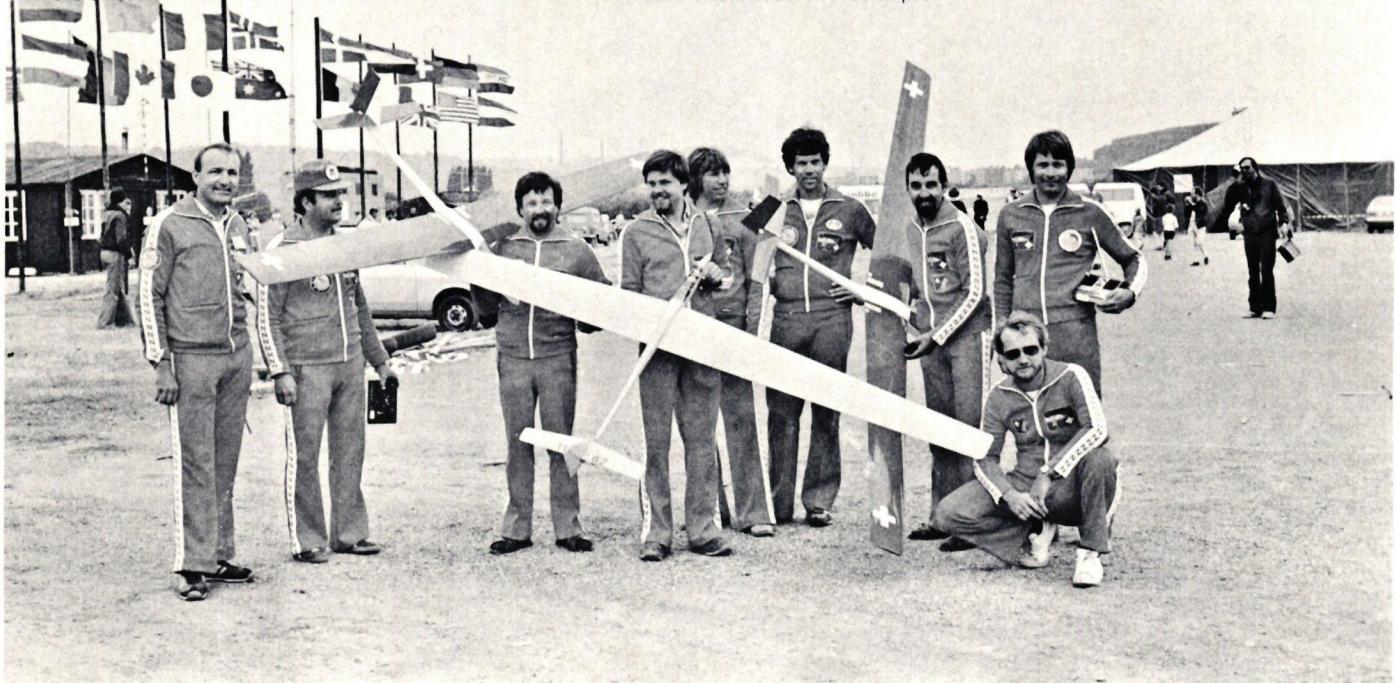
The 2nd F3B World Championship concluded with a very close Austrian victory by Anton Wackerle in the individual standings ahead of Ralf Decker (West Germany) and a team victory for South Africa. Sixty pilots from 20 countries competed for these coveted titles from July 4 through 7. The championship was held at the model aircraft field in Amay, not far from the city of Liège in Belgium.
In the following, I would like to share some of my impressions of this World Championship with you. Amay is situated in a valley approximately 2 km wide, through which the Meuse River flows slowly. The airfield prepared for this World Championship barely met the demands of such a spectacle. However, thanks to good weather conditions throughout the entire championship week, it proved to be very thermally active, so much so that some pilots even managed to catapult their models by hand into the generous thermals during practice. The feared strong sea winds did not materialize until the very last of the four competition days.
Our team, consisting of pilots Ruedi Baumgartner, Fredy Schenk (both from MG Wettingen), and Peter Gerber (MG Thun), the high-launch crew with Heiner Gautschi (MG Wettingen), Hansruedi Wägli (MG Grosshöchstetten), and Hans Dürst (MG Erlenbach), as well as “mechanic” Hanspeter Senn and team manager Rolf Girsberger (both MG Wettingen), gathered for the first time on Monday morning for breakfast.
Since I will only be mentioning our pilots from here on out, I would like to take this opportunity to pay a big tribute to the rest of our team, because without their tireless dedication, great sacrifice, and selfless support, the success of a national team would be completely unthinkable. Thank you very much.
Once everyone’s hunger had been satisfied, our pilots naturally wanted to explore the secrets of the competition grounds as quickly as possible. Many nations set up weather-proof accommodations with tents and RVs. We Swiss did the same with two residential tents, which allowed us to protect the aircraft, repair equipment, and much more from any potential downpours. Apparently, the Belgian organizer had also informed the weather gods of our wishes in good time, because we actually enjoyed nothing but wonderful sunshine throughout the entire week.
On Monday, we were free to train, and on Tuesday, training took place under official time control. We watched the flights of opposing teams with a critical eye. The successes of the Austrian Dassel—in its design and especially in its construction techniques—are now increasingly prompting other pilots to adopt a similar construction method. This is certainly also thanks to this very friendly Dassel team, who openly and thoroughly answer all questions and don’t keep anything under wraps. Ralf Decker from Munich, for example, created an excellent all-plastic aircraft with his club partner Dieter Pfefferkorn, which garnered much praise and ultimately great success. Eugenio Pagliano, the brilliant builder of the “Pylon Glider” used at the first World Championship, flew this year—in addition to yet another extraordinary design—a revised and perfectly executed fiberglass “Pylon version,” which, unfortunately, crashed during the competition. These distinctive designs have finally been explained: Eugenio works in Turin as chief designer at Bertone.
The fact that the future belongs to composite-material gliders with their perfect wing surfaces is surely underscored by their one-two finish. South Africa, in particular, proved, however, that top positions can still be secured with conventional designs, excellent pilots, and good teamwork. A surprisingly large number of teams used electric winches with anti-reverse mechanisms throughout the competition, although in some cases this “anti-reverse” simply meant using a foot to apply the brakes. With the winch, 400 meters of rope can be utilized via a pulley system. By using a snap hook and briefly accelerating the model before unhooking, the pilots were able to pull their gliders up an additional 20 meters or more, resulting in a reassuring starting altitude.
Endurance flying has become more exciting thanks to this new flying tactic. Thanks to the unlimited number of restarts allowed within the discipline time limit, pilots begin their flight immediately after the start signal, attempt to find a thermal briefly, and—if unsuccessful—land immediately to take off a second time. Under favorable weather conditions, another model is sure to spot a thermal bubble before the finish line. However, a team should be well-practiced for this challenge, as time can slip away all too quickly in the event of mechanical failures.
In the distance flight, four gliders always took off together, and the distance measurement apparently worked without any problems. Here, too, just as in the speed flight, lead weights are used today to create the best glide ratios. The distance flight could quickly become the most exciting discipline if the route length were unlimited again and a group-based scoring system were used. Currently, the 12-length course can be completed in 4 minutes with a little thermal support. With a group-based scoring system, pilots would have to fully utilize their skills—including adding lead ballast, immediately assessing the prevailing weather conditions, and employing appropriate flight tactics—to avoid being outmaneuvered by an opponent. (At this year’s Oktoberfest Cup in Munich, this variant—as well as a group-based scoring system for endurance flight involving 8 pilots—will be implemented for the first time.)
Herbert Sitar set the fastest official speed time of 9.5 seconds flying a Dassel. For this event, the Dassel is weighted down with lead, increasing its ready-to-fly weight from 970 g to a full 2,060 g. In addition to this superb time, the Austrians mostly flew times between 10 and 11 seconds. However, with times between 11 and 13 seconds, they were still among the fastest.
Throughout the World Championship, we were treated daily to the “Daily Lift,” a specially printed newsletter. This newsletter contained the latest rankings, interesting construction drawings of current F3B gliders, and other news.
Frequency monitoring was carried out very thoroughly—and successfully, as no crashes due to interference were recorded.
The evaluation of the results also went smoothly. Shortly after the end of each round, participants could already study the latest rankings in detail. (The computer made this possible.)
All nations were provided with accommodations at the boarding school in nearby Huy. Right behind this building, a large meadow invited participants to engage in sports, and soon everyone was watching exciting international soccer matches, which was great fun for everyone involved.
On Tuesday evening, the moment had finally arrived. The 2nd World Cup was officially opened with a ceremony. All nations lined up in neat rows, smartly dressed and adorned with their national flags. Mexico, which hadn’t even officially registered but had pleaded for help and admission at the Huy train station on Monday, cobbled together its own national emblem on Tuesday using an Italian flag and some paint, and thus proudly lined up beneath its creation. Accompanied by the Belgian national anthem, each team captain unfurled his country’s flag in the evening breeze. This was followed by warm congratulations and speeches from various dignitaries, and the signal to begin the competition.
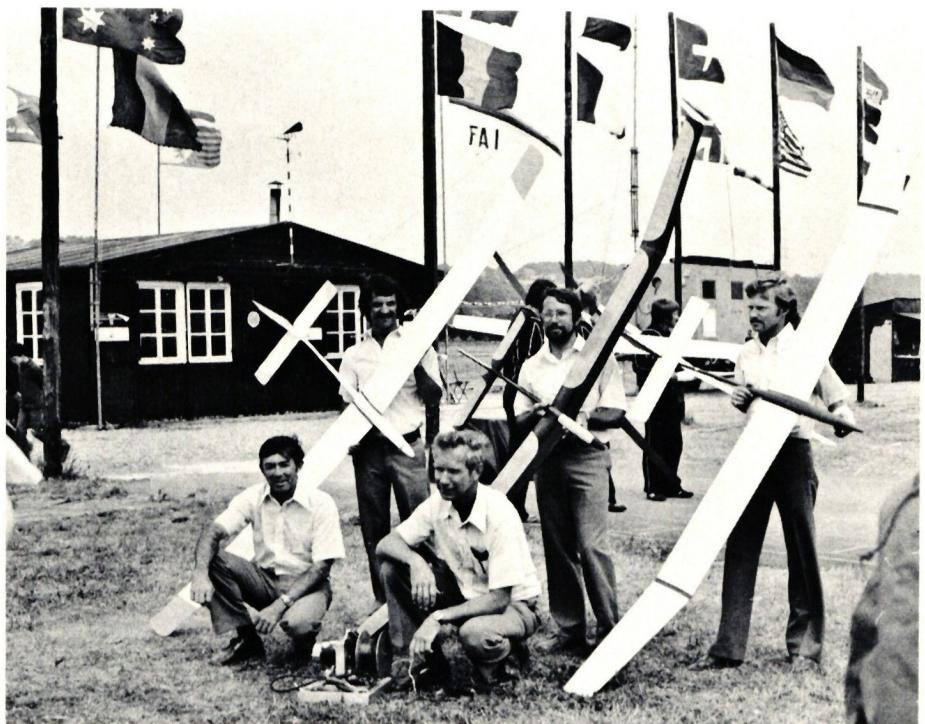
On Wednesday morning, the weather gods surprised us with thick fog, which delayed the start of the first round—featuring the “Speed” and “Endurance” disciplines—by about two hours. But at 11 a.m., the go-ahead was given. Our pilots had to prove their skills right away in the most nerve-wracking discipline. With times of 12.2 seconds for Peter, 12.4 seconds for Ruedi, and 13.2 seconds for Fredy, everyone put in a great performance. As expected, the Austrians claimed the top three spots. With a time of 10.3 seconds, Werner Sitar earned 1,000 points. In the endurance flight, the Australian Learmont and the South African Roos secured the coveted 1,000 points with a full 360 seconds of flight time and 100 landing points. Werner Sitar took the lead in this first round with a successful endurance flight and the fastest speed time, closely followed by his teammate Anton Wackerle. Herbert Sitar, Werner’s brother and the third Austrian pilot, was pushed back to 21st place after a somewhat botched endurance flight. Our Fredy fared similarly and had to settle for 33rd place for the time being. Ruedi earned 987 endurance points and finished in 8th place as the top Swiss pilot, while Peter landed in 19th place with 804 endurance points.
In the second round, featuring the “endurance” and “distance” disciplines, Werner Sitar solidified his lead. But even at this stage, the South Africans—Gernek in 2nd place and Spavins in 6th—were closing in on the top. Ruedi lost some ground due to a botched landing and was now in 15th place, while Fredy moved up to 24th place with some good flights. Peter had to swallow a bitter pill with a distance of just 6 course lengths, which dropped him to 34th place.
Meanwhile, Thursday morning dawned with bright sunshine. The third round featured “Speed” and “Endurance” events. Fredy once again improved his position to 19th place with consistent flight performances. Ruedi followed suit and moved up two spots to 13th place. Only Peter had to take another hit. With a dismal performance in the endurance flight, he remained stuck in 34th place. At the top, the Austrians Sitar and Wackerle continued to showcase their skills. Ralf Decker, however, had already moved up to 3rd place. With a superb performance, he—like Werner Sitar—demonstrated that even at an altitude of 10 meters, it’s still possible to make up time in the endurance flight. Just how consistent endurance flight performances can be is perhaps best illustrated by Ruedi’s result in this round. With 924 points, he achieved his 39th-best performance.
Unfortunately, there were no encouraging changes in the rankings for our Swiss pilots in the fourth round. Peter unfortunately got stuck in 34th place, which really shook his confidence. Although all three pilots flew well, the point margins in the top third became increasingly tight, which ultimately led to negative changes in ranking. Incidentally, Skip Miller, the first world champion, was still keeping up quite well with the leading group, sitting in 9th place after four rounds. However, I’m convinced that the very likable Americans will have to come up with some innovative solutions regarding their aircraft for the next World Championship. It was clear to see that all three pilots were flying at the limit of their aircraft’s capabilities.
Unfortunately, we’ve lost the rankings for rounds 5 and 6, so I can’t explain the changes in the standings until round 7. This 7th round demanded “endurance” and “speed.” In contrast to the first three days, a fairly strong wind set in for the first time on Saturday. For us spectators, it was of course very interesting to watch how the individual teams adapted to these new weather conditions. These last two rounds clearly demonstrated how such factors can significantly shake up the standings. Werner Sitar, who had been comfortably in the lead up to that point, had to cede the top spot to Anton Wackerle—who was on course for victory with two scores in the 2,000s—despite having 713 endurance points and the second-best speed time. After 7 rounds, the top 10 places were as follows:
| 1. Wackerle, A. | A | 13220 |
|---|---|---|
| 2. Sitar W. | A | 12977 |
| 3. Roos F. | SAF | 12754 |
| 4. Decker R. | BRD | 12677 |
| 5. Spavins R. | SAF | 12593 |
| 6. Schiboor F. | BRD | 12573 |
| 7. Miller S. | USA | 12552 |
| 8. Gerneke N. | SAF | 12337 |
| 9. Pawelenko M. | B | 12248 |
| 10. Worral D. | GB | 12203 |
Ruedi held on to 12th place, Fredy was in 19th, and Peter, unfortunately, remained in 33rd. At that point, Austria was still leading the team standings ahead of South Africa and Germany. Switzerland was in 7th place and still had every chance of possibly overtaking England and the Netherlands, who were ahead of them. The final, 8th round was arguably the most turbulent of all in terms of changes in the standings. Of the top competitors, Werner suffered the biggest setback: despite the same effort and flying tactics as his brother Herbert—who had flown successfully just moments earlier (12 lengths)—he managed a meager 4½ lengths, which earned him a paltry 354 points. This drop in performance now pushed Werner back to 6th place overall. At the same time, South Africa was able to overtake Austria in the team standings thanks to successful flights. Anton Wackerle successfully defended his 1st place despite a somewhat botched endurance flight. Things took a dramatic turn for Ralf Decker. If Ralf could fly a full 12 lengths in the final distance flight, he would miss the world championship title by a mere 2 points with a total of 14,679 points. Strong nerves and experience are Ralf’s strengths, and so what was to be expected happened. He finished a mere 2 points behind Anton Wackerle in second place. It’s truly understandable that the German team was on the verge of losing their composure. Within the South African team, there was another swap in rankings between Spavins, now in third place, and Roos, who moved down to fourth. Our Swiss pilots also stepped it up once again. Ruedi took a brilliant 8th place, Fredy came in 18th, and Peter was able to climb out of that pesky 34th spot to finish in 31st place. Our pilots can be truly proud of their performance in the team standings. Behind South Africa, Austria, Germany, and the U.S., our team took an excellent 5th place.
In closing, our entire team deserves heartfelt congratulations for their tremendous effort, the wonderful camaraderie that prevailed throughout the championship, and their strong flying performances. Many friendships were formed during this World Championship, and we learned a great deal in the process.
Our national team would like to take this opportunity to extend our heartfelt thanks to all model aviators who provided both moral and financial support.
The Belgian model aviators, with great dedication and passion, organized a wonderful and interesting World Championship for us, for which we would like to thank them most sincerely. We are left with many fond memories and a curiosity about who will compete in the next World Championship.


TEAM MANAGER "THIS" BOSSHARD
 Rodito Nussbaumer

SUMMER FUN 2026 AT MG USTER
Martin Wunderli
TRY-OUT DAY AT MFV WETTINGEN
Urs Keller
52. 2026 ALPS CUP
 Emil Giezendanner

ATOM, THE NEW DOUBLE-DECKER FROM CPLR
 Matthias Bosshard

INSIGHTS INTO THE HISTORY OF SEAPLANES

34th HAHNENMOOS ALPINE MODEL AIRPLANE CAMP
Res Dauwalder
CORSAIR F4U – A WARBIRD WITH A MEMORABLE LOOK
Jürgen Rosenberger, Jürgen Prinz
SMALL, MODEL-LIKE SAILBOATS
Res Dauwalder
F3A EUROPEAN CHAMPIONSHIPS IN ST-MACAIRE, FRANCE
Matthias Bosshard
What's New at Leomotion.com

HORIZON HOBBY/LEMACO NEWS: MICRO OV-10 BRONCO 645 MM BY E-FLITE

PRIDE AND GOOD IDEAS
 Markus Nussbaumer

News from HEBU

BY YOUTH, FOR YOUTH
Lorena Betschen
YOU KNOW WHAT I MEAN? 125 YEARS OF THE SWISS AERO CLUB
Emil Giezendanner
FREE FLIGHT IN THE MIDDLE OF SUMMER
Urs Muntwyler
THE PC-21 STORY
Emil Giezendanner
TWIN TOWN PARTNERSHIP
Wolfgang Voeller
EURO CONTEST GLIDER ACRO TOUR AUSTRIA 2026

WELCOME, NEW MEMBER!
Andrea Bolliger
COUPE DES ALPES – OBSERVE AND LEARN
Rodito Nussbaumer
NEWS FROM HEBU
 Julia Bucher

FROM 0 TO 100
Markus Nussbaumer
MEMORIES
Wolfgang Völler
NOS REGION – A HUB FOR ELECTRIC AVIATION
Emil Giezendanner
Have you almost forgotten about aircraft that take off and land vertically?
Emil Giezendanner
70 YEARS OF THE NIDWALDEN MODEL AIRPLANE CLUB
Martin Barmettler