
The Quick-Build Kit from 1982
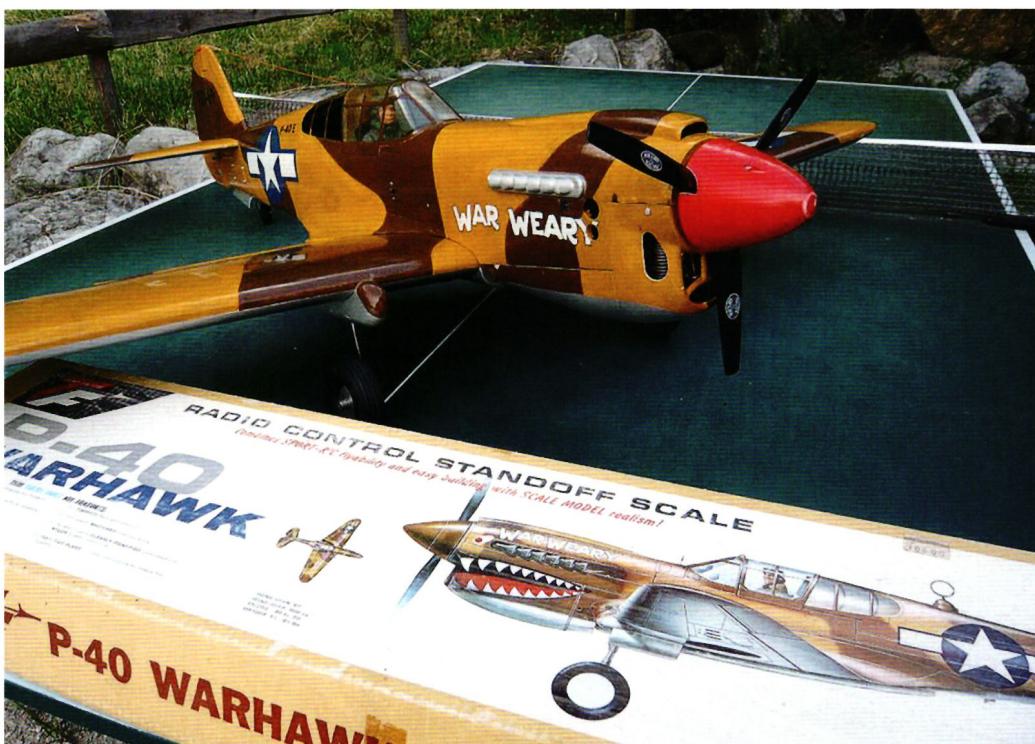
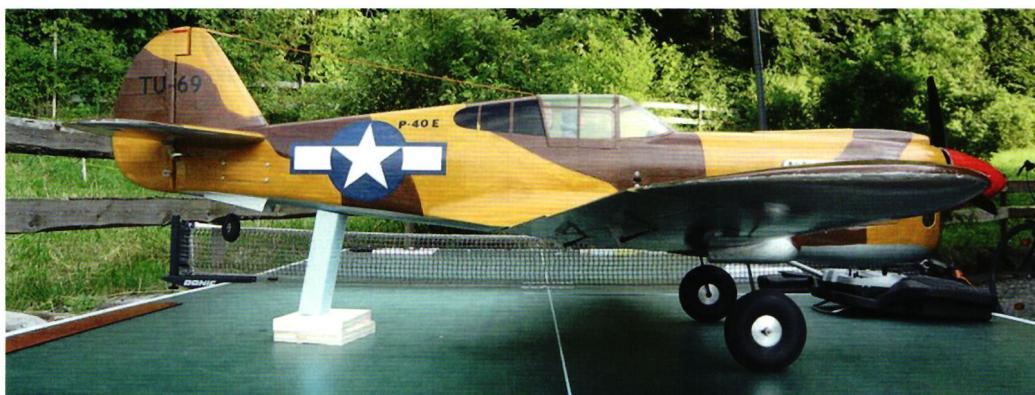
Reviews of new models make it clear: The kits (mostly ARF) are getting better and better; assembly is minimal; all the parts fit perfectly; the center of gravity and EWD are just right right out of the box—and the new model practically flies on its own. That’s what you call flying fun. Really boring—there’s nothing spectacular left to talk about over a leisurely beer afterward! It was a completely different story with my P-40E Warhawk, which—29 years after I started building it—was finally ready for its second maiden flight, equipped with a brand-new Saito FA-72.
You read that right—for its second maiden flight. The first maiden flight—back when it was still fitted with a 10-cm³ two-stroke engine with an ugly, externally mounted resonance tube—took place about 15 years ago. It lasted only a few seconds and can be described in three words: takeoff – engine failure – crash landing. Then came another model-flying hiatus.
After a futile attempt to get rid of the model at our club swap meet two years ago, I decided to try flying it again, but this time with a four-stroke engine. This idea motivated me,
and so one day the old plane stood ready for flight on the ping-pong table, with the new, broken-in 12-cm³ Saito engine under the cowl.
A few days later, I’m standing at the edge of the runway with slightly shaky knees. But this time, the takeoff is perfect: I slowly open the throttle; as speed increases, the tail section lifts off the ground, and before reaching the end of the runway, I get the plane airborne with a looooot of elevator input. The model is extremely top-heavy, and I don’t dare let go of the control stick to trim it even for a moment—
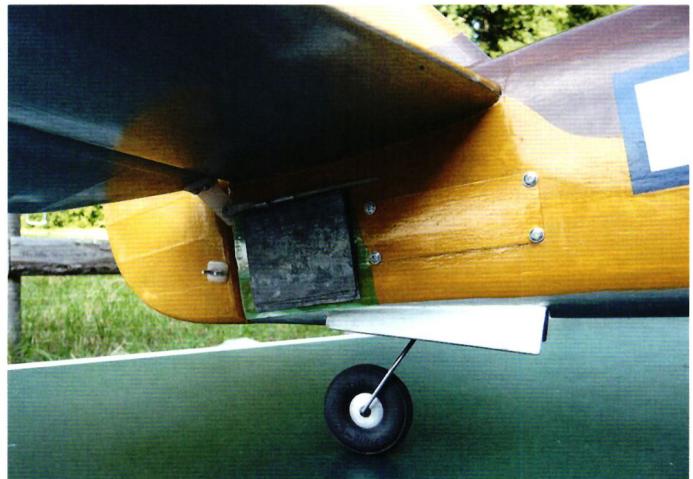
Let it go! Still, shortly afterward, I managed a picture-perfect landing.
Our F3A veteran Rolf Schenk had witnessed the flight and advised me to carefully—in 10-g increments—attach lead plates to the tail and then reassess the control response flight by flight. That makes sense to me, so for the next flight I bring four 20-gram rolled lead plates—prepared with double-sided carpet tape—to the airfield. The flight
test with 20 g of lead on the tail still showed extreme nose-heaviness, so I immediately glued an additional 40 g of lead (why be so timid?) to the end of the fuselage and took off again. But this time, the takeoff is harder to describe. Shortly after taking off a bit too early, the model veers off to the left, and only by making a bold move with the control stick can I prevent a collision with the tree standing on the left at the end of the runway. The next few seconds of flight remind me of a rodeo in the Wild West, and I still need to use the elevator aggressively to keep the model at altitude. So, throttle off, deploy the air brakes, and land immediately! Land? Despite calm wind conditions, the Warbird’s approach is wobbly, and it ultimately slams down at an angle onto its landing gear. Phew—I made it! No sooner had I reached the model than a boy came running up and looked at me questioningly: “Why do you land so wildly!?” (I probably won’t forget that question anytime soon.) →
Today’s quick tip:
If the landing isn’t quite right anymore, there’s probably too much lead in the tail!
Center-of-gravity markings on construction plans are a matter of luck. The first stroke of luck is if there’s a marking at all, and the second is if you can make sense of it.
In any case, the center of gravity of my unfueled model (without lead in the tail) matches exactly the “BALANCE HERE” notation on the plan. Since the C.G. RANGE only extends forward, I interpret the shift in center of gravity
caused by filling the tank. Recalculations show that filling my 350-cm³ tank accounts for exactly the 14 mm measured on the plan. Now, of course, I’m interested in the shift in the center of gravity resulting from my tail weight experiment:
$$\Delta s = s_B \cdot m_B / (m_B + m_F) = 680 \text{ mm} \cdot 60 \text{ g} / (60 \text{ g} + 3300 \text{ g}) = 12 \text{ mm}$$
$\Delta s$ shift in the center of mass in mm
$s_B$ Distance of the lead plates from the center of mass in mm
$m_B$ Mass of the lead in g
$m_F$ Mass of the model aircraft in g
That’s actually less than the shift in the center of gravity caused by filling the fuel tank! In any case, with a fully fueled model and 60 g of lead on the tail, the center of gravity is still within the C.G. RANGE. Based on these considerations, I doubt that the instability during
flight is due to a center of gravity that is too far back—i.e., too close to the overall neutral point. Was the problem perhaps a stall on the horizontal stabilizer, or was it simply the pilot’s fault after all?
While measuring the angle-of-attack difference (AOD) on the model, I’m surprised to find that it’s 0°. My eyes widen even more when I measure the angles of attack of the wing and the horizontal stabilizer from the plan: Both are 0°, even with symmetrical airfoils. Aha, so that’s where the rub lies. So now I begin a series of test flights with a gradual increase in the wing’s angle of attack—again, of course, without any lead in the tail.
After inserting 5.5 mm(!) wooden shims, the plane finally flies level—still with a slight elevator trim. The EWD is now 1.3°, and strangely enough, the landing goes so smoothly that no kid runs up to ask an embarrassing question. Although the model now flies properly, the wing transition—which I built with so much care—is, of course, ruined, and I still don’t have an explanation for the unstable flight behavior with the lead weight on the tail.
Helmut Stettmaier, a member of the Alling/Upper Bavaria Model Aircraft Club, has published an interesting article online about EWD and center of gravity positions.1 Somewhat hidden within the article is a calculation program on this topic (Sstab&EWD.xls).
- The calculation confirms that with a center of gravity position of 80 mm (measured from the leading edge) and 1.3° EWD, the model flies nicely straight at a speed of 25 m/s (90 km/h). That’s reassuring, to say the least.
- However, entering the extreme conditions “empty tank” and “60 g of lead on the tail” yields a surprising result during slow flight at 15.6 m/s (56 km/h): The lift coefficient at the leading edge ( $c_{AH}$ ) is positive!
Stall. This is like a curved glider airfoil in an inverted flight. The flow over the airfoil breaks away, causing the model aircraft to become unstable and nearly uncontrollable. Figure 6b shows the same situation when the wing is backed with 5.5-mm wooden strips. The elevator deflection during takeoff and landing is minimal, and the angle of attack of the tailplane relative to the oncoming airflow is merely $\alpha_H - \alpha_W = 2.7^\circ$ . Here we have a situation where the flow is still attached to the NACA 0009 airfoil, and the landing is successful.
Conclusion (this time somewhat more substantiated):
If I apply a lot of elevator control and the model becomes unstable, I am now absolutely certain: there is a stall on the horizontal stabilizer!
Until now, I had always assumed that using the elevator pushed the tailplane downward. However, a positive lift coefficient $c_{AH}$ means lift! So when I apply the elevator, I’m not generating downforce here—I’m reducing lift! In the following two figures, I have plotted the calculated values to scale. They show the conditions at the horizontal stabilizer of my Warbird before and after the angle-of-attack correction.
- $\alpha_H$ angle of attack of the tailplane relative to the direction of flight
- $\alpha_W$ Direction of airflow (deflected downward by the wing)
Here, the horizontal stabilizer “flies” with a positive angle of attack of $\alpha_H - \alpha_W = 4^\circ$, and with a very large elevator deflection—
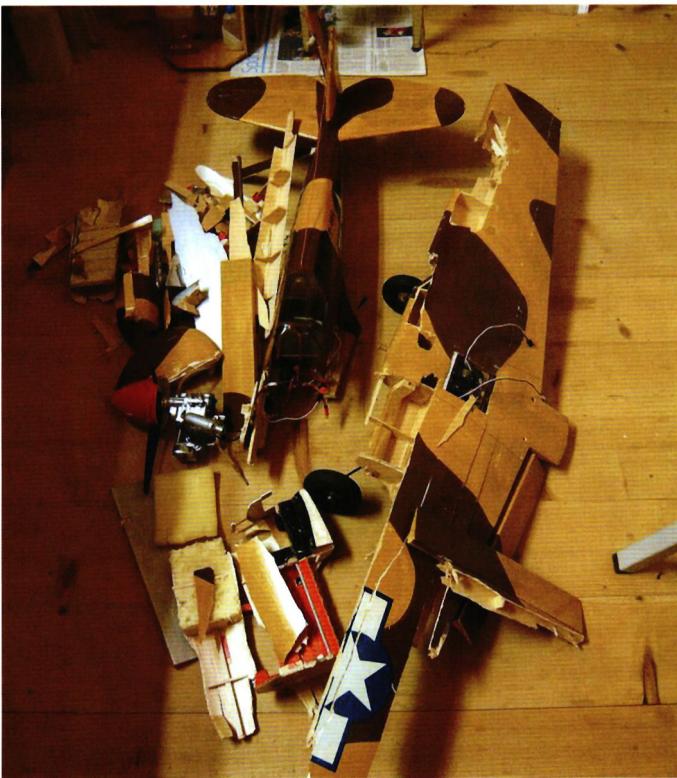
After a few flights of genuine, hard-earned flying fun, the model unfortunately became uncontrollable one day while flying at a somewhat greater distance. My P40-E Kittyhawk met the same fate as most aircraft of this type during World War II, with the sole difference being a different cause of the crash. (It wasn’t the 4.8 V NiMH battery!)
And so this story comes to an unplanned end. But a mysterious shadow still hangs over the crash site: Despite a lengthy search, the pilot figure could not be found! Witnesses to the crash claim to have seen the pilot escape with his parachute...
*Ruedi Schmid, MG Thun*


TEAM MANAGER "THIS" BOSSHARD
 Rodito Nussbaumer

F3A EUROPEAN CHAMPIONSHIPS IN ST-MACAIRE, FRANCE
 Matthias Bosshard

News from HEBU

YOU KNOW WHAT I MEAN? 125 YEARS OF THE SWISS AERO CLUB
 Emil Giezendanner

SUMMER FUN 2026 AT MG USTER
Martin Wunderli
TRY-OUT DAY AT MFV WETTINGEN
Urs Keller
52. 2026 ALPS CUP
Emil Giezendanner
BY YOUTH, FOR YOUTH
Lorena Betschen
CORSAIR F4U – A WARBIRD WITH A MEMORABLE LOOK
Jürgen Rosenberger, Jürgen Prinz
SMALL, MODEL-LIKE SAILBOATS
Res Dauwalder
What's New at Leomotion.com

ATOM, THE NEW DOUBLE-DECKER FROM CPLR
Matthias Bosshard
INSIGHTS INTO THE HISTORY OF SEAPLANES

34th HAHNENMOOS ALPINE MODEL AIRPLANE CAMP
Res Dauwalder
HORIZON HOBBY/LEMACO NEWS: MICRO OV-10 BRONCO 645 MM BY E-FLITE

COUPE DES ALPES – OBSERVE AND LEARN
Rodito Nussbaumer
PRIDE AND GOOD IDEAS
 Markus Nussbaumer

EURO CONTEST GLIDER ACRO TOUR AUSTRIA 2026

FREE FLIGHT IN THE MIDDLE OF SUMMER
Urs Muntwyler
THE PC-21 STORY
Emil Giezendanner
TWIN TOWN PARTNERSHIP
Wolfgang Voeller
WELCOME, NEW MEMBER!
Andrea Bolliger
NEWS FROM HEBU
 Julia Bucher

FROM 0 TO 100
Markus Nussbaumer
MEMORIES
Wolfgang Völler
NOS REGION – A HUB FOR ELECTRIC AVIATION
Emil Giezendanner
Have you almost forgotten about aircraft that take off and land vertically?
Emil Giezendanner
70 YEARS OF THE NIDWALDEN MODEL AIRPLANE CLUB
Martin Barmettler