
Airplanes Straight from the Printer
There are often situations in which a model airplane enthusiast wants to design a component for their aircraft or even build their own model. But not everyone has the talent or the time to do so. Others lack the space and woodworking tools, or they worry about the dust when working indoors.
Who knows—maybe 3D printing is the answer? A 3D printer is similar to a larger computer printer. But instead of applying a single layer of ink, the device builds up dozens or hundreds of thin layers of a material on top of one another until a three-dimensional object is formed. To do this, the material in the print head is heated—either thermally or with laser beams—liquefied, and applied. Architectural models are built this way, and in the U.S., dental technicians are beginning to manufacture dentures. Eyeglass frames and jewelry produced using 3D printing are already widely available.
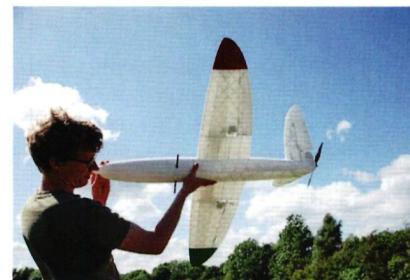
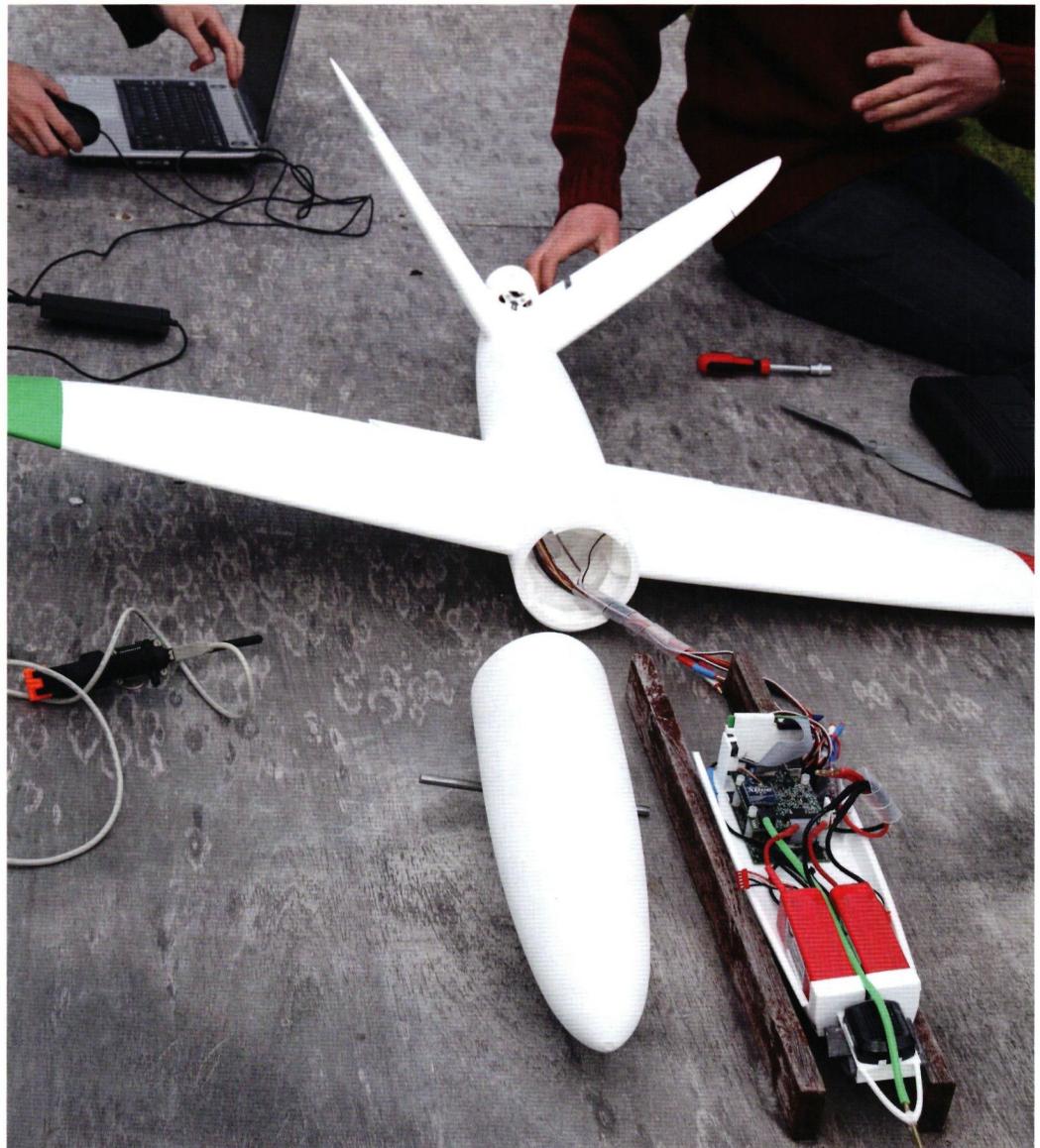
There’s even the first model airplane: A team from the University of Southampton in England recently flew Sulsa, an airplane produced entirely using a 3D printing process. It has a wingspan of 2 meters, is designed for a speed of 180 km/h, and could be used as a drone. So it’s no toy. The ten-minute test flight met all expectations.
The design and construction took only five days, explains project manager James Scanlan. The model, made of nylon, consists of just four parts. Although movable, the control surfaces were manufactured in a single process along with the wings. The wings are elliptical—a shape that is very
efficient but difficult to manufacture. With 3D printing, however, this was no problem, according to Scanlan.
3D printers have been available for industrial applications for 20 years. As these devices have become more reliable and affordable, they are slowly making their way into the hobbyist market. 3D printers work like robots. It’s fascinating to watch them produce an object completely on their own. The process generates neither waste nor dust—only a quiet hum fills the air. The products come out of the printer practically finished and require little post-processing.
Dozens of materials are available: a battery-powered slide made of gold? A propeller made of titanium? It’s not the 3D printer that’s the issue—it’s just a matter of your budget. For model builders, therefore, the inexpensive, run-of-the-mill plastic ABS (acrylonitrile butadiene styrene) is likely to be the go-to choice.
. We used to play with ABS even as kids, and we called it “Lego.” It’s one-third heavier than aircraft plywood and can be either elastic or rock-hard, depending on the direction of pressure. ABS can be sanded, glued, reinforced with carbon fiber, and covered with heat-sealable film or painted.
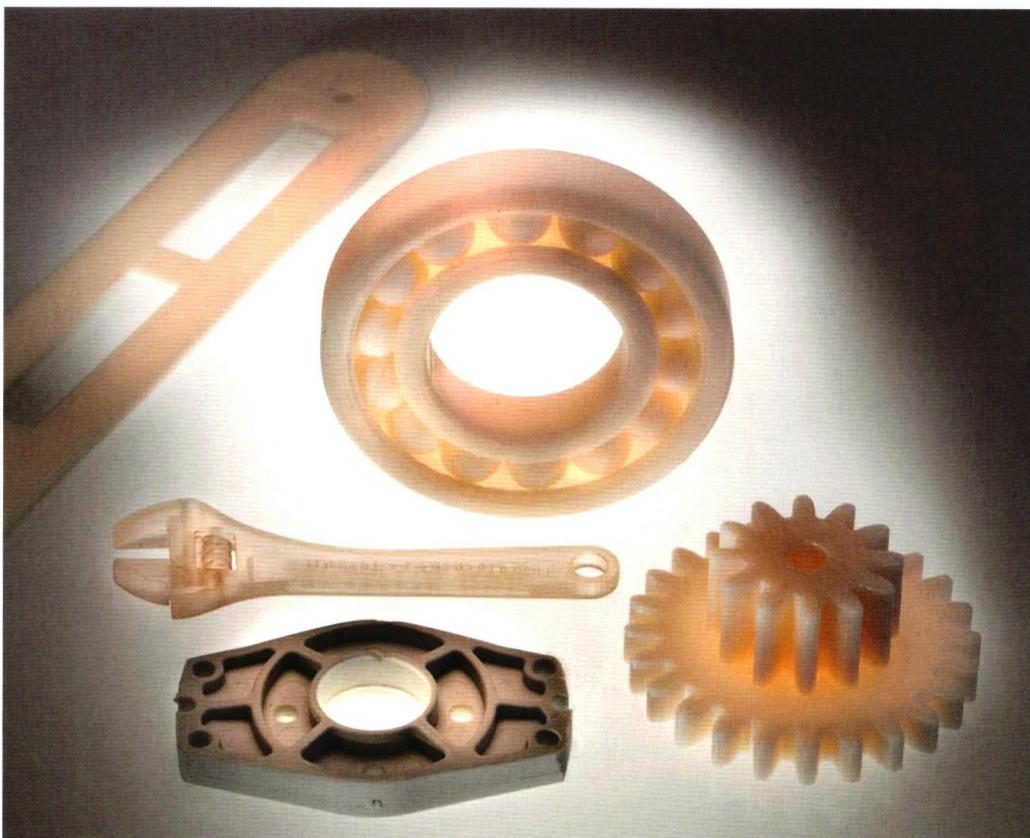
The 3D printing process allows for the creation of shapes that are virtually impossible to produce with wood: cavities, threads, gears, or ball bearings. Thin ribs are just as feasible as thick motor plates. It’s also conceivable to use ABS to create negative molds for deep drawing or to manufacture a special tool. To save weight, structures can be built in a honeycomb pattern. They are lightweight and surprisingly strong. 3D printers can produce anything that can be designed. Commercially available ABS printers operate with a precision of 0.1 millimeters. Objects must be at least 1 millimeter thick. Technically, there is no limit to the maximum size, but printers for large formats are more expensive. An entry-level model like the Chinese Up! costs around $1,000 and supports sizes up to 10 cm. The Rapman is a proven model that’s sufficient for many hobbyist purposes; it prints up to 27 cm and is available starting at 1,800 francs. Tinkerers can find more affordable open-source printers online that can be assembled and expanded with modular components. Search terms include RepRap, fab@home, or Bukobot.
To get started, however, you don’t need your own printer, because right near Zurich there is
3D-Model, Switzerland’s first store specializing in 3D printing, recently opened. Customers simply email their design to the store and pick up the finished part later. 3D-Model also aims to assist with the development of ideas and offer courses if there is sufficient demand. The young company also sells printers from several manufacturers. Another provider is 3D-Prototyp in Stans. Managing Director Marcus Bieri already has experience working with model makers and the aviation industry. He sees his strength in the implementation of more technically demanding printing projects. Finally, it’s worth mentioning the Belgian company i.materialise, which, with 1,000 employees, ranks among Europe’s largest 3D printing firms. With them, you can check a design online for errors before printing and get a price quote before placing an order. Unfortunately, neither the price, nor the support, nor the delivery times are particularly impressive.
First, however, you have to tell the printer what to produce. The design of three-dimensional objects takes place entirely on the computer. The process is similar to that for flat CAD objects, but is more complex due to the additional dimension. Free programs designed for beginners are a good place to start. One example is SketchUp; this software is popular but was developed for architecture and has its limitations when it comes to details. 123D is from Autodesk, the market leader in technical software. The program leaves nothing to be desired—
It’s straightforward, but more complex projects require a lot of practice. It’s best to work your way through all the features right from the start. After that, it’s helpful to download sample projects and modify them. That way, you can see how each change affects the result. Only after this frustrating phase should you venture into your own challenging projects. YouTube has
numerous tutorials on the program, but the first steps are—and remain—frustrating. Once you’ve overcome the initial hurdles, however, three-dimensional drawing is a real experience. The vision for 3D printing is that, one day, a library of parts frequently needed in model aircraft building will be available online—parts that you
can be downloaded and customized to your own specifications with just a few mouse clicks. This is how the gearbox (picture) was created. It’s already possible to photograph objects and convert them almost automatically into a 3D print. That’s how an engine mount was copied (picture) and printed—while I was out flying.


News from HEBU

TEAM MANAGER "THIS" BOSSHARD
 Rodito Nussbaumer

YOU KNOW WHAT I MEAN? 125 YEARS OF THE SWISS AERO CLUB
 Emil Giezendanner

F3A EUROPEAN CHAMPIONSHIPS IN ST-MACAIRE, FRANCE
 Matthias Bosshard

52. 2026 ALPS CUP
Emil Giezendanner
PRIDE AND GOOD IDEAS
 Markus Nussbaumer

ATOM, THE NEW DOUBLE-DECKER FROM CPLR
Matthias Bosshard
CORSAIR F4U – A WARBIRD WITH A MEMORABLE LOOK
Jürgen Rosenberger, Jürgen Prinz
SUMMER FUN 2026 AT MG USTER
Martin Wunderli
TRY-OUT DAY AT MFV WETTINGEN
Urs Keller
TWIN TOWN PARTNERSHIP
Wolfgang Voeller
BY YOUTH, FOR YOUTH
Lorena Betschen
SMALL, MODEL-LIKE SAILBOATS
Res Dauwalder
What's New at Leomotion.com

HORIZON HOBBY/LEMACO NEWS: MICRO OV-10 BRONCO 645 MM BY E-FLITE

COUPE DES ALPES – OBSERVE AND LEARN
Rodito Nussbaumer
EURO CONTEST GLIDER ACRO TOUR AUSTRIA 2026

INSIGHTS INTO THE HISTORY OF SEAPLANES

34th HAHNENMOOS ALPINE MODEL AIRPLANE CAMP
Res Dauwalder
WELCOME, NEW MEMBER!
Andrea Bolliger
FREE FLIGHT IN THE MIDDLE OF SUMMER
Urs Muntwyler
THE PC-21 STORY
Emil Giezendanner
NEWS FROM HEBU
 Julia Bucher

FROM 0 TO 100
Markus Nussbaumer
MEMORIES
Wolfgang Völler
NOS REGION – A HUB FOR ELECTRIC AVIATION
Emil Giezendanner
Have you almost forgotten about aircraft that take off and land vertically?
Emil Giezendanner
DO YOU KNOW WHAT I MEAN IN THE LAND OF SMILES?
Emil Giezendanner