
Winter Flying by the Lake
This report shows whether it's fun to go water flying on a lake that's just starting to freeze when temperatures are below freezing.
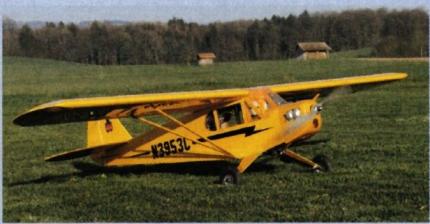
Ring! The phone rings. It’s one of the last days of the old year, 2007. Bruno Ferrari, my model-airplane buddy from the Grischhei Model Flying Club (ZH), wants to give it another try despite the cold and dreary weather: “Are you coming with me to Türlersee tomorrow for some water flying?” That had actually been my heart’s desire for quite some time, because the newly installed, one-size-larger floats—along with a newly designed water rudder—on my Piper Cub J-3 had been waiting for their first flight for ages. But with a heavy heart, I turn Bruno down. My cold has just reached its peak: my nose is running, and every sip is torture. “Oh well,” says Bruno, “then I’ll just go with Röbi.” Yeah, let them go. But definitely without me—I’m not crazy. I’m definitely staying home. Drinking tea, rest and relaxation...
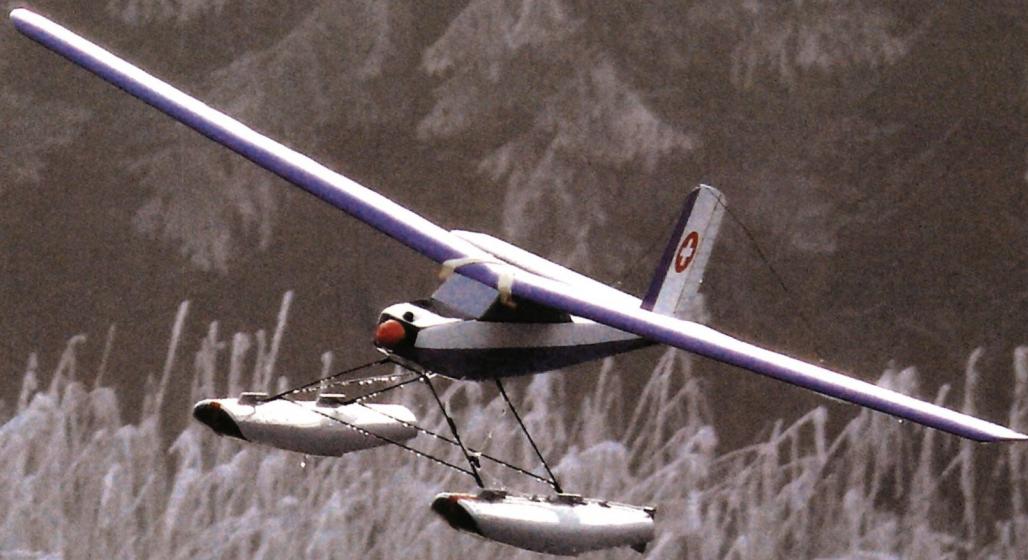
the homemade water oar—it’s been waiting a long time for its first outing. But with a heavy heart, I turn Bruno down. My cold has just reached its peak: my nose is running, and every sip is torture. “Oh well,” says Bruno, “then I’ll just go with Röbi.” Yeah, let them go. But definitely without me—I’m not crazy. I’m definitely staying home. Drinking tea, rest and relaxation...
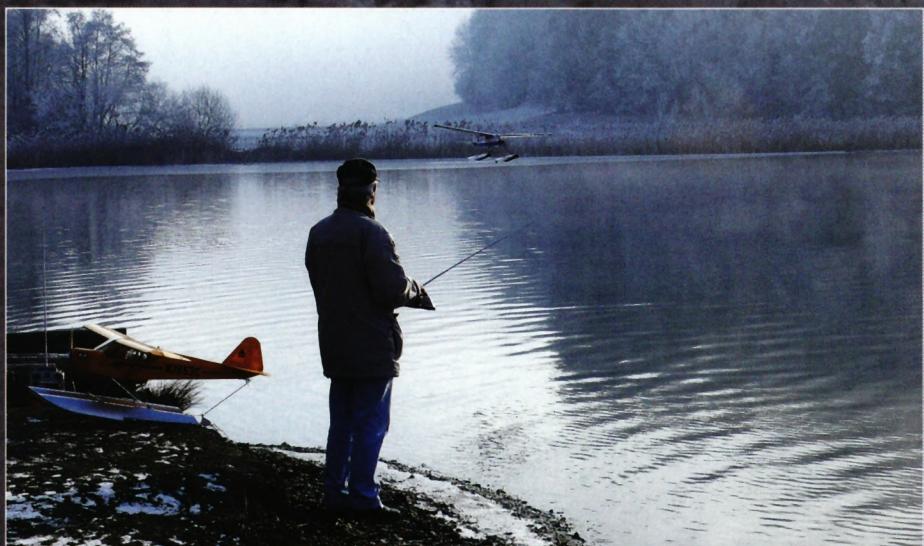
On the way to the lake, a magnificent sight: all the trees dusted with hoarfrost! And right away, my inner devil pipes up: “The lake is surely already frozen over. If only you, you idiot, had just stayed in bed!” But we’ve already passed the point of no return, and we meet up in the parking lot at Türlersee. Just as penguins protect their chicks from icy snowstorms, we tuck the LiPo batteries into our pants pockets to keep them warm.
Once we arrive at the lake, we realize that it’s only frozen at the very edge—and even then, only in certain spots. On top of that, the weather gods are kind to us and send the first few rays of sunshine through the fog. What an unforgettable sight: the lake steaming against the backlight. An indescribable atmosphere! Visibility is still lousy, but it’s steadily improving. Röbi is the first to sling the Lumix FZ50 camera around his neck, and the rule is: whoever isn’t flying takes pictures. In no time, the planes are ready, and Bruno, being the nice guy he is, lets me go first. Everyone should be able to enjoy putting on their own show in peace. Besides, especially with seaplanes, watching is (almost) as much fun as flying yourself.
Steering with a single water rudder—which, as it happens, is attached to my left float—actually works quite well. However, I could enhance the effect a bit by lowering the rudder a little deeper into the water. I make one or two circles in displacement mode to create small waves on the mirror-smooth lake, which will make takeoff easier.
So now it’s time for a textbook takeoff. Slowly apply throttle and pull back on the elevator slightly so that the tips of the floats rise out of the water almost to the leading edges. Gradually increase the throttle while patiently holding the elevator back until the speed continues to build. Then set the elevator to neutral. Just a little more power, and lo and behold: the slightly larger floats have already—just as I’d hoped—transitioned from displacement mode to planing mode. Beautifully, like a windsurfer gliding, the Piper Cub J-3 shoots across the water. A tiny, positive nudge on the elevator, and our kingfisher is airborne.
In flight, it becomes apparent that the slightly larger floats do have a minor effect on the flight characteristics. Although the low-speed flight characteristics haven’t noticeably deteriorated, the turns must be flown a bit more briskly. Now I’m curious to see how the landing goes. At moderate speed, the Piper approaches against the light wind, and just above the water, I gently pull back on the elevator with a bit of throttle to adjust the altitude. The floats touch down on the water as smoothly as butter, and after a short glide, they transition to displacement mode. So the calculation paid off: The advantages of the slightly larger floats far outweigh the minor disadvantages during flight.
Now I’m heading for the airport. But my water rudder contraption doesn’t seem to be working anymore. So I’ll just do what I’ve been doing: With plenty of throttle and full rudder deflection, I fight the crosswind and make it to land. Once I reach the shore, I realize that the water rudder is partially frozen and barely moves. Apparently, I still need to winterize my design.
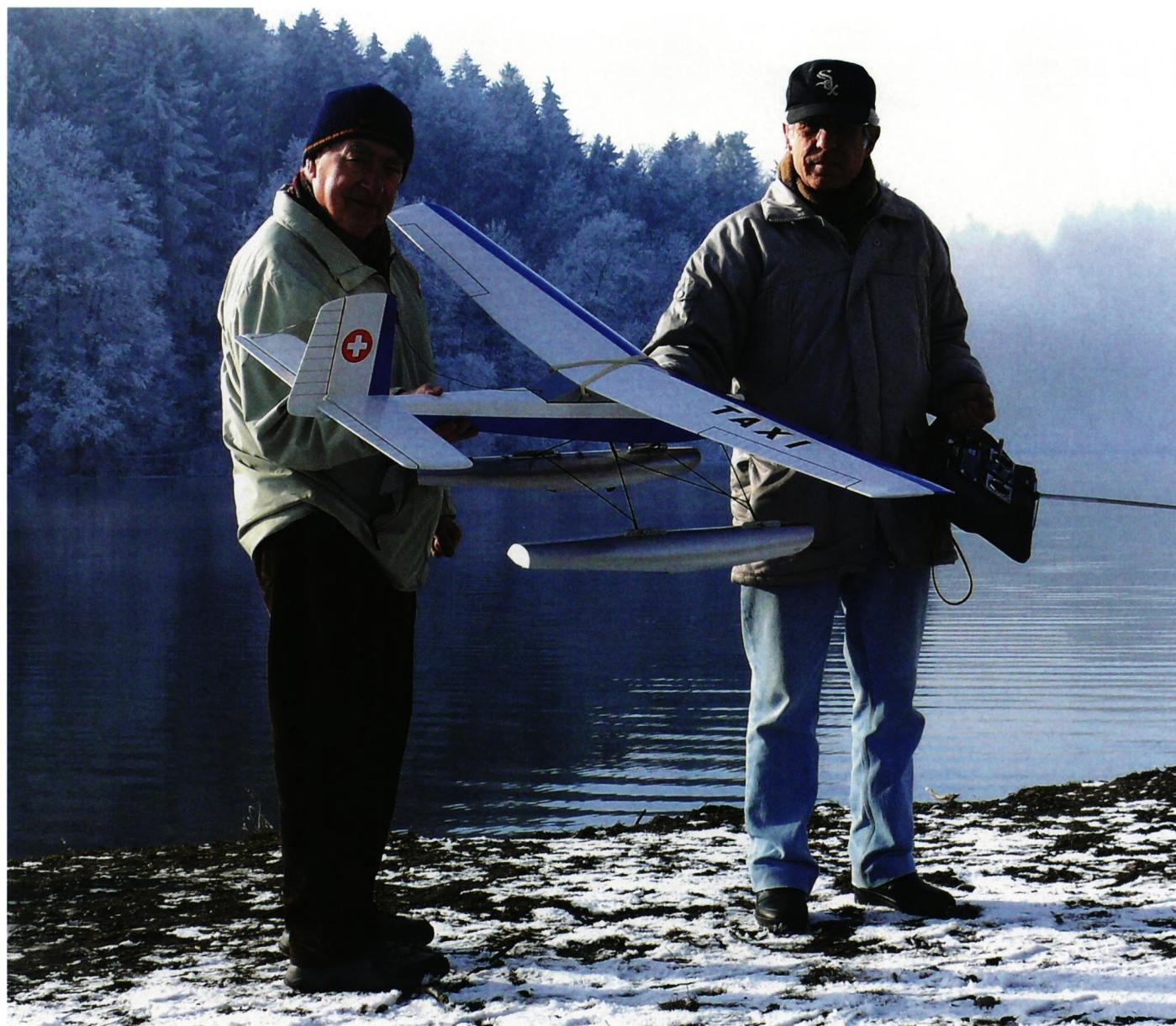
Bruno, an experienced seaplane pilot, now performs a flawless takeoff in his Taxi, with a beautiful glide phase before lifting off. After a safe flight with low passes that seem close enough to touch, the expected perfect landing follows. It’s just as beautiful to watch as a flying swan touching down on the water. It’s my turn again, and I take off for my second flight, which goes off without any major mishaps. Bruno, on the other hand, notices during his second flight that the elevator’s effectiveness is slowly but surely diminishing. He immediately begins his landing, and I hear him mutter, “Now the worst thing that can happen to a model pilot has happened!” What happened? The elevator hinges, which had been wet from the spray during takeoff, are now completely frozen solid!
The fog is rolling in, the sun is setting... Meanwhile, the fog is returning. The cold cuts right to the bone. The lake vanishes into the gray, and the airshow is called off, even though my 4-cell LiPo with a capacity of 4200 mAh could have easily handled two more flights. As I had predicted, the models are completely iced over, especially on their undersides. Oh well—the ice will melt in the car or at home at the latest. After patting each other on the back and having gained some valuable experience, we call it a day on this absolutely one-of-a-kind winter water-and-ice flying event.
This Piper Cub J-3, with a wingspan of 1.72 meters, is made by Jamara. It should be available at any specialty store and includes practically everything you could want for a beautiful, easy-to-fly semiscale model. At a price of 160 francs, it’s practically a steal. The manufacturer recommends 8-cm³ two-stroke and 11.5-cm³ four-stroke engines. Building—or rather, assembling—this nearly ready-to-fly model poses hardly any problems. Unless, that is, you get frustrated by the screws on the engine mount (which is unnecessary for electric operation) that are glued in place and cannot be removed. Every now and then, you’ll need to make a few adjustments to compensate for the lack of precision in certain areas.
The following powerplant, distributed by eflight.ch and weighing about 600 grams, was used with this model: Kontronik Fun 480-28 motor with a 5.2:1 gearbox, Kontronik Jazz 55-6-18 ESC, a 4-cell ePower LiPo with 4200 mAh, and a 13×10 APC electric propeller. The model’s total weight, ready to fly, is 2.9 kg, with a wing loading of a modest 69 g/dm².
I’ve been happily cruising around the world with this Piper for about a year now, and I even take my colleague Hanno Pfeiffer’s little gliders up into the air outside of permitted flight times—long live whisper-quiet electric flight! An ideal seaplane can be built using Hacker’s 90-cm-long floats, which are available in all sizes at www.top-model.ch, for example. Since a single rudder mounted at the stern of a float is sufficient, I built one myself and controlled it via a small carbon-fiber tube connected to the rudder. Switching from water to land operation takes about 10 minutes.

Unlike me—a shameless consumer of ready-made models—my colleague Bruno is a die-hard model enthusiast who’s also actively involved in the vintage model scene. Two years ago, he picked up a kit for the Graupner Taxi—released in 1966—for next to nothing, along with the matching floats. The wingspan of this tried-and-true utility model is 1.5 meters. There’s hardly any need to say much more about this legendary model here. Bruno chose the following components, distributed by eflight.ch, for the powertrain: an Axi 2814-10 motor, a Phönix 45 ESC, a three-cell LiteStorm CL 3S1P LiPo battery with 2100 mAh, and a 9×6 APC E-propeller.
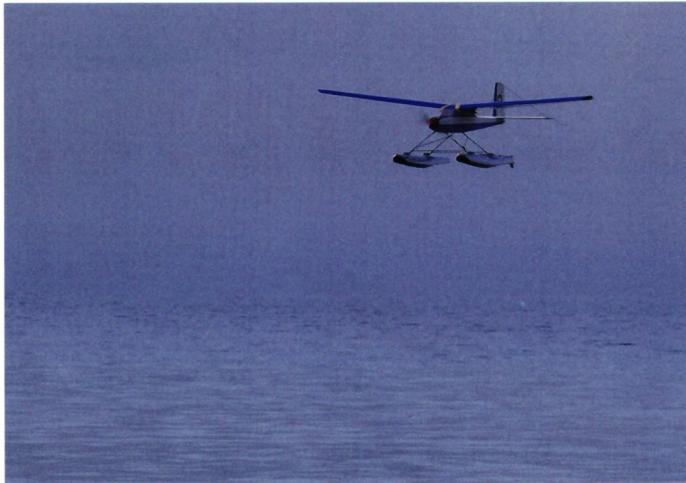
When the lake is as smooth as glass, swimmers may find that they literally stick to the water when they start and can’t seem to get going. So, first, you swim a lap or two using the displacement stroke to create small waves. These waves spread quickly and form an ideal starting lane. It works like a charm!


News from HEBU

TEAM MANAGER "THIS" BOSSHARD
 Rodito Nussbaumer

YOU KNOW WHAT I MEAN? 125 YEARS OF THE SWISS AERO CLUB
 Emil Giezendanner

F3A EUROPEAN CHAMPIONSHIPS IN ST-MACAIRE, FRANCE
 Matthias Bosshard

SUMMER FUN 2026 AT MG USTER
Martin Wunderli
TRY-OUT DAY AT MFV WETTINGEN
Urs Keller
52. 2026 ALPS CUP
Emil Giezendanner
BY YOUTH, FOR YOUTH
Lorena Betschen
ATOM, THE NEW DOUBLE-DECKER FROM CPLR
Matthias Bosshard
CORSAIR F4U – A WARBIRD WITH A MEMORABLE LOOK
Jürgen Rosenberger, Jürgen Prinz
SMALL, MODEL-LIKE SAILBOATS
Res Dauwalder
What's New at Leomotion.com

TWIN TOWN PARTNERSHIP
Wolfgang Voeller
EURO CONTEST GLIDER ACRO TOUR AUSTRIA 2026

INSIGHTS INTO THE HISTORY OF SEAPLANES

34th HAHNENMOOS ALPINE MODEL AIRPLANE CAMP
Res Dauwalder
WELCOME, NEW MEMBER!
Andrea Bolliger
HORIZON HOBBY/LEMACO NEWS: MICRO OV-10 BRONCO 645 MM BY E-FLITE

FREE FLIGHT IN THE MIDDLE OF SUMMER
Urs Muntwyler
COUPE DES ALPES – OBSERVE AND LEARN
Rodito Nussbaumer
PRIDE AND GOOD IDEAS
 Markus Nussbaumer

THE PC-21 STORY
Emil Giezendanner
NEWS FROM HEBU
 Julia Bucher

FROM 0 TO 100
Markus Nussbaumer
MEMORIES
Wolfgang Völler
NOS REGION – A HUB FOR ELECTRIC AVIATION
Emil Giezendanner
Have you almost forgotten about aircraft that take off and land vertically?
Emil Giezendanner
DO YOU KNOW WHAT I MEAN IN THE LAND OF SMILES?
Emil Giezendanner