
Throw gliders — a fun little side activity
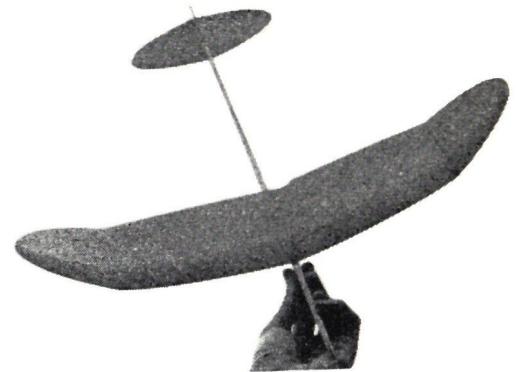
The experiment with a throw glider could probably be described under the motto “less building time, more flying.” You can build it as a beginner’s model, as a large-scale project for relaxation, or just for fun. The “Sweepette” model shown here was the American champion for five years.
The designer, Lee Hines, certainly has the most experience in this field. Competitions in this category have been held in some countries since 1965 (Germany, England, the United States, etc.). MG-Zürich has already held internal competitions, during which flights out of sight occurred.
The wing shape is cut from a single piece of soft balsa wood, 6 x 100 mm. All shaping is done on the entire wing. Afterward, the bends are cut, and the front angles are sanded precisely using appropriate shims. The tailplane parts are best sanded to shape on a glass plate. The fuselage is cut from a hard balsa board, 6 mm thick, and sanded. The wings and fuselage are coated 3–4 times with varnish. Sand with fine-grit sandpaper after each coat. Sand the tail assembly parts only twice. The weight of a throw glider is 21–26 g for calm weather and 28–34 g for rough weather.
The elevator and horizontal stabilizer are glued only to the front half. The center of gravity is located 55 mm from the leading edge of the wing. It is recommended to glue on a little extra lead, which can be sanded down during trim adjustments. Angle adjustments can now be made to the elevator (cut out or insert a tab). During gliding flight, the model should fly in a slight right turn.
To launch the glider, place your index finger in the recess on the trailing edge; hold the fuselage with your thumb and middle finger against the sandpaper. With our arm extended downward and backward, we run a few steps forward and fling the glider forward with a powerful arm rotation, releasing it at head height. Achievable altitude: 15–20 meters. Not every launch will be successful, as this, too, requires practice and training.
Following the Regional High-Launch Competition on May 6, 1973, we will hold a contest between the last launch and the announcement of the results. There will be 10 launches; the 5 best will be scored. Maximum flight time: 90 seconds.
I hope everyone has fun building and flying. W. Heise


TEAM MANAGER "THIS" BOSSHARD
 Rodito Nussbaumer

F3A EUROPEAN CHAMPIONSHIPS IN ST-MACAIRE, FRANCE
 Matthias Bosshard

News from HEBU

YOU KNOW WHAT I MEAN? 125 YEARS OF THE SWISS AERO CLUB
 Emil Giezendanner

SUMMER FUN 2026 AT MG USTER
Martin Wunderli
TRY-OUT DAY AT MFV WETTINGEN
Urs Keller
52. 2026 ALPS CUP
Emil Giezendanner
BY YOUTH, FOR YOUTH
Lorena Betschen
ATOM, THE NEW DOUBLE-DECKER FROM CPLR
Matthias Bosshard
CORSAIR F4U – A WARBIRD WITH A MEMORABLE LOOK
Jürgen Rosenberger, Jürgen Prinz
SMALL, MODEL-LIKE SAILBOATS
Res Dauwalder
What's New at Leomotion.com

INSIGHTS INTO THE HISTORY OF SEAPLANES

34th HAHNENMOOS ALPINE MODEL AIRPLANE CAMP
Res Dauwalder
HORIZON HOBBY/LEMACO NEWS: MICRO OV-10 BRONCO 645 MM BY E-FLITE

COUPE DES ALPES – OBSERVE AND LEARN
Rodito Nussbaumer
PRIDE AND GOOD IDEAS
 Markus Nussbaumer

EURO CONTEST GLIDER ACRO TOUR AUSTRIA 2026

FREE FLIGHT IN THE MIDDLE OF SUMMER
Urs Muntwyler
THE PC-21 STORY
Emil Giezendanner
TWIN TOWN PARTNERSHIP
Wolfgang Voeller
WELCOME, NEW MEMBER!
Andrea Bolliger
NEWS FROM HEBU
 Julia Bucher

FROM 0 TO 100
Markus Nussbaumer
MEMORIES
Wolfgang Völler
NOS REGION – A HUB FOR ELECTRIC AVIATION
Emil Giezendanner
Have you almost forgotten about aircraft that take off and land vertically?
Emil Giezendanner
70 YEARS OF THE NIDWALDEN MODEL AIRPLANE CLUB
Martin Barmettler