
LiPo—but safely!
The solar panel on the roof and the electric car plugged into the outlet give it away: Urs Stahel from Esslingen is all about electricity. So it’s no surprise that electric model airplanes have been one of his passions for over 30 years. He has witnessed the development of batteries firsthand.
Spring is approaching, and soon model builders will emerge from their hobby rooms to take their latest aircraft into the air. For Urs Stahel, a member of the Pfäffikon ZH Model Flying Club, this will include, among other things, a wooden seaplane with a 3.60-meter wingspan. In his long career as a model aviator, there have been no
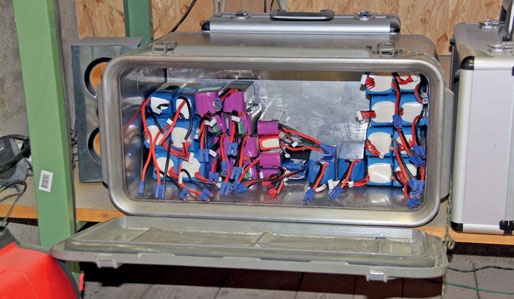
He has accumulated not only countless airplanes but also a substantial number of lithium-polymer (LiPo) batteries. Stahel has found a clever solution for storing them: a decommissioned military cooking box with a pressure relief valve serves as his fireproof battery cabinet. A battery has actually leaked inside it once—fortunately, without any consequences. “Compared to the past, batteries have not only become significantly more powerful but also safer,” says Stahel.
There are numerous videos circulating online showing rechargeable batteries with
Responsible pilots...
- do not modify the batteries, and do not unpack them
- do not store their batteries in the model, but rather keep them half-charged in a fireproof container and insert the batteries only shortly before the flight,
- charge the batteries only with special chargers suitable for the specific battery type and inside fireproof containers,
- never charge their batteries unattended or overnight,
- make preparations in case of a fire,
- read the battery supplier’s instructions and be familiar with the specifications of your batteries,
- protect the batteries from overheating, mechanical damage, and access by unauthorized persons (e.g., children),
- dispose of the batteries properly in the separate battery collection program (never in household trash!),
- immediately turn in swollen or damaged batteries at a staffed collection point (model aircraft retailers, customer service departments at electronics retailers, or staffed recycling centers).
deliberately destroyed with a sharp object. While older batteries would literally explode due to the magnesium they contain, today’s LiPo batteries—depending on their charge level—mainly produce a lot of smoke. Nevertheless, it happens time and again in model flying that a LiPo battery catches fire. Urs Stahel has the impression that smaller batteries in particular are involved in such incidents—people generally take more care with the larger ones. Often, a fire is caused by errors during the charging process. If the wrong battery type is selected on the charger—for example, nickel-metal hybrid instead of lithium-polymer—the situation can become critical. Urs Stahel minimizes the risk by using only LiPo batteries. Realistically, hardly anyone leaves the batteries unattended while they’re charging, but most pilots use a fireproof bag. “I never charge them overnight or when I’m away from home,” says Stahel.
How aware are pilots of the LiPo issue? According to Stahel, the topic is brought up time and again, for example at club meetings or through the regional association. If the batteries are purchased in a specialty store rather than online, the salespeople personally point out the potential dangers. While it does happen that someone charges their batteries
in their car during a flying day does happen, but most pilots handle their equipment very responsibly. People generally don’t tinker with the batteries. If a pilot wants to use multiple batteries in parallel, special connectors ensure that the terminals aren’t reversed. However, if someone rewires the cables, a short circuit can certainly occur. Stahel
disposes of the batteries as recommended by INOBAT Battery Recycling Switzerland: After discharging the battery and covering the terminals with tape, he either returns it to a specialty store equipped with an INOBAT steel drum or drops it off at municipal collection points or KEZO locations.
Author: Rahel Meister, on behalf of Inobat


News from HEBU

TEAM MANAGER "THIS" BOSSHARD
 Rodito Nussbaumer

SUMMER FUN 2026 AT MG USTER
Martin Wunderli
SMALL, MODEL-LIKE SAILBOATS
Res Dauwalder
TRY-OUT DAY AT MFV WETTINGEN
Urs Keller
What's New at Leomotion.com

52. 2026 ALPS CUP
 Emil Giezendanner

ATOM, THE NEW DOUBLE-DECKER FROM CPLR
 Matthias Bosshard

INSIGHTS INTO THE HISTORY OF SEAPLANES

YOU KNOW WHAT I MEAN? 125 YEARS OF THE SWISS AERO CLUB
Emil Giezendanner
34th HAHNENMOOS ALPINE MODEL AIRPLANE CAMP
Res Dauwalder
CORSAIR F4U – A WARBIRD WITH A MEMORABLE LOOK
Jürgen Rosenberger, Jürgen Prinz
F3A EUROPEAN CHAMPIONSHIPS IN ST-MACAIRE, FRANCE
Matthias Bosshard
HORIZON HOBBY/LEMACO NEWS: MICRO OV-10 BRONCO 645 MM BY E-FLITE

PRIDE AND GOOD IDEAS
 Markus Nussbaumer

BY YOUTH, FOR YOUTH
Lorena Betschen
FREE FLIGHT IN THE MIDDLE OF SUMMER
Urs Muntwyler
THE PC-21 STORY
Emil Giezendanner
TWIN TOWN PARTNERSHIP
Wolfgang Voeller
EURO CONTEST GLIDER ACRO TOUR AUSTRIA 2026

WELCOME, NEW MEMBER!
Andrea Bolliger
COUPE DES ALPES – OBSERVE AND LEARN
Rodito Nussbaumer
NEWS FROM HEBU
 Julia Bucher

FROM 0 TO 100
Markus Nussbaumer
MEMORIES
Wolfgang Völler
NOS REGION – A HUB FOR ELECTRIC AVIATION
Emil Giezendanner
Have you almost forgotten about aircraft that take off and land vertically?
Emil Giezendanner
70 YEARS OF THE NIDWALDEN MODEL AIRPLANE CLUB
Martin Barmettler