
Back in the air after 35 years
Valentino Fry’s Super Sabre F-100
It’s been a long time since, as an apprentice, I designed and built the Super Sabre entirely out of wood. Back then, electric impellers and turbines weren’t yet a thing. The planes were powered exclusively by high-performance 10-cc engines.
The propeller-driven jets flew surprisingly well, despite weighing more than 6 kg and measuring 1.8 m in length with a wingspan of 1.5 m. By the late 1970s, these models were the craziest things around.
At that time, I had built and flown many such jets—like the Crusader, Mirage, Hunter, and whatever else they were called—but the F-100 was the best of all the jets back then,
since it was, after all, my own build. Despite the thin, pointed wing profile I’d developed, it flew incredibly smoothly; it was lightning-fast, and its flight characteristics were one-of-a-kind. After three years of flying, however, I finally hung up the Sabre for good in my workshop after it had sustained a few dings. That was in 1979. It stayed there until last fall, when I had the brilliant idea to get the Super Sabre back in the air. →
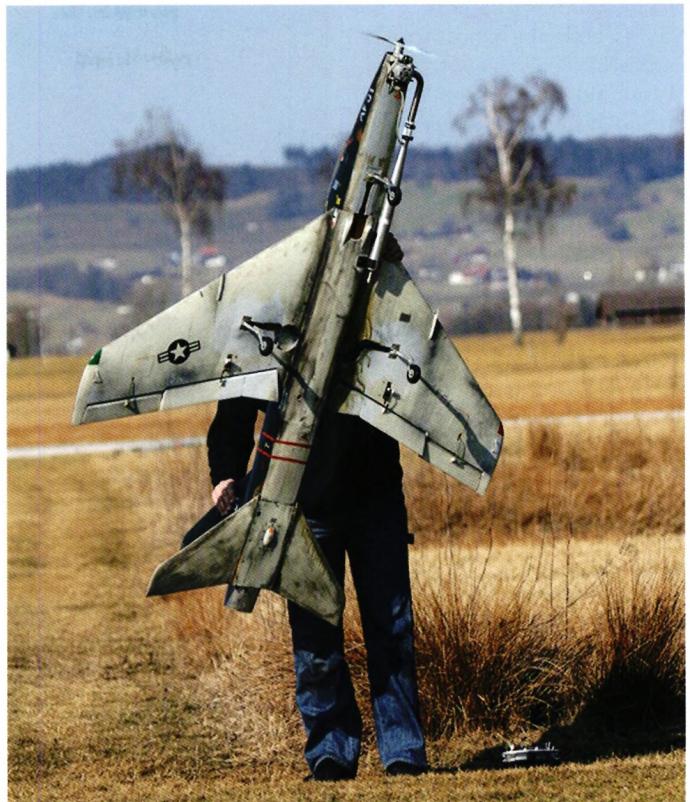
Covered in dust, I took the fragile airplane down from the wall and quickly realized that my idea wasn’t going to be so easy to carry out. Everything was in a very dilapidated state. The balsa wood was dry and brittle, and the front section was caked with so much dried castor oil that it was barely holding the wood together. The hoses and fuel tank were crumbling, and the control levers simply snapped in half. First, I removed everything that was no longer really airworthy. After refurbishing the airframe, I fitted the plane with a new Jet A1 landing gear, a new high-performance OS-FX61 engine with a resonator tube, and a new fuel system. I also replaced all the control surfaces. The only condition, however, was to leave the exterior exactly as it was. I preserved the battle scars and patina from back then, and the result was simply something different. After a few weeks, the
The F-100 Super Sabre is in airworthy condition.
In December 2011, I ventured out for the maiden flight—more than 30 years after the Sabre’s last flight. It was a freezing-
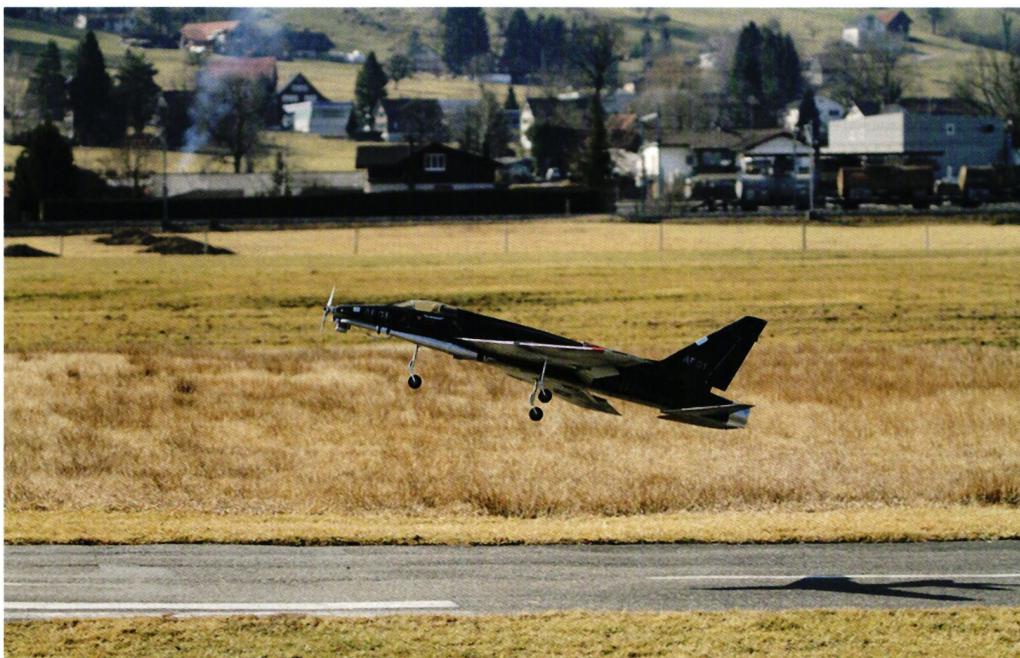
cold day, but there wasn’t a breath of wind, and I launched the Super Sabre from the Reichenburg model airfield to bring it back to life. At first, the runway seemed very short, but after just three-quarters of the way down the runway, I gently lifted the plane off the run-
. The climb was surprisingly good, and after retracting the landing gear and flaps, the F-100 picked up speed steadily.
I really enjoyed the flight, because it brought back all those old memories,
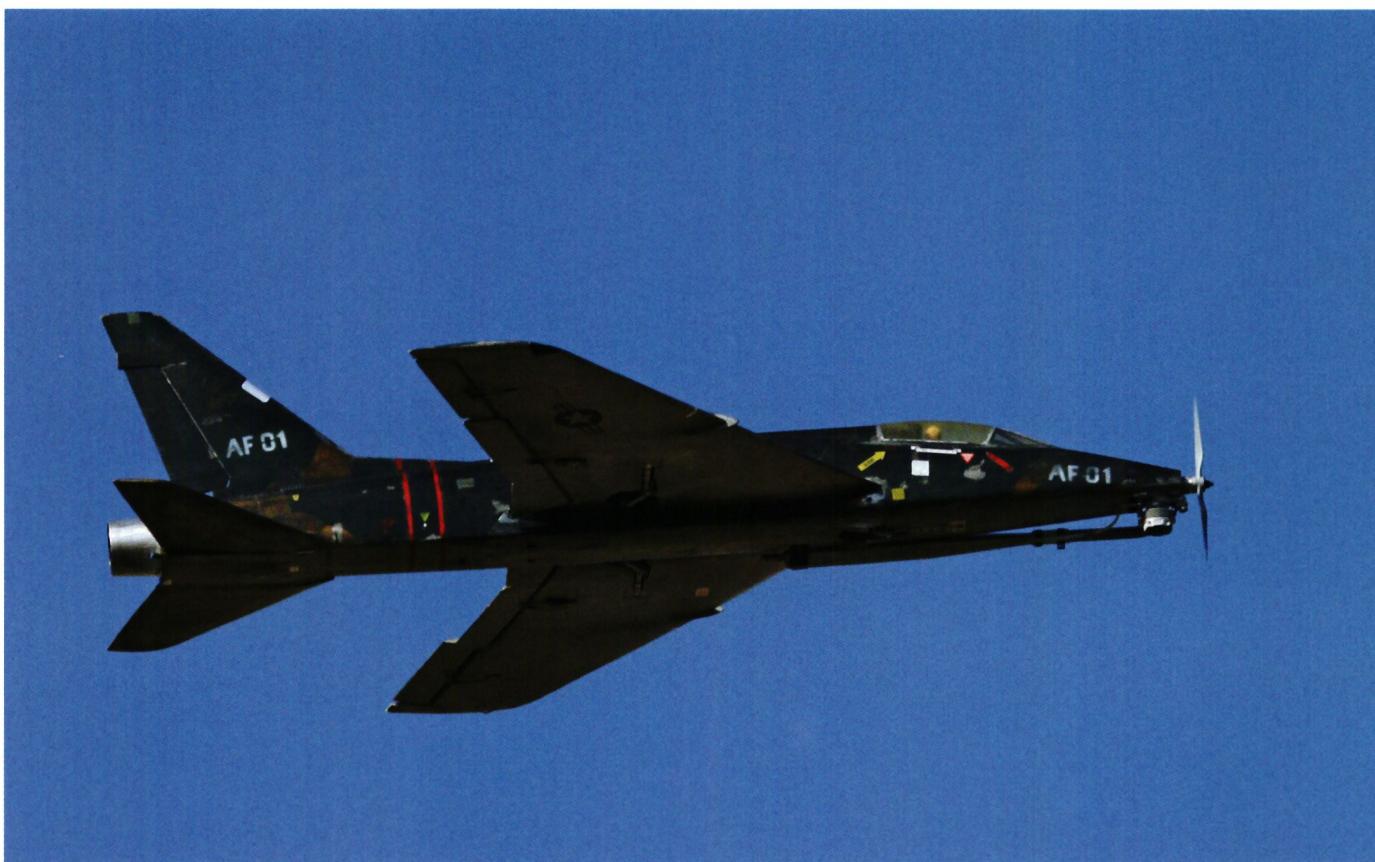
which I got to experience as a young model airplane enthusiast with the F-100.
It’s just amazing how the plane handles—it’s fast, really fast, and easy to fly, too. I felt the same pride as I did back in 1977 when I flew the Super Sabre for the first time.
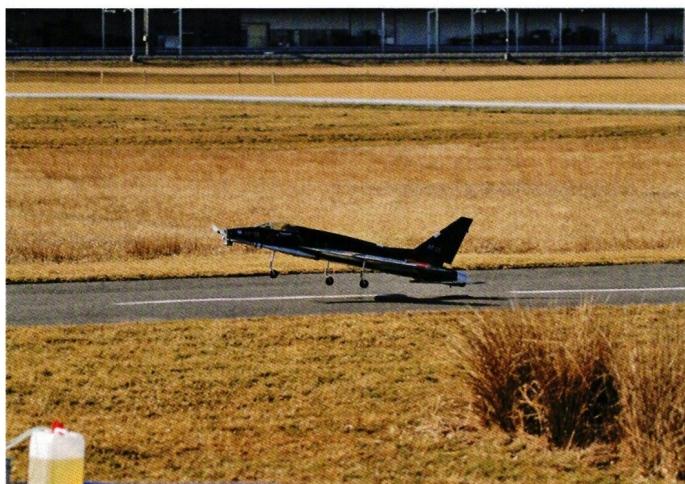
After about 10 minutes, I began preparing for landing: I checked the wind, extended the landing gear and flaps, and shortly afterward touched down on the short runway in Reichenburg. To date, I’ve had quite a few trouble-free flights, but the last one, unfortunately, involved a minor incident that
real jet with a turbine. Getting a hand caught in the propeller always hurts, and for me, it was another valuable lesson in what not to do. An old hand like me should know better. At the same time, a picture was shown at the chairmen’s conference of a model airplane that had a propeller guard like a table fan… Coincidence?
I’m hoping my hand will soon be ready again for more wonderful flights with the F-100, and I hope to be able to fly it at one or another airshow. ■
Valentino Fry
Photos by Reto Diethelm


News from HEBU

TEAM MANAGER "THIS" BOSSHARD
 Rodito Nussbaumer

YOU KNOW WHAT I MEAN? 125 YEARS OF THE SWISS AERO CLUB
 Emil Giezendanner

F3A EUROPEAN CHAMPIONSHIPS IN ST-MACAIRE, FRANCE
 Matthias Bosshard

52. 2026 ALPS CUP
Emil Giezendanner
PRIDE AND GOOD IDEAS
 Markus Nussbaumer

ATOM, THE NEW DOUBLE-DECKER FROM CPLR
Matthias Bosshard
CORSAIR F4U – A WARBIRD WITH A MEMORABLE LOOK
Jürgen Rosenberger, Jürgen Prinz
SUMMER FUN 2026 AT MG USTER
Martin Wunderli
TRY-OUT DAY AT MFV WETTINGEN
Urs Keller
TWIN TOWN PARTNERSHIP
Wolfgang Voeller
BY YOUTH, FOR YOUTH
Lorena Betschen
SMALL, MODEL-LIKE SAILBOATS
Res Dauwalder
What's New at Leomotion.com

HORIZON HOBBY/LEMACO NEWS: MICRO OV-10 BRONCO 645 MM BY E-FLITE

COUPE DES ALPES – OBSERVE AND LEARN
Rodito Nussbaumer
EURO CONTEST GLIDER ACRO TOUR AUSTRIA 2026

INSIGHTS INTO THE HISTORY OF SEAPLANES

34th HAHNENMOOS ALPINE MODEL AIRPLANE CAMP
Res Dauwalder
WELCOME, NEW MEMBER!
Andrea Bolliger
FREE FLIGHT IN THE MIDDLE OF SUMMER
Urs Muntwyler
THE PC-21 STORY
Emil Giezendanner
NEWS FROM HEBU
 Julia Bucher

FROM 0 TO 100
Markus Nussbaumer
MEMORIES
Wolfgang Völler
NOS REGION – A HUB FOR ELECTRIC AVIATION
Emil Giezendanner
Have you almost forgotten about aircraft that take off and land vertically?
Emil Giezendanner
DO YOU KNOW WHAT I MEAN IN THE LAND OF SMILES?
Emil Giezendanner