
Model Airplane Flying at the Beach
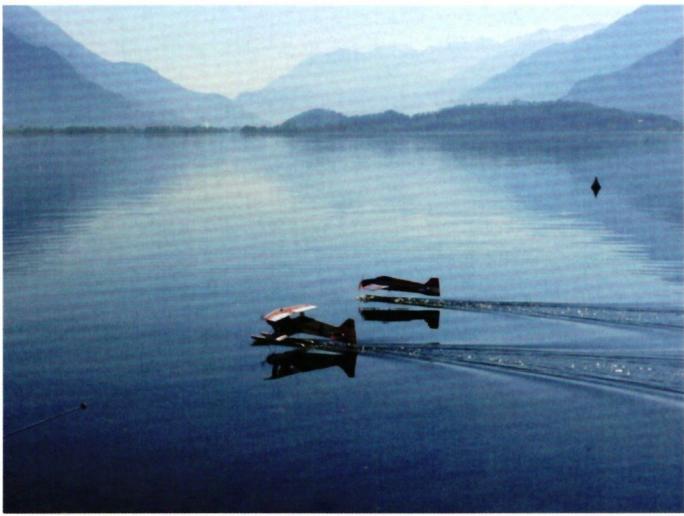
The article in the Northeast Switzerland Region’s Newsletter 3/08 “Seaplane Flying as an Alternative and Complement to Beach Vacations”—which featured pictures of beautiful multi-engine seaplanes—brought back many memories of the experiences I’d had with my sons while flying seaplanes, and I’d like to share a very brief summary of our “splash-filled lessons” here.
Those who can afford a secluded villa by the water for their vacation or who spend their beach vacation at a remote fjord face far fewer problems than those who have to look for a flight to a bustling beach resort. And it is precisely for the latter group that this report is intended.
The space available in the transport vehicle usually determines the size of the vacation plane. This could be a small funflyer, a medium-sized flying boat, or even a larger model. Clearly, combustion engines have no place on the beach anymore, and electric motors
must be absolutely silent. So no screeching gearboxes and no roaring from unbalanced folding-rigid propellers, etc.
If you’re spending your beach vacation at a campground by a lake, you can expect the following schedule, which may vary slightly depending on the weather and season:
- At 8 a.m., you’ll be flying practically all by yourself, and it’s usually completely windless. Only a few early risers are watching. Since quite a few people are still asleep, use only an extremely quiet motor!
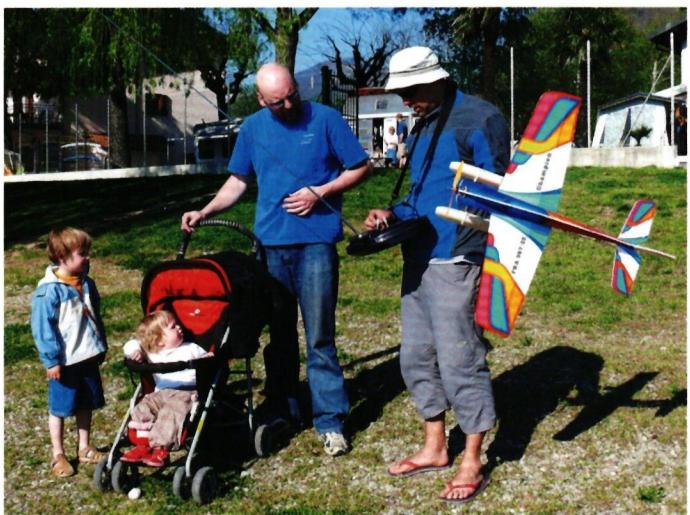
- At 9 a.m., the first appreciative spectators arrive. Groups of interested people begin to form—
People of all ages come, and the younger generation is shown how a model airplane works.
- By 10:30 a.m., the beach starts to fill up, and model airplane enthusiasts have to slowly start looking for a secluded spot or call off the flight show. In addition, when the weather is nice, thermal winds set in around noon
and lightweight funflyers start to have trouble.
- Around 6:00 to 7:00 p.m., the beach empties, the wind dies down, and flying can resume. However, with steep-sided mountains in the vicinity, one must expect evening downdrafts of varying intensity.
Once you arrive at the beach, there are a few things to keep in mind. Of course, common sense should always prevail here as well. But do we always have it?
I don’t mean to come across as some kind of water police officer; I simply want to point out the temptations we face time and again.
Rule Number One: No one should be harassed—and certainly not put in danger—at the beach!
Even a fast-moving Funflyer can injure someone if it gets out of control—not to mention larger models.
- So the rule is very clear: Flying is not allowed when swimmers are in the water!
- It’s also too risky to fly on a beach full of sunbathers—
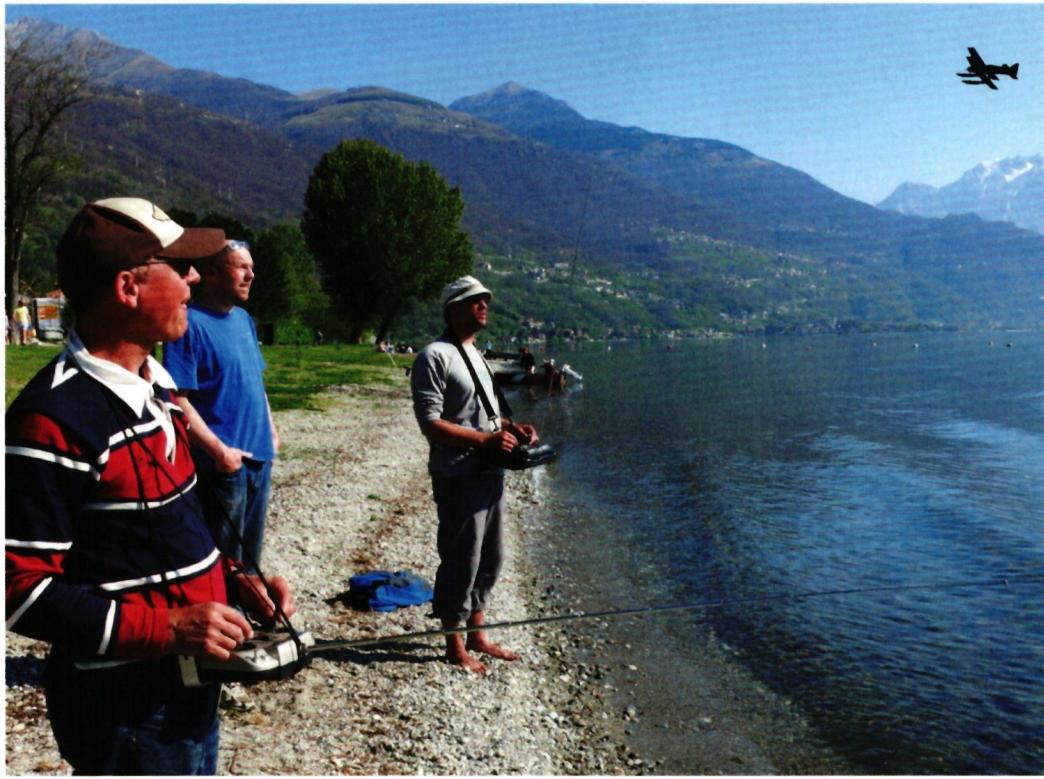
to put on his air show for people swimming.
– This means: When the weather is nice, you can only fly early in the morning or in the evening. That’s when there’s the least wind, and it’s the most fun.
– When there’s no wind, you don’t land from the lake toward the pilot. Anyone coming in too high or too fast (a tailwind gust!) will crash into the beach or even into the spectators. You always land parallel to the beach. That way, the landing strip is almost infinitely long...
We also follow the simplest rules, such as:
– The airfield is the lake, so don’t zoom past people on the beach—behind or over them
– Don’t fly toward people and abort at the last moment
– Only practice risky maneuvers when there’s enough distance from the spectators
The next step in safety when flying in unfamiliar territory is clearly 2.4 GHz! An ideal—and very affordable—remote control for vacation use is the Futaba 6EX 2.4 GHz. It’s an incredibly good feeling to be able to fly anywhere without the fear of being interfered with
or the risk of interfering with anyone else. Since I bought this transmitter from Willy Siegrist about half a year ago, I haven’t experienced even the slightest hint of interference, either at home or abroad.
It goes without saying that you should make sure your model is in perfect working order when flying over water. But time and again (!) I hear from seaplane pilots that their LiPo batteries have detached from the model unexpectedly during extreme maneuvers...
I advise against flying in saltwater with aircraft that are more or less prone to leaks. Recently, we learned the hard way what happens when saltwater spray penetrates the tiniest cracks and causes switch contacts, plugs, and sockets to corrode incredibly quickly.
Flying model airplanes at the beach is a wonderful activity. When done responsibly, it’s the best way to promote a very worthwhile hobby that can help young people, in particular, spend their free time in a far more meaningful way than sitting in front of a PlayStation. For seasoned landlubbers, seaplane flying adds a new, fascinating dimension to model flying. Hans Jürg Baum


News from HEBU

PRIDE AND GOOD IDEAS
 Markus Nussbaumer

TEAM MANAGER "THIS" BOSSHARD
 Rodito Nussbaumer

YOU KNOW WHAT I MEAN? 125 YEARS OF THE SWISS AERO CLUB
 Emil Giezendanner

F3A EUROPEAN CHAMPIONSHIPS IN ST-MACAIRE, FRANCE
 Matthias Bosshard

HORIZON HOBBY/LEMACO NEWS: MICRO OV-10 BRONCO 645 MM BY E-FLITE

ATOM, THE NEW DOUBLE-DECKER FROM CPLR
Matthias Bosshard
SUMMER FUN 2026 AT MG USTER
Martin Wunderli
52. 2026 ALPS CUP
Emil Giezendanner
TWIN TOWN PARTNERSHIP
Wolfgang Voeller
CORSAIR F4U – A WARBIRD WITH A MEMORABLE LOOK
Jürgen Rosenberger, Jürgen Prinz
SMALL, MODEL-LIKE SAILBOATS
Res Dauwalder
TRY-OUT DAY AT MFV WETTINGEN
Urs Keller
WELCOME, NEW MEMBER!
Andrea Bolliger
What's New at Leomotion.com

COUPE DES ALPES – OBSERVE AND LEARN
Rodito Nussbaumer
EURO CONTEST GLIDER ACRO TOUR AUSTRIA 2026

BY YOUTH, FOR YOUTH
Lorena Betschen
INSIGHTS INTO THE HISTORY OF SEAPLANES

34th HAHNENMOOS ALPINE MODEL AIRPLANE CAMP
Res Dauwalder
FREE FLIGHT IN THE MIDDLE OF SUMMER
Urs Muntwyler
THE PC-21 STORY
Emil Giezendanner
NEWS FROM HEBU
 Julia Bucher

FROM 0 TO 100
Markus Nussbaumer
MEMORIES
Wolfgang Völler
NOS REGION – A HUB FOR ELECTRIC AVIATION
Emil Giezendanner
DO YOU KNOW WHAT I MEAN IN THE LAND OF SMILES?
Emil Giezendanner
Have you almost forgotten about aircraft that take off and land vertically?
Emil Giezendanner