
THE WORD “YOUTH WORK” CONTAINS THE WORD “WORK”
As more and more model airplane enthusiasts are purchasing off-the-shelf aircraft—including those that come fully equipped—it is likely to become increasingly difficult for many to get a so-called “ready-to-fly” model airworthy. At the Young SilentWings Workshop in the Northeast Switzerland (NOS) region, this is one of the central objectives.
Quality isn’t universal, unfortunately! But we know manufacturers who deliver products of nearly flawless quality. Anyone who holds such models in their hands can’t help but dream of building something like that from scratch themselves one day. That would be a long-term project, though—too long for teenagers. Some manufacturers rate the difficulty of assembly on a scale. This is mostly theoretical, though, since the work involved depends largely on experience, manual dexterity, and a knack for precision and perseverance.
Choosing the right model is, not least, a matter of experience for the course instructors. Without prior experience installing a prototype
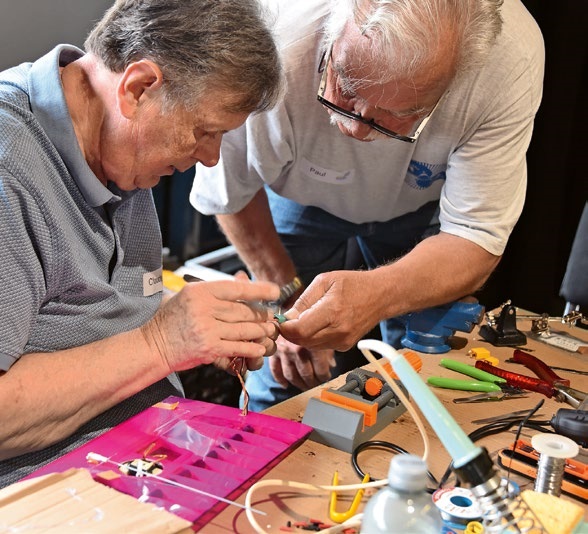
It is impossible to estimate either the level of difficulty or the average time required. Even then—just as in school—some individuals will always be faster than others. Care must be taken to ensure that the faster students do not disturb the others. This must be prevented, especially when working on more delicate projects. However, this can be easily managed through additional tasks (e.g., making wing protectors), guidance from the instructors, etc.
At first glance, installing an electric aerobatic or glider model may seem simple and straightforward. But this has led many people to be sorely mistaken and driven them to despair. Careful installation, carried out in well-thought-out steps, takes you into the depths of model aircraft construction. As is well known, this is rarely the case when using models that come fully equipped.
For the Young SilentWings program, the organizers handle the selection of components such as the propulsion system and RC control. This is no simple task and is fraught with pitfalls: a choice between quality and cost? It’s just one aspect of the extensive preparatory work. Some rather difficult tasks were handled with commendable care during the preliminary work: installing the motor mount on the glider or securing the wings with screws. This saves time and prevents frustration for the young participants.
Provide instruction and let them work. This isn’t always an easy task for the instructor. When should you step in? There are always tasks where mistakes can be corrected. In this case, the “participant” has learned a great deal. But if irreversible mistakes are becoming apparent, it’s time to intervene to correct them—or even demonstrate the correct method. In general, a role model who exudes calm and confidence has a positive effect. Leaders are neither clients nor supervisors, but rather helpful guides and coaches who ensure that the second screw is tightened properly.
The idea of supplementing Young SilentWings with a sort of short program may sound appealing. Going “from the box to the sky” appeals to today’s often impatient youth. The attempt to embrace this trend and provide at least a little technical guidance shouldn’t be dismissed out of hand. After all, guiding the young participants onto the right (flight) path for an entire day—from assembly to the first flight—must be seen as a positive step. It would be presumptuous to expect further educational effects and development in such a short time. Entirely different questions concern the quality of such models. If the quality is lacking or parts are missing, this leads to premature frustration and disappointment, especially among young people seeking quick success. The second question is whether the Young SilentWings program—which focuses on serious performance and endurance—should be supplemented with a short-term project. After all, there are several key points that fundamentally distinguish the objectives of the two youth programs from one another. Kudos to the organizers for daring to undertake this experiment. Important conclusions can undoubtedly be drawn for future youth projects.
Wingspan | 158 cm |
Length | 167 cm |
Wing area | 47.5 dm² |
Weight | 2,750 g without battery |
Radio | 6-channel |
Battery | 4,500–5,000, 6S Li-Po |
Wingspan | 275 cm |
Length | 1,340 cm |
Weight | 1,500 g |
Wing area | 48.7 dm² |

News from HEBU

TEAM MANAGER "THIS" BOSSHARD
 Rodito Nussbaumer

YOU KNOW WHAT I MEAN? 125 YEARS OF THE SWISS AERO CLUB
 Emil Giezendanner

F3A EUROPEAN CHAMPIONSHIPS IN ST-MACAIRE, FRANCE
 Matthias Bosshard

52. 2026 ALPS CUP
Emil Giezendanner
PRIDE AND GOOD IDEAS
 Markus Nussbaumer

CORSAIR F4U – A WARBIRD WITH A MEMORABLE LOOK
Jürgen Rosenberger, Jürgen Prinz
SUMMER FUN 2026 AT MG USTER
Martin Wunderli
TRY-OUT DAY AT MFV WETTINGEN
Urs Keller
BY YOUTH, FOR YOUTH
Lorena Betschen
ATOM, THE NEW DOUBLE-DECKER FROM CPLR
Matthias Bosshard
SMALL, MODEL-LIKE SAILBOATS
Res Dauwalder
What's New at Leomotion.com

HORIZON HOBBY/LEMACO NEWS: MICRO OV-10 BRONCO 645 MM BY E-FLITE

COUPE DES ALPES – OBSERVE AND LEARN
Rodito Nussbaumer
TWIN TOWN PARTNERSHIP
Wolfgang Voeller
EURO CONTEST GLIDER ACRO TOUR AUSTRIA 2026

INSIGHTS INTO THE HISTORY OF SEAPLANES

34th HAHNENMOOS ALPINE MODEL AIRPLANE CAMP
Res Dauwalder
WELCOME, NEW MEMBER!
Andrea Bolliger
FREE FLIGHT IN THE MIDDLE OF SUMMER
Urs Muntwyler
THE PC-21 STORY
Emil Giezendanner
NEWS FROM HEBU
 Julia Bucher

FROM 0 TO 100
Markus Nussbaumer
MEMORIES
Wolfgang Völler
NOS REGION – A HUB FOR ELECTRIC AVIATION
Emil Giezendanner
Have you almost forgotten about aircraft that take off and land vertically?
Emil Giezendanner
DO YOU KNOW WHAT I MEAN IN THE LAND OF SMILES?
Emil Giezendanner