
Summer Activity Pass at the Reichenburg Model Aircraft Club
On July 5, 2008, the Reichenburg Model Aircraft Club organized a summer activity program for the March/Höfe region for the fifth time. Fourteen students competed in a contest using hand-launched gliders they had built themselves.
In keeping with tradition, the Reichenburg Model Aircraft Club once again organized a summer activity program this year for students in the March/Höfe region. In previous years, we usually organized the event with various stations that the participants worked through in groups. This year, however, we seized the opportunity to do something special with the hand-launched glider kits provided to the groups by the Northeast Switzerland Model Flying Region. So we set aside an entire day for the summer activity program. In the morning, the gliders were to be assembled so they could be used in the competition that afternoon.
This throw glider (actually a catapult glider) is the “SAL-Slipper” model from Graupner. Our president ordered 15 of them from NOS. One model was subjected to extensive construction and flight testing by our member Godi Bachmann beforehand. In the process, he identified several critical issues, which were then resolved thanks to his help. For example, as part of the preparation, the wing tabs were glued to the wing halves in advance to avoid long drying times. After all, participants had to be able to fully assemble the gliders within a single morning. This also allowed us to determine the position of the wing on the fuselage and the center of gravity in advance, which sped up both assembly and the subsequent test flights.
The competition was planned as follows: The builders are to compete with their aircraft in three disciplines:
- 1. Construction evaluation
- 2. Time flight
- 3. Distance flight
The construction evaluation later proved to be the most difficult task for the jury, as no objective measurement was possible here. The individual disciplines were evaluated or measured. For the speed flight and distance flight, three runs were flown in each. The shortest flight or the shortest distance was excluded from the scoring, and the other two times or distances were added together. The results were then normalized so that the best participant in each run scored 1,000 points. To calculate the rankings, the author prepared a spreadsheet and score sheets.
Fourteen students in grades 1 through 6, including two girls and four volunteers from the MFGR, began building the glider at 8:30 a.m. on Saturday morning. The “workspace” was the foyer of a gym, which was equipped with tables. Additional materials, such as small wooden boards, pins, rubber, etc., were brought by the volunteers. Thanks to the thorough preparations, the gliders were completed by noon, including a break.
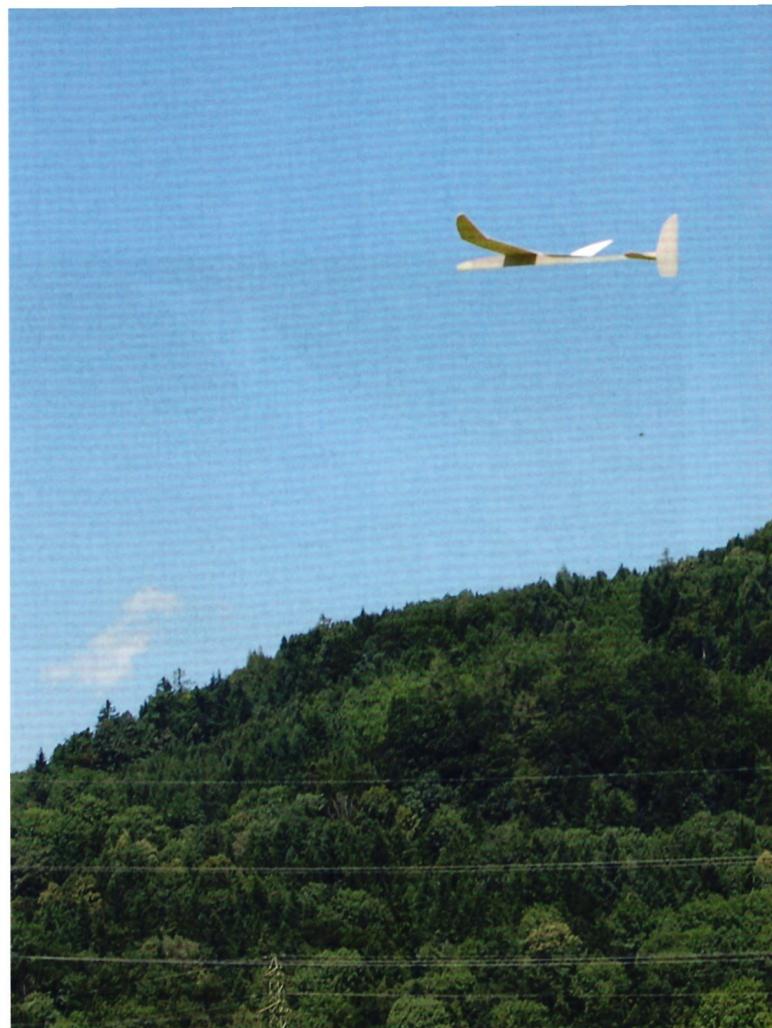
The simulator was available with two models. This allowed the students to prepare for operation in a teacher-student setting using the simulator. But the most exciting part for the participants was probably the competition. For this, the models were flown in once again under the expert guidance of Godi Bachmann. For the actual competition, the students lined up in a
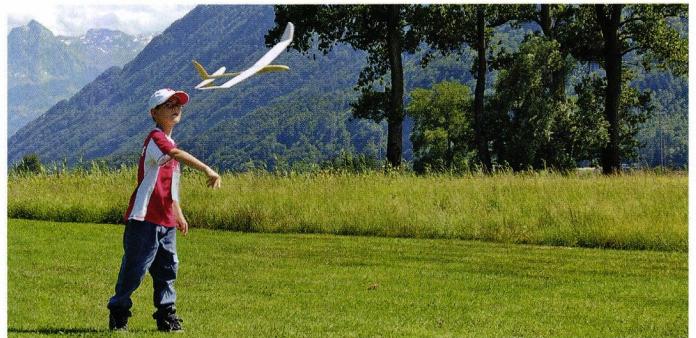
They lined up, and one at a time took off for a flight. The flight times and distances were recorded on the score sheets. It was a pleasure for us to see how disciplined the students were and how focused they remained on the task at hand.
With the help of the computer, we were able to quickly determine the rankings, and then we moved on to the awards ceremony. The first-place winners in grades 1–2, 3–4, and 5–6 each received a small electric helicopter, donated by the company Hobby-Frei in Lachen. Everyone else received small consolation prizes, and of course, everyone got to take their homemade creations home with them. Our president even thought of the volunteers, so everyone received a small gift as well. It was a wonderful day for all of us. After the official part of the event, we continued flying until late in the evening and enjoyed a cozy get-together.
Roland Schäuble,
Reichenburg Model Flying Club
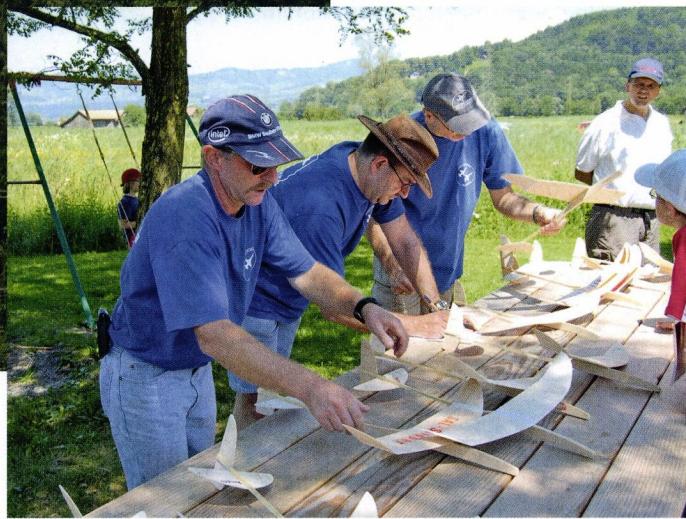
After the obligatory cervelat for lunch, the afternoon program could begin. First up was the model evaluation (as long as everything is still in one piece). Three members of the MFGR had to evaluate the 14 aircraft. But what should one look for? Is a crookedly glued vertical stabilizer worse than an unsightly glue joint? How should the artistic elements—such as decorations applied with a felt-tip pen—be rated? Ultimately, the jury proceeded as follows: The models were ranked according to their build quality. The first model received 100% of the points, and the last 75%. The scores in between were determined by linear interpolation.
In addition to the competition, there was also a PC flight simulator with a projector and screen, as well as a teacher/student workshop—


TEAM MANAGER "THIS" BOSSHARD
 Rodito Nussbaumer

SUMMER FUN 2026 AT MG USTER
Martin Wunderli
52. 2026 ALPS CUP
 Emil Giezendanner

ATOM, THE NEW DOUBLE-DECKER FROM CPLR
 Matthias Bosshard

INSIGHTS INTO THE HISTORY OF SEAPLANES

34th HAHNENMOOS ALPINE MODEL AIRPLANE CAMP
Res Dauwalder
CORSAIR F4U – A WARBIRD WITH A MEMORABLE LOOK
Jürgen Rosenberger, Jürgen Prinz
SMALL, MODEL-LIKE SAILBOATS
Res Dauwalder
F3A EUROPEAN CHAMPIONSHIPS IN ST-MACAIRE, FRANCE
Matthias Bosshard
What's New at Leomotion.com

HORIZON HOBBY/LEMACO NEWS: MICRO OV-10 BRONCO 645 MM BY E-FLITE

PRIDE AND GOOD IDEAS
 Markus Nussbaumer

News from HEBU

BY YOUTH, FOR YOUTH
Lorena Betschen
YOU KNOW WHAT I MEAN? 125 YEARS OF THE SWISS AERO CLUB
Emil Giezendanner
TRY-OUT DAY AT MFV WETTINGEN
Urs Keller
FREE FLIGHT IN THE MIDDLE OF SUMMER
Urs Muntwyler
THE PC-21 STORY
Emil Giezendanner
TWIN TOWN PARTNERSHIP
Wolfgang Voeller
EURO CONTEST GLIDER ACRO TOUR AUSTRIA 2026

WELCOME, NEW MEMBER!
Andrea Bolliger
COUPE DES ALPES – OBSERVE AND LEARN
Rodito Nussbaumer
NEWS FROM HEBU
 Julia Bucher

FROM 0 TO 100
Markus Nussbaumer
MEMORIES
Wolfgang Völler
NOS REGION – A HUB FOR ELECTRIC AVIATION
Emil Giezendanner
Have you almost forgotten about aircraft that take off and land vertically?
Emil Giezendanner
70 YEARS OF THE NIDWALDEN MODEL AIRPLANE CLUB
Martin Barmettler