
BORZONI
The number of Swiss internal combustion engine models from the 1930s and 1940s is relatively small. Well-known designs include the Riedstern by Alwin Kuhn, the Dyno by J. Klemenz, the Pionier by W. Schramme, and the Moskito, whose designer is unknown. Construction plans for most of these models have also been preserved, ensuring that knowledge of these designs has not been lost.
One model that appeared repeatedly in the literature at that time was designed by the well-known Bern model builder Willy Tauss, chairman and co-founder of the Bern Model Flying Club: the “Borzoni” model from 1942. Unfortunately, many attempts to track down a plan or even just sketches of this model have so far been unsuccessful. It is also not entirely clear whether there ever was an actual construction plan. However, there are several known photographs showing this beautiful model, including one in Dr. Erich Tilgenkamp’s standard work on Swiss aviation (*Figure 1*).
In 1942, Willy Tauss successfully competed with his Borzoni at the National Competition in Arosa. This beautiful color photo in
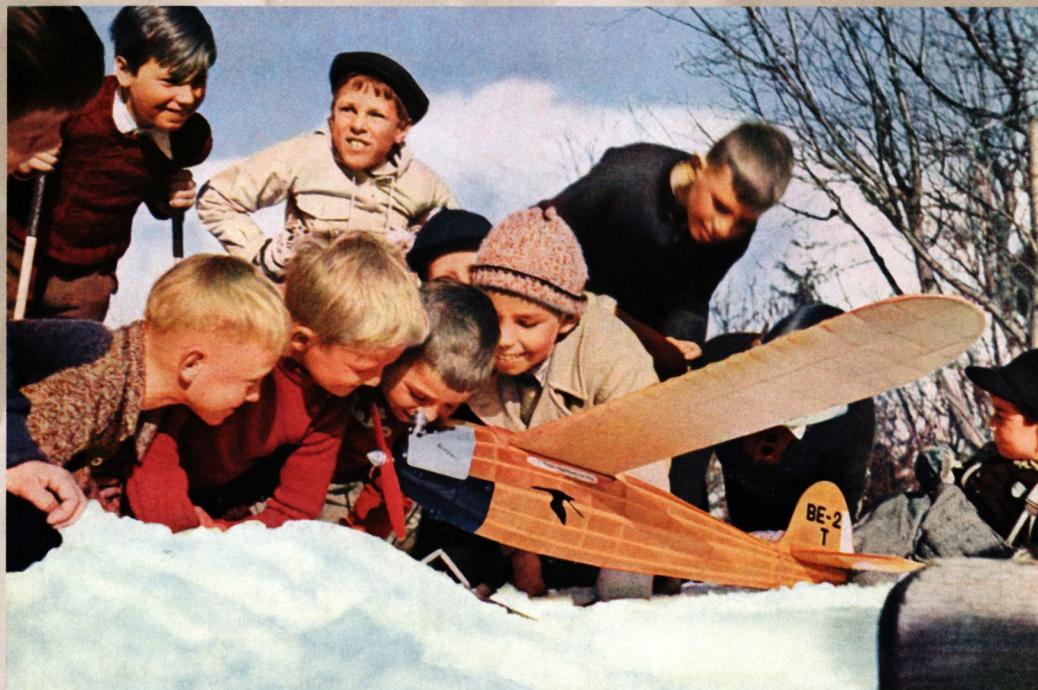
That widely known book may have contributed to many antique model builders harboring a desire to build a replica in order to keep this groundbreaking design alive. However, after years of fruitless searching, the hope of ever finding a blueprint had reached rock bottom.
Then, in the fall of 2010, a small miracle happened. Urs Brand, currently president of MG-Bern, received an email with a small photo of an antique model and the brief message: “Interested?” The email came from Bern’s Kirchenfeld neighborhood, where this airplane had spent the last few decades hanging in a basement of Mr. Fritz Frei’s legendary Café Royal. As part of a cleanup, the model now had to go. Urs reacted immediately and informed Peter Renggli, who had organized several vintage model gatherings for MG-Bern in recent years. Peter recognized the built-in motor as a DYNO I and suspected right away that the model must be one of the legendary designs from back then. So he picked it up in Bern, thereby saving it from being thrown away for good.
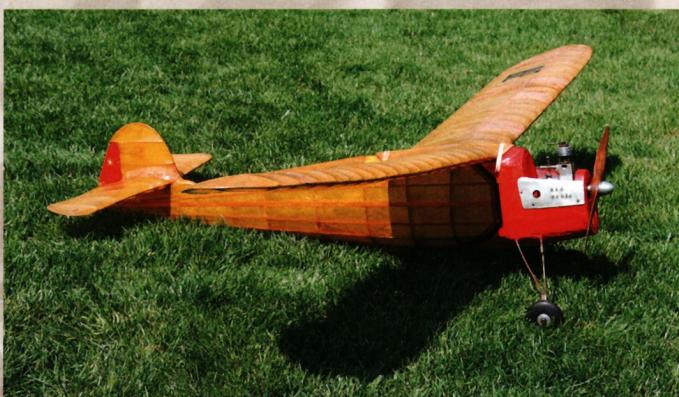
When Peter sent me photos of the model, I didn’t have to look twice. I nearly fell off my chair—it was a BORZONI! The frame spacing and the number of ribs matched those in the photos I was familiar with. The only differences were that the nose of the fuselage was a bit angular and the landing gear was positioned a little too low (*Image 2*).
After I shared my discovery with Peter, we agreed that I would measure the model and draw up a construction plan for it. So the model was reconstructed piece by piece. It was important to me that the old model be preserved. So I didn’t take it apart to get the measurements. Thanks to a few holes in the fabric covering, however, the interior could still be reconstructed perfectly. Through one of these holes, I then discovered the definitive proof that the model was indeed a Borzoni: on one of the wing ribs, the word “Borzoni” was handwritten in pencil. I have since performed a “structural” restoration on the extremely fragile original model. It is to be preserved as an authentic historical artifact.
Regarding the model's name, it should be noted that Giovanni Borzoni was an Italian aerobatic pilot whose performances presumably so impressed Willy Tauss that,
that he named his plane after him. It's possible that Willy witnessed Borzoni making headlines at the 1937 International Air Show in Dübendorf.
While reconstructing the model, I couldn’t resist tracing the individual parts onto plywood and sawing them out right away. My goal was to end up with not only the construction plan but also a flyable model. The dimensions were very plausible and bore the hallmark of Willy Tauss, who had always designed his models on 4-mm “Hüseli paper.” I had once received this tip from Ernst Schlachter. Unlike the original model, I had to glean a few details from historical photos, as they had evidently been implemented in the model differently from the original design. These included the aforementioned angular shape of the fuselage nose and the landing gear, as well as smaller details such as the position of the elevator on the fuselage, the design of the tail skid, and similar features. Christian Tanner was a great help to me in obtaining historical photos.
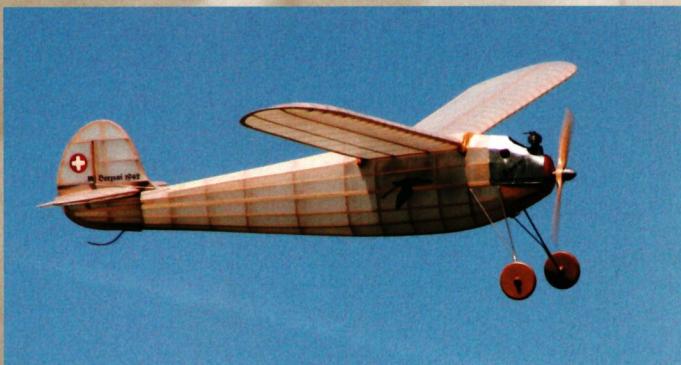
The crowning achievement of the project and the reward for all the hard work was ultimately the maiden flight of the newly restored Borzoni on April 11, 2011 (*Figure 3*). The DYNO engine, now nearly 70 years old, still runs reliably today
until the tank is empty and safely brought the model up to altitude. The flight performance is fantastic. The handling is forgiving—just as you’d expect from a free-flight model of that era. For safety reasons, however, my model is, of course, equipped with a radio control system.
The construction plan has now been completed and is available to anyone interested through the IG Albatros construction plan archive:
<http://www.ig-albatros.ch/modellplanarchiv.html>
My thanks go to everyone who contributed to the preservation of this Swiss model design, especially the individuals mentioned in the text. Another gap in the long history of Swiss model aviation has been filled.
In closing, I have one more request: Despite my successful reconstruction, I have not given up hope that one day an original drawing by Borzoni will turn up. I therefore urge all readers who have any information or even documents to share them with the author or the IG Albatros in the interest of preserving these old designs.
*Thomas Ghisler,
MG-Münchenbuchsee,
ghisler@gmx.ch*


News from HEBU

TEAM MANAGER "THIS" BOSSHARD
 Rodito Nussbaumer

SUMMER FUN 2026 AT MG USTER
Martin Wunderli
SMALL, MODEL-LIKE SAILBOATS
Res Dauwalder
TRY-OUT DAY AT MFV WETTINGEN
Urs Keller
52. 2026 ALPS CUP
 Emil Giezendanner

ATOM, THE NEW DOUBLE-DECKER FROM CPLR
 Matthias Bosshard

INSIGHTS INTO THE HISTORY OF SEAPLANES

YOU KNOW WHAT I MEAN? 125 YEARS OF THE SWISS AERO CLUB
Emil Giezendanner
34th HAHNENMOOS ALPINE MODEL AIRPLANE CAMP
Res Dauwalder
CORSAIR F4U – A WARBIRD WITH A MEMORABLE LOOK
Jürgen Rosenberger, Jürgen Prinz
F3A EUROPEAN CHAMPIONSHIPS IN ST-MACAIRE, FRANCE
Matthias Bosshard
What's New at Leomotion.com

HORIZON HOBBY/LEMACO NEWS: MICRO OV-10 BRONCO 645 MM BY E-FLITE

PRIDE AND GOOD IDEAS
 Markus Nussbaumer

BY YOUTH, FOR YOUTH
Lorena Betschen
FREE FLIGHT IN THE MIDDLE OF SUMMER
Urs Muntwyler
THE PC-21 STORY
Emil Giezendanner
TWIN TOWN PARTNERSHIP
Wolfgang Voeller
EURO CONTEST GLIDER ACRO TOUR AUSTRIA 2026

WELCOME, NEW MEMBER!
Andrea Bolliger
COUPE DES ALPES – OBSERVE AND LEARN
Rodito Nussbaumer
NEWS FROM HEBU
 Julia Bucher

FROM 0 TO 100
Markus Nussbaumer
MEMORIES
Wolfgang Völler
NOS REGION – A HUB FOR ELECTRIC AVIATION
Emil Giezendanner
Have you almost forgotten about aircraft that take off and land vertically?
Emil Giezendanner
70 YEARS OF THE NIDWALDEN MODEL AIRPLANE CLUB
Martin Barmettler