
Against Deadly Seriousness—or: Fun DIY Projects
This lighthearted article attempts to answer the question of whether model aircraft flying and humor are mutually exclusive.
When Emil Giezendanner saw my email offering to write an article for “Wider den tierischen Ernst” along with the photo “Man with Bird,” he said, “That would be a great change of pace from the 1,000 air shows featuring the same old jets! Thanks in advance and best regards.” And since Emil had already thanked me in advance, there was no turning back, and the typewriter began to clatter...
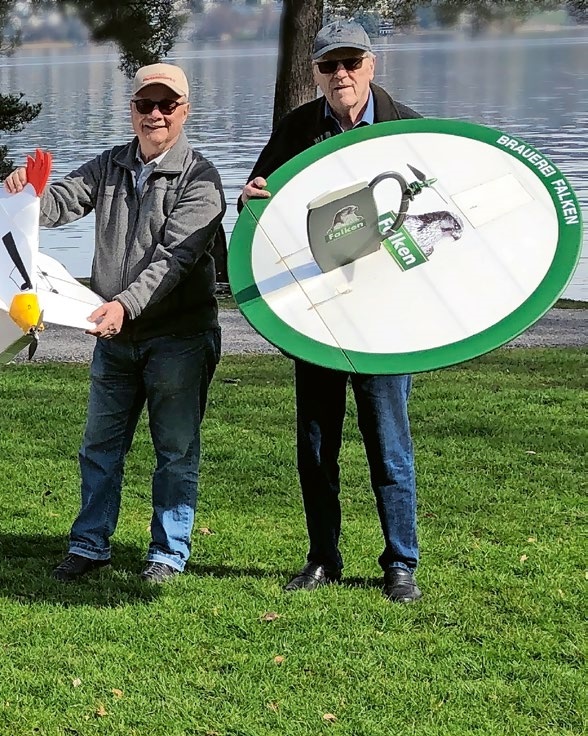
A few seaplane enthusiasts came up with the idea of showcasing fun, homemade models at a small, private event. So everyone had about half a year to design something and get it airworthy. Of course, everyone worked in secret, although there was a bit of “industrial espionage” here and there. All the models except the Cubby Cub—which was designed by Mathias Jasinski and built by Martin Gassmann—are genuine DIY creations. The big day arrived, and everyone presented their model and then flew it. It was a day no one will forget anytime soon, and every participant now has a lovely memento of that fun and exciting time in the form of their model.
This article is not intended to be a detailed, in-depth building guide. The space available in this trade magazine would be far too limited for that. To anyone who doesn’t just want to build models based on tried-and-true plans with a “guarantee of success,” but instead wants to take the much more exciting path of bringing their own ideas to life, I recommend studying the recording of the DMFV online seminar “Designing Custom-Built Models” by Hillmar Lange and the recording of the DMFV online seminar “Building Your Own Simple and Unusual Depron Models” by Thomas Buchwald.
It’s well known that Depron can be used to build very beautiful and intricate semi-scale models using a spar-frame construction method. My colleague Martin Gassmann is an expert in this field and has, for example, built a stunning Berijev Be-200 using a combination of wood and Depron. His “Fatty” model, modeled after a Piper Cub, is also built using an elaborate wood-Depron rib construction with a Clark-Y airfoil. In addition, Martin covered the model with Oratex, which he ironed directly onto the Depron. Martin will soon describe his construction method in detail in the mfs.
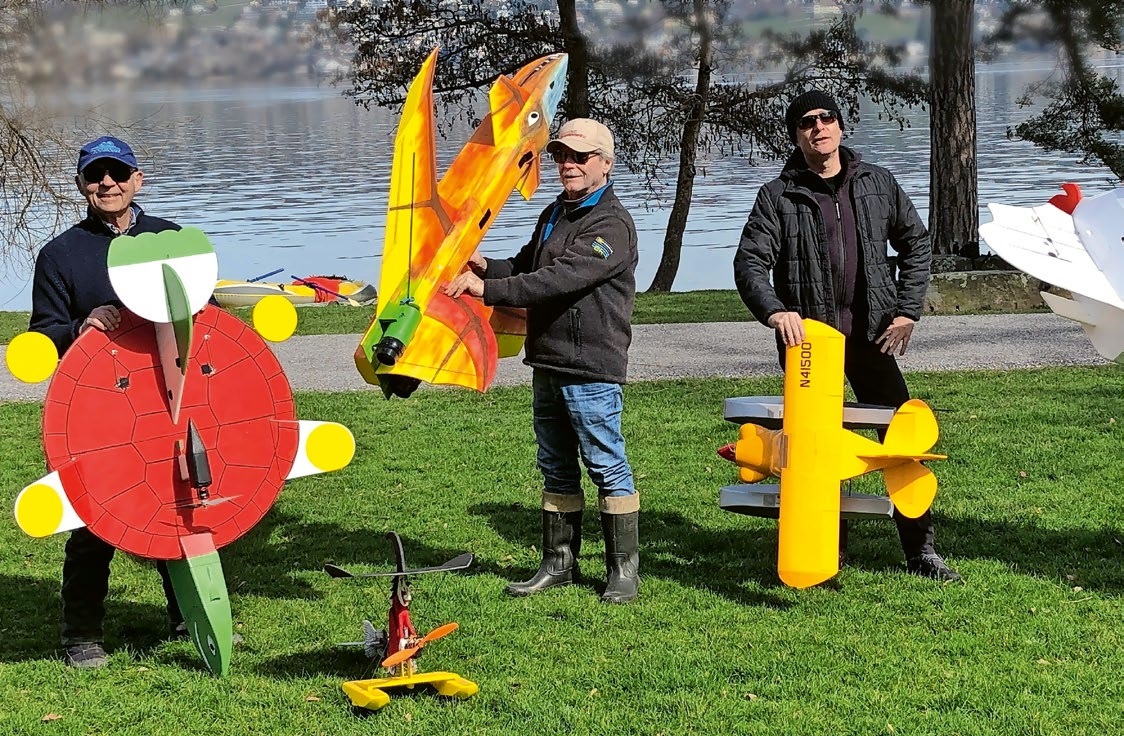
In addition to this labor-intensive wood-and-Depron construction method, there is a very simple Depron construction method using KFm profiles, which makes it possible to build models in a relatively short amount of time. Reinforced with carbon fiber rods and fiberglass fabric, these methods allow for the creation of lightweight yet sturdy models. As a result, the damage that typically occurs during the first flight tests of self-built models can be quickly repaired, and the models can be modified until they exhibit acceptable flight characteristics. So, after some initially disheartening experiences, I ended up building three experimental models with negative sweep that flew very well: a flying turtle and the certainly not entirely scale-accurate swift. I came up with the idea of negative sweep because my colleagues at the time were mostly building delta wings. So I had to come up with something completely different!
The simple Depron construction method described above is accessible to anyone, because it requires neither a computer with CAD software nor a 3D printer, neither above-average manual dexterity nor a large budget—but, above all, your own ideas. The base material used is Depron sheeting in 3 mm and 6 mm thicknesses. Ultra-sharp craft knives with replaceable blades are absolutely essential for cutting these sheets to size. As mentioned earlier, the models are reinforced with carbon fiber rods of various dimensions. On my models, the leading edge consists of 2-mm carbon fiber round rods that are glued in place and smoothly sanded; these can be easily adapted to different shapes—such as on my swift model. This ensures that no dents form, even when the wings are firmly tapped against door edges. Additional carbon fiber rods—in my case, usually 1 mm × 5 mm × 1000 mm—are glued in as needed. For this, I use 5-minute and 20-minute epoxy. The fuselages are usually reinforced with fiberglass mesh (approx. 50 grams/m²). Epoxy resin L and hardener L are used for laminating. Painting is done with acrylic paints, though these adhere only moderately well to Depron. For his Depron models, Heinz Lattmann uses Mixed Media Acrylic Color from tubes (available at Jumbo), which produces beautiful colors and results in fairly hard, durable surfaces.
These KFM profiles, which feature varying numbers of steps, were developed in the 1960s by Richard Kline and Floyd Fogleman for paper airplanes. They were granted two patents for this work. However, tests conducted by NASA yielded devastating results. According to NASA, a flat plate is said to have a better “lift-to-drag ratio” than the KFM profile tested by NASA. That’s why you won’t find these profiles on manned aircraft. Nevertheless, model aircraft builders highly value these profiles, and my own experience—as a non-expert in airfoils and a moderately talented hobbyist—has been thoroughly positive.
I myself have built three models with KFM4 profiles so far, and these models fly smoothly and quite fast. A model built by Heinz Lattmann using the KFM6 profile also performs flawlessly in the air. Of course, these airfoils don’t look very good on semi-scale models from a purely visual standpoint. As such, they’re particularly well-suited for functional and experimental models that can be built quickly and with little effort.
The indescribable sense of joy felt by a designer, builder, and pilot who finally succeeds after a long struggle cannot be experienced with any commercially available model, no matter how expensive.
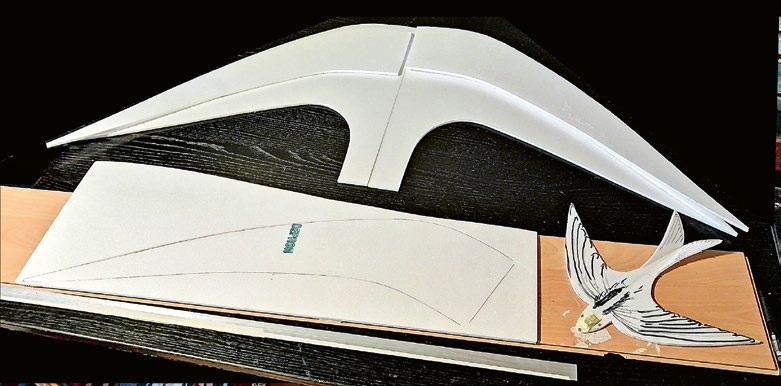
René Signer advised me to first build a mini glider of each model and test it in the backyard. I make sure the neighbors don’t see me too often tossing this “toy model” around, especially since its flight characteristics are initially questionable. This mini-model, which already takes the angle of attack into account, gives an indication of where the center of gravity might be on the large maxi-model. If the mini-model flies flawlessly, it is measured, a drawing is made, and the dimensions are then scaled up by a factor of X.
However, the flight characteristics of these mini-models do not always match those of the maxi-models. For example, the mini-model of the first prototype with negatively swept wings flew well, but the maxi-model merely tumbled uncontrollably through the air until it crashed into the ground. After various optimizations using the “trial and error” method, the model finally flew very well. I had a nearly identical experience with the “Flying Turtle.”
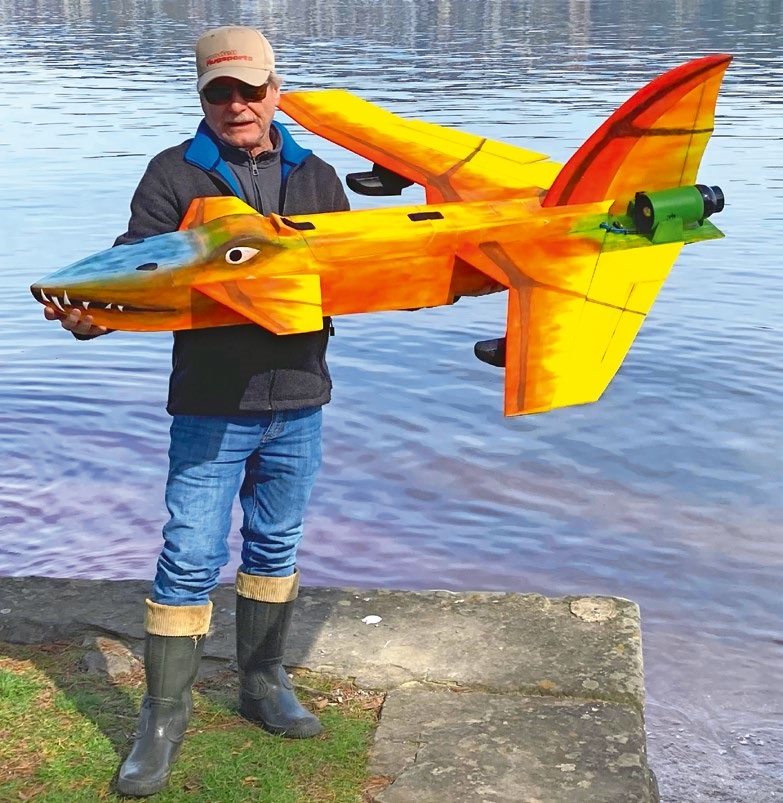
I’ve always admired swifts for their high-speed flight and their crescent-shaped wings. So it was clear to me that one day I would build a model with this wing shape. Of course, there are already plans available online for model swifts that fly well, though some are rather ugly and quite small. However, I wanted my model to be a hand-launched model—not entirely true to the original—that’s easy to control at all speeds and has a wingspan of 115 cm that’s clearly visible even from a distance. While it would have been quite labor-intensive to build this wing shape using a spar-and-stringer construction, the KfM4 profile was practically the obvious choice. With a 3S LiPo battery rated at 1,800 mAh, the intricately painted model—reinforced with numerous carbon fiber rods—weighs just 850 grams.
Given that the KfM4 profile isn’t exactly known for its low drag, I certainly didn’t expect high speeds. However, the speed measured by my GPS speed sensor during level flight—powered by a modest 3S motor producing 400 watts—still reached 130 km/h. And all this without whistling, without fluttering noises, and without the infernal roar of the motor! This is due in no small part to a perfectly balanced Aeronaut 10x7 folding propeller plus an aluminum turbo spinner—and, of course, moderate RPMs. Watching this “Silent Wing” model fly as if on rails is a true joy. Praise also came from the club, with comments such as “a really fast bird” or “excellent flight characteristics—almost like a real bird.”
Of course, the model—which was still white—wasn’t exactly a pretty sight, so my granddaughter Iva embellished it with a beautiful feathered outfit. Thank you so much, Iva! The fact that this also significantly increased the “bird acceptance factor” became clear when, during one of the first flights in its new outfit, no fewer than 8 (!) red kites showed up. They circled the model at a respectful distance to determine what kind of intruder had entered their territory. However, they did not attack it and flew away again.
I hope this report has shown that humor and model flying aren’t mutually exclusive! Bringing my own ideas to life in a cost-effective and not-too-time-consuming way has become my favorite pastime. As we all know, you can even make lawn mowers and tanks fly.
So if you haven’t tried it yourself yet… Oops…! I just had an idea about how I could finally get my X-Wing model—which recently crashed and still needs to be repaired—airworthy! So, enough writing—off to the workshop right away… my goodness, this is exciting…


News from HEBU

TEAM MANAGER "THIS" BOSSHARD
 Rodito Nussbaumer

SUMMER FUN 2026 AT MG USTER
Martin Wunderli
SMALL, MODEL-LIKE SAILBOATS
Res Dauwalder
TRY-OUT DAY AT MFV WETTINGEN
Urs Keller
What's New at Leomotion.com

52. 2026 ALPS CUP
 Emil Giezendanner

ATOM, THE NEW DOUBLE-DECKER FROM CPLR
 Matthias Bosshard

INSIGHTS INTO THE HISTORY OF SEAPLANES

YOU KNOW WHAT I MEAN? 125 YEARS OF THE SWISS AERO CLUB
Emil Giezendanner
34th HAHNENMOOS ALPINE MODEL AIRPLANE CAMP
Res Dauwalder
CORSAIR F4U – A WARBIRD WITH A MEMORABLE LOOK
Jürgen Rosenberger, Jürgen Prinz
F3A EUROPEAN CHAMPIONSHIPS IN ST-MACAIRE, FRANCE
Matthias Bosshard
HORIZON HOBBY/LEMACO NEWS: MICRO OV-10 BRONCO 645 MM BY E-FLITE

PRIDE AND GOOD IDEAS
 Markus Nussbaumer

BY YOUTH, FOR YOUTH
Lorena Betschen
FREE FLIGHT IN THE MIDDLE OF SUMMER
Urs Muntwyler
THE PC-21 STORY
Emil Giezendanner
TWIN TOWN PARTNERSHIP
Wolfgang Voeller
EURO CONTEST GLIDER ACRO TOUR AUSTRIA 2026

WELCOME, NEW MEMBER!
Andrea Bolliger
COUPE DES ALPES – OBSERVE AND LEARN
Rodito Nussbaumer
NEWS FROM HEBU
 Julia Bucher

FROM 0 TO 100
Markus Nussbaumer
MEMORIES
Wolfgang Völler
NOS REGION – A HUB FOR ELECTRIC AVIATION
Emil Giezendanner
Have you almost forgotten about aircraft that take off and land vertically?
Emil Giezendanner
70 YEARS OF THE NIDWALDEN MODEL AIRPLANE CLUB
Martin Barmettler