
F5A Electric Aerobatics – The Smart Aerobatics Class
A fun but no less demanding alternative
Why yet another new category of electric aerobatics, when almost all F3A pilots use electric motors anyway? Let me provide some information here. Because “power” RC aerobatics isn’t necessarily F3A. Many other interesting aerobatic categories now enrich the world of model aviation.
Only electric propulsion systems are permitted (unlike in F3A, F3M, or F3S).
Maximum model weight, including battery: 3.0 kg.
The maneuver sequence is open-ended.
Turn maneuvers are not evaluated individually but based on their overall impression.
Maneuvers may also be performed perpendicular to the flight axis.
Final freestyle routine set to music.
The flight area is confined to a relatively small “box” (110 m long × 75 m high × 75 m wide).
The selection of models suitable for aerobatics (most of which are made of wood and foil), with takeoff weights ranging from 2 to 3 kg, is almost limitless. These models are most often equipped with high-performance outrunner motors and have three to six cells. At least for some of them, there is no denying that their behavior is somewhat similar to that of F3A models. However, since they generally fly less stably, they are not suitable for F3A aerobatic routines performed over large open areas that include long straight lines. Yet it is precisely these characteristics that are useful for F5A flying. In fact, the maneuvers performed are significantly smaller than in F3A, carried out at very close range from both the pilot and the judges within a confined space. This style of flying is also appealing to spectators, and because of its limited spatial scope, it beautifully places the smallest models at the heart of the event. Nor should we overlook the fact that the “flawless” flight of these little marvels requires a good deal of talent and practice, as well as a love for recreational activities. Although it’s notoriously inappropriate to talk about “big bucks,” it’s no exaggeration to say that the price of an F5A model is equivalent to the cost of a fully equipped F3A model—“minus a zero.” This is a welcome financial reality, opening up tremendous opportunities for promoting the next generation of pilots in particular. Furthermore, anyone who has mastered this model in all flight attitudes and extreme maneuvers can easily move on to other categories of RC aerobatics.
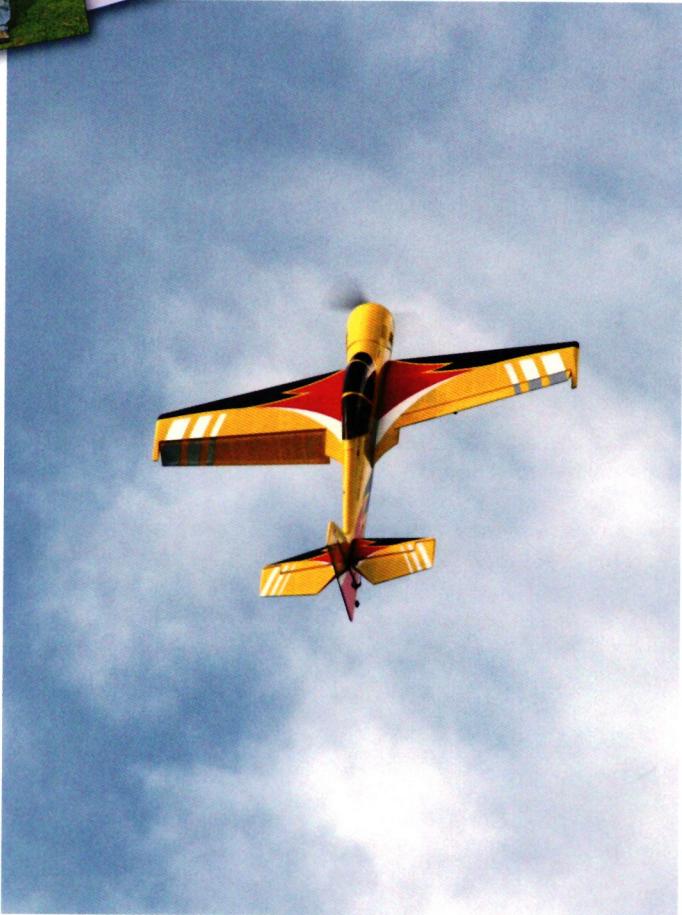
In fact, the models are significantly smaller than those in F3A, flying at very close range to both the pilot and the judges within a confined space. This style of flying is also appealing to spectators, and because it takes up so little space, it beautifully places even the smallest models at the heart of the event. Another point worth noting: the “flawless” flight of these little marvels requires a good deal of talent and practice, as well as a love for recreational activities. Although it’s notoriously improper to talk about “big bucks,” it’s no exaggeration to say that the price of an F5A model is equivalent to the cost of a fully equipped F3A model—“minus a zero.” This is a welcome financial reality, opening up tremendous opportunities for promoting the next generation of pilots in particular. Furthermore, anyone who has mastered this model in all flight attitudes and extreme maneuvers can easily move on to other categories of RC aerobatics.
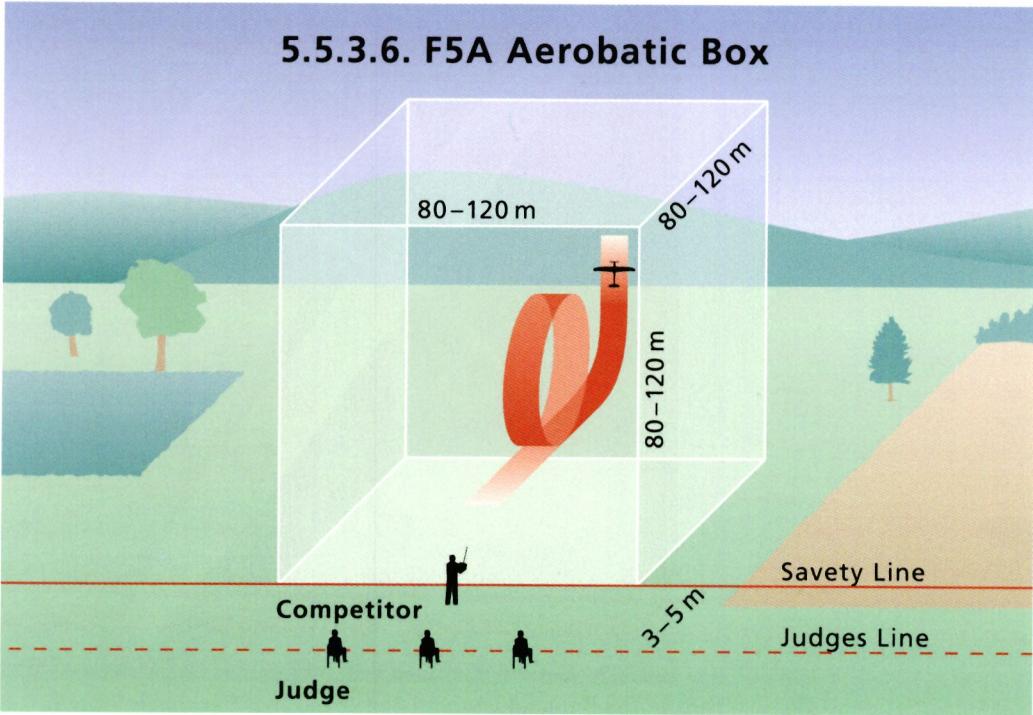
As mentioned above, each competitor designs their own program based on their abilities and preferences. To do so, they choose up to 12 figures from a catalog. Important: the sum of the coefficients must not exceed 50. This means they can select twelve easier figures, or a smaller number of more difficult ones. The catalog of figures is logically organized. It consists of 14 basic maneuvers, each with the lowest coefficients, plus three options per maneuver, with progressively higher difficulty levels and coefficients. The individual maneuvers also allow for a great deal of flexibility in terms of execution. For example, you can perform a loop with a barrel roll or “snap” above or below, just as with “humpty bump” combinations, etc. Critics of this system dislike the fact that anyone can create their own routine, which can lead to potential problems during scoring. However, based on my experience and assessment, this drawback is offset by the fact that F5A competitions are less monotonous, which encourages the judges to pay closer attention. The judges themselves have, in fact, responded very positively. In addition to scoring individual maneuvers, a score is also awarded for overall impression. This encompasses transitions between maneuvers, takeoffs and landings, positioning and use of airspace, and staying within the boundaries of the “box.”
Participating in F5A competitions requires less technical preparation, without compromising on aeronautical sophistication. Training can take place at small airfields (and even on sports fields in some countries), over short distances, and with virtually no noise. The selection of F5A aerobatic models—which are as beautiful as they are affordable—is virtually unlimited. The power system (3 to 6 LiPo batteries) is undemanding and widely available. The freedom pilots have in designing their aircraft brings a breath of fresh air to the world of aerobatics, diversifying the sport and making it more appealing to the public. The freestyle program, in particular, is generating intense support and enthusiasm everywhere. For those who want to learn more, consult the FAI regulations for electric flight at:
www.fai.org/aeromodelling/documents
Good luck and have fun!
E. Giezendanner


News from HEBU

TEAM MANAGER "THIS" BOSSHARD
 Rodito Nussbaumer

SUMMER FUN 2026 AT MG USTER
Martin Wunderli
SMALL, MODEL-LIKE SAILBOATS
Res Dauwalder
TRY-OUT DAY AT MFV WETTINGEN
Urs Keller
What's New at Leomotion.com

52. 2026 ALPS CUP
 Emil Giezendanner

ATOM, THE NEW DOUBLE-DECKER FROM CPLR
 Matthias Bosshard

INSIGHTS INTO THE HISTORY OF SEAPLANES

YOU KNOW WHAT I MEAN? 125 YEARS OF THE SWISS AERO CLUB
Emil Giezendanner
34th HAHNENMOOS ALPINE MODEL AIRPLANE CAMP
Res Dauwalder
CORSAIR F4U – A WARBIRD WITH A MEMORABLE LOOK
Jürgen Rosenberger, Jürgen Prinz
F3A EUROPEAN CHAMPIONSHIPS IN ST-MACAIRE, FRANCE
Matthias Bosshard
HORIZON HOBBY/LEMACO NEWS: MICRO OV-10 BRONCO 645 MM BY E-FLITE

PRIDE AND GOOD IDEAS
 Markus Nussbaumer

BY YOUTH, FOR YOUTH
Lorena Betschen
FREE FLIGHT IN THE MIDDLE OF SUMMER
Urs Muntwyler
THE PC-21 STORY
Emil Giezendanner
TWIN TOWN PARTNERSHIP
Wolfgang Voeller
EURO CONTEST GLIDER ACRO TOUR AUSTRIA 2026

WELCOME, NEW MEMBER!
Andrea Bolliger
COUPE DES ALPES – OBSERVE AND LEARN
Rodito Nussbaumer
NEWS FROM HEBU
 Julia Bucher

FROM 0 TO 100
Markus Nussbaumer
MEMORIES
Wolfgang Völler
NOS REGION – A HUB FOR ELECTRIC AVIATION
Emil Giezendanner
Have you almost forgotten about aircraft that take off and land vertically?
Emil Giezendanner
70 YEARS OF THE NIDWALDEN MODEL AIRPLANE CLUB
Martin Barmettler