
Building and Flying
For more than 25 years, I’ve been experimenting with electric motors on various types of models. Sometimes with success, but also with disappointments. However, the products that have come onto the market in the last three years are truly remarkable. The wide variety of products makes it increasingly difficult to choose.
Not long ago, I read an article in FMT (2/07) about new products—specifically, MVVS outdoor-runner motors with a solid casing, dual bearings, and built-in plug-in contacts for the controller. I couldn’t get it out of my head. I searched the Internet for more information and found the 5.6/960 Redliner. Since I knew that Topmodel is the importer for MVVS, I contacted the company, and in less than 14 days I received the first motor from this series to be delivered to Switzerland. It’s a real feast for the eyes.
| Engine: | MVVS 5.6/960 Redliner | |
| Voltage | 12 V | |
| Lipo | 3–4 | |
| Operating current | 35–45 A | |
| Max. weight | 65 A for 20 seconds | |
| 270 g | ||
| Lipo: | Dualsky, 3S 2P | |
| 11.1 V | ||
| 4,500 mAh | ||
| 12–15 C, briefly 20 C | ||
| ESC: | Jeti, Adv. 75–3P Opto | |
| Model: | Marabu high-wing | |
| Wingspan | 180 cm | |
| Flight weight | 2.9 kg | |
| Propeller | APC 11 × 8 standard | |
| Max. current at idle | 40 A | |
| Receiver battery | NiCd, 1400 mAh |
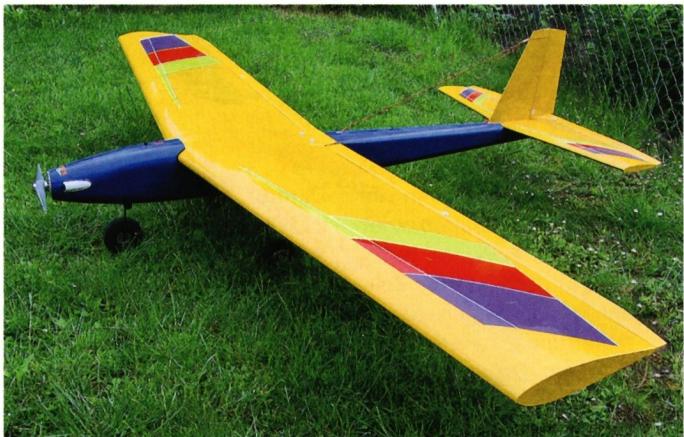
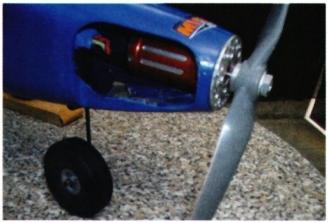
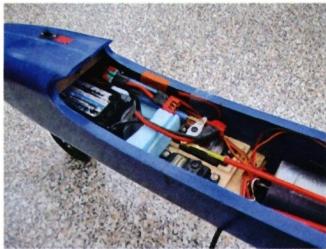
CNC-milled motor with fan and cooling slots. In the “hangar” there was still a rough-built Marabu high-wing airframe, which, however, was not intended for electric propulsion and had a correspondingly medium-weight structure. None of this prevented me from milling out the epoxy-embedded motor bulkhead in the epoxy fuselage so that the new electric motor, weighing only 270 grams, would fit into the nose of the fuselage. A nose bulkhead made of 2-mm aluminum, complete with mounting and cooling holes, was embedded in the fuselage using 4-mm aircraft plywood, just as one would with a glider fuselage. All other internal components were placed as far forward as possible. Nevertheless, adding approximately 200 grams of lead was unavoidable. Three weeks after receiving the motor, the maiden flight was
(retiree’s haste). A group member took on the maiden flight because my fingers were already shaking before we even started rolling. The maiden flight went off without a hitch. There was plenty of power. Initial nose-heavy tendencies were corrected, and I’ve been flying the model myself ever since. As befits a trainer, simple maneuvers are easy to fly. For a standard—
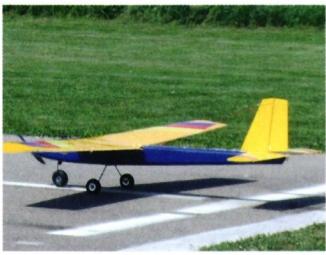
During flight, you only need to use about half to three-quarters of the throttle. The heating of the power units is barely noticeable. I am convinced that this power system can be used to fly model aircraft with wingspans between 150 and 180 cm using three LiPo batteries.
*Oskar Itel, MG Diessenhofen*


TEAM MANAGER "THIS" BOSSHARD
 Rodito Nussbaumer

F3A EUROPEAN CHAMPIONSHIPS IN ST-MACAIRE, FRANCE
 Matthias Bosshard

News from HEBU

YOU KNOW WHAT I MEAN? 125 YEARS OF THE SWISS AERO CLUB
 Emil Giezendanner

SUMMER FUN 2026 AT MG USTER
Martin Wunderli
TRY-OUT DAY AT MFV WETTINGEN
Urs Keller
52. 2026 ALPS CUP
Emil Giezendanner
BY YOUTH, FOR YOUTH
Lorena Betschen
CORSAIR F4U – A WARBIRD WITH A MEMORABLE LOOK
Jürgen Rosenberger, Jürgen Prinz
SMALL, MODEL-LIKE SAILBOATS
Res Dauwalder
What's New at Leomotion.com

ATOM, THE NEW DOUBLE-DECKER FROM CPLR
Matthias Bosshard
INSIGHTS INTO THE HISTORY OF SEAPLANES

34th HAHNENMOOS ALPINE MODEL AIRPLANE CAMP
Res Dauwalder
HORIZON HOBBY/LEMACO NEWS: MICRO OV-10 BRONCO 645 MM BY E-FLITE

COUPE DES ALPES – OBSERVE AND LEARN
Rodito Nussbaumer
PRIDE AND GOOD IDEAS
 Markus Nussbaumer

EURO CONTEST GLIDER ACRO TOUR AUSTRIA 2026

FREE FLIGHT IN THE MIDDLE OF SUMMER
Urs Muntwyler
THE PC-21 STORY
Emil Giezendanner
TWIN TOWN PARTNERSHIP
Wolfgang Voeller
WELCOME, NEW MEMBER!
Andrea Bolliger
NEWS FROM HEBU
 Julia Bucher

FROM 0 TO 100
Markus Nussbaumer
MEMORIES
Wolfgang Völler
NOS REGION – A HUB FOR ELECTRIC AVIATION
Emil Giezendanner
Have you almost forgotten about aircraft that take off and land vertically?
Emil Giezendanner
70 YEARS OF THE NIDWALDEN MODEL AIRPLANE CLUB
Martin Barmettler