
Friendly Fly-In of the Bülach, Erlenbach, and Wehntal Model Aircraft Clubs; F3 B Gliding Championship
As part of a friendly gathering of the Bülach, Erlenbach, and Wehntal model aircraft clubs, a practical test of the new F3 B / FAI RC Glider Championship was conducted near Schneisingen on November 26, 1974.
The three groups mentioned are primarily involved in RC gliding and are therefore showing keen interest in this new program.
After a thorough review of the provisional regulations, the club presidents concluded that, given the likely length of time required for each session (assuming optimal staggering of start times and minimal breaks due to organizational inefficiencies; a duration of 4 hours per round was assumed for 20 participants), the early onset of nightfall at this time of year, and the possibility of fog, to limit the event to just one run. As a result, 9 pilots completed the program in about 3 hours on this cold, wet, and unpleasant Sunday.
From the lively discussions during the competition and afterward over a warming cup of coffee at the Wehntalers’ regular hangout, it was unanimously agreed that the current rules, with a few minor exceptions, are very well thought out and have been put to the test in practice on multiple occasions. The years of fine-tuning within CIAM have undoubtedly paid off.
The alignment with man-carrying performance gliding seems particularly striking, as the individual tests place similar and quite high demands on both pilot and model (naturally, always tailored to RC gliding and its practical limitations).
What is certain is that this program will bring about a new direction in model construction. Due to the requirement that all three tests must be completed with the same, unmodified model—with only ballast additions within the FAI weight limits and changes to the EWD permitted—we are compelled to focus our attention during model development on achieving a good $v_{\text{sink}}$, a good glide angle, a wide speed range, good maneuverability, and precise controllability. Airfoils with flaps will become the norm, and the ability to control the model around all three axes will be a given. Since only one round of flying took place, it is not possible to make a comparison based on the results. Furthermore, the comparatively large differences in performance are likely not due to the models themselves, but rather to the pilots, as the requirements were still relatively new.
The goal here is to achieve an ideal flight time of 6 minutes with the model glider by utilizing slope or thermal lift in combination with the lowest possible $v_{\text{sink}}$ from a high-launch line just 150 m long. Afterward, a precision landing must be performed, taking the elapsed time into account.
In this test, the pilot and the model—which remains unchanged from Test A—are evaluated to determine whether the speed corresponding to the best glide angle can be maintained for 4 minutes. The objective here is to fly an optimal turn at each maneuver without any additional loss of altitude, speed, or distance.
Since the measurement period is only 4 minutes, compared to the maximum available flight time of 8 minutes, the pilot can, with smart tactical maneuvering, gain altitude from the 150-meter mark onward and then guide the model over the course at the ideal glide angle. The speed required for this—particularly with high-performance airfoils—is far higher than is generally assumed and demands a great deal of concentration and flying skill from the pilot.
There appears to be a strong aversion to this part of the program, particularly among South African and American model aviators. We believe the main reason for this lies in the extremely lightweight construction of these models, which is still too heavily based on A2 gliding. If, during the turn, an attempt is made to bring the model onto the opposite course as quickly as possible by executing a sharp horizontal turn, wing fractures are inevitable. However, the fact that a 180° turn must be flown within the speed course and that the model must be carried over unchanged from Tests A and B (with the exception of added ballast) prevents the competition from becoming the exclusive domain of specialists from the outset. We do not believe it makes sense to attempt to reach the model’s absolute top speed on the straightaway. Rather, the pilot should work toward an optimal speed at which he is able to incorporate a quick turn—in the form of an Immelmann, a downswitch, or another maneuver. We are convinced that, with the models available to us today, it is possible to achieve times of 10 seconds—corresponding to 30 m/s or 108 km/h—without crashing.
As can be seen from the above, this competition offers a very challenging but also extremely interesting test in which all data can be measured.

What's New at Leomotion.com

PRIDE AND GOOD IDEAS
 Markus Nussbaumer

News from HEBU

TEAM MANAGER "THIS" BOSSHARD
 Rodito Nussbaumer

ATOM, THE NEW DOUBLE-DECKER FROM CPLR
 Matthias Bosshard

INSIGHTS INTO THE HISTORY OF SEAPLANES

34th HAHNENMOOS ALPINE MODEL AIRPLANE CAMP
Res Dauwalder
CORSAIR F4U – A WARBIRD WITH A MEMORABLE LOOK
Jürgen Rosenberger, Jürgen Prinz
SUMMER FUN 2026 AT MG USTER
Martin Wunderli
F3A EUROPEAN CHAMPIONSHIPS IN ST-MACAIRE, FRANCE
Matthias Bosshard
52. 2026 ALPS CUP
 Emil Giezendanner

HORIZON HOBBY/LEMACO NEWS: MICRO OV-10 BRONCO 645 MM BY E-FLITE

TWIN TOWN PARTNERSHIP
Wolfgang Voeller
EURO CONTEST GLIDER ACRO TOUR AUSTRIA 2026

BY YOUTH, FOR YOUTH
Lorena Betschen
YOU KNOW WHAT I MEAN? 125 YEARS OF THE SWISS AERO CLUB
Emil Giezendanner
SMALL, MODEL-LIKE SAILBOATS
Res Dauwalder
TRY-OUT DAY AT MFV WETTINGEN
Urs Keller
WELCOME, NEW MEMBER!
Andrea Bolliger
FREE FLIGHT IN THE MIDDLE OF SUMMER
Urs Muntwyler
THE PC-21 STORY
Emil Giezendanner
COUPE DES ALPES – OBSERVE AND LEARN
Rodito Nussbaumer
NEWS FROM HEBU
 Julia Bucher

FROM 0 TO 100
Markus Nussbaumer
NOS REGION – A HUB FOR ELECTRIC AVIATION
Emil Giezendanner
MEMORIES
Wolfgang Völler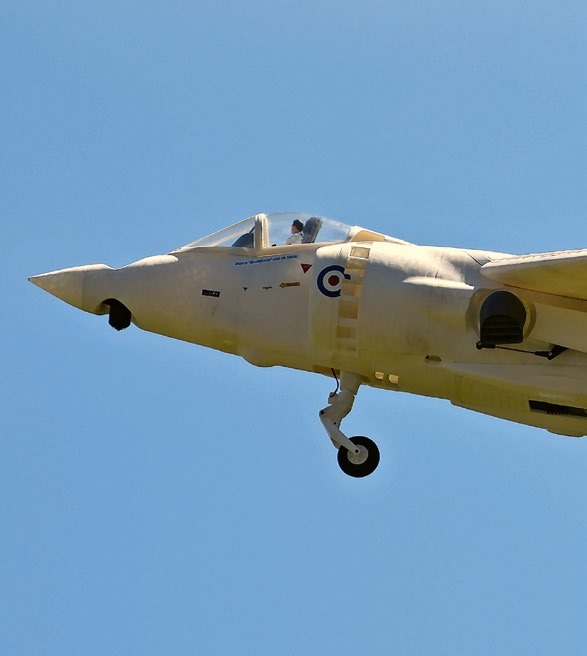
Have you almost forgotten about aircraft that take off and land vertically?
Emil Giezendanner
70 YEARS OF THE NIDWALDEN MODEL AIRPLANE CLUB
Martin Barmettler