
A Replica of a Classic: Bell 47G3
The Bell 47 (military designation Bell H-13; known as the Bell HTL and Bell HUL in the United States Navy until 1962) was a light two- or three-seat helicopter developed by the Bell Aircraft Corporation. In the United States, it became the first civilian helicopter to receive certification on March 8, 1946. Various versions of the helicopter remained in service worldwide well into the 1980s and beyond. A few are still flying today, including the HB-XMG here in Switzerland, which served as the model for Franz Planzer’s replica.
Franz Planzer with his model.
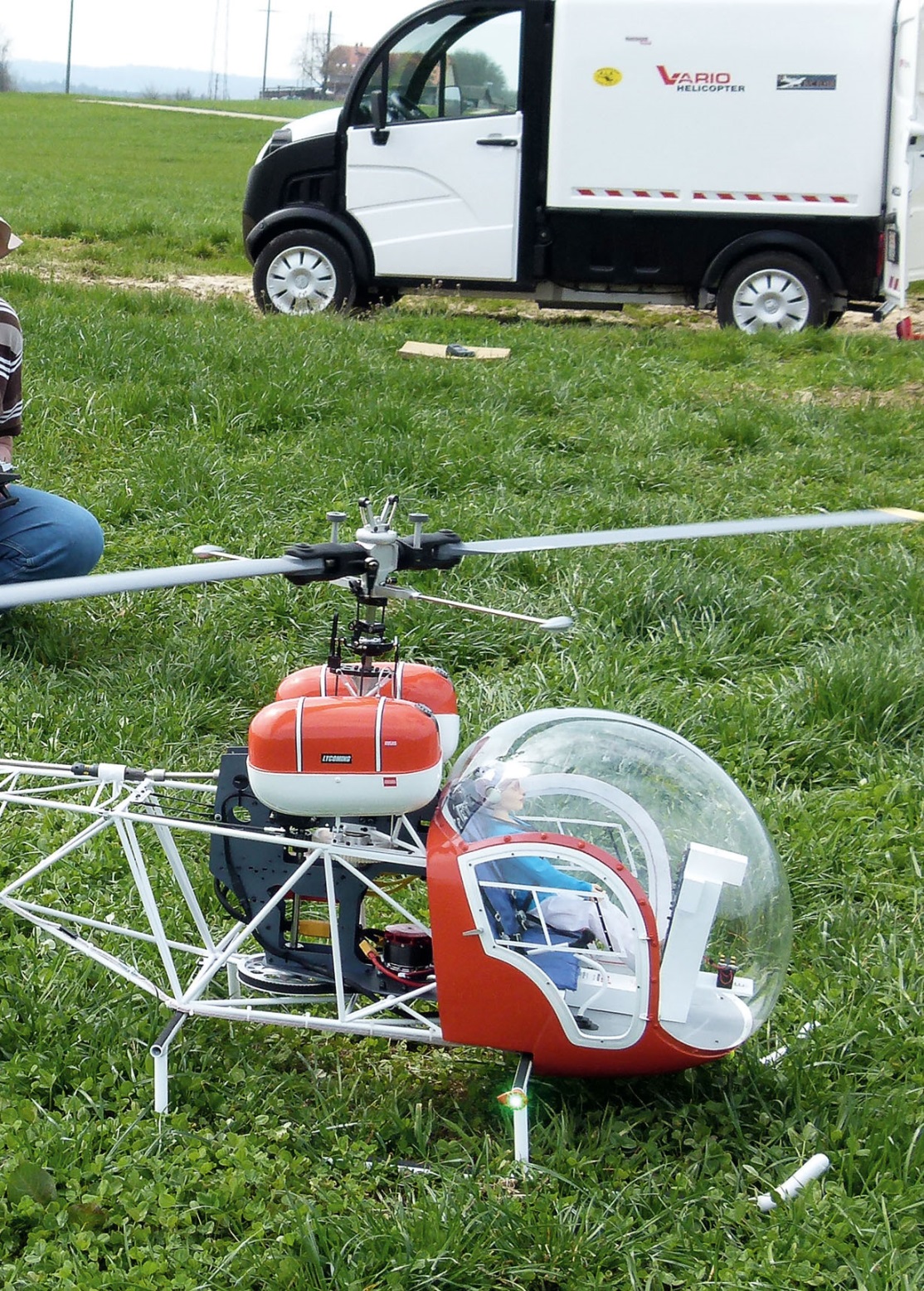
The development of the Bell 47 traces back to the Model 30, designed by Arthur M. Young, which made its maiden flight as early as June 1943. The Model 30 was the first helicopter developed and built by Bell. This helicopter already exhibited the characteristics of subsequent models: the two-blade rotor with cyclic pitch control, the stabilizer strut arranged at right angles to the rotor blades, and the partially fairing-covered tubular frame.
Following the prototype’s maiden flight on December 8, 1945, production of the first production version began in 1946. The Bell 47A was intended for military use; it was designated YR-13 for the U.S. Air Force and HTL-1 for the Navy. Almost simultaneously, production of the 47B, a civilian version of the helicopter, was already underway. Experiments were also conducted with a five-seat variant—the Bell Model 42—which, however, did not enter series production.
The first model to feature the well-known Plexiglas cockpit was the Bell 47D. The Model D was the first helicopter Bell produced in large-scale series for military purposes. In the United States Army, this variant was designated H-13B or, in one instance, YH-13C; in the Navy, it was designated HTL-2. The Army’s YH-13C was a pre-production prototype of an ambulance variant;
Later, some H-13Bs were to be converted into the final H-13C ambulance helicopters. On September 17, 1952, a Bell 47 D-1 (N167B) set the world record—still standing today—for the longest distance flown (1,958.80 km without a stopover) in a helicopter powered by an internal combustion engine, as recognized by the International Air Sports Federation. Further versions followed. The 47J “Ranger” was the first model to feature a fully enclosed fuselage; the 47G, equipped with a new engine and additional fuel tanks, along with its sub-versions, was the most successful model in the 47 series.
In Europe, the Bell 47 was built under license by both Agusta (Italy) and Westland Aircraft (United Kingdom). As a result, the Bell 47 became one of the most widely used helicopters in the world. A total of 45 Bell 47G-2 “Sioux” and Agusta/Bell AB 47G-2 helicopters remained in service with the German Bundeswehr until the mid-1970s.
Kawasaki Heavy Industries in Japan began manufacturing the Bell 47 under license in 1952. In addition, Kawasaki also introduced the Kawasaki KH-4, a helicopter further developed from the Bell 47.
The aircraft that served as the model for the Bell 47 G3 HB-XMG replica—painted in the colors of the former Heliswiss—is owned by the Krista Rooschütz Foundation in Bern and is stationed at Écuvillens Airport (LSGE). The original Bell 47 is in very good, airworthy condition and can be admired from time to time at air shows.
Franz Planzer is a model pilot who has been demonstrating his super-scale models at air shows for many years. He began model flying back in the 1970s with Schlüter’s Heli-Boy and Heli-Baby. For him, it all started in the scale model category with a Heli Bernina Lama. This was soon followed by the Rega EC145, powered by a JetCat PHT3, and then a Lama from Söllner. Unfortunately, that model was lost due to a technical problem. Over the past four years, he has been seen at countless events flying his large Bell 429 “Susi” from Alterbaum.
During his extensive research for a new model, it was clear to Franz from the very beginning that it should be an electric scale helicopter. The model needed to weigh well under 20 kilograms so that it could be handled alone during transport and flight; but it should also be of a respectable size and have a connection to a real-world counterpart in Switzerland. It soon became clear to him that these many requirements could only be met by a model with a lattice fuselage, primarily because of the weight. It soon became clear that it would be the Bell 47 G3 from Vario. The fuselage kit consists of a four-piece stainless steel lattice fuselage, various fiberglass parts with a white finish, an eight-milli-
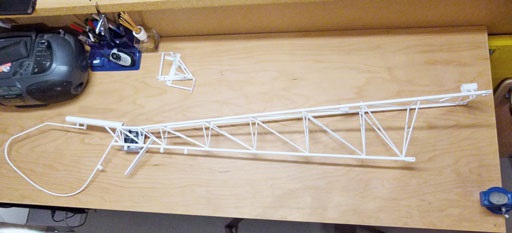
A meter-thick stainless steel shaft for the exposed tail drive, a fully welded landing gear, a complete set of frames, and the glazing. Various small parts are also included. Hinges, door handles, the cockpit, and other scale parts must be purchased separately. Also not included are the mechanical components, the complete rotor head, rotor blades, tail rotor with blades, lighting, motor and ESC, electronic components, etc.
First, the stainless steel mesh fuselage, the fuselage center section, and the landing gear were thoroughly prepared for powder coating. To do this, the solder joints were carefully sanded down, and other irregularities were smoothed out. It then took some time to find a powder coater who would coat all these parts at a reasonable price.
First, the parts must pass through the cleaning bath and then be dried in the oven. Only then can the powder be applied and, in a second step, cured in the oven. If this were done in a single step, there would be a risk that cleaning fluid could seep into the tubes at the solder joints, causing blisters to form during the curing process. Of course, this also presupposes that, given today’s high level of automation, the powder coater would have the capability to carry out the process in this manner. Unfortunately, there are only a few small powder coating shops left that can handle such jobs. You’re welcome to request the address from the editorial office.
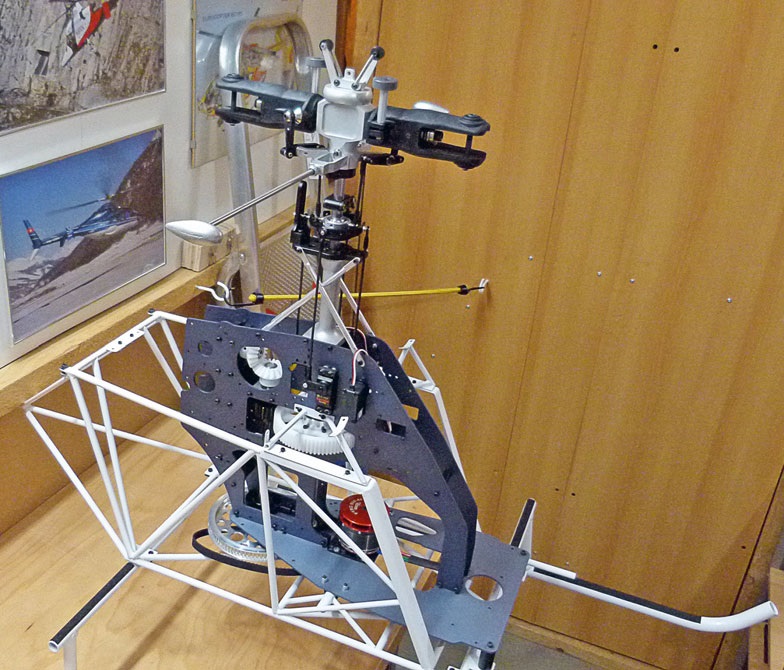
The major advantage of powder coating for the fuselage is that, compared to liquid painting, it eliminates the need for filler and primer, and the impact resistance of the powder coating is much higher. Unfortunately, however, it is only possible on metallic materials. While the parts were at the powder coating shop, work could begin on assembling the mechanical components. Vario’s electromechanical system not only looks very sturdy and robust—it actually is. The builder found the assembly process very straightforward, and the setup and adjustment were completed in no time. The drive motor, a Kontronik Pyro 800-40, is mounted at the bottom of the mechanical assembly. The Kontronik Kosmik 160 HV is used as the controller. A toothed belt is used for the first gear stage, which later contributes significantly to very quiet operation. All four Tausendscheibe servos, as well as the tail rotor servo, are mounted in the mechanical side plates.
| Bell 47G3B | Prototype | Model |
|---|---|---|
| Crew | Pilot, two passengers | – |
| Max. takeoff weight | 1,340 kg | 15.0 kg |
| Engine | Lycoming TVO-*435, 270 PS | Electric motor controller |
| Fuel capacity | Approx. 600 liters | 2 x 6S 5200 mA battery |
| Fuselage length | 9.62 m | 2.40 m |
| Length overall | 13.17 m (rotor spinning) | 3.05 m (rotor spinning) |
| Rotor diameter | 11.35 m | 2.50 m |
| Height | 2.83 m | 0.76 m |
| Rotor speed | 384 rpm | 800 rpm |
| Max. cruising speed | 169 km/h | – |
| Range | Up to 500 km | – |
| Max. climb rate | Up to 9 m/s | – |
After the fuselage sections returned from powder coating, the landing gear was installed first to ensure everything was properly positioned on the workbench, and then the mechanical components could be “integrated” with the fuselage. When assembling the tail boom, it’s very pleasing that this lattice structure is attached to the chassis with just five screws. This makes it relatively quick to disassemble, which greatly facilitates transport, especially given its impressive size. The stainless-steel tail rotor shaft, featuring multiple ball bearings, is mounted at the top of the boom—just like on the manned prototype—and is clearly visible. The mechanical connection to the tail drive and tail rotor is made via appropriate universal joints, which closely resembles the original.
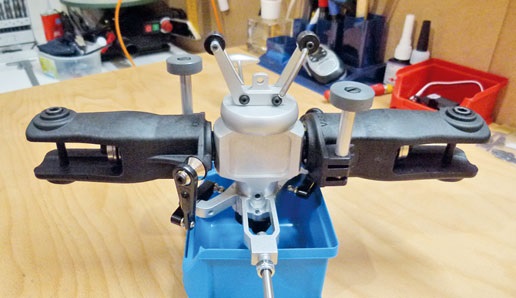
For the main rotor, Vario’s semi-scale two-blade rotor head was used, which—like the prototype—is mounted with the Hiller rod and matching counterweights. The centrifugal weights with springs mounted on the center section have no functional purpose and serve only to replicate the real-life model as closely as possible. The same applies to the paddle rod with the weights on the outside. Thus, from a purely control-system perspective, only the two Vario main rotor blades with S-swash are used, each measuring 1120 mm in length. The blade attachment diameter is 22 mm, and the blades are secured to it with M6 screws. The aluminum version from Vario is used as the tail rotor. The only things that aren’t ideal here are the angular housing and the plastic blade holders.
The Futaba BLS 452 servos are installed in the four-point swashplate linkage. The same fast and powerful servo is also used for tail control. The tail rotor linkage is implemented using a carbon fiber rod. This control method allows for direct and precise control of the tail rotor. The BavarianDemon HC3X was installed for the flybarless system.
In the rotor head linkage, the deflection levers mounted on the rotor head’s center piece demonstrate their advantages. These are not used for their original purpose—namely, mixing the Hiller (stabilizer bar) with the Bell (main rotor blades)—but are also employed to mechanically reduce the control travel. Without this additional reduction, the control deflection on the two-blade rigid main rotor system would be too great. Thanks to this cleverly designed deflection mechanism from Vario—in which the levers are mounted on a bracket attached to the center piece—the servos are significantly relieved of load during flight. It also increases the precision of the linkage through greater servo resolution.
The openings for the doors and windows, as well as all other necessary cutouts, were cut out as usual using a “Dremel” fitted with a diamond cutting disc. The doors turned out to be unexpectedly labor-intensive, as the frames didn’t fit at all and had to be adjusted by carefully heating the contours of the fuselage. The doors are secured with magnets, so the door handles are purely decorative. But the result made all the hard work worthwhile. After embedding the frames in resin and attaching the lighting to the canopy, the glazing could be fitted. Extreme concentration and caution are required here, unless you want to end up ordering a second set of glazing. Afterward, the cockpit could be adjusted to fit the chassis and then mounted. Fitting the horizontal and vertical stabilizers also posed no major problems. For the dummy fuel tanks, an internal brace made of 4 mm plywood was additionally fabricated and embedded in resin. This provides greater rigidity. The fuel tank caps were upgraded with scale screws. The missing vent, which is a distinctive feature of the Bell 47 G3’s fuel tanks, was recreated using brass tubing, in accordance with the prototype.
All fiberglass parts were painted using Tamiya spray paint. After sanding with 600-grit sandpaper, everything was primed, then painted, and finally sealed with a gloss clear coat from the same manufacturer. Although the model builder did not have much experience with painting and the painting was done outdoors, the result is more than impressive.
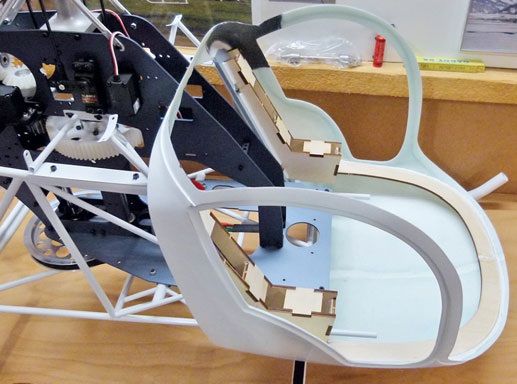
The cockpit floor can be easily removed—after loosening four screws—to quickly access the electronics. The power supply is located under the cockpit floor. It is the PowerBox Evolution-Spektrum, a dual power supply with an integrated 9-channel receiver. Three satellite receivers are connected to it. The entire system is powered by two 7.4 V Li-Lo batteries, each with a capacity of 2500 mAh. The switch for the PowerBox is mounted on the rear frame. The remaining controls—such as the charging ports for the two PowerBox batteries, the charge monitor, and the switch for the lighting—are mounted on the rear of the cabin. This has the advantage that almost nothing is visible, the doors do not need to be opened to operate the components, and the model’s appearance is not unnecessarily marred.
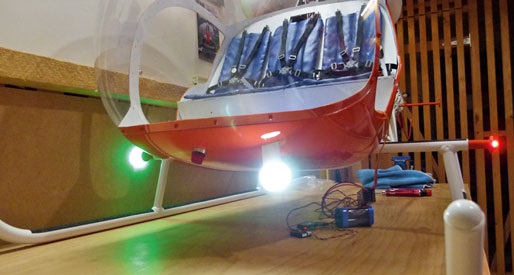
Further cockpit-scale work on the model involved positioning the tail rotor pedals, the instrument panel, and the control sticks. Extensive assembly and painting work on the instruments, seats, seat belts, and control elements make the model an absolute “gem.” The scale-accurate seat belts, pedals, control sticks, and pitch levers are from Vario. But other cockpit details, such as the fire extinguisher, starter battery, and the pilots, are also included. The instrument panel is held in place by five strong magnets—so it can be removed and reinserted in seconds.
Most Bell 47 G3s have their position lights in the cabin sidewalls. The chosen prototype, however, has them mounted on extensions of the front cross member of the landing gear. So, a custom solution was required here. The teardrop-shaped mounts were cut out of plywood and adapted to fit the Power LEDs; then, matching aluminum tubes were slipped over the heat sinks, glued in place, painted, and installed into the struts of the skids. The landing light was adapted from an original flip-up headlight and is equipped with an extremely bright LED. The 3-watt power LEDs are extremely bright and are controlled by the Aurora LCU; a 3.6V, 2600 mAh Li-Io battery serves as the power source for the lighting. The Aurora’s six outputs can be freely programmed. The headlights and position lights are set to steady beam, the lower ACL as a strobe light, and the upper ACL as a double flash.
Unfortunately, the kit does not include mock-ups of the drive motor, nor are any offered by small-batch manufacturers. As a result, anyone looking at the model is left with an unsightly view of the controller or the chassis—which is simply unacceptable for a scale model. Franz simply couldn’t stand this, so he decided to make them himself and recreate them based on the real thing. He crafted the six-cylinder heads out of balsa wood. Scale screws and lettering complete the overall look of the heads after painting. Everything was mounted on an aluminum plate and installed in the correct locations on the model. After the usual finishing touches and the programming of all RC components, nothing stood in the way in the spring of 2018, following about a year of construction.
It was clear right from the first flight: In the air, the Bell 47 G3 model is in its element. Without any major changes to settings or programming, everything worked perfectly right away. “The helicopter flies like a large trainer and has an absolutely docile handling characteristic,” said the model’s builder and pilot, Franz Planzer, after the first flights. He flies his model very skillfully and true to the original. The “whisper probe” and its virtually unbeatable flight performance are sure to thrill almost every spectator at air shows. Thanks to the very quiet electric motor and the “whispering” mechanics, the flapping of the rotors is beautifully audible during flight.
With a low rotor speed of 800 revolutions per minute, flight times of up to nine minutes are achieved, which speaks to an efficient and perfectly tuned propulsion system.
A great model that’s sure to please—it offers just the right combination of simple yet modern technology in an extraordinary design.
"On April 8, 2018, I was able to take my Bell on its maiden flight. I’ll be doing some fine-tuning on the next few flights. This thing flies at just 800 RPM—truly low RPM—with a wonderful, fantastic propeller sound. The flight characteristics are very docile and balanced, almost like those of a large trainer model. Overall, I’m very satisfied with the result.”
Photos: E. Bürgler, F. Planzer, A. Laube
History: Excerpts from Wikipedia


News from HEBU

TEAM MANAGER "THIS" BOSSHARD
 Rodito Nussbaumer

SUMMER FUN 2026 AT MG USTER
Martin Wunderli
SMALL, MODEL-LIKE SAILBOATS
Res Dauwalder
TRY-OUT DAY AT MFV WETTINGEN
Urs Keller
What's New at Leomotion.com

52. 2026 ALPS CUP
 Emil Giezendanner

BY YOUTH, FOR YOUTH
Lorena Betschen
ATOM, THE NEW DOUBLE-DECKER FROM CPLR
 Matthias Bosshard

INSIGHTS INTO THE HISTORY OF SEAPLANES

YOU KNOW WHAT I MEAN? 125 YEARS OF THE SWISS AERO CLUB
Emil Giezendanner
34th HAHNENMOOS ALPINE MODEL AIRPLANE CAMP
Res Dauwalder
CORSAIR F4U – A WARBIRD WITH A MEMORABLE LOOK
Jürgen Rosenberger, Jürgen Prinz
F3A EUROPEAN CHAMPIONSHIPS IN ST-MACAIRE, FRANCE
Matthias Bosshard
HORIZON HOBBY/LEMACO NEWS: MICRO OV-10 BRONCO 645 MM BY E-FLITE

PRIDE AND GOOD IDEAS
 Markus Nussbaumer

EURO CONTEST GLIDER ACRO TOUR AUSTRIA 2026

FREE FLIGHT IN THE MIDDLE OF SUMMER
Urs Muntwyler
THE PC-21 STORY
Emil Giezendanner
TWIN TOWN PARTNERSHIP
Wolfgang Voeller
WELCOME, NEW MEMBER!
Andrea Bolliger
COUPE DES ALPES – OBSERVE AND LEARN
Rodito Nussbaumer
NEWS FROM HEBU
 Julia Bucher

FROM 0 TO 100
Markus Nussbaumer
MEMORIES
Wolfgang Völler
NOS REGION – A HUB FOR ELECTRIC AVIATION
Emil Giezendanner
Have you almost forgotten about aircraft that take off and land vertically?
Emil Giezendanner
70 YEARS OF THE NIDWALDEN MODEL AIRPLANE CLUB
Martin Barmettler