
Semi-Scale Competition in Hausen am Albis
For the third time, participants gathered at the Swissair training and practice airfield in Hausen am Albis for the internationally advertised competition in the semi-scale and the increasingly popular quarter-scale classes. Once again, the competition was organized and conducted by MFG Affoltern am Albis.
The first semi-scale competition was held in October 1979. Prior to that, a Swiss championship for RC-1 aerobatic models had been held three times.
Various manufacturers in the model-making industry offer very beautiful, true-to-scale model airplanes in their product lines. This gives a skilled modeler the opportunity to participate in a semi-scale competition. Since the flight program is not (yet) too difficult to fly, even average pilots have a real chance of success.
Since Swissair and the local flying clubs kindly make the airfield available for a weekend in October, it’s almost a “must” to hold such an event. The infrastructure at the airfield is simply fantastic.
Just how generous and forward-thinking these people at Swissair are (most pilots began their careers in model flying or have remained loyal to this hobby to this day) is worth mentioning here, if only in passing.
It’s certainly clear to everyone that a competition like this doesn’t go off without a hitch, especially during the planning phase. But the fact that only one pilot had registered two weeks before the event was less obvious. That’s enough to make even the coolest organizers feel the heat—or get nervous.
However, through a phone campaign, 23 pilots were ultimately “recruited,” seven of whom were from Germany.
Semi-Scale
Martin Sannwald, a very young pilot who is already a top-notch pilot in terms of flying skills, presented a Hunter MK58.
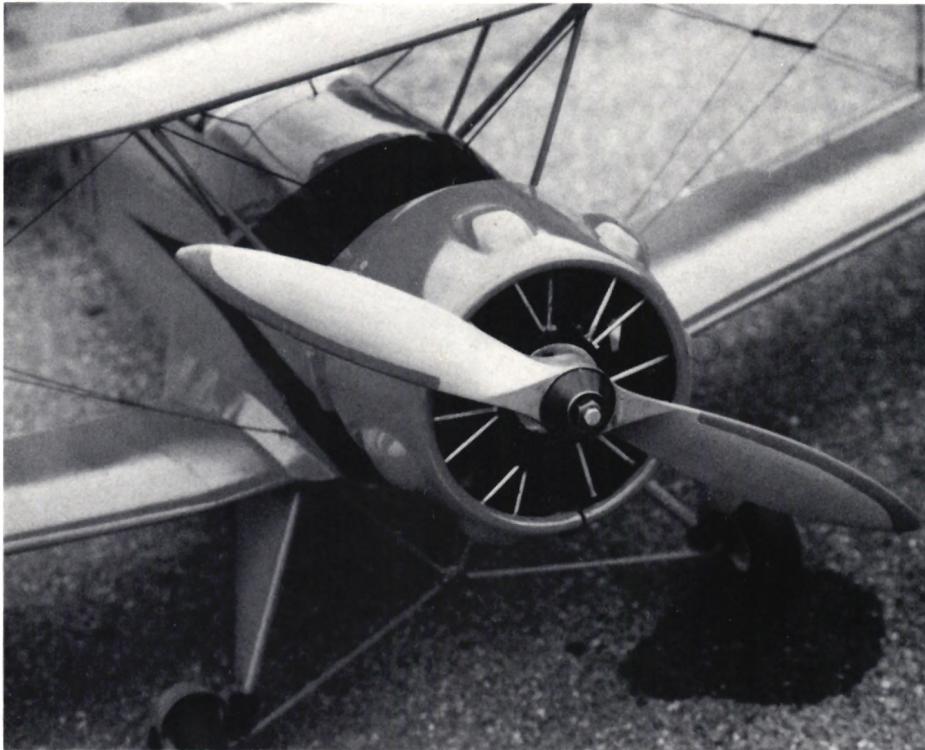
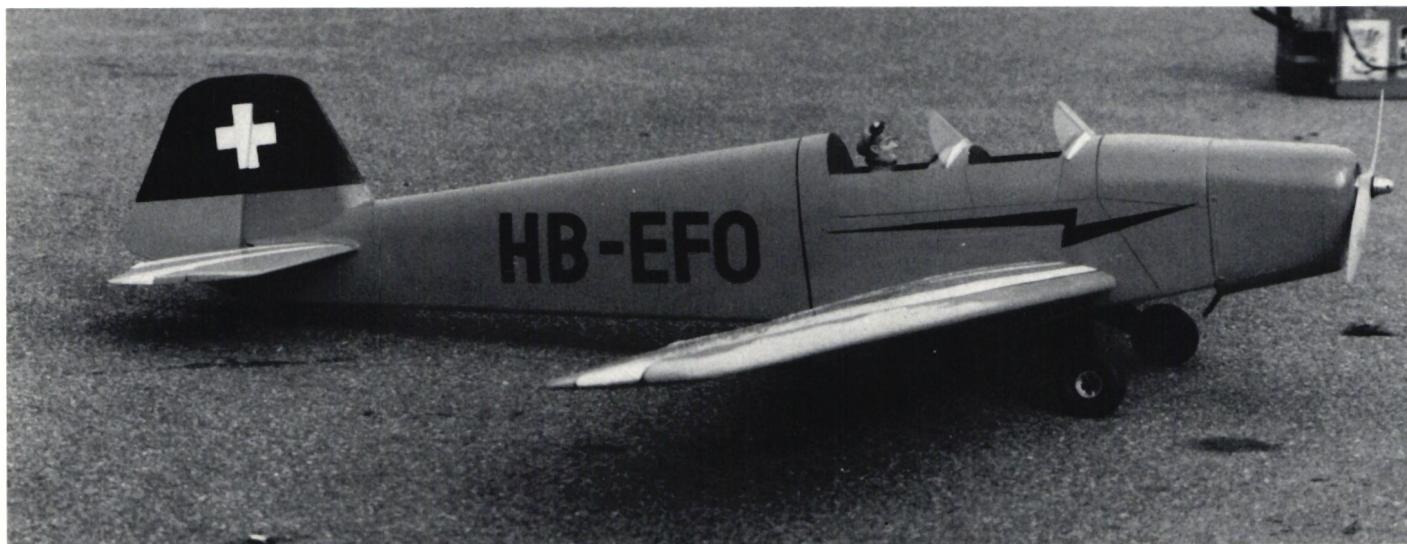
Konrad Oetiker flew a beautifully built Bücker 133 Jungmeister. He used the Webra 60 gear-driven engine. Like all models equipped with a gearbox, this engine produces a sound all its own.
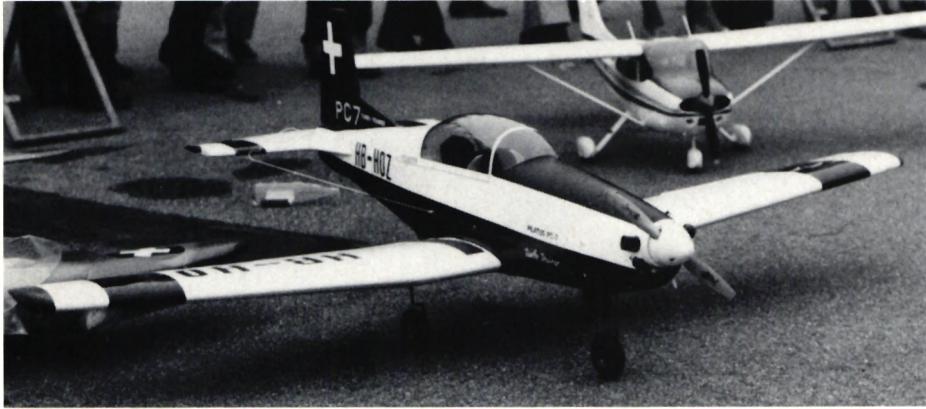
The Pilatus PC-7 trainer aircraft, ordered by many air forces and, more recently, by the Swiss Army, was flown by Max Ulrich. His low-altitude flights at high speed were daring but were met with enthusiastic applause from the spectators.
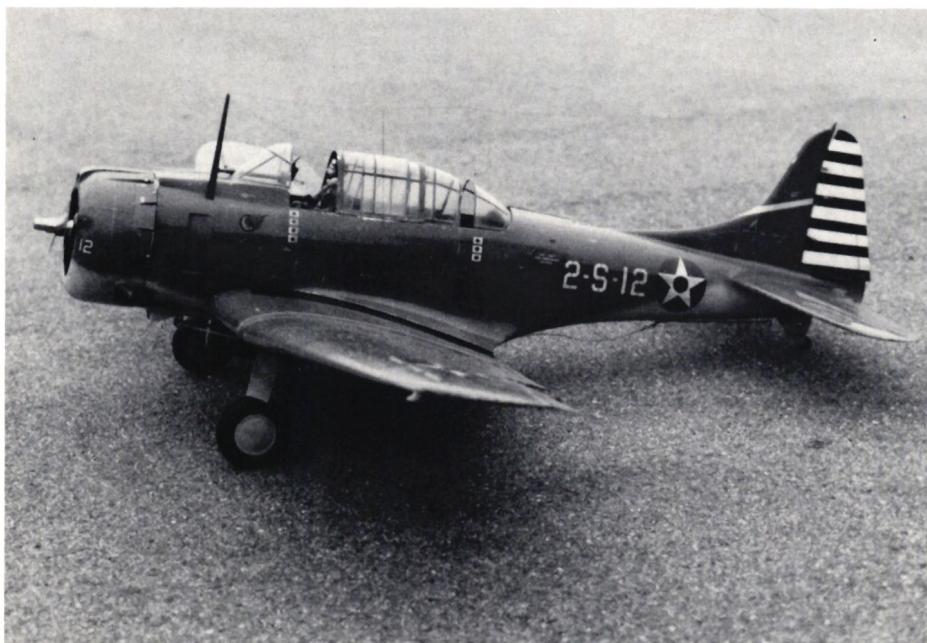
Peter Müller flew the 1980 Swiss Champion model. His Douglas SBD-3 Dauntless is a sight to behold both on the ground and in the air. The lead he had built up over his competitors in the construction evaluation was enough to secure a victory.
Werner Ott of the Balsania Filder Flying Club is a well-known German class pilot. He flew a very rare aircraft, namely the Tornado MY 102, which bears a strong resemblance to the MBB 209 Monsun. Things were interesting under the cowling, too. He used the long-stroke engine newly developed by Webra.
Herbert Steinemann from Schaffhausen flew a Piper L-4 with a 4-cc engine!
It’s been clear that the North American T-28B is a popular competition aircraft ever since this superbly detailed model kit became available from specialty retailers. Andreas Gasser flew this aircraft.
Thomas Ott, from Germany, brought a Citabria. Especially during the small air show on Sunday afternoon, he demonstrated just what’s possible with a high-wing aircraft. For instance, he performed an inverted flight at an altitude (or rather, a low altitude) that’s rarely seen.
Marcel Ansermin, from Mendrisio, took to the air in a beautiful—though also loud—YAT 28-E, the turbocharged version of the T-28.
Horst Wisst, a veteran of the semi-scale scene, relied on his large Zlin 526AS by Pat French. It was beautifully detailed, but unfortunately deviated too much from the original.
I don’t need to introduce Erich Rabe from Germany at length. He flew his well-known Bücker 180 Student. It was the first model to compete in contests with a four-stroke engine (1978).
It’s a shame that Alex Gyr’s excellently built Cessna 182 could only be admired on the ground. The craftsmanship, down to the smallest detail, impressed both spectators and judges alike.
Biplanes are popular aircraft for this type of competition. Erwin Leutenegger brought a PT-17 to the starting line. It was a nice model, though the resonance tube was a bit of an eyesore.
And yet another biplane was flown by Hans Enzeroth: the well-known Tiger Moth. Hans Enzeroth was the only pilot to fly with a 15-cc engine.
A 1:7-scale replica of the Lockheed Orion—an aircraft that was considered “the” aircraft of the future in its day and was also used by Swissair—was piloted by Sven Wiesendanger.
Peter Bühler flew a Piper Super Cup equipped with an OS four-stroke engine.
Quarter-Scale
This category of large model aircraft enjoys enormous popularity. The basic idea behind this American-inspired style is that not only the details but also the flight characteristics should match the full-scale model. This means relatively large and slow models.
The largest model was the Rally Commodore, with a wingspan of 2.7 m, a 32-cc engine, and a weight of 13 kg. The model was built by Kurt Furrer. Unfortunately, the model was not flown.
Egon Ritz from Germany presented a very beautifully built Turbulent. Unfortunately, the documentation (three-view drawings, color scheme, etc.) was insufficient. As a result, he scored only 800 points in the build evaluation. As it turned out, he had forgotten the documentation at home. What a shame!
Jodel BEBE, 2.3 m wingspan, OS two-cylinder four-stroke engine—these are some of the details about the “winner” of the build evaluation. If there hadn’t been any problems with the engine, Stephan Wisst would certainly have achieved an even better placing.
Peter Bühler flew a Tiger Moth. It was neatly built and flown quite true to the original.
Bücker 180 Student by Erich Rabe / D.
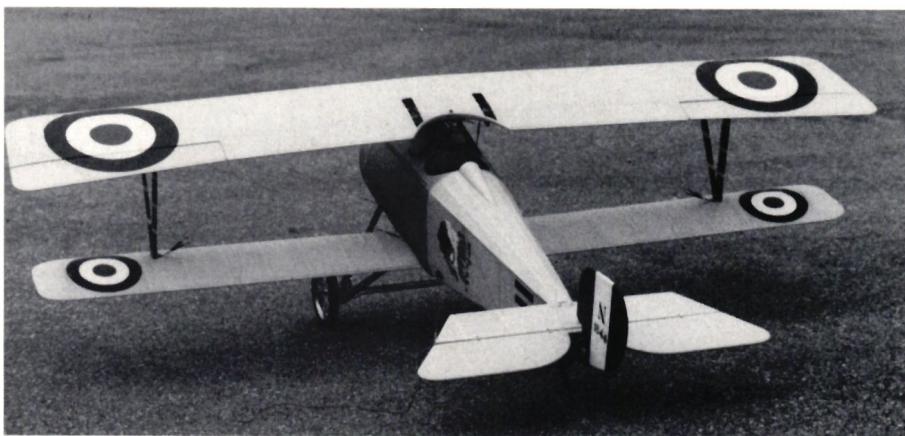
A beautiful model of a Newport, which unfortunately did not participate in the competition.
A “giant” Bücker 131 Jungmann with a 2.2-meter wingspan was demonstrated by Sven Wiesendanger. In flight, the model is virtually indistinguishable from the original.
The American aerobatic aircraft Laser 200 was flown by the talented Martin Sannwald from Fehraltorf—and he flew it so perfectly that he won the flight judging by a wide margin.
Also of American origin is the Pitts Special biplane flown by Max Ulrich. He ultimately won the competition with this model.
The model evaluation judges—all specialists trained by FAKO Scale—assessed each model with great care. Many of the models that received low scores were simply poorly documented.
Three evaluation flights were scheduled for the flight portion of the competition. However, only two were actually flown due to uncertain weather conditions on the first day of the competition. The flight program was divided into a compulsory and a freestyle program. The compulsory program included takeoff, straight flight, 90°/270° turns, approach, and landing within a 25-meter rectangle.
In the freestyle program, five maneuvers of the pilot’s choice had to be performed. Depending on the model type and the pilot’s skill level, the following maneuvers were demonstrated, among others: Jmmelmann, loop, roll, inverted flight, dive, low pass, etc.
A small air show on Sunday afternoon brought the successful event to a close.
| Ed. | Name | Group | Construction | Flight license | Total | Model | Engine | Weight | Remarks |
| 1. | Müller P. | Fehraltdorf | 1707.5 | 1274.9 | 2982.4 | Dauntless | OS 60 | 5.2 kg | German Champion Model 1980 |
| 2. | Ott W. | Balsamia (D) | 1425 | 1468.5 | 2893.5 | Tornado | Webra | 5.9" | Long-stroke motor |
| 3. | Gasser A. | Thal | 1357.5 | 1428.9 | 2786.4 | T-28-B | OS | 4.5" | |
| 4. | Oetiker K. | Thal | 1582.5 | 1164.9 | 2747.4 | Bü 133 | Webra | 5.9" | Gearmotor |
| 5. | Steinemann H. | Schaffhausen | 1475 | 1191 | 2666 | Piper | OS 25 | 2.4" | |
| 6. | Rabe E. | Balsamia (D) | 1272.5 | 1219.05 | 2491.55 | Bü 180 | OS | 3.8 " | Four-stroke engine |
| 7. | Ott T. | Balsamia (D) | 1220 | 1186.5 | 2406.5 | Citabria | OS | 4" | Four-stroke engine |
| 8. | Wiesendanger S. | Fehraltdorf | 990 | 1336.5 | 2326.5 | Orion | Webra | 4.5" | |
| 9. | Ulrich M. | Fehraltdorf | 1065 | 1250.7 | 2315.7 | PC-7 | Rossi | 4.5 " | |
| 10. | Wisst H. | Balsamia (Germany) | 1035 | 1149 | 2184 | Zlin | HP | 5.9" | |
| 11. | Enzeroth H. | Zumikon | 1172.5 | 943.95 | 2116.45 | Tiger-M | OS | 5.2" | Double-decker |
| 12. | Ansermin M. | Mendrisio | 902.5 | 1138.5 | 2041 | YAT-28 | ST | 4.9 " | |
| 13. | Sannwald M. | Fehraltdorf | 692.5 | 1,157.2 | 1,849.7 | Hunter | OS | 4.6" | Brake Chute |
| 14. | Zeier B. | 915 | 744 | 1659 | |||||
| 15. | Gyr A. | Affoltern a/A | 1647.5 | 1647.5 | Cessna | 5 " | |||
| 16. | Bühler P. | Dietikon | 690 | 928 | 1618 | Piper | OS | 4.5" | Four-stroke engine |
| 17. | Leutenegger E. | Affoltern a/A | 955 | 588 | 1543 | PT-17 | Enya | 5 " | Double-decker |
| Rg. | Name | Group | Construction | Airworthiness Certificate | Total | Model | Engine | Weight | Remarks |
| 1. | Ulrich M. | Fehraltdorf | 1,450 | 894.6 | 2344.6 | Pitts | Rossi | 7.2 kg | Gearmotor |
| 2. | Sannwald M. | Fehraltdorf | 940 | 1256.85 | 2196.85 | Laser | OS 90 | 4.8" | Mid-wing |
| 3. | Wiesendanger S. | Fehraltdorf | 1035 | 1066.8 | 2101.8 | Bü 131 | Moki | 8.5" | Double-decker |
| 4. | Do you know, S. | Balsamia (D) | 1535 | 507.15 | 2042.15 | BEBE | OS 120 | 6.5" | Two-cylinder four-stroke engine |
| 5. | Bühler P. | Dietikon | 925 | 1052.10 | 1977.10 | Tiger-M | Quadra | 10.5" | Double-decker |
| 6. | Ritz E. | Balsamia (D) | 800 | 1064.7 | 1864.7 | Turbulent | OS 120 | 6" | Two-cylinder four-stroke engine |
| 7. | Furrer K. | Müswangen | 432.5 | 432.5 | Rally | Quadra | 13" |
In summary, it can be said that the atmosphere throughout the entire competition was exceptionally good and relaxed. It was certainly a great experience for both the participants and the spectators to be there.
The Affoltern am Albis Model Flying Club proved once again this year that it can organize excellent competitions. We would like to extend a special thank you to Swissair at this time. If they and the flying clubs can “do without” their airfield for a weekend, there’s sure to be another “event” in October 1982. It’s expected to feature the Semi-Scale and Quarter-Scale classes again. Long live the ’82 competition!


What's New at Leomotion.com

PRIDE AND GOOD IDEAS
 Markus Nussbaumer

News from HEBU

TEAM MANAGER "THIS" BOSSHARD
 Rodito Nussbaumer

ATOM, THE NEW DOUBLE-DECKER FROM CPLR
 Matthias Bosshard

INSIGHTS INTO THE HISTORY OF SEAPLANES

34th HAHNENMOOS ALPINE MODEL AIRPLANE CAMP
Res Dauwalder
CORSAIR F4U – A WARBIRD WITH A MEMORABLE LOOK
Jürgen Rosenberger, Jürgen Prinz
SUMMER FUN 2026 AT MG USTER
Martin Wunderli
F3A EUROPEAN CHAMPIONSHIPS IN ST-MACAIRE, FRANCE
Matthias Bosshard
52. 2026 ALPS CUP
 Emil Giezendanner

HORIZON HOBBY/LEMACO NEWS: MICRO OV-10 BRONCO 645 MM BY E-FLITE

TWIN TOWN PARTNERSHIP
Wolfgang Voeller
EURO CONTEST GLIDER ACRO TOUR AUSTRIA 2026

BY YOUTH, FOR YOUTH
Lorena Betschen
YOU KNOW WHAT I MEAN? 125 YEARS OF THE SWISS AERO CLUB
Emil Giezendanner
SMALL, MODEL-LIKE SAILBOATS
Res Dauwalder
TRY-OUT DAY AT MFV WETTINGEN
Urs Keller
WELCOME, NEW MEMBER!
Andrea Bolliger
FREE FLIGHT IN THE MIDDLE OF SUMMER
Urs Muntwyler
THE PC-21 STORY
Emil Giezendanner
COUPE DES ALPES – OBSERVE AND LEARN
Rodito Nussbaumer
NEWS FROM HEBU
 Julia Bucher

FROM 0 TO 100
Markus Nussbaumer
NOS REGION – A HUB FOR ELECTRIC AVIATION
Emil Giezendanner
MEMORIES
Wolfgang Völler
Have you almost forgotten about aircraft that take off and land vertically?
Emil Giezendanner
70 YEARS OF THE NIDWALDEN MODEL AIRPLANE CLUB
Martin Barmettler