
Aerobatics is a sport that requires concentration
This statement appeared in Federal Councilor Ueli Maurer’s welcome address at the 2015 F3A World Championships in Dübendorf. As the head of the Federal Department of Defense at the time, he surely must have known that.
When it comes to model aircraft flying, in my experience there’s still a lot of room for improvement. I could name names and teams. Mistakes are made that border on—or even cross the line into—stupidity or negligence. In team sports, the vast majority of the credit for the athletes’ focused behavior must go to the leadership or coaching staff. As a role model, the coach must exude a certain calmness. Emotional behavior rarely helps.
The Swiss Model Aviation Association offers professional concentration exercises. However, participants must cover part of the costs, because concentration not only enhances athletic performance but also generally enables people to tackle challenging life tasks. It has been observed time and again that model aviators who excel in highly precise and demanding professional roles also succeed in the sport of model aviation. Concentration can also be trained on your own. This can be done through various proven concentration exercises, such as those from Asian or Indian cultures. Creating something beautiful and technically challenging demands more concentration from the brain than the media overload provided by TV, social media, and the constant beeping of a smartphone in your pocket.
Especially in technical sports like model aircraft flying, the groundwork is laid during the preparation of the model aircraft. The testing and trial phases are complete. Checklists can be reassuring and take some of the pressure off the mind—what have I forgotten? Preparing the equipment is calming in itself. Even the final practice sessions need to go off without a hitch. Any persistent problems can get on your nerves and lead to overreactions.
Practicing frequently is, in itself, good preparation. You know the entire sequence of the routine.
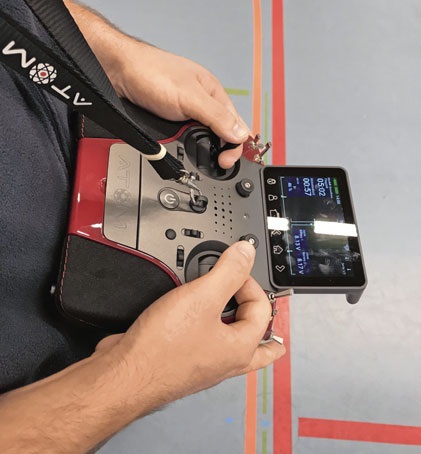
Still, having an assistant with a checklist is reassuring. Things get more challenging with unfamiliar flight programs. That would be unthinkable without intensive support from the “co-pilot.” Either way, the pilot will mentally go over his maneuver sequences one more time before the flight, focusing especially on specific critical points. Clear checklists are indispensable tools.
Time and again, I’ve noticed how model airplane pilots lose their focus or their performance drops sharply after a failed maneuver or other difficulties. This could have disastrous consequences in the final tally. Concentration, in this context, also means staying fully focused on the task at hand. Giving up is not an option!


TEAM MANAGER "THIS" BOSSHARD
 Rodito Nussbaumer

F3A EUROPEAN CHAMPIONSHIPS IN ST-MACAIRE, FRANCE
 Matthias Bosshard

News from HEBU

YOU KNOW WHAT I MEAN? 125 YEARS OF THE SWISS AERO CLUB
 Emil Giezendanner

SUMMER FUN 2026 AT MG USTER
Martin Wunderli
TRY-OUT DAY AT MFV WETTINGEN
Urs Keller
52. 2026 ALPS CUP
Emil Giezendanner
BY YOUTH, FOR YOUTH
Lorena Betschen
ATOM, THE NEW DOUBLE-DECKER FROM CPLR
Matthias Bosshard
CORSAIR F4U – A WARBIRD WITH A MEMORABLE LOOK
Jürgen Rosenberger, Jürgen Prinz
SMALL, MODEL-LIKE SAILBOATS
Res Dauwalder
What's New at Leomotion.com

TWIN TOWN PARTNERSHIP
Wolfgang Voeller
EURO CONTEST GLIDER ACRO TOUR AUSTRIA 2026

INSIGHTS INTO THE HISTORY OF SEAPLANES

34th HAHNENMOOS ALPINE MODEL AIRPLANE CAMP
Res Dauwalder
HORIZON HOBBY/LEMACO NEWS: MICRO OV-10 BRONCO 645 MM BY E-FLITE

COUPE DES ALPES – OBSERVE AND LEARN
Rodito Nussbaumer
PRIDE AND GOOD IDEAS
 Markus Nussbaumer

FREE FLIGHT IN THE MIDDLE OF SUMMER
Urs Muntwyler
THE PC-21 STORY
Emil Giezendanner
WELCOME, NEW MEMBER!
Andrea Bolliger
NEWS FROM HEBU
 Julia Bucher

FROM 0 TO 100
Markus Nussbaumer
MEMORIES
Wolfgang Völler
NOS REGION – A HUB FOR ELECTRIC AVIATION
Emil Giezendanner
Have you almost forgotten about aircraft that take off and land vertically?
Emil Giezendanner
70 YEARS OF THE NIDWALDEN MODEL AIRPLANE CLUB
Martin Barmettler