
The PZL DROMADER M-18: An Electric Agricultural Aircraft
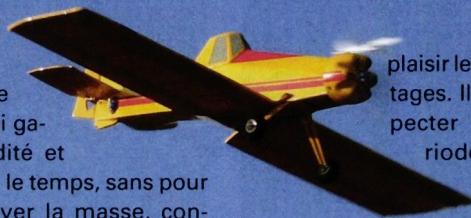
The design of the planes used for agricultural spraying is really cool. There are models like the PZL Dromader M-18 and the Piper Pawnee. I prefer the one made by PZL (which, by the way, also makes the famous WILGA tugboat), and that’s what led me to build an electric version of this aircraft with a 1-meter wingspan, featuring my own custom paint scheme.
The original (source: Wikipedia)
The PZL Mielec M-18 Dromader is a Polish single-engine aircraft manufactured by PZL Mielec. The aircraft is used primarily for spraying chemicals or for firefighting. Its design began in the 1970s, with assistance from the American manufacturer Rockwell, particularly to obtain internationally recognized certification. Rockwell, for its part, was interested in the powerful Asz-62 radial engine for other agricultural aircraft. The first flight took place on August 27, 1976, and the aircraft was certified in Poland in September 1978. It has been sold to more than 24 countries, with 200 in service in the U.S.
The proposed design is a traditional balsa wood build, using good old-fashioned white glue
, which ensures strength and durability over time without adding significant weight—contrary to popular belief. The model has a wingspan of one meter, which simplifies its construction. It is equipped with 4-channel control: ailerons, elevator, rudder, and throttle. I installed a 57-gram brushless motor (Axi 2212/20), but this isn’t necessary—a 35-gram motor would suffice. However, the short front lever arm requires significant weight up front, so you might as well put it to good use. I used 1200 Ah LIFE batteries for safety reasons and fast charging (20 min). As a side note on this topic, I’m generally in the process of switching from LiPO to LIFE batteries, and I’m delighted
to discover their advantages. You need to allow for a break-in period (4 or 5 charge cycles) for them to perform properly. The covering is entirely Oracover, with the exception of the engine cowling, which is painted. The aircraft was actually designed around this cowling, which is made from the bottom of a Badoit bottle, whose shape resembles the cylinders of a radial engine. Construction is very quick—it takes less than a week.
As usual, I used the DriveCalc software to size the motor. It’s available for free online and has a database
that updates constantly and automatically whenever you’re connected. The results are in good agreement with the observations. The following figure shows the results of the calculations at full throttle at 10 volts and 10.9 A. The 8×4.7 APC propeller rotates at 9,585 rpm, producing a static thrust of 629 g, with a power consumption of 109 W. The motor efficiency is 78%, close to the maximum efficiency of 80%. At this power level, the thrust-to-weight ratio is close to 1, which suggests a good margin for takeoff even from difficult terrain. In flight, this allows for basic aerobatics. A quick calculation shows that with a battery pack consisting of three LIFE 1200 mAh cells, the model can fly at full throttle for 6.5 minutes. In a simulation that is not
| Crew: | one pilot |
| Capacity: | 2,200 liters or 1,900 kg of chemicals |
| Length: | 9.47 m |
| Wingspan: | 17.70 m |
| Height: | 3.70 m |
| Wing area: | 40 m² |
| Empty weight: | 2,710 kg, 5,300 kg fully loaded |
| WSK “PZL-Kalisz” engine | ASz-62IR-M18 piston, radial, 745 kW (1,000 horsepower) |
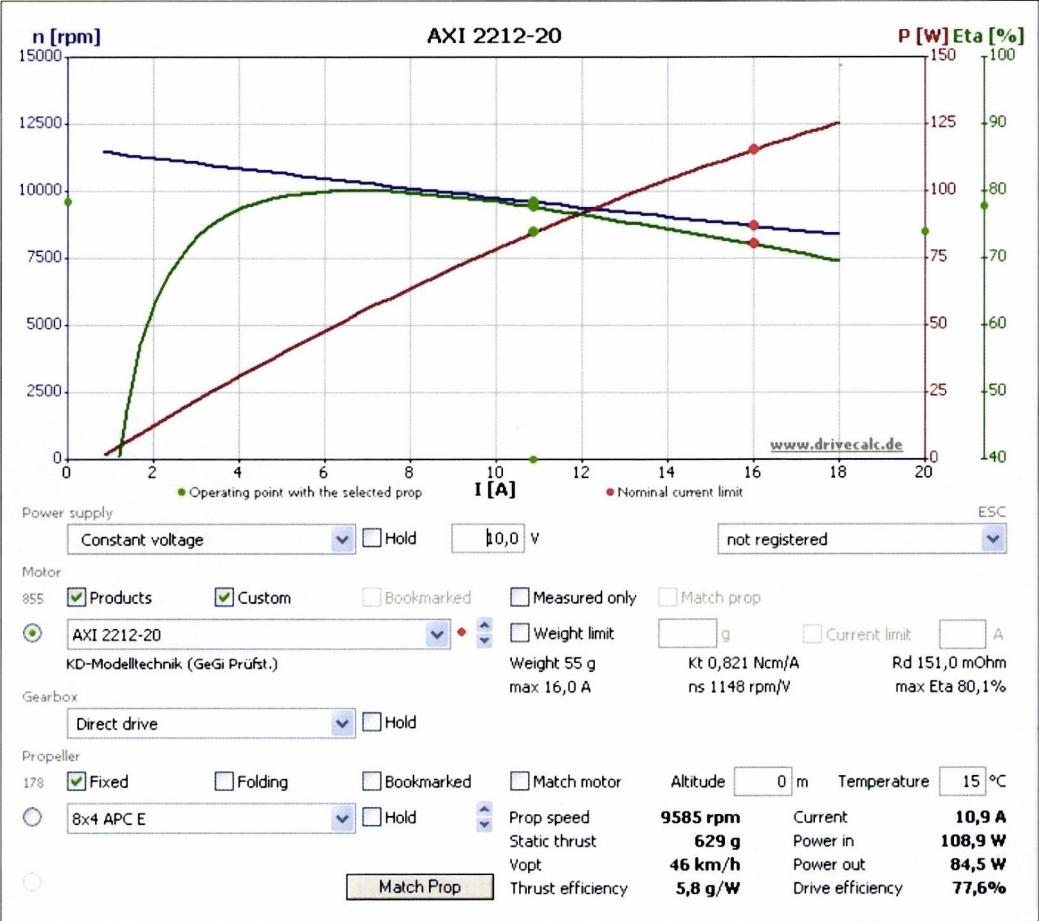
| Prop speed | 9585 rpm | Current | 10,9 A |
| Static thrust | 629 g | Power in | 108,9 W |
| Vopt | 46 km/h | Power out | 84,5 W |
| Thrust efficiency | 5,8 g/W | Drive efficiency | 77,6% |
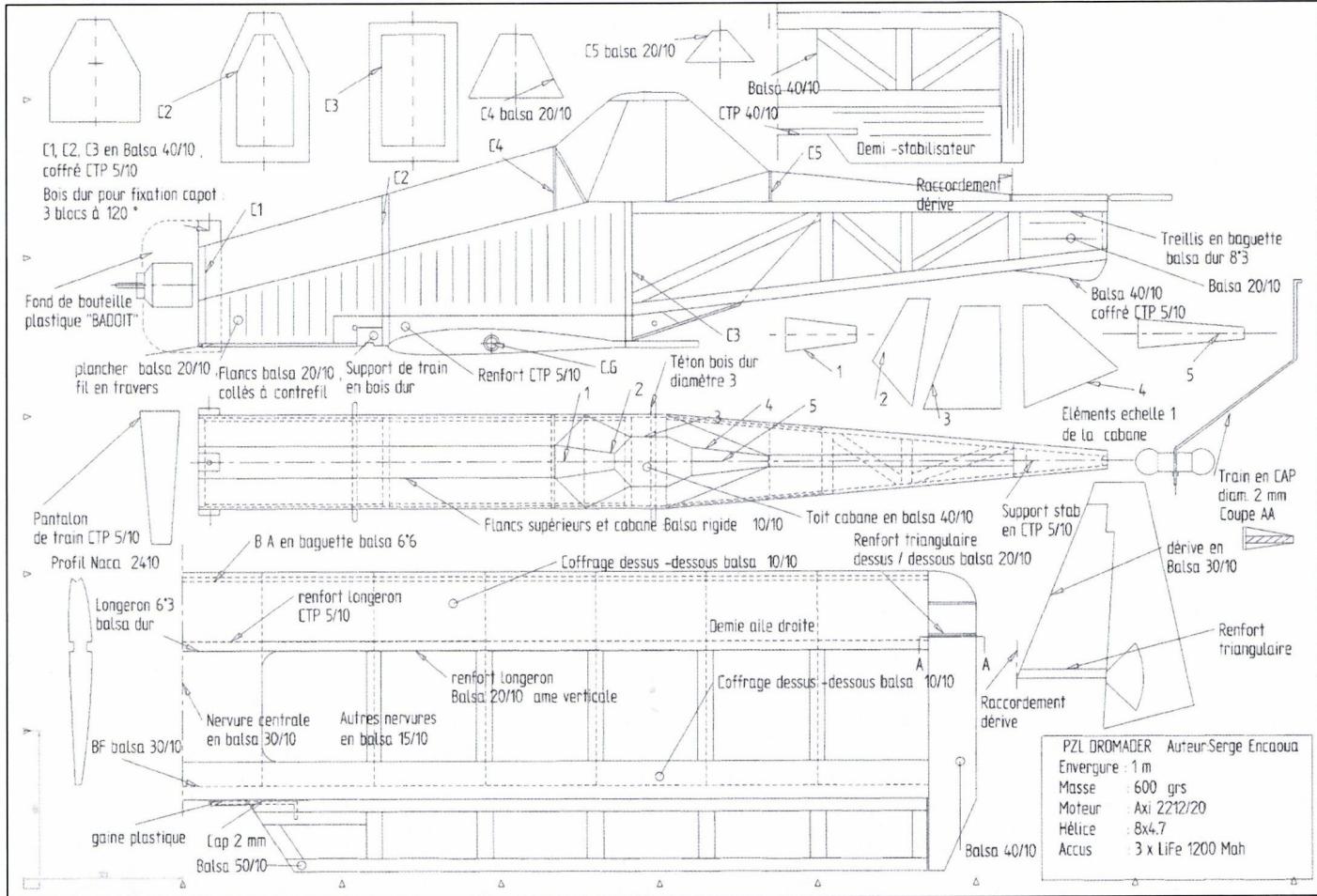
Please refer to the attached scaled-down diagram. The 1:1 scale plan is available at http://verti4.blogspot.com/. The wing profile used is a classic symmetrical NACA 2410, with a flat trailing edge for the ailerons, which are constructed from 50/10 balsa wood. I use fabric hinges, which are glued to the balsa. The ribs are constructed from lightweight 15/10 balsa (except for the center rib, which is 30/10), and the rib skins and caps are made from lightweight 10/10 balsa. The wing has no dihedral; it is built flat on the workbench as a single piece. The spar is made of ba-
Rigid 6×3 balsa wing, reinforced with 5/10 CTP in the center and 20/10 balsa, with vertical wire. The entire wing is covered with Oracover. The aileron servo is located in the center of the wing; it’s a standard 5-gram servo. The aileron control link is a bent bicycle spoke, to which a piece of carbon fiber strip—previously drilled—is tied.
Tail: No difficulty here; they are made from lightweight 40/10 balsa wood and covered with Oracover. Take your time to check the squareness (white glue works well for this).
Fuselage: The cockpit is the only part specific to this airplane. It is built first, entirely from 10/10 balsa wood chosen for its stiffness. To
fine-tune the fit and check the symmetry of the canopy, as this part is what gives the plane its charm.
The rest of the fuselage will be built separately—a classic approach.
Cut the side panels from a 20/10 plank, then install the rear strut.
The ribs are made of 40/10 balsa, covered on each side with 5/10 CTP. It’s lightweight and very sturdy. Glue the 5/10 CTP reinforcement to the wing mounts, glue the stringers in place, and then install the vertical side reinforcements. The sides are then assembled, followed by the installation of the forward floor and the rear crossbrace. All that remains is to install the forward and rear upper formwork made of 10/10 balsa, as well as the cockpit support. At this
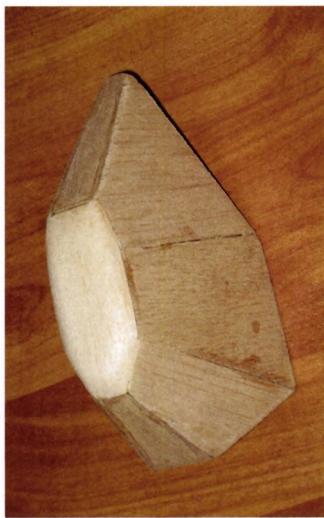
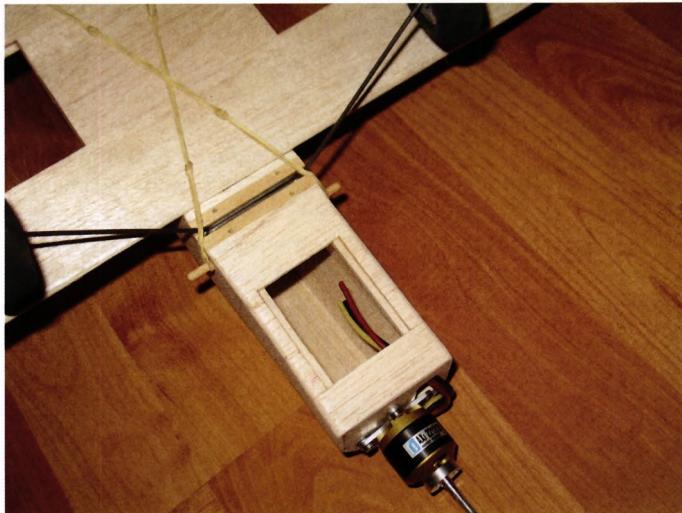
At this stage, you can position the wing and tail to check the overall geometry. The cowling is made from the bottom of a Badoit bottle, which has been cut out and then drilled to the correct diameter using a hole saw. Install the motor and drill a hole in the spindle to route the ESC wires through. Cut a hatch in the front of the fuselage to make it easier to install the motor mounting screws and, most importantly, to connect the ESC without having to remove the wing. The landing gear is made from 2 mm diameter rod. For the wheels, choose a 50 mm diameter model with foam, which provides good shock absorption. The landing gear fairings, made of 5/10 CTP, are attached to the landing gear (after covering) using Sader’s Fortissimo glue, which bonds strongly while maintaining some flexibility.
Only the engine cowling was painted with glycerophthalic lacquer; the
cylinders were created by wrapping them with black duct tape. The wings, tail surfaces, fuselage, and cockpit are covered with Oracover, and the markings are applied using Venilia or an equivalent product.
The vertical stabilizer and horizontal stabilizer will be covered with fabric before assembly. Here’s a little tip to help you work with Oracover on the fuselage: Mark the boundary between two surfaces to be covered by placing a piece of tape on the first surface covered with Oracover, onto which you’ll then apply the adjacent Oracover. This makes it easier to peel back the Oracover once it’s been trimmed with a utility knife. Also, be sure to use an iron set to a very low temperature to avoid any tension that could cause the Oracover to peel between adjacent areas. The canopy is covered with Oracover; this takes a while, since there’s one section to apply per flat surface. To attach the
fuselage to the fuselage, use Sader’s Fortissimo. The step plates installed on the wings are made of fiberglass fabric glued with… Fortissimo.
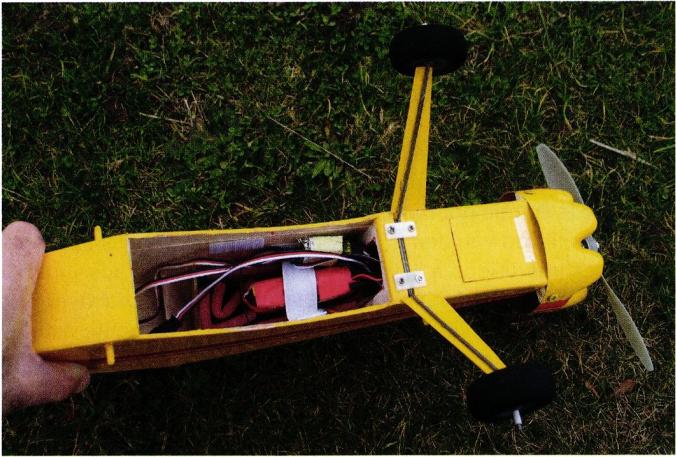
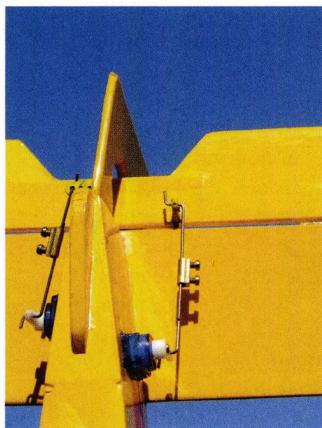
The LIFE 3×1200 mAh battery and the 4-channel receiver are mounted at the rear of the fuselage, under the wing. The ESC is mounted in the forward compartment. The elevator and rudder servos are mounted at the rear of the fuselage, secured directly with Fortissimo. I use standard 5-gram servos. The aileron servo is placed in the center of the wing, secured with Fortissimo. All controls are made using two lengths of CAP 2/10, which are connected at their centers by the core of an electrician’s domino. Easy to make and adjust; no clevises are used (see photos).
The settings are as follows:
- Elevator: +/-30 degrees, 50% expo
- Rudder: +/-30 degrees, 50% expo
- Ailerons: +/-20 degrees, 50% travel
Before beginning flight tests, carefully check the direction of the control surfaces' travel, as well as the po-
| Weight: | 600 g |
| Wingspan: | 1,000 mm |
| Length: | 650 mm |
| Wing area: | 19.5 dm² |
| Radio: | 4-channel receiver |
| Servos: | Ailerons, elevator, rudder: 5 g |
| Motor: | AXI 2212/20 |
| ESC: | 15 A |
| Propeller: | APC 8×4.7 |
| Batteries: | LIFE A123-1200 mAh ×3 in series |
Position of the center of gravity. Its arrival on the field didn’t go unnoticed; it caught everyone’s eye—after all, you don’t often see this type of aircraft. The first flight took place on a cold winter afternoon, with a steady wind. Takeoff from the grass runway was
was a breeze; it can climb almost vertically afterward without losing power. A slight correction by pulling back on the elevator was necessary, as well as increasing the aileron travel. The plane looks impressive in flight; it’s a real treat to fly back and forth over the runway. It’s not very sensitive to wind, and despite its small size, I was able to fly safely. The controls are smooth and consistent; the plane is very light—and that’s what surprised me the most, since I was expecting significant drag from the canopy. It runs a bit long on landing; I had to make another circuit the first time. A stall test with the elevator fully pulled back shows that the plane… doesn’t stall; it gently sinks into
on axis, without banking onto one wing. Thanks to the low wing loading.
In the flights that followed, I tried some basic aerobatics, but that’s not its primary purpose: rolls in under 3 seconds, loops, and
The rudder is very effective—use it with caution. Flying inverted is no problem at all; you feel very confident. In short, this is a unique little aircraft that’s easy to fly and can be recommended to a reasonably experienced beginner. Happy flying.


What's New at Leomotion.com

PRIDE AND GOOD IDEAS
 Markus Nussbaumer

News from HEBU

TEAM MANAGER "THIS" BOSSHARD
 Rodito Nussbaumer

INSIGHTS INTO THE HISTORY OF SEAPLANES

34th HAHNENMOOS ALPINE MODEL AIRPLANE CAMP
Res Dauwalder
CORSAIR F4U – A WARBIRD WITH A MEMORABLE LOOK
Jürgen Rosenberger, Jürgen Prinz
SUMMER FUN 2026 AT MG USTER
Martin Wunderli
F3A EUROPEAN CHAMPIONSHIPS IN ST-MACAIRE, FRANCE
 Matthias Bosshard

52. 2026 ALPS CUP
 Emil Giezendanner

TWIN TOWN PARTNERSHIP
Wolfgang Voeller
EURO CONTEST GLIDER ACRO TOUR AUSTRIA 2026

BY YOUTH, FOR YOUTH
Lorena Betschen
ATOM, THE NEW DOUBLE-DECKER FROM CPLR
Matthias Bosshard
YOU KNOW WHAT I MEAN? 125 YEARS OF THE SWISS AERO CLUB
Emil Giezendanner
SMALL, MODEL-LIKE SAILBOATS
Res Dauwalder
TRY-OUT DAY AT MFV WETTINGEN
Urs Keller
WELCOME, NEW MEMBER!
Andrea Bolliger
HORIZON HOBBY/LEMACO NEWS: MICRO OV-10 BRONCO 645 MM BY E-FLITE

FREE FLIGHT IN THE MIDDLE OF SUMMER
Urs Muntwyler
THE PC-21 STORY
Emil Giezendanner
COUPE DES ALPES – OBSERVE AND LEARN
Rodito Nussbaumer
NEWS FROM HEBU
 Julia Bucher

FROM 0 TO 100
Markus Nussbaumer
NOS REGION – A HUB FOR ELECTRIC AVIATION
Emil Giezendanner
MEMORIES
Wolfgang Völler
Have you almost forgotten about aircraft that take off and land vertically?
Emil Giezendanner
70 YEARS OF THE NIDWALDEN MODEL AIRPLANE CLUB
Martin Barmettler