
Sunny Dreams – Solar-Traum
Building an electric model airplane powered by solar cells has been a long-term project of mine. Throughout the history of aviation, model builders have been pioneers in almost every field, and the development of solar-powered airplanes is no exception.
The first solar-powered aircraft prototype took flight as early as 1974. The first manned solar flight followed in the early 1980s. Going back a bit further in history, we see that the foundation for this development was laid by Albert Einstein when he explained the photoelectric effect in 1905 and received the Nobel Prize for it. The first practical photovoltaic cell, with an efficiency of 6%, was developed in 1954. Since then, scientists have been trying to improve efficiency. For widespread use, efficiency stands at 18%, while the best photovoltaic cells—such as those used in satellites—are estimated to reach 30%. The sun does not shine with the same intensity on all parts of the Earth’s surface. Solar energy is strongest at the equator, while in our region, we can expect to achieve little more than 1,000 watts per square meter. With an efficiency of 18%, we can therefore expect about 180 watts per square meter. In model aircraft construction, we are unfortunately limited in terms of usable surface area.
At the end of last year, as part of the extracurricular activities at the Vega School of Electrical Engineering, we built a solar-powered model airplane. To get off on the right foot, we consulted the International Air Sports Federation (FAI) for information on the regulatory requirements. The rules for this F5E category are as follows:
Maximum wing area: 75 dm²
Maximum voltage: 42 V
The propulsion system must be powered solely by photovoltaic cells.
A rechargeable battery may be used for the RC unit. Our goal was to build a simple RC electric model using standard components. The solar company Bisol kindly provided us with GI56S3 photovoltaic cells. Each cell measures 156 mm × 156 mm and weighs 14 g, including contacts. There were many technical problems to solve: What should the shape of the wings and the
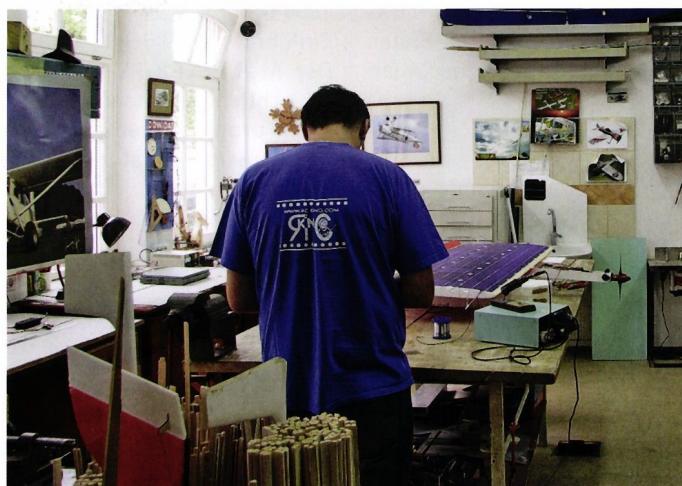
What about the fuselage? How should the cells be assembled, and how should the wing-fuselage joint be constructed? We then decided to build a wing out of Styrofoam, use only two small carbon fiber struts (5 × 1 mm) for reinforcement, and reinforce the nose with 3-mm poplar plywood. The rudder and winglets were cut from 6-mm Depron.
So far, there hadn't been any problems, but the difficulties began when soldering the cells
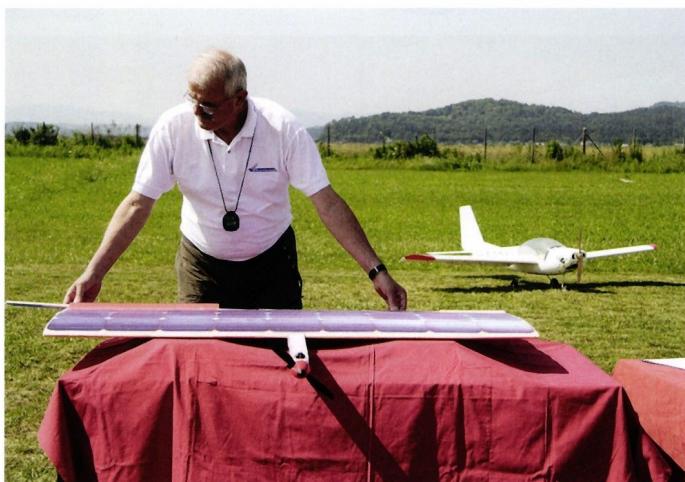
and their installation on the wing. Photovoltaic cells are primarily made of silicon and are therefore very fragile. We decided to mount the cells directly using polyurethane adhesive to avoid creating any protective film and thereby improve efficiency. We connected all twenty-one cells into series groups of seven, each connected directly to the controller. Under load, we measured a voltage of 12 V and a current of 6.5 A. Under ideal conditions, we achieved 80. The model’s weight, ready to fly, is 1,200 g. We must not forget that we built a motorized aircraft and not a glider. There is a significant difference: this aircraft is kept in the air by its mechanical propulsion system. Until now, designers have primarily equipped gliders with electric propulsion systems to bridge upwind zones.
For me, our work was groundbreaking, and at the Vega School we were able to prove that it is both possible and worthwhile to build solar-powered airplanes in the future. Of course, we will continue our work. To improve efficiency, we were able to implement a new controller. The receiver battery can also be powered by solar energy—
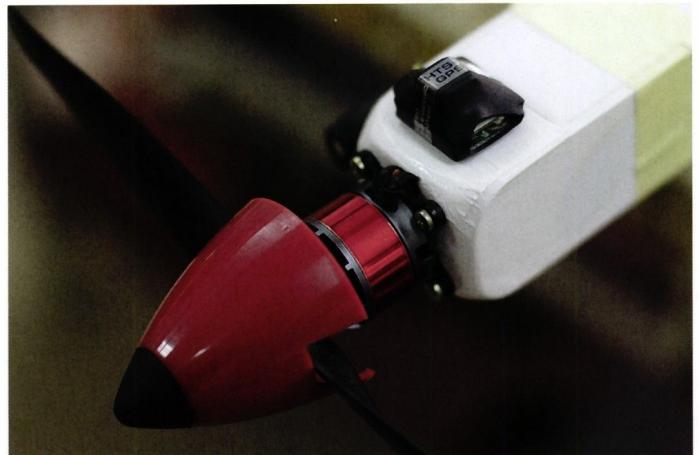
ensures that better solar cells can be used. We made a film about our project, titled *Sončne Sanje* (Solar Dream),
and was broadcast by RTV Slovenija (the national television network) in November 2012. ■
Roman Ložar


TEAM MANAGER "THIS" BOSSHARD
 Rodito Nussbaumer

F3A EUROPEAN CHAMPIONSHIPS IN ST-MACAIRE, FRANCE
 Matthias Bosshard

News from HEBU

YOU KNOW WHAT I MEAN? 125 YEARS OF THE SWISS AERO CLUB
 Emil Giezendanner

SUMMER FUN 2026 AT MG USTER
Martin Wunderli
TRY-OUT DAY AT MFV WETTINGEN
Urs Keller
52. 2026 ALPS CUP
Emil Giezendanner
BY YOUTH, FOR YOUTH
Lorena Betschen
ATOM, THE NEW DOUBLE-DECKER FROM CPLR
Matthias Bosshard
CORSAIR F4U – A WARBIRD WITH A MEMORABLE LOOK
Jürgen Rosenberger, Jürgen Prinz
SMALL, MODEL-LIKE SAILBOATS
Res Dauwalder
What's New at Leomotion.com

TWIN TOWN PARTNERSHIP
Wolfgang Voeller
EURO CONTEST GLIDER ACRO TOUR AUSTRIA 2026

INSIGHTS INTO THE HISTORY OF SEAPLANES

34th HAHNENMOOS ALPINE MODEL AIRPLANE CAMP
Res Dauwalder
HORIZON HOBBY/LEMACO NEWS: MICRO OV-10 BRONCO 645 MM BY E-FLITE

COUPE DES ALPES – OBSERVE AND LEARN
Rodito Nussbaumer
PRIDE AND GOOD IDEAS
 Markus Nussbaumer

FREE FLIGHT IN THE MIDDLE OF SUMMER
Urs Muntwyler
THE PC-21 STORY
Emil Giezendanner
WELCOME, NEW MEMBER!
Andrea Bolliger
NEWS FROM HEBU
 Julia Bucher

FROM 0 TO 100
Markus Nussbaumer
MEMORIES
Wolfgang Völler
NOS REGION – A HUB FOR ELECTRIC AVIATION
Emil Giezendanner
Have you almost forgotten about aircraft that take off and land vertically?
Emil Giezendanner
70 YEARS OF THE NIDWALDEN MODEL AIRPLANE CLUB
Martin Barmettler