
Flight Coach
Most well-known aerobatic pilots train alone or with a well-coordinated team of assistants, but hardly any train with a judge who evaluates the maneuvers and provides feedback on mistakes or areas for improvement. This can lead to pilots repeatedly making the same mistakes or performing maneuvers with the same inaccuracies without ever being made aware of them. That is why a rapidly growing number of F3A pilots are using technical aids to improve the geometric precision of their maneuvers.
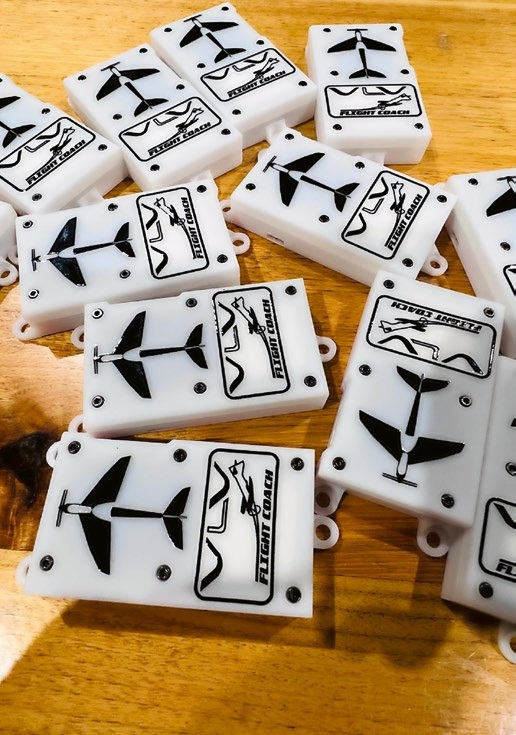
Flight Coach is part of a family of software tools designed to record and analyze the flight of a radio-controlled model. It was developed for aerobatic pilots and judges with the goal of making the sport more objective. The software tools are continuously being refined by experienced pilots and are available for free online:
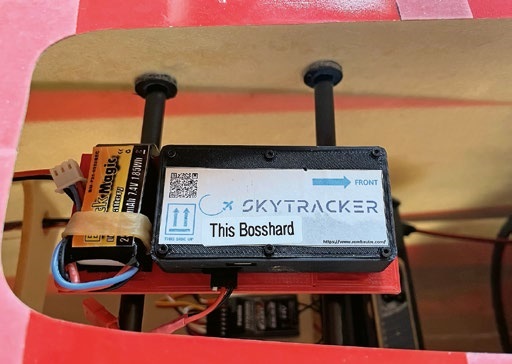
The hardware—a small box about the size of a receiver with GPS positioning and flight attitude detection capabilities—is installed in the aircraft. Power is supplied by a small 2S LiPo battery. Data is recorded during flight and can then be retrieved using a micro-SD memory card on a laptop or at home on a PC.
Using it at the model airfield is therefore very simple. The hardware is attached to a flat surface on the model using Velcro. It must not be mounted too close to the high-voltage motor, battery, or ESC, as this could cause recording errors. I usually fly several programs before analyzing the data so that I can better identify systematic errors that occur across all my flights.
The on-screen analysis allows me to evaluate the maneuvers based on various criteria. I can view the entire program or individual maneuvers from above, from behind, from the side, from the pilot’s perspective, or even from the judge’s perspective. This enables a wide range of perspectives; here are a few examples:
- Adherence to the F3A window; consistent and correct distance throughout the routine
- Altitude maintenance during entry and exit maneuvers
- Placement of maneuvers within the window (center and boundaries)
- Geometry, such as angles, centered placement of rolls, and the roundness of loops
Using these analyses too early can also lead to frustration. The maneuvers look terrible, and you have no idea where to even begin analyzing them. That’s why I recommend that a beginner in aerobatics first use conventional resources—such as assistants, fellow pilots, and instructors—to get a handle on the typical beginner’s problems.
This achieves the primary goal of using Flight Coach: to provide objective feedback—unbiased by personal preferences—on the precision of the maneuvers. However, the analysis of errors and their causes only really begins at this point. I can see my systematic errors and can now set out to identify their root causes. A personal example: In the P25 program, a backward spin is flown in the center of the window. Even before using the Flight Coach, I had noticed several times that after exiting the spin, I was too close and had thus lost the required distance. Is it perhaps due to the crosswind? Upon analysis, I discovered that I tend to let the wing hang toward me during the backroll maneuver. Surely just a few degrees of bank, but it’s crucial. On my next flights, I made sure that—based on my subjective feeling—the wing was banking outward until my eyes had adjusted to the correct flight attitude. That’s just a small
At this point, I don’t think so. First, there’s the fundamental issue of equal opportunity. If a pilot isn’t allowed to use aids during a flight, should he then be evaluated using digital aids? Gymnastics, figure skating, and other sports are graded using validated evaluation criteria, but the scoring is still subjective and carried out by individual, well-trained judges. The saying, “It’s not the one who flies most precisely who wins, but the one who makes it look most precise,” still holds true. A scoring system is already implemented in the software; however, I have not yet seen any concrete application of it. The scenario I can most easily imagine is that the Flight Coach evaluation would be incorporated into the scoring as an additional B-grade (geometric accuracy) with a weighting yet to be defined. For now, however, that’s still a long way off.


TEAM MANAGER "THIS" BOSSHARD
 Rodito Nussbaumer

F3A EUROPEAN CHAMPIONSHIPS IN ST-MACAIRE, FRANCE
 Matthias Bosshard

News from HEBU

YOU KNOW WHAT I MEAN? 125 YEARS OF THE SWISS AERO CLUB
 Emil Giezendanner

SUMMER FUN 2026 AT MG USTER
Martin Wunderli
TRY-OUT DAY AT MFV WETTINGEN
Urs Keller
52. 2026 ALPS CUP
Emil Giezendanner
BY YOUTH, FOR YOUTH
Lorena Betschen
ATOM, THE NEW DOUBLE-DECKER FROM CPLR
Matthias Bosshard
CORSAIR F4U – A WARBIRD WITH A MEMORABLE LOOK
Jürgen Rosenberger, Jürgen Prinz
SMALL, MODEL-LIKE SAILBOATS
Res Dauwalder
What's New at Leomotion.com

TWIN TOWN PARTNERSHIP
Wolfgang Voeller
EURO CONTEST GLIDER ACRO TOUR AUSTRIA 2026

INSIGHTS INTO THE HISTORY OF SEAPLANES

34th HAHNENMOOS ALPINE MODEL AIRPLANE CAMP
Res Dauwalder
HORIZON HOBBY/LEMACO NEWS: MICRO OV-10 BRONCO 645 MM BY E-FLITE

COUPE DES ALPES – OBSERVE AND LEARN
Rodito Nussbaumer
PRIDE AND GOOD IDEAS
 Markus Nussbaumer

FREE FLIGHT IN THE MIDDLE OF SUMMER
Urs Muntwyler
THE PC-21 STORY
Emil Giezendanner
WELCOME, NEW MEMBER!
Andrea Bolliger
NEWS FROM HEBU
 Julia Bucher

FROM 0 TO 100
Markus Nussbaumer
MEMORIES
Wolfgang Völler
NOS REGION – A HUB FOR ELECTRIC AVIATION
Emil Giezendanner
Have you almost forgotten about aircraft that take off and land vertically?
Emil Giezendanner
70 YEARS OF THE NIDWALDEN MODEL AIRPLANE CLUB
Martin Barmettler