
The Man with the Flying Boxes
ANTOINETTE VII 1910 by Rainer Mattle
Markus Nussbaumer

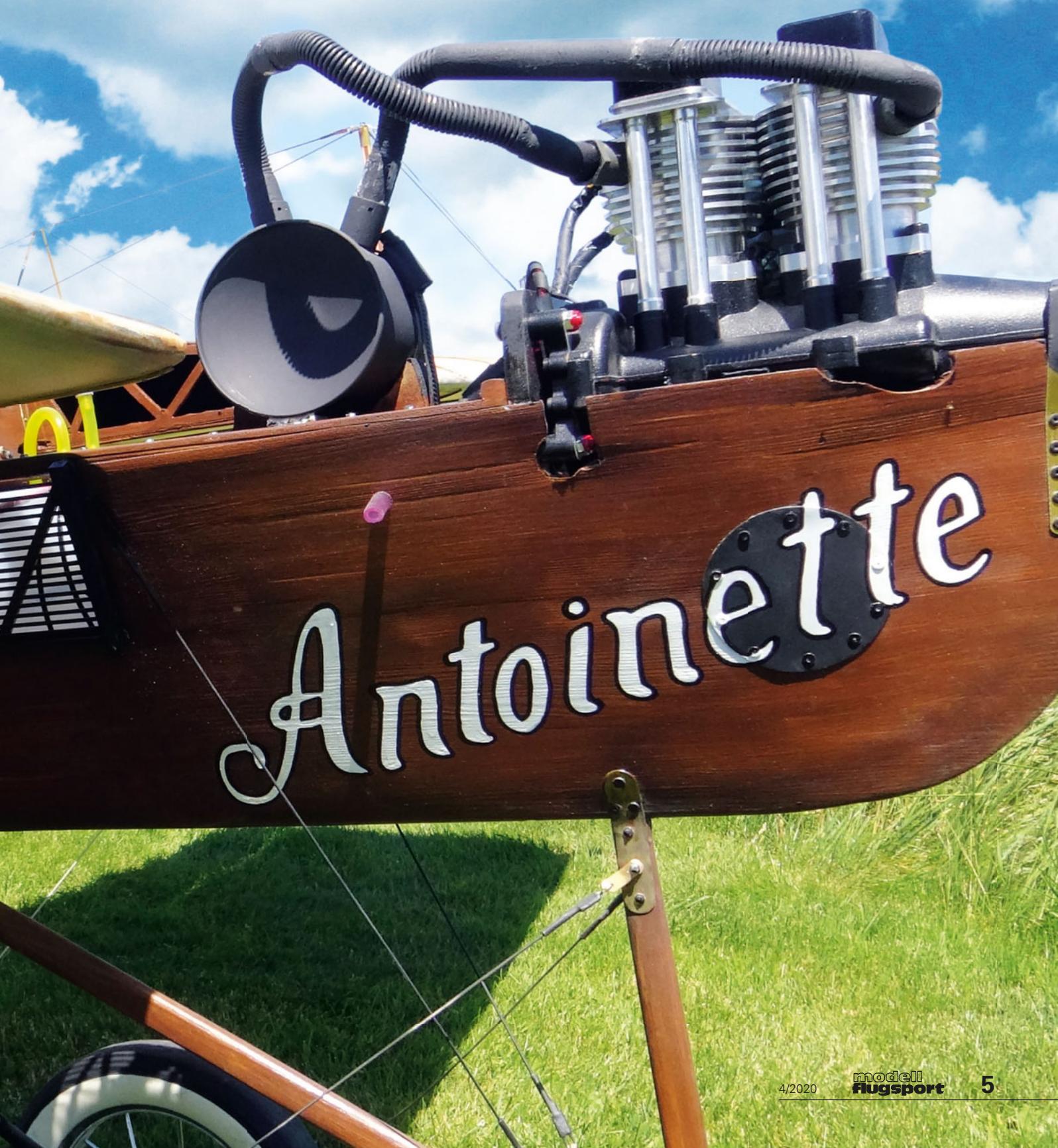
Here you can get a good look at the eye-catching water cooler. It is made of aluminum and carbon fiber.
It’s a special spring in 2020. COVID-19 has us confined to our homes; we’re only allowed to go out to work—those of us who are allowed to work, that is.
So it goes without saying that we’re not allowed at the model airfield, even if some people refuse to understand that. Model flying is our hobby—nothing more, but also nothing less! One positive aspect—if I may put it that way—is that model builders have more time to continue working on or finish their models.
Well, since the end of May, we’ve finally been allowed back at the model airfield—subject to certain conditions. It makes sense that many pilots have been waiting for this opportunity, so it’s hardly surprising that social distancing is proving to be a challenge. Since no one wants to take any risks, it’s not really a problem—though it does take some getting used to no longer shaking hands with a fellow pilot. Who would have thought it? Rainer Mattle will soon be bringing a brand-new Antoinette VII 1910 to the field. This vintage sports plane has been waiting for its maiden flight for quite some time. Rainer, who suffers from a lung condition, is in the high-risk group for the pandemic. Nevertheless, he wants to send his model soaring into the sky.
As is often the case with vintage models from this era, assembling one of these on the field requires quite a bit of patience. It takes some time to attach the wings and the numerous struts. The result is certainly impressive. If the model flies as well as it looks, nothing can go wrong. As usual, when Rainer starts the engine, he finds a colleague to take over the strenuous task of turning the propeller. Soon, the 85-cc Roto engine is chugging along nicely. Since the engine is still new, they let it break in without any stress.
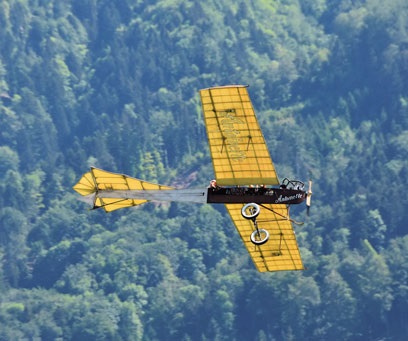
The moment of truth has arrived; all launch preparations are complete, and the Antoinette VII is ready to take to the skies. Rainer walks calmly behind his masterpiece toward the launch site. Engine test, control check—and off it goes; the model accelerates and soon takes off. You can hear the beeping from Rainer’s transmitter; he only had to make a slight adjustment to the elevator trim—otherwise, the model is flying beautifully. It’s quite majestic to watch the old lady Antoinette glide through the air.
You can tell just by looking at Rainer—he’s pulled off another huge success; that thing is flying! Every now and then, the pilot figure raises its left arm, expressing the joy that must be reigning aboard this vintage model. The wait was definitely worth it. Soon Rainer begins his approach; the model comes in smoothly and touches down gently despite its 21 kg weight. A few minor tweaks still need to be made to the landing gear, but otherwise it’s an absolute dream. More flights of the Antoinette follow later that day. As evening approaches, nature creates a special atmosphere; the clouds in the sky are illuminated in a golden-brown hue by the setting sun, beautifully highlighting the model against the backlight. An extremely successful day of flying is drawing to a close.
We say goodbye without a handshake, but with a wave. Satisfied and with plenty of photos and video footage, I drive home.
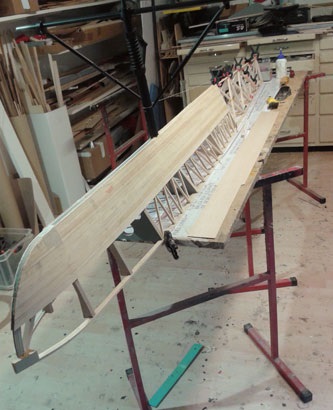
The ship-shaped hull was built upside down using a strip-built construction method with spruce. The planking on the front part of the hull consists of 2-mm-thick spruce strips.
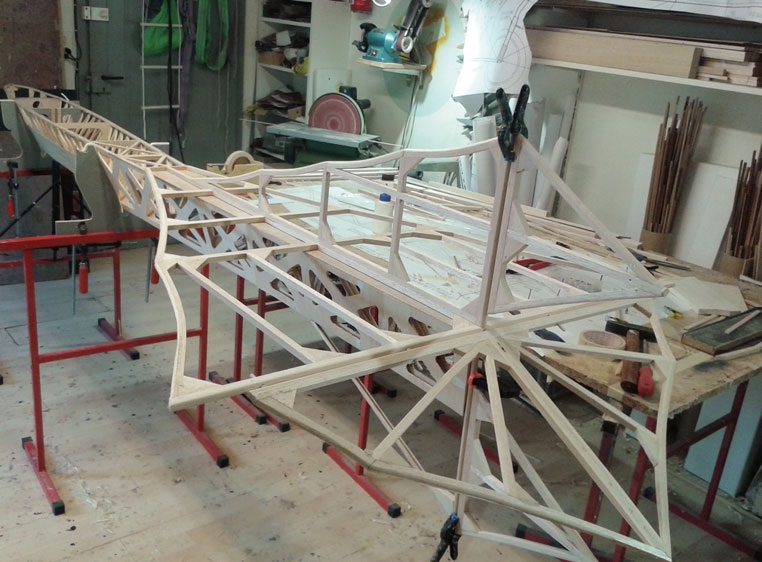
The elevator/rudder is a removable, complete unit made of balsa wood.
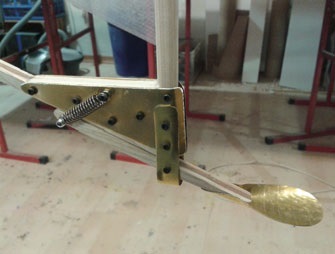
The rear skid has to be able to withstand quite a bit of stress. The support bars are therefore made of laminated ash and mahogany and reinforced with brass fittings.
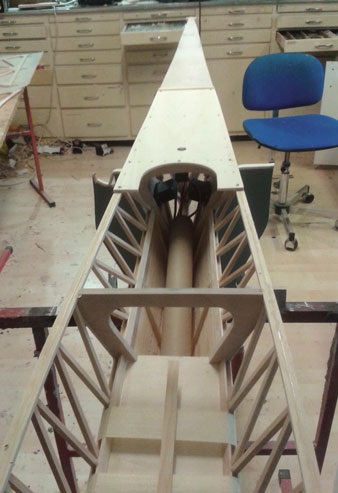
The various servo cable connections are hidden inside a cardboard tube in the fuselage floor.
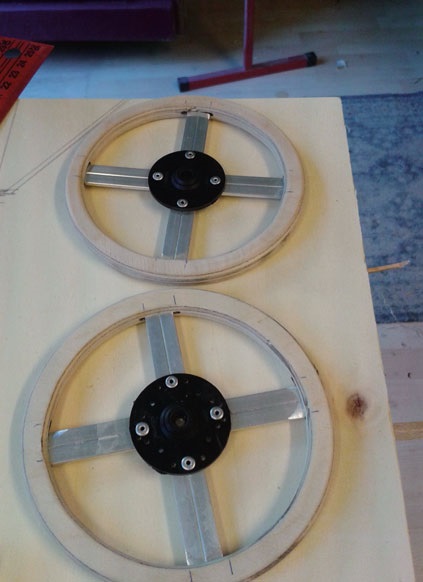
The steering wheels are taking shape.
The Antoinette VII was a French monoplane from 1909. The Antoinette VII was one of the first aircraft to be successfully mass-produced. Its immediate predecessor, the Antoinette IV, was used in an attempt to be the first to fly across the English Channel. The Société Antoinette was founded in 1904 by Léon Levassieur. Levassieur actually specialized in boat engines. Based on these engines, he developed the outstanding 8-cylinder Antoinette V engine, one of the most important aircraft engines of early aviation.
Starting in 1908, Levassieur began building his own aircraft. The Antoinette I–III were still replicas of other aircraft. Beginning with the Antoinette IV, Levassieur designed his famous Antoinette monoplanes, which had a boat-like fuselage. With the Antoinette VI, he switched the aircraft’s control system from ailerons to wing warping. The aircraft made its maiden flight on April 17, 1909. Shortly before that, Hubert Latham had become chief pilot at the Société Antoinette.
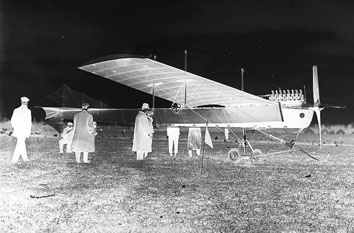
Original Antoinette VII (According to Wikipedia).
In October 1908, the British newspaper *Daily Mail* had offered a prize of 10,000 British pounds. The prize was to be awarded to the first person to fly across the English Channel. Levassieur was determined to win this prize, so Latham conducted a series of long test flights with the Antoinette IV. On July 19, 1909, Latham made his first attempt to fly across the English Channel in an Antoinette IV. The takeoff point was Cap Blanc-Nez near Sangatte on the French coast. Latham was accompanied by the French frigate Harpon. The flight took off at 6:42 a.m. However, Latham did not complete the crossing and, after suffering engine failure, crashed into the Channel after flying 13 km. The frigate Harpon pulled him and his aircraft out of the sea.
Levassieur then turned to his improved aircraft, the Antoinette VII, to attempt another flight across the English Channel. The aircraft made its maiden flight on July 25, 1909. On the same day, the Frenchman Louis Blériot successfully flew across the English Channel in his Blériot XI monoplane.
Levassieur nevertheless wanted to prove that his Antoinette VII was also capable of the feat. On July 27, Latham took off again. This time, the aircraft came within about 2.5 km of the English coast before the engine failed once more. Latham was rescued by the British warship Russell.
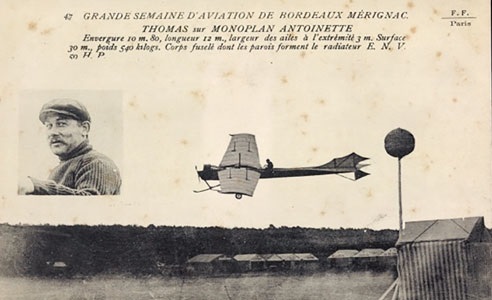
The Antoinette did not have a conventional control stick.
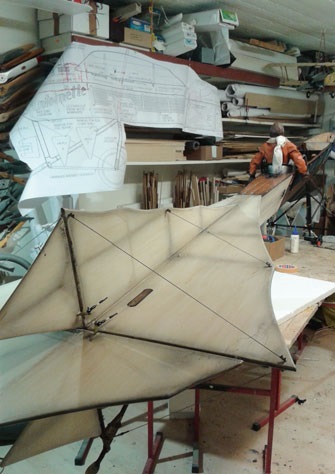
The elevator-rudder unit, covered with Solartex, has been authentically aged to look slightly worn.
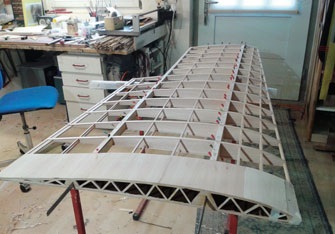
The wings are taking shape. The first rib is particularly striking; it was modeled after the original and was left exposed.
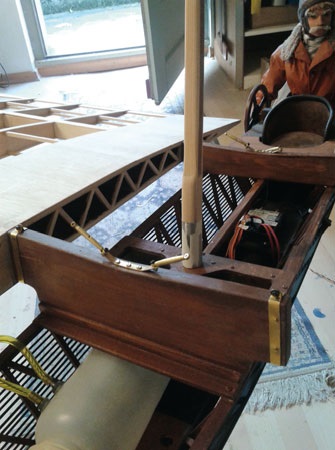
The wing mounts and the main spar are designed to match the original.
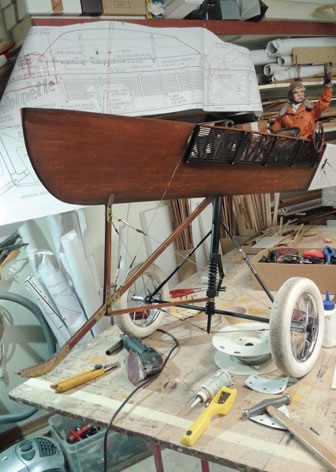
The design of the spring-loaded single-leg landing gear is very challenging. The individual tension cables ensure directional stability, but must be mounted with a slight amount of slack to accommodate the suspension travel.
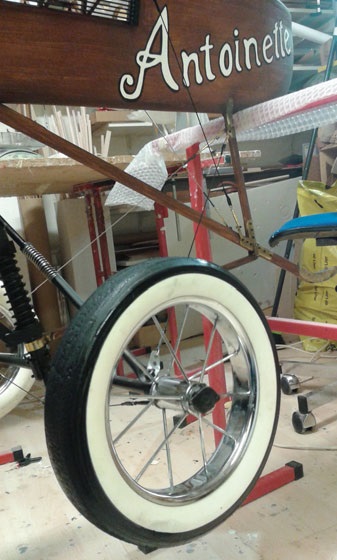
The wheels are from an old stroller (Maybe some mom is desperately looking for the wheels to her stroller? Ha, ha...)
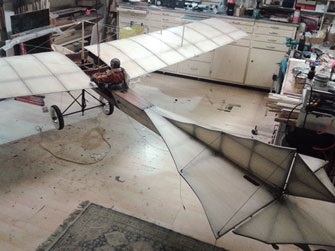
Things are getting crowded again in Rainer's studio!
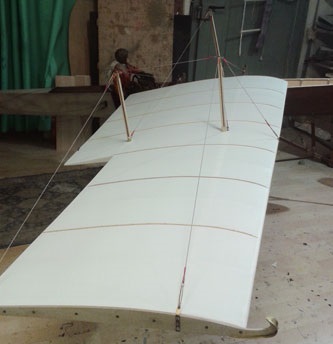
The skids at the wing tips are particularly striking. These served a very good purpose, as they significantly reduced the stress on the wings when they touched the ground.
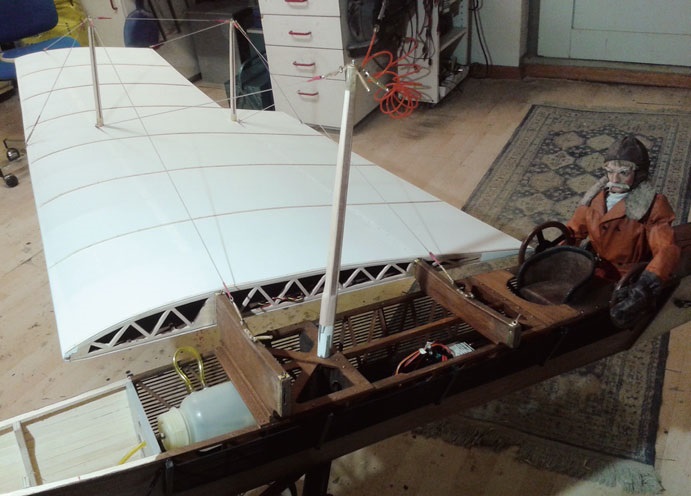
An exotic-looking configuration. However, the wing struts halve the forces generated during flight.
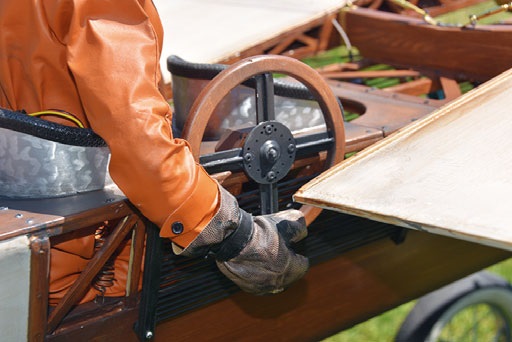
The pilot used those control wheels to steer the Antoinette back then.
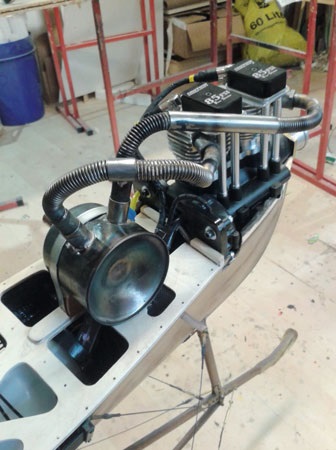
The Roto 85-cc inline engine is a perfect fit. The exhaust system was soldered together from a camping gas cartridge. There are 3.5 kg of lead stowed under the engine. This was to be expected for a model of this size with such an extremely long fuselage.
| Original Antoinette VII | Model Mattle | |
| Crew | 1 to 2 | |
| Scale | 1:3.5 | |
| Length (m) | 11.5 | 3.210 |
| Wingspan (m) | 12.80 | 3.740 |
| Height (m) | ||
| Flight area | 50 m² | |
| Takeoff weight (kg) | 590 | 21 |
| Powerplant | Eight-cylinder V-engine 8 | Roto 85 cc four-stroke |
| Top speed | 70 km/h |
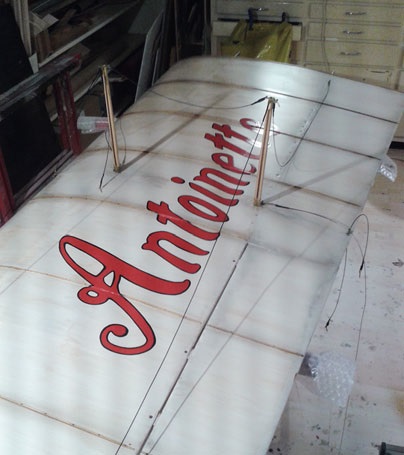
Just like back then, the lettering here is also applied by hand. It’s also nice to see the nailed fabric-holding strips.
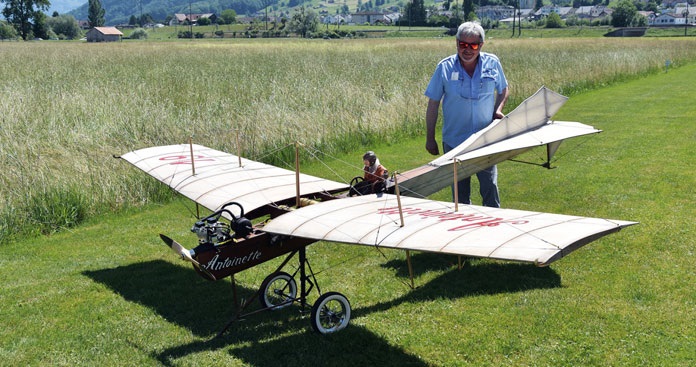
Rainer Mattle with his outstanding work.
Watch the video:

Antoinette:


What's New at Leomotion.com

PRIDE AND GOOD IDEAS
 Markus Nussbaumer

News from HEBU

TEAM MANAGER "THIS" BOSSHARD
 Rodito Nussbaumer

ATOM, THE NEW DOUBLE-DECKER FROM CPLR
 Matthias Bosshard

INSIGHTS INTO THE HISTORY OF SEAPLANES

34th HAHNENMOOS ALPINE MODEL AIRPLANE CAMP
Res Dauwalder
CORSAIR F4U – A WARBIRD WITH A MEMORABLE LOOK
Jürgen Rosenberger, Jürgen Prinz
SUMMER FUN 2026 AT MG USTER
Martin Wunderli
F3A EUROPEAN CHAMPIONSHIPS IN ST-MACAIRE, FRANCE
Matthias Bosshard
52. 2026 ALPS CUP
 Emil Giezendanner

HORIZON HOBBY/LEMACO NEWS: MICRO OV-10 BRONCO 645 MM BY E-FLITE

TWIN TOWN PARTNERSHIP
Wolfgang Voeller
EURO CONTEST GLIDER ACRO TOUR AUSTRIA 2026

BY YOUTH, FOR YOUTH
Lorena Betschen
YOU KNOW WHAT I MEAN? 125 YEARS OF THE SWISS AERO CLUB
Emil Giezendanner
SMALL, MODEL-LIKE SAILBOATS
Res Dauwalder
TRY-OUT DAY AT MFV WETTINGEN
Urs Keller
WELCOME, NEW MEMBER!
Andrea Bolliger
FREE FLIGHT IN THE MIDDLE OF SUMMER
Urs Muntwyler
THE PC-21 STORY
Emil Giezendanner
COUPE DES ALPES – OBSERVE AND LEARN
Rodito Nussbaumer
NEWS FROM HEBU
 Julia Bucher

FROM 0 TO 100
Markus Nussbaumer
NOS REGION – A HUB FOR ELECTRIC AVIATION
Emil Giezendanner
MEMORIES
Wolfgang Völler
Have you almost forgotten about aircraft that take off and land vertically?
Emil Giezendanner
70 YEARS OF THE NIDWALDEN MODEL AIRPLANE CLUB
Martin Barmettler