
The future flies quietly and efficiently
Marco Buholzer has always been fascinated by the third dimension: At age 13, he took up model aircraft flying; this was followed by flight pre-school, a private pilot’s license, and an airline transport pilot’s license, and today the entrepreneur from Buttikon is the owner of Switzerland’s first electric flight school, Pitch Power, in Schänis.
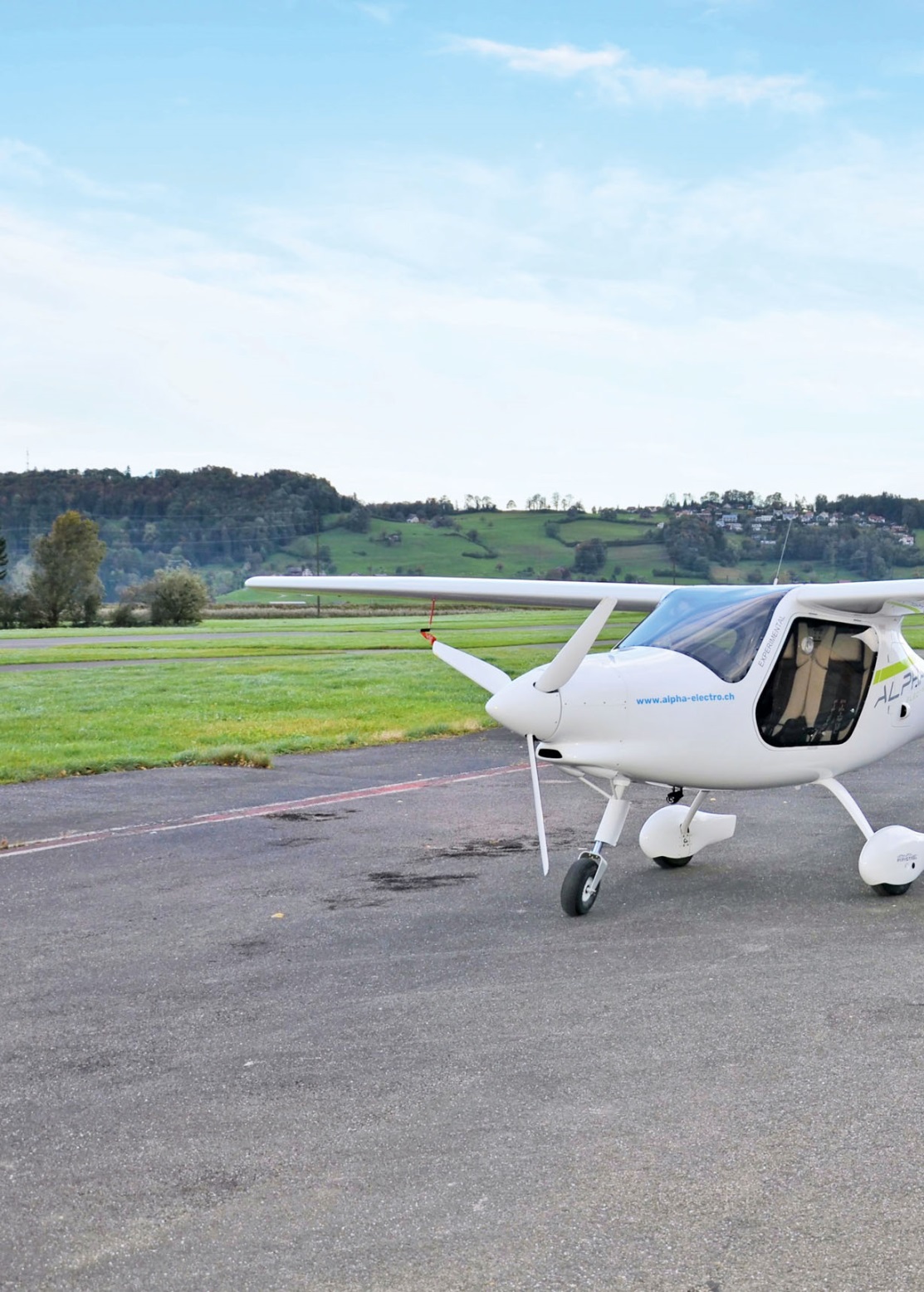
The Föhn is raging; the gusts can be felt with full force even at the bottom of the valley—flying is out of the question today. Even the huge umbrella with its massive concrete base had to give in and is now lying on the terrace of the airfield restaurant. A visit to Schänis is still worth it, though, because there’s something special in the hangar: a fully electric small aircraft, an Alpha Electro from the Slovenian manufacturer Pipistrel.
Ever since pilot and flight instructor Marco Buholzer saw an electric airplane for the first time, he’s been thrilled: simple, quiet, and emission-free—that’s how he wants to train pilots in the future. Flight training requires countless takeoffs and landings, which can be heard from far away when using a combustion engine. A quiet electric powertrain is highly accepted by the surrounding community. That’s why Buholzer’s idea for an electric flight school was immediately well-received at the Schänis airfield—which is actually a glider airfield—and local politicians were also supportive of the project from the very beginning.
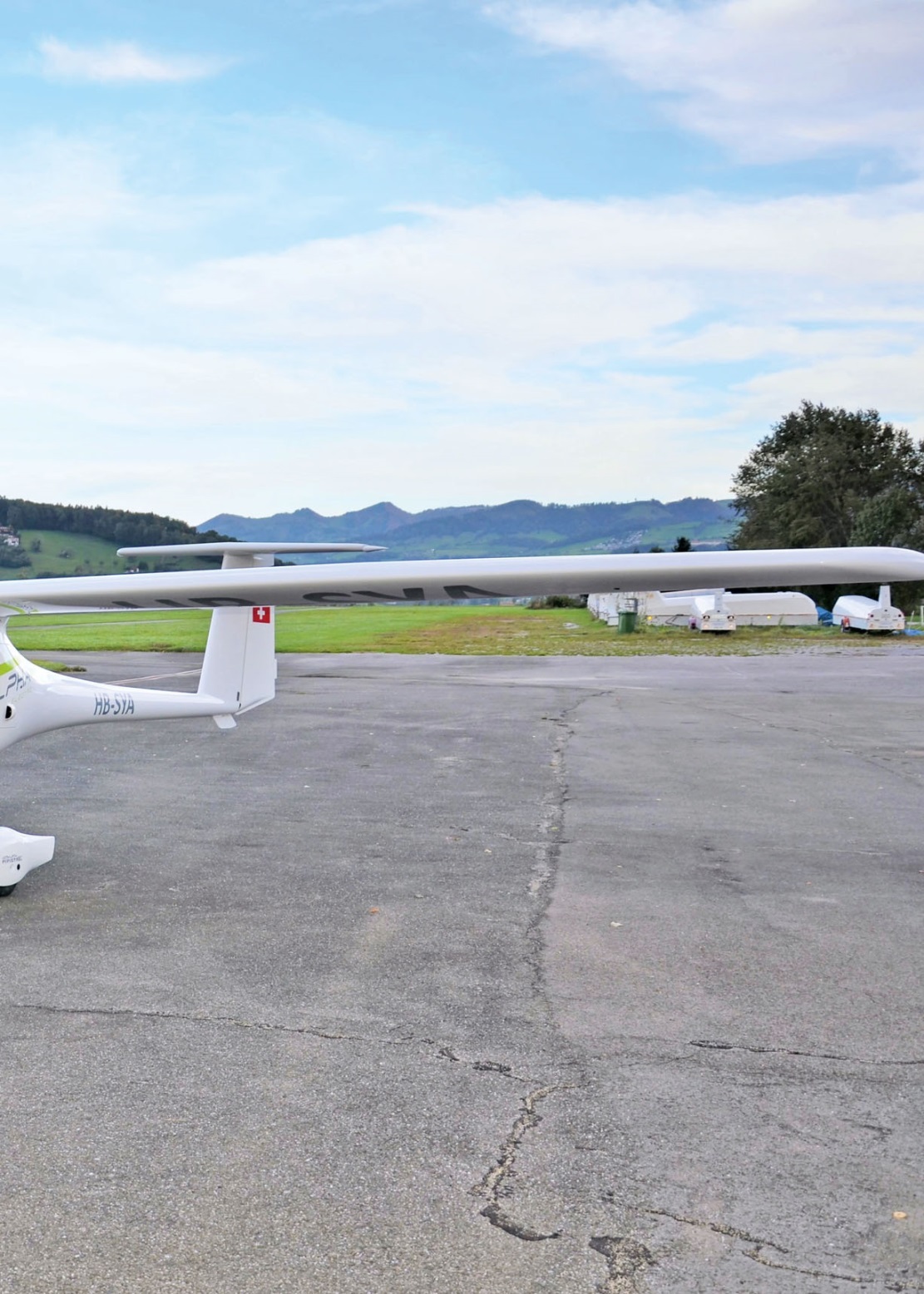
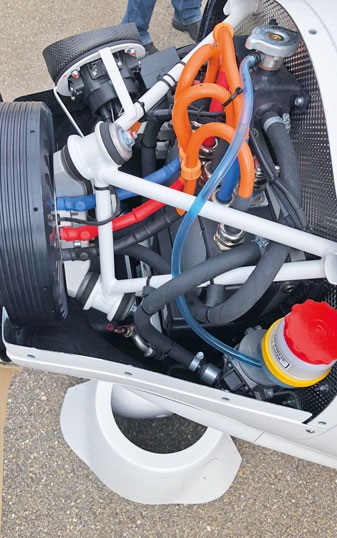
Buholzer is certain that electric aviation will secure a firm place in the aviation industry in the future: “If something makes flying more environmentally friendly and is technically feasible, it should be implemented.” While commercial aviation is still a long way from—or may never fully become—all-electric—Buholzer is working on an e-fuel project in this area—the electric light aircraft is ideal for training: With two redundant 10-kWh batteries, flights of 40 to 50 minutes are possible at a cruising speed of 85 knots. In a few years, solid-state batteries are expected to roughly triple the capacity. In addition, the aircraft, which features so-called flaperon control surfaces, is extremely efficient: thanks to its excellent aerodynamics, it climbs twice as well as small aircraft currently in service and flies at a cruising power of just 20 kW—about two-thirds that of combustion-engine aircraft in the same class. Also noteworthy is the comprehensive rescue system in the form of a giant parachute that the pilot can deploy in an emergency.
To charge the batteries with electricity from renewable energy sources, a large solar array will soon be installed on the hangar roof—with a capacity of 200 kW and a storage system, this will optimize the Schänis airfield’s self-consumption; excess electricity will be fed into the local power grid.
Somehow, Marco Buholzer has always had a certain pioneering spirit about him: As early as the late 1980s, he and his business partner at the time were building speed controllers for electric model airplanes that didn’t exist in that form. He often designed his models entirely from scratch and even built the motors himself. He flew his own designs in numerous competitions—with great success. In the F3E category—the electric flight competition class featuring distance and time-based tasks—he became Swiss champion. He competed in the first World Championships and traveled to model aircraft competitions throughout Europe.
Even though the trained telecommunications, electrical, and equipment technician and business economist has long since “spread his wings” himself and has over 4,500 flight hours in small aircraft to his credit: “Model flying still fascinates me—both the technology and the skills required for a successful flight,” says the 54-year-old, who is a member of the Erlenbach Model Flying Club.
He doesn’t have time to build his own models, as his main job as the owner of RIPEnergy AG—a company specializing in energy conversion products—and his diverse aviation projects keep him very busy. However, he never misses an opportunity to cast a fishing line or go on a bike ride every now and then. When it comes to model aviation, the father of two usually follows his own path: Together with his adult son, he hoists one of his large electric gliders—such as a Lesky FX2 with a 6-meter wingspan—onto his shoulders and hikes up a mountain. There, the two enjoy the peace and quiet, the view, and the undisturbed pleasure of flying.
How would Buholzer describe the new electric flying experience in the 550-kg, single-engine Alpha Electro? His answer is clear: “There’s only one way—try it yourself!” Pitch Power offers introductory flights where you can fly the aircraft yourself alongside an experienced flight instructor. “In my experience, model airplane pilots find it a bit easier to fly an airplane themselves, since they already have a basic understanding of aerodynamics and flight techniques,” says Buholzer. In principle, however, anyone can learn to fly: “It’s not rocket science,” laughs the experienced pilot and flight instructor. “For me, it’s always exciting to introduce people from all walks of life to flying.”
And for those who catch the flying bug, training for a private pilot’s license will begin in Schänis in the spring of 2020: Two modern CSA23-certified Velis Electro electric aircraft and an identical model with a combustion engine—for Alpine orientation and the mandatory navigation flight—will make the dream of flying come true.
Photos: Marco Buholzer,
Rahel Meister


What's New at Leomotion.com

PRIDE AND GOOD IDEAS
 Markus Nussbaumer

News from HEBU

TEAM MANAGER "THIS" BOSSHARD
 Rodito Nussbaumer

ATOM, THE NEW DOUBLE-DECKER FROM CPLR
 Matthias Bosshard

INSIGHTS INTO THE HISTORY OF SEAPLANES

34th HAHNENMOOS ALPINE MODEL AIRPLANE CAMP
Res Dauwalder
CORSAIR F4U – A WARBIRD WITH A MEMORABLE LOOK
Jürgen Rosenberger, Jürgen Prinz
SUMMER FUN 2026 AT MG USTER
Martin Wunderli
F3A EUROPEAN CHAMPIONSHIPS IN ST-MACAIRE, FRANCE
Matthias Bosshard
52. 2026 ALPS CUP
 Emil Giezendanner

HORIZON HOBBY/LEMACO NEWS: MICRO OV-10 BRONCO 645 MM BY E-FLITE

TWIN TOWN PARTNERSHIP
Wolfgang Voeller
EURO CONTEST GLIDER ACRO TOUR AUSTRIA 2026

BY YOUTH, FOR YOUTH
Lorena Betschen
YOU KNOW WHAT I MEAN? 125 YEARS OF THE SWISS AERO CLUB
Emil Giezendanner
SMALL, MODEL-LIKE SAILBOATS
Res Dauwalder
TRY-OUT DAY AT MFV WETTINGEN
Urs Keller
WELCOME, NEW MEMBER!
Andrea Bolliger
FREE FLIGHT IN THE MIDDLE OF SUMMER
Urs Muntwyler
THE PC-21 STORY
Emil Giezendanner
COUPE DES ALPES – OBSERVE AND LEARN
Rodito Nussbaumer
NEWS FROM HEBU
 Julia Bucher

FROM 0 TO 100
Markus Nussbaumer
NOS REGION – A HUB FOR ELECTRIC AVIATION
Emil Giezendanner
MEMORIES
Wolfgang Völler
Have you almost forgotten about aircraft that take off and land vertically?
Emil Giezendanner
70 YEARS OF THE NIDWALDEN MODEL AIRPLANE CLUB
Martin Barmettler