
Bell 412 – Original and Model
The Bell 412 is a helicopter manufactured by Bell Helicopter in the United States. The helicopter was developed as an evolution of the Bell 212. It is a turbine-powered multipurpose helicopter that has found both civilian and military customers around the world.
The nose section with the two intake ducts, the radar nose, and the hatch providing access to the radar.
EXT PWR
28V
D.C.

The Bell 412 is a further development of the UH-1 Iroquois, which is used worldwide and is also unofficially known as the “Huey.” Its maiden flight took place in August 1989. To date, just under 1,000 units have been delivered in a wide variety of configurations.
The Bell 412’s areas of operation include, among others,
- airborne coast guard missions
- Maritime search and rescue (SAR)
- offshore operations (ocean flights, e.g., to supply oil rigs)
- airborne emergency medical services as a rescue or critical care transport helicopter
- use in support of the air force missions of various armies
Depending on the mission, Bell offers various optional equipment, such as a winch, weather radar, a searchlight, a Forward-Looking Infrared(FLIR) surveillance system, as well as the capability to carry external loads such as firefighting containers (Bambi Buckets). The Bell 412 can also be equipped for instrument flight in accordance with IFR flight rules.
The “4” in the Bell 412’s model designation stands for the four-blade main rotor (Bell 212—two rotor blades). The torque of the main rotor is balanced by a two-blade tail rotor. The helicopter can be delivered with either a skid landing gear or a wheeled landing gear. With the Bell 412, the U.S.-based Bell Helicopters Textron Inc. offers a helicopter that is used extremely frequently internationally for critical care transport. In the U.S. in particular, this comparatively large helicopter type is frequently used to transport critically ill or injured patients between specialized hospitals.
Snowy Hydro SouthCare is a rescue and aeromedical helicopter service based at Canberra International Airport in Australia. Its service area covers the Australian Capital Territory, parts of New South Wales—including the South Coast region—parts of the Southern Tablelands, regions of the Central and Western Riverina, and the southern portion bordering Victoria. SouthCare operates a single Bell 412 provided by CHC Helicopters, with medical crews from the Capital Region Retrieval Service and the ACT Government Health Directorate. The service is funded by substantial contributions from Snowy Hydro, a hydroelectric power company. Rescue and recovery missions outside the service area are coordinated with the Ambulance Service of New South Wales. Snowy Hydro SouthCare was founded in 1998 and had already completed its 5,000th mission by January 2013.
Operations conducted by helicopter include primary or rescue missions, in which patients are stabilized and flown from accident sites to major hospitals. Additionally, there are secondary missions such as patient transfers between major and regional hospitals to provide access to urgent specialized treatment. Other missions include search and rescue operations as well as firefighting.
The SouthCare Helicopter Service was founded in October 1998. As early as December of that same year, the organization faced one of the largest missions in its history. During the Sydney-Hobart Yacht Race, under extreme weather conditions, six people on five yachts lost their lives. During the operation, which lasted several hours, the SouthCare crews rescued nine sailors from two capsized yachts. In recognition of their extraordinary rescue efforts, the Cruising Yacht Club of Australia made a donation of $20,000 to the SouthCare Helicopter Service, which was able to put the money to good use in the organization’s still-young history.
In 1999, SouthCare signed a five-year contract with Canberra International Airport, which granted the rescue organization free use of a hangar and free flight operations. This temporary measure made it possible to maintain the service while planning and construction of its own hangar proceeded; the hangar became operational in 2005. In June 2013, SouthCare received 500,000.The funds were used to finance and construct an administrative and training facility at the base. Starting in mid-2017, the Bell 412 was replaced by an AgustaWestland AW139. In November 2016, the AW139 was transferred to Snowy Hydro SouthCare. Once again, Snowy Hydro made a significant financial contribution toward the new helicopter as part of this model change.
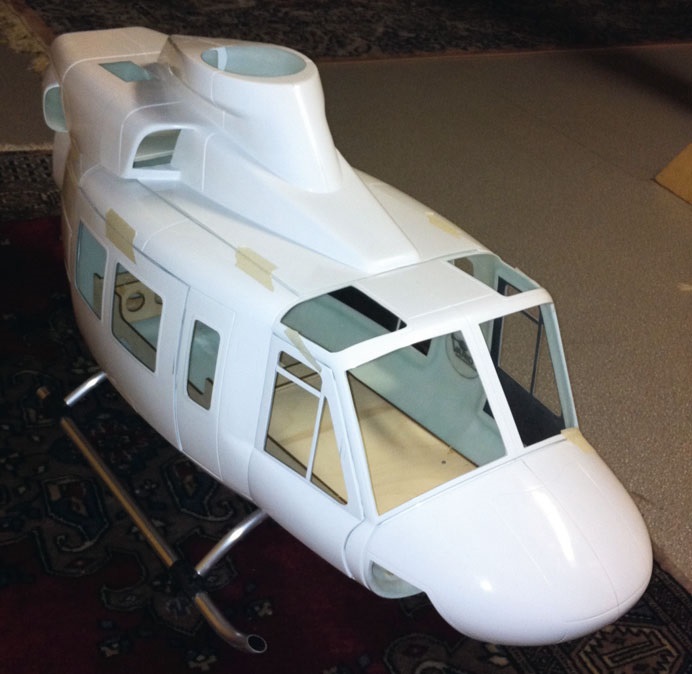
| Prototype / Original | Model / Scale Model | |
|---|---|---|
| Scale / Échelle: | 1:7 | |
| Rotor diameter / Diamètre du rotor: | 14.00 meters | 1.78 meters |
| Length / Longueur: | 14.00 meters | 1.66 meters |
| Height / Hauteur: | 3.90 meters | 0.49 meters |
| Width / Largeur: | 2.80 meters | 0.34 meters |
| Curb weight / Masse à vide: | 3,066 kilograms | |
| Takeoff weight: | 5,400 kilograms | 10.1 kilograms |
| Speed: | 250 km/h | |
| Range / Autonomy: | max. 700 kilometers |
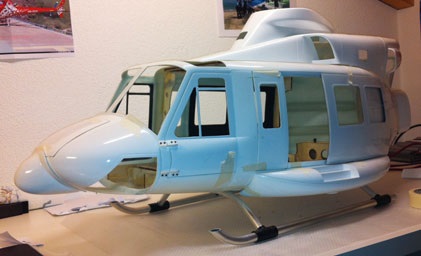
Luca Jardini had been searching for his first scale project for a long time, but he could never quite decide on a model. That changed, however, at JetPower 2010 in Bad Neuenahr, when he saw the Bell 412 model at the Vario booth. From that moment on, it was decided: this was the model he would build.
At the same time, three of his colleagues were also looking for a new scale project, and since, as we all know, things go better when we work together, they decided to build four full-scale models and appear as a squadron at events. The fuselage kits, rotor heads, and accessories were ordered from Vario and picked up together at the 2011 Vario Event in Gräfendorf.
Since the model was to be powered by a turbine, the JetCat PHT2 was chosen based on the model’s size.
By chance, the four friends were suddenly confronted with the fact that models powered by a PHT2 should not exceed the nine-kilogram weight limit. When they weighed all the components to be installed—starting with the fuselage and including the scale-model attachments—the scale already read 11 kilograms. And that was without the fuel tank or even a minimum of two liters of kerosene.
After several inquiries with JetCat and other dealers with turbine experience, it became increasingly clear that the turbine project would have to be replaced with an electric one. Since one of Luca’s colleagues’ models was already well underway, test flights could be conducted with the turbine-powered Bell 412. But what theory had predicted became reality in practice. Already on the second flight, the PHT2 failed. Weighing 11.3 kilograms, the model was simply too heavy to be powered by this turbine.
Now it was clear to everyone else as well: formation flying with four Bell 412s was a thing of the past. Only Luca Jardini refused to give up. More than ever before, he was determined to get the “Bell” airborne.
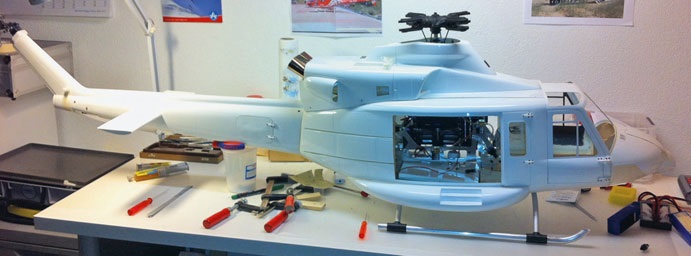
The PHT2 was removed and replaced with an electromechanical system. A Scorpion motor is used, controlled by a Castle 120HV and powered by two 6S 5000mAh batteries. For servos, Luca installed Futaba BLS 451s on the swashplate and at the tail. For attitude stabilization, he still uses the Helicommand Rigid with a Futaba GY401 tail gyro. Since the tail rotor on the original is mounted freely at the top of the tail, Luca opted for the M-Copter, which closely resembles the prototype.
The prototype had actually been decided on from the very beginning of the project: it was to be the Bell 412 from Air Zermatt. However, while searching the internet late one night for details on the prototype, another model suddenly caught his eye. After some internal deliberation and a sleepless night, Luca changed his mind; it would be the Bell 412 based on the Snowy Hydro SouthCare model. He quickly drafted an email to Australia, and he could hardly believe his eyes when, after just six hours, all his questions had been answered and detailed photos and blueprints of the original had been sent back. The only thing the people in charge at Snowy Hydro SouthCare asked in return was that, once the model was completed, Luca send them a few photos.
With these highly detailed images, Luca could now set to work adding the details to the model. Since SSM-Technik (now alk.ch) offers a wide range of scale parts, this saved him a lot of work. However, he did the following himself: the service hatch on one side of the tail and on the radar nose, the fixed section at the front of the sliding door for opening, the two auxiliary fuel tanks on the lower sides of the fuselage with steps, adjusting the landing gear to the correct angle, the rescue winch, and the VHF antenna on the boom.
A year had passed, and there before Luca stood his full-scale Bell, ready for the airframe assembly. The maiden flight was scheduled and went off without any further problems. However, after a hover time of only four minutes, the batteries were already nearly 70% drained. The very erratic flight behavior was also less than convincing. But where was the mistake?
For the turbine version, a 4-blade rotor head with M-blades 75 mm wide had been purchased. This was installed, but the torque required for these wide blades simply drew too much power. After some research and consultation with experts, Luca was advised to switch the head and blades to Vario’s system with two-blade screws, which he quickly did. And lo and behold, this change resulted in flight times of over ten minutes; the model’s tendency to spin out of control was gone, and it flew stably under stick control.
Now the model could be disassembled again to undergo the very labor-intensive painting work, which spanned several months. To keep costs from skyrocketing, Luca did all the sanding and masking work himself. Since 2013, Luca Jardini has been a regular sight at events with his Bell 412 in the Snowy Hydro SouthCare livery. The fact that this is an exceptional and rare livery is due to the fact that photos of Luca’s Bell 412 are used on Vario’s website and in its catalog.


What's New at Leomotion.com

PRIDE AND GOOD IDEAS
 Markus Nussbaumer

News from HEBU

TEAM MANAGER "THIS" BOSSHARD
 Rodito Nussbaumer

ATOM, THE NEW DOUBLE-DECKER FROM CPLR
 Matthias Bosshard

INSIGHTS INTO THE HISTORY OF SEAPLANES

34th HAHNENMOOS ALPINE MODEL AIRPLANE CAMP
Res Dauwalder
CORSAIR F4U – A WARBIRD WITH A MEMORABLE LOOK
Jürgen Rosenberger, Jürgen Prinz
SUMMER FUN 2026 AT MG USTER
Martin Wunderli
F3A EUROPEAN CHAMPIONSHIPS IN ST-MACAIRE, FRANCE
Matthias Bosshard
52. 2026 ALPS CUP
 Emil Giezendanner

HORIZON HOBBY/LEMACO NEWS: MICRO OV-10 BRONCO 645 MM BY E-FLITE

TWIN TOWN PARTNERSHIP
Wolfgang Voeller
EURO CONTEST GLIDER ACRO TOUR AUSTRIA 2026

BY YOUTH, FOR YOUTH
Lorena Betschen
YOU KNOW WHAT I MEAN? 125 YEARS OF THE SWISS AERO CLUB
Emil Giezendanner
SMALL, MODEL-LIKE SAILBOATS
Res Dauwalder
TRY-OUT DAY AT MFV WETTINGEN
Urs Keller
WELCOME, NEW MEMBER!
Andrea Bolliger
FREE FLIGHT IN THE MIDDLE OF SUMMER
Urs Muntwyler
THE PC-21 STORY
Emil Giezendanner
COUPE DES ALPES – OBSERVE AND LEARN
Rodito Nussbaumer
NEWS FROM HEBU
 Julia Bucher

FROM 0 TO 100
Markus Nussbaumer
NOS REGION – A HUB FOR ELECTRIC AVIATION
Emil Giezendanner
MEMORIES
Wolfgang Völler
Have you almost forgotten about aircraft that take off and land vertically?
Emil Giezendanner
70 YEARS OF THE NIDWALDEN MODEL AIRPLANE CLUB
Martin Barmettler