
A successful, high-quality replica
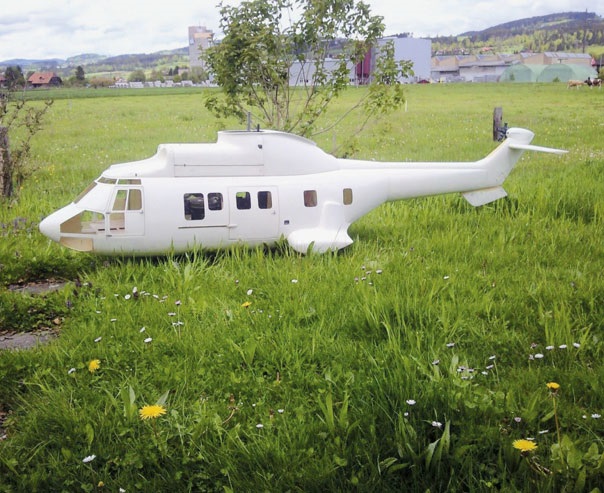
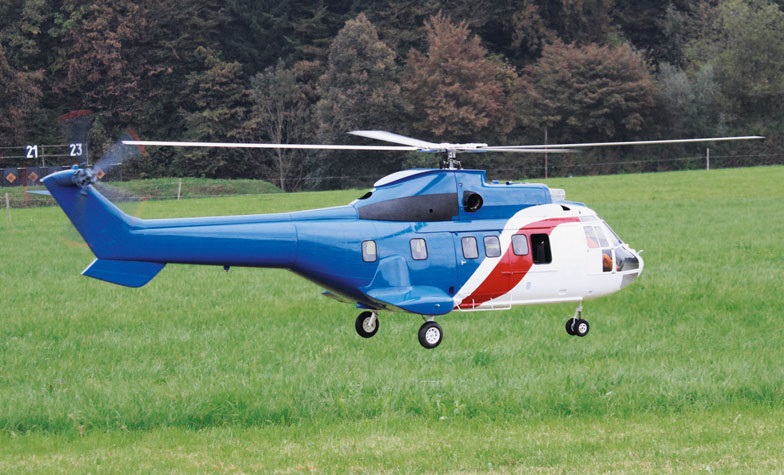
For many years, Urs Rätz from Schlierbach, Lucerne, in Central Switzerland, flew his Super Puma—which had a rotor diameter of 1.8 meters and was powered by a Zenoha ZG-23 gasoline engine—until he began to dream of owning a turbine helicopter. Over the course of about six years and countless hours of work, he built a replica of the Super Puma AS332C operated by the British company Bristow. Countless details modeled after the original make this model a one-of-a-kind creation.
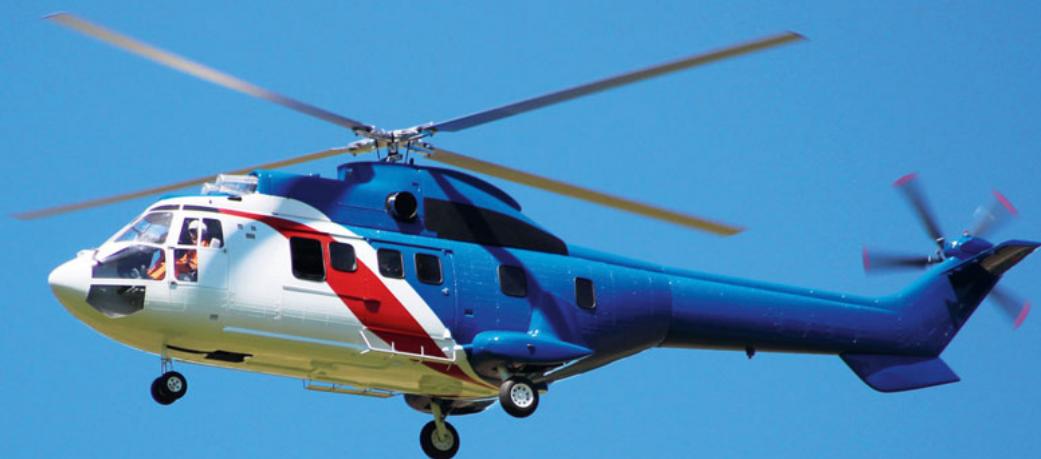
It's always a pleasure to see such a beautiful model in the air.
Bristow Helicopters Limited is a British civil helicopter operator that was originally founded at Aberdeen Airport in Scotland. It is now part of the U.S.-based Bristow Group, which is headquartered in Houston, Texas.
Bristow Helicopters Limited holds a British Type A certificate, which allows it to carry passengers, cargo, and mail on helicopters with 20 seats or more.
Bristow Helicopters Limited was founded in June 1955 by Alan Bristow.
In the beginning, Hiller UH-12 C helicopters were used to fulfill orders and train pilots. Most of the pilots were recruited from the British Army (RAF). Starting on February 17, 1965, the company began operating Westland Wessex 60s, a 10-seat helicopter designed for the North Sea oil industry to supply its offshore facilities.
In 1985, Bristow Helicopters Limited was acquired by the British company Commonwealth Holdings plc and continued to operate under the same name.
In 1996, Bristow Helicopters was acquired by Offshore Logistics, an American offshore helicopter operator that operated as Air Logistics in the Gulf of Mexico and Alaska. The group subsequently operated a global fleet of over 400 helicopters and aircraft. In 2006, Offshore Logistics rebranded itself as “The Bristow Group.”
The Bristow Group expanded its portfolio in April 2007 with the purchase of Helicopter Adventures, a Florida-based flight school that was subsequently renamed Bristow Academy. The deal made the Bristow Group the world’s largest civilian fleet operator of Swiss 269C-1 helicopters.
In January 2010, Bristow announced that it would discontinue the use of the name “Air Logistics.” From that point on, the company operated solely under the name Bristow. Bristow provides helicopter services, maintenance, and other support services for the oil and gas industry. It operates more than 170 helicopters in the United States.

In addition to its wholly owned international operations, the Bristow Group holds service contracts and equity interests in helicopter operators in Brazil, Canada, Colombia, Egypt, Kazakhstan, Turkmenistan, Mexico, Norway, Russia (Sakhalin), and the United Kingdom. This enables Bristow to expand its range of services into new and emerging oil and gas markets and to offer a lower cost structure in certain operational areas.
Partners include:
- Cougar Helicopters, Newfoundland
- Helicopteros Nacionales de Colombia
- Helicol SA, Colombia
- Petroleum Air Services, Egypt
- Atyrau Bristow Airways Services (ABAS), Kazakhstan
- Turkmenistan Helicopters Limited, Turkmenistan
- Heliservicio Campeche, Mexico
- Norsk Helikopter, Norway – now Bristow Norway
- Sakhalin Bristow Air Services (AKA Aviashef), Sakhalin, Russia
- FBH Limited, United Kingdom
Although no joint venture between Bristow and Agusta-Westland had been agreed upon by 2015, Bristow is assisting in the development of the AW609 tiltrotor with offshore, search, and rescue capabilities. This could simplify the supply of oil platforms, as this model can be used as either an airplane or a helicopter. Bristow intends to order more than 10 AW609s.
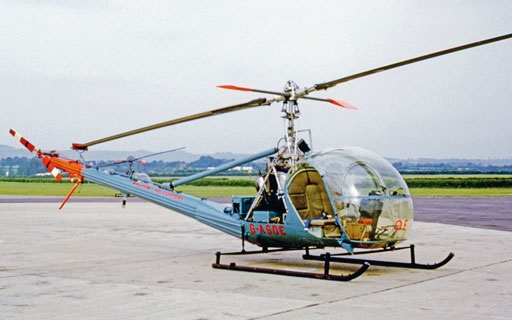
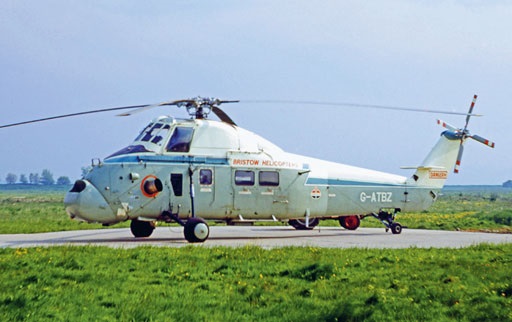
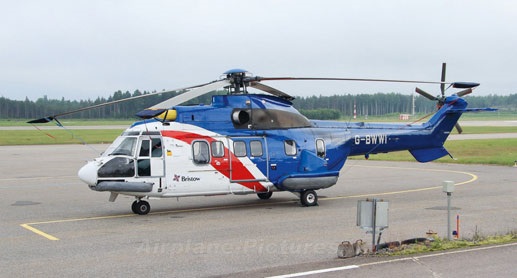
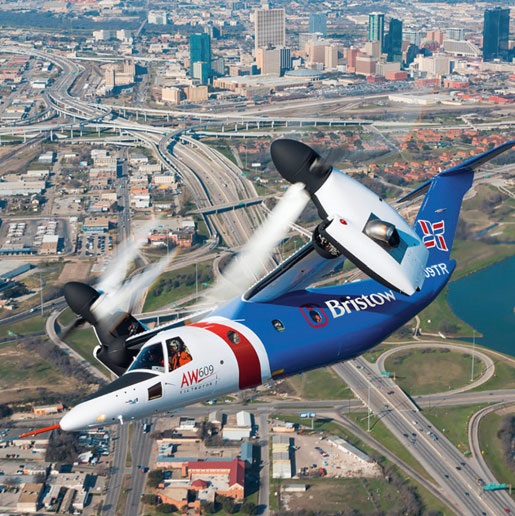
Bristow Helicopters operated several Sikorsky S-61Ns on behalf of Her Majesty's British Coast Guard until July 2007, after which there was a twelve-month transition period during which CHC Helicopter took over the contract and replaced the S-61Ns with new helicopters.
Bristow operated four decentralized Search and Rescue (SAR) stations in the United Kingdom on behalf of the Coast Guard Service. The units were located in Portland, Lee-on-Solent on the south coast of England, near Stornoway in the Outer Hebrides, and near Sumburgh in the Shetland Islands. Northern North Sea Services operates out of Aberdeen, Scatsta (EGPM), and Stavanger.
Bristow operates a large fleet of more than 450 helicopters and aircraft, including unconsolidated subsidiaries and joint venture partners. The company plans to reduce the current fleet of 24 helicopter types to six over the next few years. The subsidiaries Eastern Airways and Airnorth will continue to operate turboprop and jet aircraft.
The Eurocopter AS332 Super Puma (now the Airbus Helicopters H215) is a four-bladed, twin-engine, medium-sized helicopter developed and marketed by Aérospatiale and Eurocopter (now Airbus Helicopters). It is an enlarged and re-engined version of the original Aérospatiale SA 330 Puma. The prototype of the SA 330 (Super Puma) made its maiden flight in 1978.
Series production began in 1980. Since 1990, the Super Pumas have been marketed for military service under the designation AS532 Cougar. In 2004, the Super Puma AS 332 was succeeded by the Eurocopter EC225 Super Puma.
Bristow’s Super Puma AS 332 rolled off the assembly line in 1983 as F-WTNN. Registered as OY-HMF, it was operated by Mersk Air from 1983 to 1986, before serving with Bristow from 1986 to 2012 under the registration G-BWWI. Since September 2012, the Super Puma AS332C has been based in Canada with the new registration N204VA and flies on behalf of Wells Fargo Bank.
However, it was clear to him from the very beginning that as many detailed scale additions and modifications as possible would need to be made to the fuselage. The frame set included with the fuselage allows the builder to take his time deciding what kind of mechanical components to install and to make this decision only after the airframe is complete.
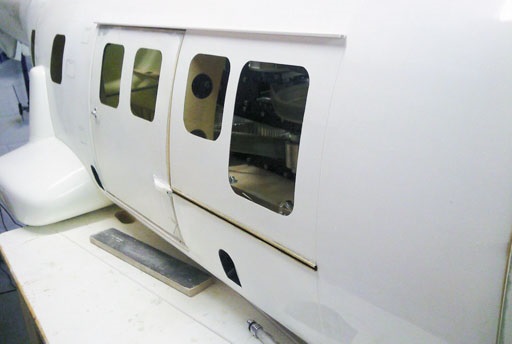
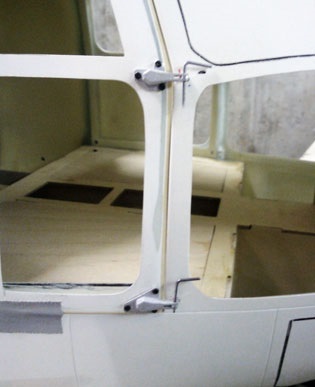
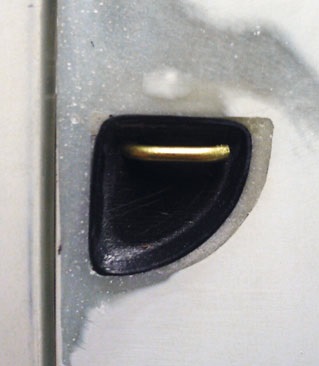
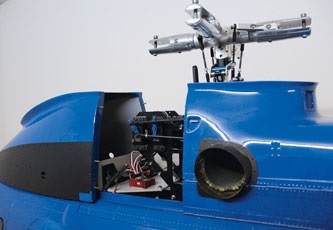
The well-fitting set of frames was quickly adjusted and installed. He also made the stern removable. To do this, he fabricated and installed two additional frames. After drilling the precise holes, the stern section can be detached using five M6 screws. To ensure the sliding doors function perfectly, a square brass profile was milled out and fitted into a slot in the fuselage. An M2 screw connects the hinge to the sliding profile. The door hinge is a 3D-printed part. The sliding door is unlocked and locked using a cable pull operated by the sliding door handle. The two pins of the locking mechanism serve as the upper and lower slide guides. →
For many years, Urs Räz from Grosswangen in Central Switzerland flew his Super Puma—which had a rotor diameter of 1.8 meters and was powered by a Zenoha ZG-23 gasoline engine—until he began to feel the desire to own a turbine-powered helicopter. After considering converting his existing model helicopter to a turbine, he dismissed the idea because the model was simply too small to accommodate a turbine. From that point on, Urs was determined to build a Super Puma with a rotor diameter of 2.5 meters from Heli-Kopter Baumann in Belp. A few weeks after placing the order, he was able to hold the fuselage in his hands. However, it was also clear to him from the very beginning that as many detailed scale attachments and extensions as possible would need to be added to the fuselage. The frame set included with the fuselage allows the builder to take his time deciding what kind of mechanics to install and to make that decision only after the airframe is complete.
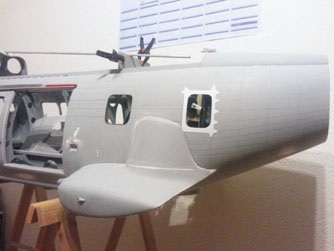
The details have been applied to the fuselage, and the lines for the decals have been marked.
The rear section of the dome was constructed using the same principle as the sliding doors, allowing it to slide backward. This ensures that the electronics and part of the mechanical components will be freely accessible from the rear at a later stage. From the very beginning, Urs Rätz was not satisfied with the design and installation of the main landing gear. For this reason, the bearings were reinforced and the shock absorbers were converted to oil-filled dampers. Since the shock absorbers supplied by Heli Baumann lack damping, this can lead to severe impacts on the frame and servos during hard landings. This solution and the modification prevent that from happening.
After weighing his options regarding the turbine and mechanical components, Urs decided on the SPT5-H from JetCat. The turbine’s power output is ideally suited for models with a flying weight of 20–30 kilograms. Urs found the right mechanical components at Heli-Factory. Unfortunately, an eight-month lead time forced a lengthy hiatus in the Super Puma project. When the shipment from Heli-Factory arrived—consisting of the mechanical assembly, swashplate, swashplate, drive shaft, and linkage, the mechanical components could finally be installed on a trial basis into the model—which was ready for the airframe—after mounting the JetCat SPT5-H turbine and the Futaba BLS 452 servos. The ball-bearing-mounted fixed drive is guided through a carbon fiber tube and, via an angle gear, leads to the five-blade tail rotor from HF Rotorkopf. Aluminum blades from M-Blades are used for the main and tail rotors.
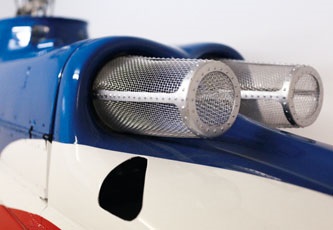
But before we could even think about the maiden flight, we had to solve the problem of the exhaust pipe. Unfortunately, specialty retailers do not offer ready-made exhaust pipes that fit. Zimmermann-Schalldämpfer carries a wide range of suitable segments in various diameters, lengths, radii, and angles. These segments were adapted to the turbine in the model. A specialist then welded the segments together to form a perfectly fitting exhaust pipe. Insulation was provided using an insulation mat from Vario-Helicopter, which is designed specifically for such tasks. A Futaba GY 750 was used for attitude stabilization; unfortunately, during the first hover test while the model was still a shell, it did not meet Urs’s expectations for an attitude stabilization system. However, this problem could wait until the final finishing touches and first flights were scheduled after the model had been painted and completed.
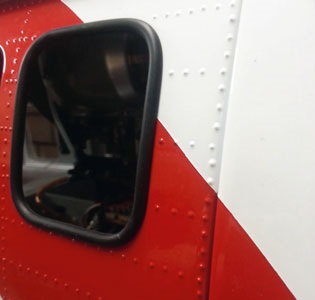
A great deal of effort went into installing the panes in the window seals.
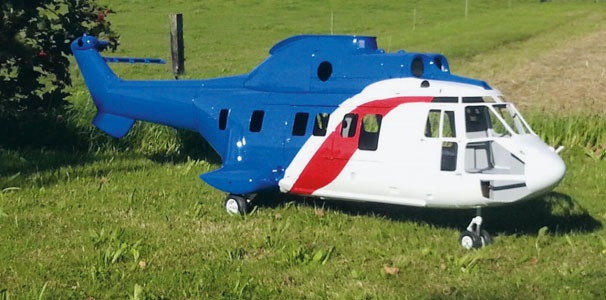
The fuselage is fully painted. The rivets and the faux reinforcements really stand out.
| Prototype | Model | |
| Scale: | 1:21.624 | |
| Rotor diameter: | 16.20 m | 2.50 m |
| Length: | 16.29 m | 2.51 m |
| Height: | 4.97 m | 0.76 m |
| Width: | 3.36 m | 0.34 m |
| Curb weight: | 4,660 kg | |
| Takeoff weight: | 9,150 kg | 27.6 kg |
| Speed: | 270 km/h | |
| Range: | 851 km |
After disassembling the mechanical parts and attaching the final details, the first layer of filler was applied, sanded, filled again, sanded—and this process was repeated six times. Finally, the fuselage was painted gray on the inside as well. What followed required a great deal of time and patience. Thicker foil was used to attach the reinforcements and sheet metal details to the fuselage. Afterward, the rivet lines could be marked. For the rivets, Urs used the tried-and-true method of a syringe filled with white glue. Many an evening and weekend were spent on this work. But the result makes all the effort worthwhile. After the painting—which a friend who is an auto painter did for the builder—everything could be reassembled. However, since some changes had occurred in the meantime regarding work and family, the completion of the model was delayed until spring 2016.
Before the maiden flight, the issue of choosing the right attitude stabilization system was still up in the air. Everyone was talking about the Bavarian Demon 3X. After many phone calls with fellow scale pilots and consultations with specialty stores, it was decided that the Demon would be an “inside” model. The first two flights with the Demon 3X showed that this decision was absolutely the right one. Unfortunately, however, a problem arose during the third flight that no one could have foreseen. Two jumbo servos were installed for the retractable landing gear. When the landing gear retracted, the two servos drew so much current that it briefly caused a voltage drop. As a result, the 3X rebooted, and the turbine shut down via the properly programmed fail-safe. The result: The Super Puma crashed onto the grass from a height of 50 centimeters, without causing much damage or breaking anything.
This raised the question of how to prevent this from happening in the future. While searching online, Urs found the S-Bus S3071HV servos from Futaba. This servo is programmable; in retractable landing gear mode, the speed of the servo travel can be set from 0 to 20 seconds. The current setting of 12 seconds now makes the landing gear retraction and extension look realistic, and power spikes no longer occur.
“I’d take on this project again in a heartbeat. It was fun, and the reactions to my model at events tell me that I did everything right. But the landing gear on my project shows that things don’t always work out on the first try or can’t always be predicted.”
Photos: Bristow, Urs Rätz, Anton Laube


News from HEBU

TEAM MANAGER "THIS" BOSSHARD
 Rodito Nussbaumer

SUMMER FUN 2026 AT MG USTER
Martin Wunderli
BY YOUTH, FOR YOUTH
Lorena Betschen
SMALL, MODEL-LIKE SAILBOATS
Res Dauwalder
TRY-OUT DAY AT MFV WETTINGEN
Urs Keller
What's New at Leomotion.com

52. 2026 ALPS CUP
 Emil Giezendanner

ATOM, THE NEW DOUBLE-DECKER FROM CPLR
 Matthias Bosshard

INSIGHTS INTO THE HISTORY OF SEAPLANES

YOU KNOW WHAT I MEAN? 125 YEARS OF THE SWISS AERO CLUB
Emil Giezendanner
34th HAHNENMOOS ALPINE MODEL AIRPLANE CAMP
Res Dauwalder
CORSAIR F4U – A WARBIRD WITH A MEMORABLE LOOK
Jürgen Rosenberger, Jürgen Prinz
F3A EUROPEAN CHAMPIONSHIPS IN ST-MACAIRE, FRANCE
Matthias Bosshard
HORIZON HOBBY/LEMACO NEWS: MICRO OV-10 BRONCO 645 MM BY E-FLITE

PRIDE AND GOOD IDEAS
 Markus Nussbaumer

EURO CONTEST GLIDER ACRO TOUR AUSTRIA 2026

FREE FLIGHT IN THE MIDDLE OF SUMMER
Urs Muntwyler
THE PC-21 STORY
Emil Giezendanner
TWIN TOWN PARTNERSHIP
Wolfgang Voeller
WELCOME, NEW MEMBER!
Andrea Bolliger
COUPE DES ALPES – OBSERVE AND LEARN
Rodito Nussbaumer
NEWS FROM HEBU
 Julia Bucher

FROM 0 TO 100
Markus Nussbaumer
MEMORIES
Wolfgang Völler
NOS REGION – A HUB FOR ELECTRIC AVIATION
Emil Giezendanner
Have you almost forgotten about aircraft that take off and land vertically?
Emil Giezendanner
70 YEARS OF THE NIDWALDEN MODEL AIRPLANE CLUB
Martin Barmettler