
2011 FAI World Championship for Free Flight Model Aircrafts
Class F1E, Seniors and Juniors, Serbia, Zlatibor 28th August – 3rd September 2011
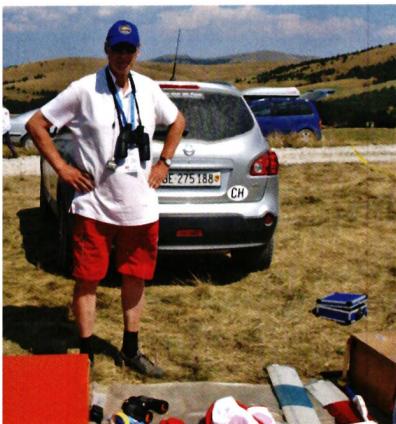
Aeronautical Union Serbia. Our team: Team Manager Edward Ernst; TM Assistant Christian Andrist; F1E pilots Fredi Andrist, Dominik Andrist, and René Pfister.
Serbia is predominantly mountainous, stretching from the Pannonian Hills in the north to the borders with Montenegro, Albania, and Macedonia in the south.
Serbia’s mountain ranges are part of the Rhodope, Carpathian, and Balkan mountain ranges.
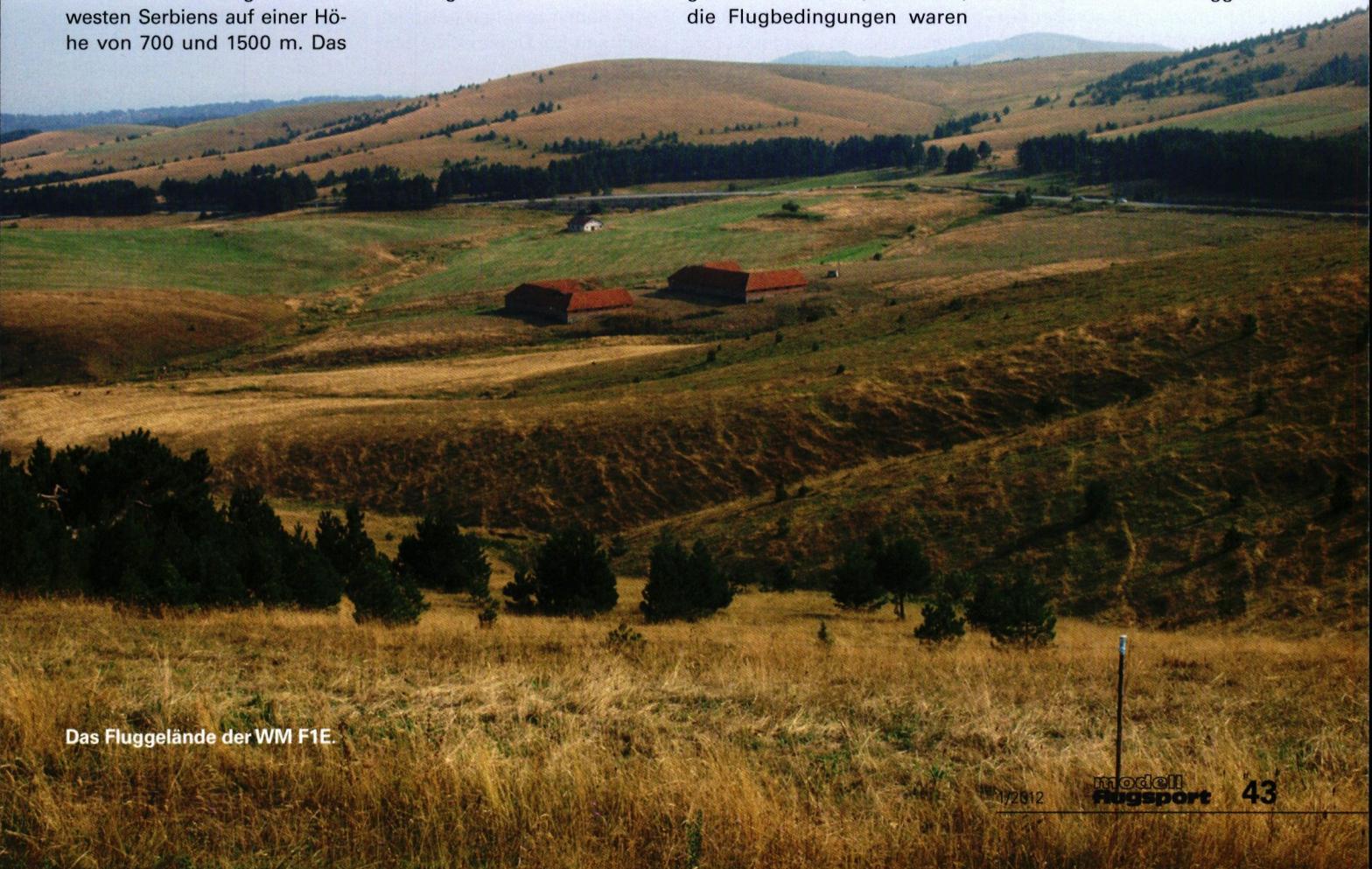
Even the names of some Serbian mountains are reminiscent of the mountain resort located in Zlatibor. Native plants in the Serbian mountains include Serbian spruce trees. The gently rolling Zlatibor Plateau lies in southwestern Serbia at an elevation between 700 and 1,500 meters. The mountain range is located near Uzice and Cajetina and is 238 km from Belgrade.
The team traveled to Serbia in a motorhome and two passenger cars. René Pfister took on the long journey with the RV, while TM Edward Ernst, TMA Christian Andrist, Alfred Andrist, and Dominik Andrist traveled to Zlatibor in two station wagons, loaded to the brim with luggage and model boxes. Everyone weathered the journey—over 1,100 km long—well in temperatures ranging from 28 to 34 degrees Celsius, even with an unexpected city tour of Belgrade thrown in! The accommodation they chose themselves at the Hotel OLYMP proved to be a good choice.
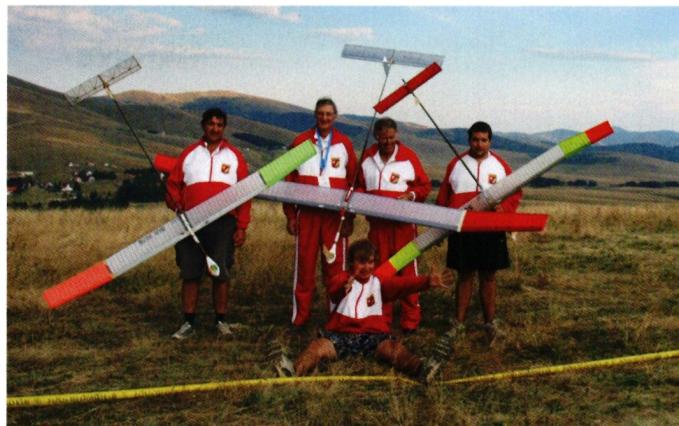
The F1E World Championship was organized and hosted by Serbia. Unfortunately, the competition organizers were not always up to the task, which unfortunately led to unpleasant discussions on several occasions. The competition site was surrounded on all sides by hills. Although there were no obstacles, the wind conditions caused the “Swiss Boys” quite a few problems. On the day of the World Championship, the launch site had to be changed four times, meaning that the flying conditions were difficult to assess. High summer temperatures between 28 and 32 degrees Celsius prevailed all week!
The construction inspection was scheduled for 10:00 a.m. Although it ran a bit behind schedule, the sealing of the five approved F1E models went off without a hitch. In the afternoon, the team moved 5 km further to the airfield and began test-flying the registered “F1E gliders” while scouting potential launch sites. During the test flights in the hilly terrain—similar to the “Emmental”—we weren’t exactly thrilled with the prevailing wind conditions!
At 8:00 p.m., the second team meeting was scheduled. The atmosphere at this team meeting was tense. Despite the regulations, the organizers had failed to provide the timekeepers with tripods for their binoculars.
In the designated flying area, a tripod would certainly have been helpful for the timekeepers. After some discussion, the jury decided to hold the F1E World Championships without tripods.
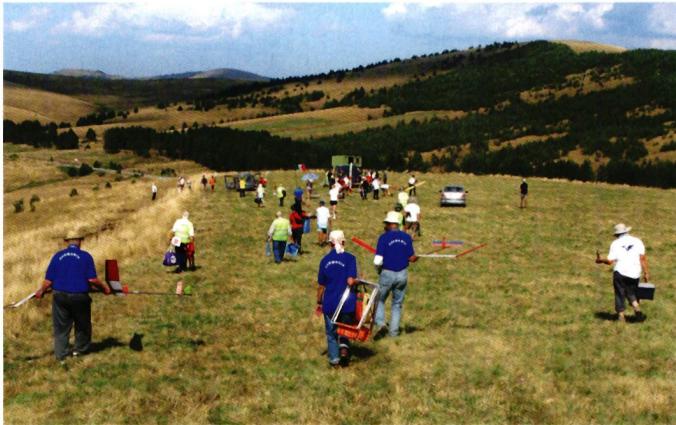
The program featured the F1E Junior World Championship. Unfortunately, no participants from Switzerland competed in the F1E Junior World Championship. Twenty young pilots from eight countries competed in the F1E Junior World Championship.
The Swiss team took advantage of this free time to take a morning stroll around Zlatibor. We spent the afternoon at the airfield, where, with temperatures at 28 degrees Celsius, we watched the junior pilots’ flights—that is, how the “kids” handled the aforementioned challenging wind conditions.
In order to be able to conduct test flights at the airfield in a timely manner and without stress before the start of the championship, the morning roll call was moved up by one hour. During the launch site draw, Switzerland drew No. 1, which means that after each flight, the team must move to the next launch site. At the start of the round, a southwest wind of 2–4 meters was blowing, so the course had to be set to the lowest point. The challenge on this slope was to adjust the angle difference so that the model would not land prematurely on the opposite slope, but also would not fly too slowly and be blown back up the slope by the F1E model.
During the first round, the wind shifted increasingly to the west; at the launch site, the wind was blowing from behind, so the second round could not begin under these conditions. After discussion, the jury decided to move the launch sites to the cross-slope. Although the maximum flight time was reduced to 3 minutes, the task of achieving the maximum distance did not become any easier. At times, the launch site was hit by crosswinds from the right. The distance to the opposite slope was even shorter than in the first round.
However, the team managed to complete this round with good thermal flights.
Apart from the fact that it got warmer, the conditions didn’t change significantly during the third flight. Only René Pfister flew over the opposite slope and, with a tailwind, into the next side valley. As a result, our TM assistant, Christian Andrist, had to rush to retrieve René’s model in time for the fourth flight.
After the third round ended, I, as TM, finally had time to check the rankings on the information board. The Swiss are still in the mix!
While preparing for the fourth flight, Dominik Andrist encountered problems with the magnetic control system. The control unit had to be removed to replace a defective Mamo bearing. Some of the models had made very hard landings on rocky terrain. While the malfunction on Dominik’s model was being analyzed, René Pfister chose less-than-ideal launch conditions. His model was too slow, drifted off course, and landed early in the lee with a flight time of only 60 seconds! After the repair, Dominik successfully completed his fourth flight and thus achieved his fourth maximum score.
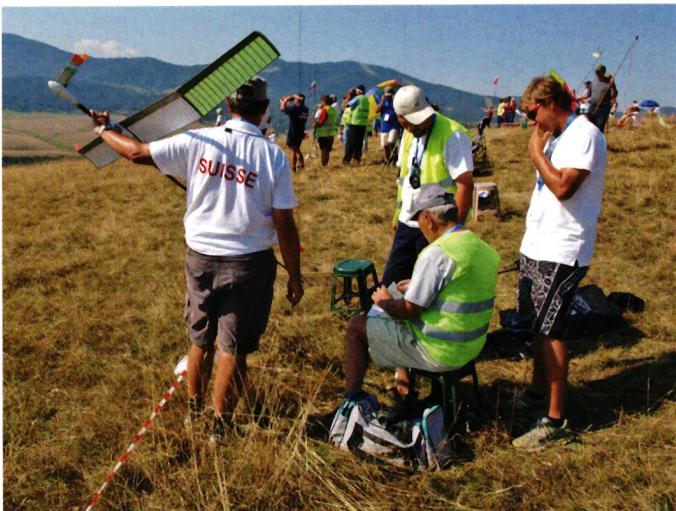
The wind played tricks on us yet again. Due to rising westerly winds, the launch sites had to be moved for the fourth time. After four flights, the current standings are as follows: Dominik Andrist and Ivan Treger of Slovenia are in the lead with four maximum scores. Here’s how the team standings look: If everything goes smoothly in the 5th round, a good ranking is still within reach. Toward evening, conditions had calmed down. Preparations are therefore focused on determining the correct course and achieving the required maximum flight time of 240 seconds with optimal glide settings. René just can’t help himself—after 210 seconds, his model still managed to hit the maximum to the second as it circled over the airfield in Serbia as a farewell.
The fifth round still has 32 minutes to go. The tension among the team members is slowly rising. Two pilots still have to take off. Unfortunately, neither Fredi nor Dominik had achieved good flight times. Fredi lands “behind the slope” with 103 seconds. Dominik achieved a flight time of only 74 seconds.
What happened: Neither pilot had calculated the optimal course. Dominik may have used the wrong model. Hindsight is always 20/20. The dream of a “Blämbu” had to be painfully buried in the hilly landscape of Serbia! The SWISS-BOYS came close once again. The only frustrating part is that we weren’t able to score points even under relatively favorable conditions. In this league, the demands on equipment and pilots are simply high. Things went according to plan for four runs. But then the “slope gliders” stopped doing what the pilots wanted!
Tired, exhausted, and with their heads hanging low, the team returned to base camp. But after a brief analysis and a review, we still treated ourselves to a beer, taking comfort in the fact that the scoreboard will be reset to zero for everyone at the next World Championship.
And so, a turbulent and eventful 2011 F1E World Championship is now history.
| 1. | Ivan Treger | Slovakia | 500.00 points |
| 2. | Stanislaw Kubit | Poland | 492.00 points |
| 3. | Wieslaw Dziuba | Poland | 487.33 points |
| Also: | |||
| 18. | Dominik Andrist | Switzerland | 430.83 points |
| 23. | Alfred Andrist | Switzerland | 415.57 points |
| 24. | Pfister René | Switzerland | 408.33 points |
| 1. | Poland | 1,463.33 points |
| 2. | Romania | 1,326.93 points |
| 3. | Czech Republic | 1,316.88 points |
| also: | ||
| 7. | Switzerland | 1,254.73 points |
The terrain where the F1E World Championship was held in Zlatibor, Serbia, is similar in landscape to the topography of the Emmental region in Switzerland. With many side valleys and constantly shifting winds, it was very challenging for the pilots to make the right decisions at the right moment.
However, the often steppe-like, steep terrain also placed considerable demands on the participants’ physical conditioning. Let anyone still claim that the F1E category isn’t a sport. This “scribbler” himself shed 2.5 kg during the week of flying!
The fact that no tiebreaker was needed after five rounds is proof enough that flying in this hilly terrain was no easy feat. Add to that the fact that the launch site had to be changed four times during the competition. Even though the Swiss delegation didn’t manage to secure top spots in Serbia, an analysis of the rankings shows that, when everything goes 100% right, Switzerland is certainly capable of keeping pace with the world’s best.
As TM, I’d like to thank the entire team for their collegial cooperation before and during the air show in Serbia. Speaking from my own experience, I can say that I haven’t always encountered such a strong team spirit.
Edward Ernst


TEAM MANAGER "THIS" BOSSHARD
 Rodito Nussbaumer

ATOM, THE NEW DOUBLE-DECKER FROM CPLR
 Matthias Bosshard

INSIGHTS INTO THE HISTORY OF SEAPLANES

34th HAHNENMOOS ALPINE MODEL AIRPLANE CAMP
Res Dauwalder
CORSAIR F4U – A WARBIRD WITH A MEMORABLE LOOK
Jürgen Rosenberger, Jürgen Prinz
SUMMER FUN 2026 AT MG USTER
Martin Wunderli
F3A EUROPEAN CHAMPIONSHIPS IN ST-MACAIRE, FRANCE
Matthias Bosshard
What's New at Leomotion.com

HORIZON HOBBY/LEMACO NEWS: MICRO OV-10 BRONCO 645 MM BY E-FLITE

PRIDE AND GOOD IDEAS
 Markus Nussbaumer

News from HEBU

YOU KNOW WHAT I MEAN? 125 YEARS OF THE SWISS AERO CLUB
 Emil Giezendanner

SMALL, MODEL-LIKE SAILBOATS
Res Dauwalder
TRY-OUT DAY AT MFV WETTINGEN
Urs Keller
52. 2026 ALPS CUP
Emil Giezendanner
THE PC-21 STORY
Emil Giezendanner
TWIN TOWN PARTNERSHIP
Wolfgang Voeller
EURO CONTEST GLIDER ACRO TOUR AUSTRIA 2026

BY YOUTH, FOR YOUTH
Lorena Betschen
WELCOME, NEW MEMBER!
Andrea Bolliger
FREE FLIGHT IN THE MIDDLE OF SUMMER
Urs Muntwyler
COUPE DES ALPES – OBSERVE AND LEARN
Rodito Nussbaumer
NEWS FROM HEBU
 Julia Bucher

FROM 0 TO 100
Markus Nussbaumer
NOS REGION – A HUB FOR ELECTRIC AVIATION
Emil Giezendanner
MEMORIES
Wolfgang Völler
Have you almost forgotten about aircraft that take off and land vertically?
Emil Giezendanner
70 YEARS OF THE NIDWALDEN MODEL AIRPLANE CLUB
Martin Barmettler