
It doesn't always have to be an F-16!
Crashes and failures will always be part of model flying. Perhaps they happen a bit more often for those of us who experiment with new technologies or lift concepts. The important thing is that we learn from them when building our next model. And we’re far from having learned everything!
The British aircraft manufacturer Supermarine was founded in Southampton in 1914 and, prior to the introduction of its most famous design, the Spitfire, focused primarily on the development of flying boats. Until the early 1930s, the company also built high-speed aircraft for the Schneider Trophy races. It is less well known that the company—which had been absorbed into the large Vickers-Armstrong conglomerate early on—also developed jets.
Shortly before the end of the war, around 1944, as the last generation of piston-engine fighter aircraft reached the limits of their aerodynamic performance, turbine propulsion was still in its infancy. Nevertheless, the Spiteful—a derivative of the Spitfire with trapezoidal wings—gave rise to the Attacker, the Royal Navy’s first jet-powered fighter. The Attacker, in turn, gave rise to the Swift with swept wings, which remained a successful fighter aircraft in several variants for many years. For this model description, however, we will focus on the second branch of the Spitfire family tree.
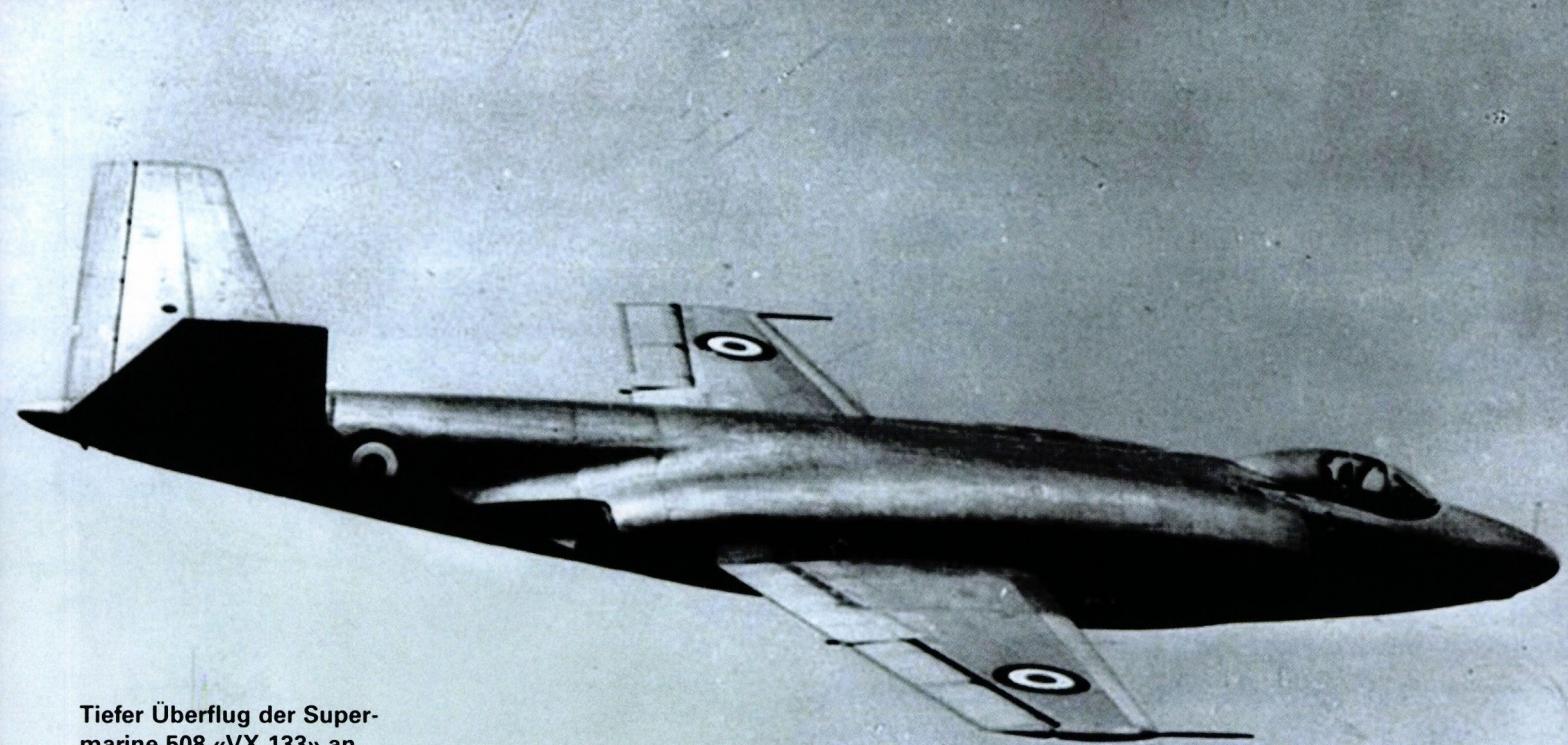
A British Navy request for proposals for a carrier-based fighter led to the Type 508, which was deliberately never intended for mass production but served as a testbed for the system. Although positive experience with swept wings had already been gained during World War II, Supermarine returned to the unswept trapezoidal wing for the 508, which promised better low-speed flight characteristics for landings on aircraft carriers. The Type 508 made its first flight on August 31, 1951, and appeared at the Farnborough Airshow that same year, with just ten flight hours under its belt. There, the design caused quite a stir. Unusual for the time were not only the V-tail but also the high-lift devices, which included not only landing flaps but also nose flaps and retractable ailerons. The flight testing was not entirely without obstacles. On two occasions, a loss of control—and consequently a crash—was narrowly averted due to aileron flutter. The installation of a hydraulically operated control system for the ailerons resolved the problem. According to test pilot Mike Lithgow, the 508 was thereafter “remarkably reliable and performed all the tasks assigned to it with grace.”
Finally, in 1954, it was replaced by the Type 525, which, although it had the same fuselage, offered significant advantages in high-speed flight thanks to its swept wings and cruciform tail. A later version of the 525 was named the Scimitar, and 100 were built for the Royal Navy, which operated the heavy fighter-bomber well into the 1960s. Thus, the Type 508 heralded the beginning of the end for a series of versatile aircraft designs bearing the Supermarine name. I first came across information about the Supermarine 508 in a bookstore in Cambridge and was immediately captivated by its clean, aerodynamic lines. After I was able to obtain additional reference material, the decision to build a model was a done deal.
From the very beginning, the model was designed to be single-motor, for the 120-mm Amacker impeller. After studying a three-view drawing and a few photos, I began drawing the construction plan. It soon became clear that building the model was a bit more complicated than I had thought, mainly because the cross-sectional shape of the fuselage changes with each frame. Based on my experience with the I-211 (see report in “modellflugsport” 5/2004), the fuselage of the Supermarine 508 was also to be constructed from styrofoam sections to be covered with skin. Six frames were planned: the nose landing gear mount, air intakes, impeller and wing mounts, nozzle outlets, and tail unit mount. The challenge with this model was to make the individual fuselage segments “flow into one another” seamlessly. A CAD program would certainly have been very helpful during the design phase, but unfortunately I haven’t found the time to learn how to use such a program to this day. Before assembling the fuselage segments, I fabricated the air intake and the so-called “Y-tube” for the exhaust nozzles from layers of 50- and 80-gram fiberglass cloth laminated on top of each other. This was done using a positive mold made of Roofmate, which was etched out after the resin had dried. Considering my limited experience with plastics processing, the result was quite acceptable. The fiberglass parts were placed inside the fuselage, and another special feature found on the original was installed in the tail: the pneumatic cylinder for a retractable tail skid, designed to protect the fuselage from ground contact at high angles of attack. Now, at last, I was able to assemble all the segments into the fuselage with the necessary frames in between.
For the wings and tail, I used styrofoam cores covered with skin. While the tail features a symmetrical NACA 0006 airfoil, I chose the ZAGI 10 airfoil for the wings—a profile with 10% thickness and a slight S-warp. During construction, I had the opportunity to make the nose flaps from the original model functional on this one as well. After cutting out all the lift-enhancing elements and control surfaces, I was quite amazed at how little of the actual wing remained. Any doubts that arose about whether it would still fly were immediately dispelled, however. For the retractable landing gear, I once again chose the Spring-Air 101HD, which I consider absolutely reliable due to its high-quality construction. I constructed the landing gear doors—some of which seemed enormous—and their covers using a sandwich construction of fiberglass mesh and Roofmate as the backing material. The canopy turned out perfectly on the first thermoforming attempt. For the positive mold, I used Deltasand for the first time. This is sand mixed with a non-toxic binder (originally intended for children to build sandcastles), which, after rough shaping, can be baked in the oven until it hardens. Afterward, it can be shaped with a file, scraper, sanding block, or similar tools. With the help of the included varnish and a few rounds of sanding, the mold becomes smooth and ready for thermoforming.
However, other tasks that were supposed to be routine presented greater challenges. For one thing, there was the attachment of the wings to the fuselage frames using plywood strips, which had to be modified at least four times due to poor accessibility and fit. Then the fuselage contours following the nozzle outlets required some creativity, as the many curves and radii meant there wasn’t a single right angle or edge that could serve as a reference line. For example, when I wanted to “quickly” glue in the tail unit, I realized that aligning a V-tail on an oval fuselage isn’t all that easy. Everything is somehow slanted and curved, yet in the end, the opening angle, EWD, and alignment around the vertical axis still have to be correct. Once again, this led to the creation of various templates designed to help me with the gluing process. About 13 months after the first pencil stroke was drawn on the construction plan, the Supermarine 508 stood on its own wheels on the workbench for the first time—and was still far from finished!
The inner workings of the 508 required further “mental gymnastics.” Mounting the impeller, linking the landing gear doors, installing the remote control system, and running about 10 meters of servo cable—to name just a few tasks. For the flight battery, I built a ramp on which the battery is pushed backward and automatically slides into the contacts. Covering the model with Oracover took about four days in total, and I caught myself cursing wildly on several occasions. At night, I was already dreaming of hot irons and shrinking film. Besides, New Year’s Eve was approaching, so I made a resolution never again to build models with any concave curves. But when the model stood before me in all its silver glory, all the effort was already forgotten.
Eagerly, I placed the plane on the scale for the first time. I stacked all the components—such as the propeller, speed controller, canopy, and anything else that hadn’t been installed yet—on top of the model. I slid the small weights back and forth on my old baby scale—the same one I’d been weighed on as an infant—and read 4,800 grams. Not a bad result, I thought, and was already pleased with my small progress in lightweight construction. However, I hadn’t counted on one thing. Or rather, I hadn’t accounted for the center of gravity! Assuming the model would be slightly tail-heavy as usual, and that I could adjust the center of gravity by moving the receiver battery back and forth from the center of the fuselage to the nose, I placed the 508 on the balancing device. And, oh no—it was hopelessly top-heavy!
The radical decision on how to successfully balance the model was made quickly. Moving any equipment backward was out of the question from the start, since there’s a lack of space in the fuselage despite its apparent volume. So I opened the fuselage in front of the tail skid and stowed the receiver battery in a compartment from below. Unfortunately, I also had to add 300 grams of lead to the compartment, so the scale now showed a flight weight of 5,100 grams. My pride took a bit of a hit, but the center of gravity was now correct. Besides, I knew of models that weighed over 6 kilograms and still delivered impressive flight performance with the 120-series propeller.
The fact that I had misjudged the center of gravity so badly was clearly due to the V-tail. It really does save weight at the tail, since the entire horizontal stabilizer—with all its spars, reinforcements, and linkages—is missing! After installing a few “scale details” such as landing gear doors and Pitot tubes, the 508 was slowly nearing completion. A decal set produced by Urs Mayländer, consisting of national insignia and serial numbers for the “VX 133,” rounded out the overall look. This was followed by extensive functional tests and adjustments for the combination of the landing flaps and nose flaps. I programmed the takeoff position with the landing flaps set to about 15 degrees and the nose flaps retracted. The landing position was set with the landing flaps at 30 degrees and the nose flaps at 10 degrees. On the original aircraft, the ailerons were lowered slightly in the landing position. Due to the large landing flaps on the model, I omitted this feature.
The maiden flight was repeatedly delayed due to the persistent winter of 2005–2006, but was finally able to take place at the end of March. Thanks to the generous president of the Dübendorf Model Flying Club, I was allowed to use the grounds of the military airfield. To get this out of the way right away: Unfortunately, the model did not survive its maiden flight! After a smooth takeoff with a takeoff roll of about 30 meters, the Supermarine 508 lifted off and entered a stable climb, during which the trim had to be set slightly “low.” After the first turn at a safe altitude, I reduced power and pointed the nose down. Shortly after transitioning to level flight, the model suddenly veered sharply to the left. Attempts to correct the course were unsuccessful; although aileron inputs were acknowledged with slight movements around the longitudinal axis, the flight attitude was dominated by what appeared to be lift coming from only one side. The subsequent impact from a height of about 50 meters gave us a hint of what awaited us at the crash site. The most likely cause of the crash, as far as could be determined from the small debris fragments, was that the linkage on the left nose flap had snapped, causing the flap to fold downward at a right angle due to the airflow. This would also explain the uncontrollable flight behavior. Believing in good faith that I had built everything to be robust, I must have underestimated the aerodynamic forces in this particular detail.
The result of the maiden flight was devastating, especially since about a year and a half had passed since I began planning and that pile of misery appeared before me. I can’t say yet whether I’ll build another 508. The list of projects still waiting in line is too long. And yet! Even though this project didn’t have a “happy ending,” I learned a lot while building the Supermarine 508. I’d like to encourage model builders to keep building models of their own design. It doesn’t always have to be an F-16 or a Hunter. A glance at an old aviation book can reveal a wide variety of unique aircraft and prototypes.
| Dimensions: | Length 1800 mm, Wingspan 1550 mm, Weight 5100 g, Wing loading 108 g/dm² |
| Powerplant: | Amacker 120 mm propeller, Kontronik Tango 45-08 motor, Hacker Master 77-O-Flight ESC, 3700 mAh 10S LiPo battery |
| RC Installation: | Total of 9 servos: 2x elevator/rudder, 2x aileron, 2x landing flaps, 2x nose flaps, 1x nose wheel steering |
| Landing gear: | Spring-Air 101HD actuated by a Jet-Tronic valve, Robart struts on the main landing gear, custom-built nose landing gear, nose wheel 75 mm, main landing gear 90 mm, pneumatically retractable tail skid |
1) *British Experimental Turbojet Aircraft* by Barry Jones, published in 2003 by Crowood Press Ltd, ISBN 1 86126 621 9
2) “Supermarine Fighter Aircraft” by Victor F. Bingham, published in 2004 by Crowood Press Ltd, ISBN 1 86126 649 9
3) “Supermarine Attacker, Swift, and Scimitar” by Philip Birtles, published in 1992 by Ian Allan Publishing, ISBN 0 7110 2034 5
4) *Mach One* by Mike Lithgow, published in 1955 by Hamilton & Co. Ltd.


News from HEBU

F3A EUROPEAN CHAMPIONSHIPS IN ST-MACAIRE, FRANCE
 Matthias Bosshard

What's New at Leomotion.com

YOU KNOW WHAT I MEAN? 125 YEARS OF THE SWISS AERO CLUB
 Emil Giezendanner

52. 2026 ALPS CUP
Emil Giezendanner
PRIDE AND GOOD IDEAS
 Markus Nussbaumer

HORIZON HOBBY/LEMACO NEWS: MICRO OV-10 BRONCO 645 MM BY E-FLITE

EURO CONTEST GLIDER ACRO TOUR AUSTRIA 2026

BY YOUTH, FOR YOUTH
 Lorena Betschen

TEAM MANAGER "THIS" BOSSHARD
Rodito Nussbaumer
SMALL, MODEL-LIKE SAILBOATS
Res Dauwalder
TRY-OUT DAY AT MFV WETTINGEN
Urs Keller
34th HAHNENMOOS ALPINE MODEL AIRPLANE CAMP
Res Dauwalder
CORSAIR F4U – A WARBIRD WITH A MEMORABLE LOOK
Jürgen Rosenberger, Jürgen Prinz
SUMMER FUN 2026 AT MG USTER
Martin Wunderli
WELCOME, NEW MEMBER!
Andrea Bolliger
FREE FLIGHT IN THE MIDDLE OF SUMMER
Urs Muntwyler
THE PC-21 STORY
Emil Giezendanner
TWIN TOWN PARTNERSHIP
Wolfgang Voeller
ATOM, THE NEW DOUBLE-DECKER FROM CPLR
Matthias Bosshard
COUPE DES ALPES – OBSERVE AND LEARN
Rodito Nussbaumer
INSIGHTS INTO THE HISTORY OF SEAPLANES

NEWS FROM HEBU
 Julia Bucher

FROM 0 TO 100
Markus Nussbaumer
MEMORIES
Wolfgang Völler
NOS REGION – A HUB FOR ELECTRIC AVIATION
Emil Giezendanner
A SPECTACULAR F3A WORLD CUP IN THE PRINCIPALITY OF LIECHTENSTEIN
Emil Giezendanner
DO YOU KNOW WHAT I MEAN IN THE LAND OF SMILES?
Emil Giezendanner