
Like a Phoenix Rising from the Ashes
Conversion of a 1976 Hope Robin DR 400/180 to electric drive
It was around 1976 when I visited the Hope model shop in Schöftland. Hanging from the ceiling was a 1.9-meter-long Robin DR 400/180, which filled me with sheer excitement. I just had to have it! By the standards of the time, a model like that was already a really big plane.
Before long, I’d managed to talk my way into buying two of them. One was orange, the other yellow. The model was designed for 10- to 12.5-cc engines and weighed 4.5 kg. In the end, however, I opted for a 15-cc Webra engine. This engine was more than sufficient for sightseeing flights and simple aerobatic maneuvers. It was, however, too weak for towing larger glider models. While searching for a more powerful engine, I came across the 2000 Super Tigre with a 20-cc displacement. Unfortunately, the extra weight practically canceled out the extra power. So I had to go with the more powerful 3000 Super Tigre with a 30-cc displacement. As a result,
the Robin’s weight steadily increased. With a full tank, the takeoff weight was now 7.8 kg—a whopping 3.3 kg increase. The engine had plenty of power, and the Robin handled the extra weight without any problems, still maintaining very good low-speed flight characteristics.
I flew the orange Robin (Figure 1) for several years until it fell victim to a broken servo lever on the elevator (back then, they were still quite delicate, with square-shaped attachments).
So I got the yellow Robin ready to fly. I installed the 3000 Super Tigre as the powerplant again, since it had proven itself very well. Over the years, it had carried many gliders into the air. Unfortunately, many pilots gradually equipped their gliders with electric motors and folding propellers, so my Robin slowly fell out of use. On top of that, the motor began showing signs of ball-bearing damage, which meant the Robin was taken out of service for the time being. This situation lasted
for over 20 years. Then came the COVID-19 pandemic and with it the flight ban—even though the flying weather in April was absolutely perfect. So all that was left was the hobby room. Soon, all the gliders were airworthy again. I hadn’t planned a new project. Just sitting around in front of the TV drinking beer isn’t my thing. Since I’d had enough of methanol engines, I decided to convert the over 40-year-old Robin to electric power. Forty years ago, this wouldn’t even have been conceivable.
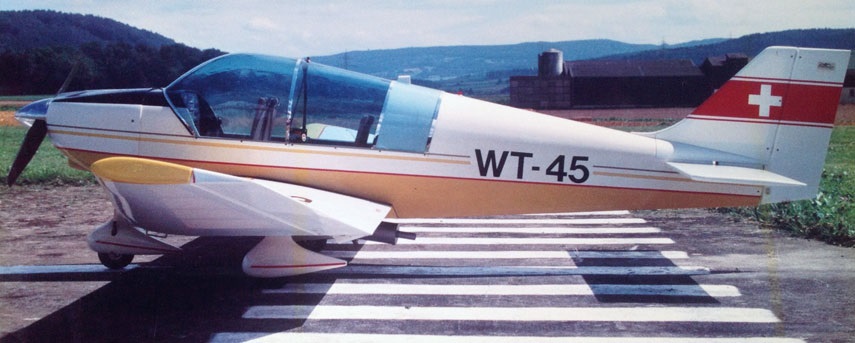
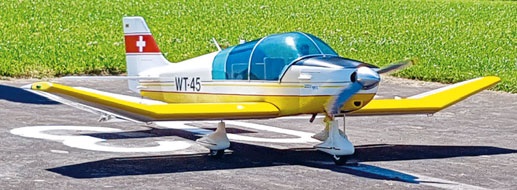
Due to the COVID-19 flight ban, a test flight was not possible at the time of this report. That is why I am only now able to provide this update: As of May 11, flying was once again permitted at our airfield under the familiar restrictions (maximum of five people, two-meter distance). On May 13, the moment finally arrived. After more than 20 years of anticipation, the Hope-Robin—converted to electric power—was finally able to take to the skies once again.
And I have to say, the conversion exceeded all my expectations. The Dualsky motor is every bit as good as the 30 Super Tigre. Takeoff went smoothly at two-thirds power. And there are even more positive aspects. Unlike with a piston engine, the plane no longer vibrates at all. I was also very pleasantly surprised by the flight time. For normal flights, a 12S battery (2x6S/5000 mAh) provides seven to eight minutes of flight time.
I’m now completely sold on electric flying. The much quieter flight operation alone makes a conversion like this well worth it.
The main focus was on selecting a suitable power system. With expert assistance from Ueli Amsler (Gloor and Amsler of Rupperswil), I decided on the following power system configuration:
Motor: Dualsky 190 kV
ESC: rated for 12S LiPo batteries and 100 A continuous load
LiPo batteries: 2 × 5000 mAh
Propellers: 18 × 10E
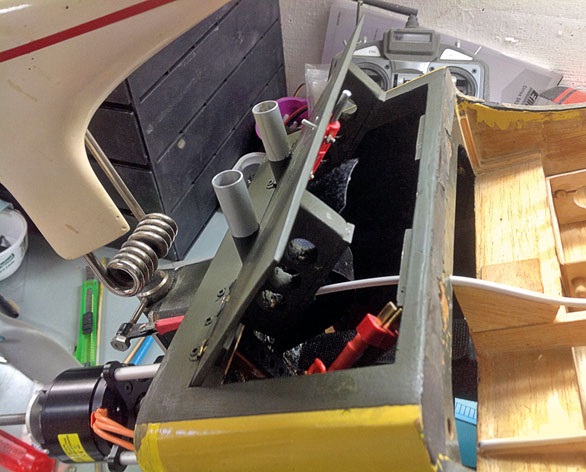
The conversion went quickly. First, a cutout for the battery compartment had to be made under the fuselage (Figure 2). That was easier to do than expected. There was plenty of room for the batteries where the original fuel tank had been. Even the instrument panel could remain in place. The motor was mounted in place using four 8-mm aluminum tubes arranged in parallel and 4-mm threaded rods.
If I had read a relevant build report earlier stating that the rods should be mounted tapered due to the forces involved, I would of course have done it that way as well (Figure 3). The speed controller was mounted at the front, in the airflow at the motor bulkhead. This way, I hope, the included fan won’t be necessary. Now all that remained was to fill in the many mounting holes on the engine cowling left over from previous engine installations. Thus, after repainting, the conversion was complete.
Pilot “Bartli” (Figure 4) has a lot of flying experience. Back then, he was already piloting the Schlüter Helibaby, which has been sitting in the basement in its original condition for over 40 years, presumably waiting in vain to be brought back to life.
Due to the COVID-19 pandemic and the closure of airfields, the maiden flight will have to wait a little longer.
It’s just a shame that the beautiful Robin von Hope hasn’t been available for quite some time. It would certainly be an interesting and attractive model for electric propulsion today.
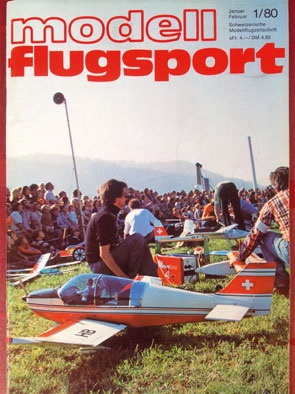
The cover of MFS, Issue 1/80, features the orange Robin. Sitting behind it is the author, who has grown a bit older in the meantime.
The great thing about this conversion is that the Robin has become a full 250 grams lighter, and the center of gravity hasn’t changed.
Of course, the old 40-MHz Simprop receiver system was subsequently replaced by the Jeti system. The aging contest servos were also sent off to their well-deserved retirement.
The conversion to electric power has many advantages. No more lugging around methanol, a starter box, or cleaning rags; no more cleaning up at the end of each day of flying; and significantly lower operating costs. Perhaps a minor drawback is the slightly shorter flight time per battery charge.


News from HEBU

TEAM MANAGER "THIS" BOSSHARD
 Rodito Nussbaumer

YOU KNOW WHAT I MEAN? 125 YEARS OF THE SWISS AERO CLUB
 Emil Giezendanner

F3A EUROPEAN CHAMPIONSHIPS IN ST-MACAIRE, FRANCE
 Matthias Bosshard

52. 2026 ALPS CUP
Emil Giezendanner
PRIDE AND GOOD IDEAS
 Markus Nussbaumer

ATOM, THE NEW DOUBLE-DECKER FROM CPLR
Matthias Bosshard
CORSAIR F4U – A WARBIRD WITH A MEMORABLE LOOK
Jürgen Rosenberger, Jürgen Prinz
SUMMER FUN 2026 AT MG USTER
Martin Wunderli
TRY-OUT DAY AT MFV WETTINGEN
Urs Keller
TWIN TOWN PARTNERSHIP
Wolfgang Voeller
BY YOUTH, FOR YOUTH
Lorena Betschen
SMALL, MODEL-LIKE SAILBOATS
Res Dauwalder
What's New at Leomotion.com

HORIZON HOBBY/LEMACO NEWS: MICRO OV-10 BRONCO 645 MM BY E-FLITE

COUPE DES ALPES – OBSERVE AND LEARN
Rodito Nussbaumer
EURO CONTEST GLIDER ACRO TOUR AUSTRIA 2026

INSIGHTS INTO THE HISTORY OF SEAPLANES

34th HAHNENMOOS ALPINE MODEL AIRPLANE CAMP
Res Dauwalder
WELCOME, NEW MEMBER!
Andrea Bolliger
FREE FLIGHT IN THE MIDDLE OF SUMMER
Urs Muntwyler
THE PC-21 STORY
Emil Giezendanner
NEWS FROM HEBU
 Julia Bucher

FROM 0 TO 100
Markus Nussbaumer
MEMORIES
Wolfgang Völler
NOS REGION – A HUB FOR ELECTRIC AVIATION
Emil Giezendanner
Have you almost forgotten about aircraft that take off and land vertically?
Emil Giezendanner
DO YOU KNOW WHAT I MEAN IN THE LAND OF SMILES?
Emil Giezendanner