
Building in the New Millennium
In an era of rampant “fast-food” model building—where many pilots and beginners are turning to models that are increasingly “ready to fly” with little or no manual labor—there is still room for the desire to build from scratch using simple, minimally processed materials.
This doesn’t mean we have to give up everything modern technology has to offer today, so one fine day, after discussing and daydreaming for a while about how wonderful it would be to bring our radio-controlled airplane projects to life exactly as we envisioned, we decided to team up and build a 3-axis computer numerical control (CNC) milling machine. The idea had taken shape after seeing similar machines in action at international model-making fairs, thanks to the realization that by combining our technical and hands-on skills, we’d be able to build one on our own, without having to bear the high cost of purchasing a professional-grade model—which would certainly perform better but would be far more expensive.
Of course, starting from scratch on this kind of project is certainly complex and not very sustainable, so we began with a proven foundation, drawing on the design for a DIY CNC milling machine called “Solsylva” (plans available online at little cost), which was certainly well-suited to our needs since the materials it was made of were easy to work with and readily available (wood, ball bearings for roller skates, metal profiles, various small parts), and the construction methods were within our capabilities (electronics and mechanics of the three axes of movement—X, Y, Z—and the wooden and metal frame).
Right from the start, we realized we would have to make some adjustments to the dimensions, since the plans we had specified measurements and models of semi-finished profiles
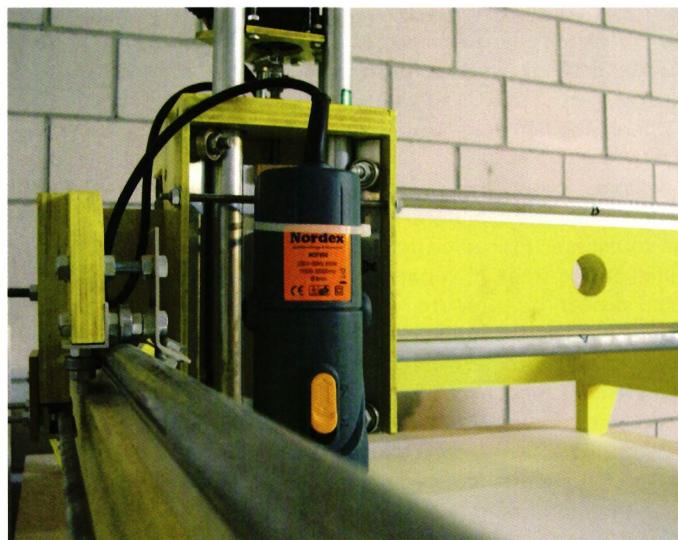
using Anglo-Saxon units of measurement. Furthermore, some materials that were readily available in the U.S. (where the project originated) were nearly impossible to find here, so we adapted the entire project and the basic measurements to our needs. Furthermore, we were not satisfied with certain parts, which—based on our expertise—we deemed mechanically weak, structurally inefficient, or insufficiently precise; consequently, we adapted certain parts on a case-by-case basis according to
our needs and assessments. The work involved in preparing the parts, construction, machining, assembly, calibration, and testing lasted a full two years, since coordinating dates when we could meet to work together wasn’t always an easy task. But with perseverance and mutual support, with enthusiasm that never wavered and, above all, the desire to finally see “our” machine built and working, we finished and brought this little dream to life—one that now allows us to design something on the computer and then see it realized in reality, a milestone that initially seemed like pure science fiction to us. Furthermore, having modified the initial design several times, we now have a CNC milling machine that’s one of a kind—self-built and customized—a great source of satisfaction!
Sometimes cutting a simple part with a CNC milling machine is a luxury—it might actually take less time to cut and finish it by hand, because the part must first be designed using CAD (computer-aided design) software, and then converted using CAM (computer-aided machining) software, which helps the operator define important details for the machining process: for example, the cutting speed based on the tool used and the material being machined, types of roughing—
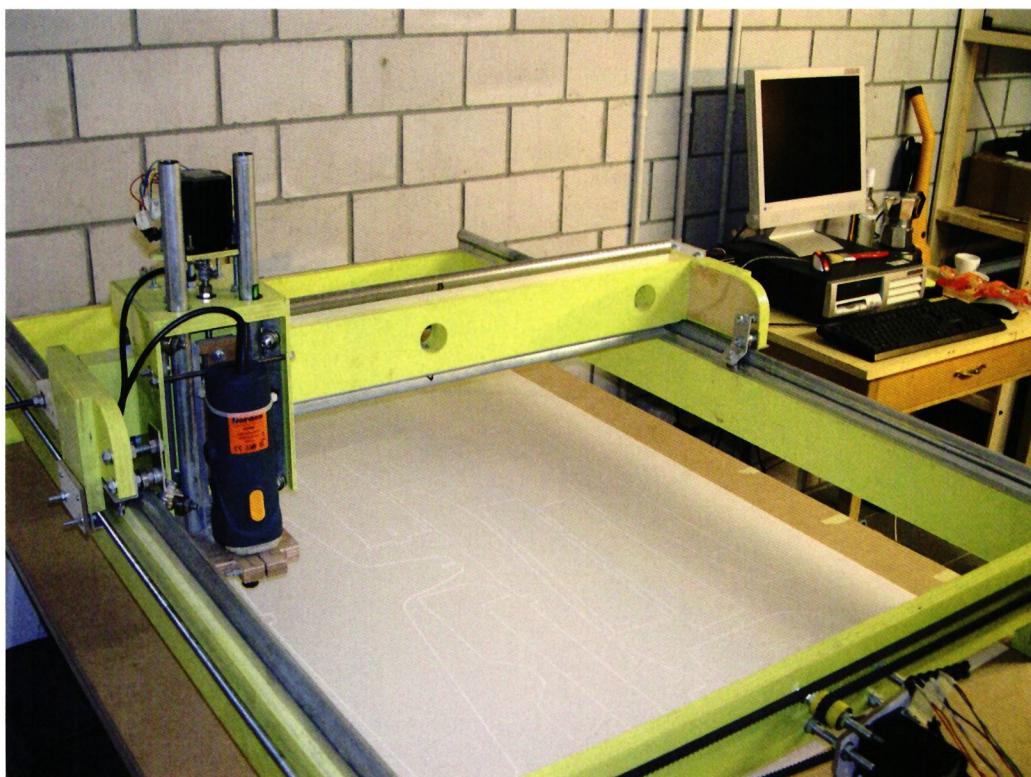
filling, hollowing, machining depth, bridges to prevent machined parts from “falling,” the way the tool enters the material, and so on. The output generated by the CAM software is a G-code file—the language that sends movement commands to the machine controller, which will perform the actual machining. This process requires a significant initial time investment, especially for the first few machining operations, but this time is recouped through the precision of the execution and the fantastic ability to repeat the machining process as many times as desired—for example, to cut ribs and similar complex objects that often need to be identical or have repetitive features. In short, it’s the famous “copy-paste” function so beloved on computers worldwide, applied to real, three-dimensional objects! The possible applications aren’t limited to simple model aircraft building; you can also create inlays, engrave text by carving into the material, lighten parts, cut templates to build objects using hot-wire cutting in polystyrene, create decorative elements (transparent lettering in Plexiglas, polystyrene shapes, etc.), and drilling repetitive holes in plates and objects... In short, the final application is limited only by your own
imagination and your ability to operate the machine.
In conclusion, we have built a machine that allows us to … build, providing human hands with a tool that combines the advantages of precision and repeatability typical of this type of equipment, enabling us to bring to life objects that were previously only imagined.
We hope that our experience will inspire other young people to undertake similar projects because we assure you that the satisfaction of seeing it through to the end and being able to say, “It works!” is immense—and having been through it ourselves, we can say it’s roughly the same as when you finally see a homemade model airplane take flight, perhaps built with materials considered less than ideal, but which ultimately yield remarkable results! Many of you know what we’re talking about, and although we, too, fly store-bought models—for obvious reasons of convenience and to save time—we urge you never to stop building, giving free rein to your ideas, and above all, experimenting—the cornerstone of this wonderful hobby!
Massimo Lafranchi,
Davide Menegalli,
Damiano Thoma, @ Lugano
Model Aircraft Group


TEAM MANAGER "THIS" BOSSHARD
 Rodito Nussbaumer

ATOM, THE NEW DOUBLE-DECKER FROM CPLR
 Matthias Bosshard

INSIGHTS INTO THE HISTORY OF SEAPLANES

CORSAIR F4U – A WARBIRD WITH A MEMORABLE LOOK
Jürgen Rosenberger, Jürgen Prinz
SUMMER FUN 2026 AT MG USTER
Martin Wunderli
F3A EUROPEAN CHAMPIONSHIPS IN ST-MACAIRE, FRANCE
Matthias Bosshard
What's New at Leomotion.com

HORIZON HOBBY/LEMACO NEWS: MICRO OV-10 BRONCO 645 MM BY E-FLITE

PRIDE AND GOOD IDEAS
 Markus Nussbaumer

News from HEBU

YOU KNOW WHAT I MEAN? 125 YEARS OF THE SWISS AERO CLUB
 Emil Giezendanner

34th HAHNENMOOS ALPINE MODEL AIRPLANE CAMP
Res Dauwalder
SMALL, MODEL-LIKE SAILBOATS
Res Dauwalder
TRY-OUT DAY AT MFV WETTINGEN
Urs Keller
52. 2026 ALPS CUP
Emil Giezendanner
TWIN TOWN PARTNERSHIP
Wolfgang Voeller
EURO CONTEST GLIDER ACRO TOUR AUSTRIA 2026

BY YOUTH, FOR YOUTH
Lorena Betschen
WELCOME, NEW MEMBER!
Andrea Bolliger
FREE FLIGHT IN THE MIDDLE OF SUMMER
Urs Muntwyler
THE PC-21 STORY
Emil Giezendanner
COUPE DES ALPES – OBSERVE AND LEARN
Rodito Nussbaumer
NEWS FROM HEBU
 Julia Bucher

FROM 0 TO 100
Markus Nussbaumer
NOS REGION – A HUB FOR ELECTRIC AVIATION
Emil Giezendanner
MEMORIES
Wolfgang Völler
Have you almost forgotten about aircraft that take off and land vertically?
Emil Giezendanner
70 YEARS OF THE NIDWALDEN MODEL AIRPLANE CLUB
Martin Barmettler