
U-Space and Drones
We model aircraft enthusiasts often view drones as a threat to our favorite pastime when inexperienced drone pilots violate airspace and provoke residents in residential neighborhoods. This perspective overlooks the surge in innovation driving the digital future of aviation. U-Space plays a key role in this.
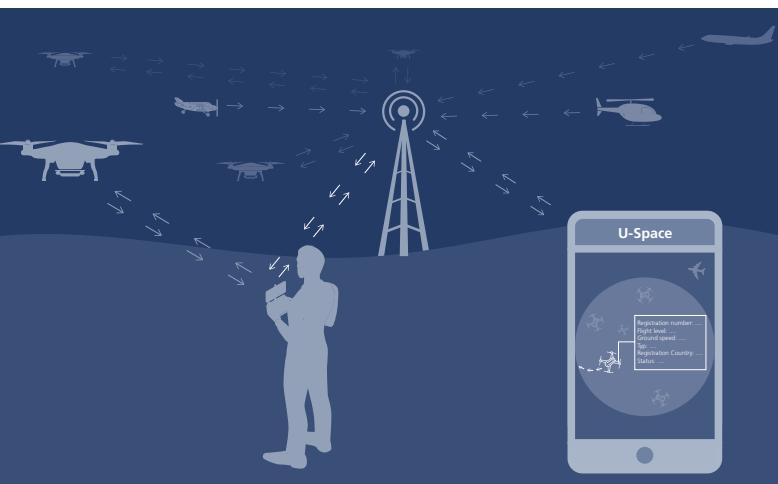
U-Space—most of us have probably heard that term before. But what does it actually mean? U-Space integrates various digital and automated processes. U-Space enables the safe and efficient operation of civil drones without relying on manned air traffic control, allowing them to coexist safely with manned aviation. Let’s take a look at a future that’s not so far off: A drone service provider receives a contract for a series of survey flights using a medium-sized drone. Using an app, the provider enters the flight plan and the time required for the flights. The system indicates whether this operation is permitted at that location. The provider can see on the app
whether the airspace in question is available for this purpose, or whether other flights are taking place there at the same time—or whether the airspace is even closed. Through the same app, they also have access to weather services that can be useful for flight planning. As soon as the system gives them the green light, they can begin their operation.
The drone, which is of course registered, is visible on the app to other users as well as to air traffic control throughout the entire flight. Normally, these drone operations take place at low altitudes (below 120 m above ground) and do not pose a threat to manned aircraft. In our example, however, a rescue helicopter needs to enter the same airspace. The drone pilot now receives a warning via U-Space indicating that a manned aircraft may cross his flight path. This allows him to take evasive action or briefly interrupt the flight.
What sounds very simple here is, in reality, a highly complex process. There is no air traffic controller to clear a flight or warn of a potential collision. A drone flying beyond the pilot’s line of sight cannot be operated according to the “see and avoid” principle. This principle is otherwise applied in uncontrolled airspace, where we also fly our model aircraft. The entire process relies on automated systems that must, among other things, integrate manned and unmanned aviation with air traffic control.
This example, which is still hypothetical, will soon become a reality. As early as September 2017, Swiss U-Space was presented to a large international audience in Geneva. The representatives of the European Commission in attendance were very impressed that this presentation took place not in a deserted area, but in a city right next to an intercontinental airport. The presentation, which involved Skyguide, the FOCA, and a number of private companies, impressively demonstrated the technical feasibility of U-Space.
In the EU, the U-Space project has been overseen since late 2018 by a working group in which Switzerland also actively participates. A pan-European U-Space regulation is planned for 2023, which will establish the regulatory framework for market access. However, it remains unclear whether Switzerland will also be able to adopt this regulation, in which it played a key role. The European Commission links U-Space to the adoption of European drone regulations, which Switzerland is not yet able to adopt. Benoit Curdy, U-Space project manager at the FOCA, comments: “So far, we have been able to benefit from international cooperation at various levels, not least thanks to Switzerland’s current leading position.” Curdy emphasizes that going it alone at the national level would make little sense.
At the national level, the FOCA, together with the air traffic control provider skyguide, launched a public-private partnership concept at the end of 2018 to develop, test, and implement technologies and services. In addition to various Swiss companies, international firms such as Airbus, drone manufacturer Matternet, and the Boeing subsidiary Aurora Switzerland are also involved in the Swiss U-Space Implementation (SUSI) initiative.
The first U-Space airspaces are expected to be operational in two years. “We’re not planning a blanket solution, but rather will implement U-Space where users want it or where it makes sense to do so,” emphasizes Benoit Curdy. The first U-Space airspace is planned for the Sion region, where agricultural drones used for spraying grapevines and helicopters sometimes share the airspace in confined areas. A second practical application for U-Space is the shared use of controlled airspaces, which currently still require individual permits from the air traffic control provider skyguide.
Is U-Space a threat to us model aircraft enthusiasts? No, says the FOCA expert quite clearly. Model aircraft flying within the framework of clubs and associations is exempt from the European U-Space regulations. Together with the Model Aircraft Association, the FOCA is even working on a solution applicable to all model aircraft flying, both in the
Drone regulations as found in U-Space regulations.
As illustrated in the aforementioned example from Sion, U-Space is deployed where it provides benefits for both air traffic control and users. But if U-Space were to be expanded further, it could one day also benefit us model aircraft enthusiasts thanks to its ease of use via a smartphone app. For example, with just a few taps, I could indicate that the airspace above my model airfield will be occupied by model aircraft for the next three hours. There would no longer be a need for a stationary Flarm system, such as those used at some of our model airfields.
The author is a long-time, dedicated model aviator and Head of Communications at the Federal Office of Civil Aviation (FOCA).


TEAM MANAGER "THIS" BOSSHARD
 Rodito Nussbaumer

SUMMER FUN 2026 AT MG USTER
Martin Wunderli
52. 2026 ALPS CUP
 Emil Giezendanner

ATOM, THE NEW DOUBLE-DECKER FROM CPLR
 Matthias Bosshard

INSIGHTS INTO THE HISTORY OF SEAPLANES

34th HAHNENMOOS ALPINE MODEL AIRPLANE CAMP
Res Dauwalder
CORSAIR F4U – A WARBIRD WITH A MEMORABLE LOOK
Jürgen Rosenberger, Jürgen Prinz
SMALL, MODEL-LIKE SAILBOATS
Res Dauwalder
F3A EUROPEAN CHAMPIONSHIPS IN ST-MACAIRE, FRANCE
Matthias Bosshard
What's New at Leomotion.com

HORIZON HOBBY/LEMACO NEWS: MICRO OV-10 BRONCO 645 MM BY E-FLITE

PRIDE AND GOOD IDEAS
 Markus Nussbaumer

News from HEBU

BY YOUTH, FOR YOUTH
Lorena Betschen
YOU KNOW WHAT I MEAN? 125 YEARS OF THE SWISS AERO CLUB
Emil Giezendanner
TRY-OUT DAY AT MFV WETTINGEN
Urs Keller
FREE FLIGHT IN THE MIDDLE OF SUMMER
Urs Muntwyler
THE PC-21 STORY
Emil Giezendanner
TWIN TOWN PARTNERSHIP
Wolfgang Voeller
EURO CONTEST GLIDER ACRO TOUR AUSTRIA 2026

WELCOME, NEW MEMBER!
Andrea Bolliger
COUPE DES ALPES – OBSERVE AND LEARN
Rodito Nussbaumer
NEWS FROM HEBU
 Julia Bucher

FROM 0 TO 100
Markus Nussbaumer
MEMORIES
Wolfgang Völler
NOS REGION – A HUB FOR ELECTRIC AVIATION
Emil Giezendanner
Have you almost forgotten about aircraft that take off and land vertically?
Emil Giezendanner
70 YEARS OF THE NIDWALDEN MODEL AIRPLANE CLUB
Martin Barmettler