
THE NIGHT OF CONSTRUCTION
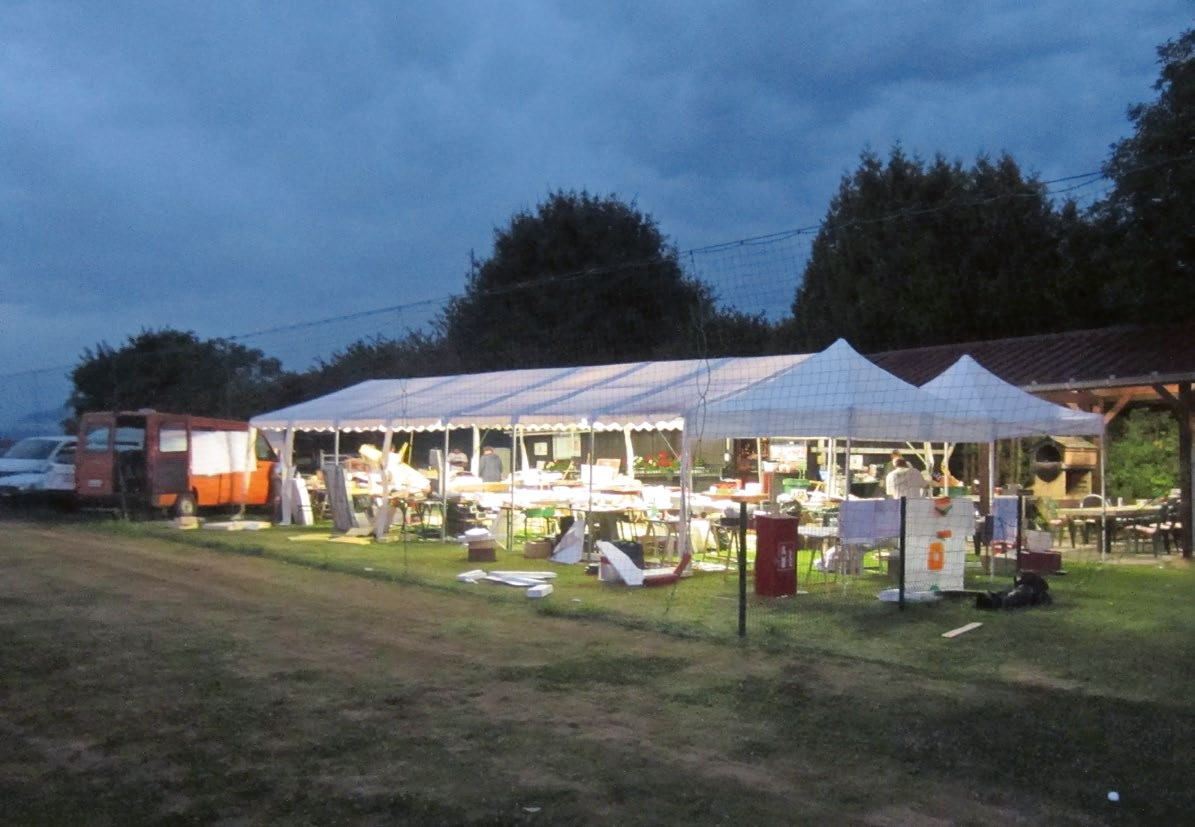
"Construction Night" is a unique gathering that began 20 years ago; we meet around the time of the summer solstice to build and fly in a particularly friendly atmosphere.
The goal of this famous “night” is to build a flying object based on a theme announced a few months in advance. Construction takes place exclusively at the AcroModelClub field in Malval (GE) between late Saturday afternoon and Sunday morning—a total of about 16 hours. Naturally, everyone is free to build, sleep, and have fun as they please, as long as the model is ready by Sunday morning.
In 2026, the 20th edition will take place on the weekend of June 20–21! Over the course of so many editions, we’ve seen some unlikely creations, ingenuity, suspense during the first test flights in the morning, and plenty of laughter during the flight trials.
Mutual support sometimes makes it possible to finish a model or make last-minute repairs, with the goal being to get as many of these ephemeral creations as possible into the air.
The refreshment stand and the kitchen team handle the logistics so that up to 20 pilots can bring their projects to life in a pleasant setting.
*Martin Reichert, AMC Geneva*
This ambitious project led by Alain Fontana (aka “Fonfon RC”) aims to recreate a radio-controlled version of the Soviet “flying aircraft carrier” from the 1930s—a craft as legendary in Russia as it is unknown in the West.
The Zveno-1a was a Soviet experimental project from the 1930s that used a Tupolev TB-1 heavy bomber as a “mother ship” for two Tupolev ANT5 fighters. The Zveno concept (which means “link” in Russian) was designed to protect a bomber group by extending the operational range of the escort fighters attached to a bomber. In the Zveno-1a configuration, the two I-4 (ANT5) fighters were mounted above the wings of a TB-1 modified for this purpose.
The fighters could detach from the bomber in flight, and, in certain configurations, it was planned that they could eventually reattach to it.
The Zveno-1a successfully completed several test flights, demonstrating the feasibility of the concept. Subsequent Zveno projects involved larger bombers and more modern fighters. Although innovative, the Zveno concept faced practical difficulties and saw limited operational use during a few combat deployments early in World War II.
The origins of this project date back to 2023, with the goal of accomplishing something that had never been done before while making the most of the lessons learned from previous projects, without exceeding a weight of 25 kilograms.
Since the team did not have all the necessary technical expertise, the novel nature of the Zveno project required the following roles to be assigned:
- Our friend Bertrand Pujin was responsible for defining and creating all the DXF drawings needed for our collaborative work.
- Roland Galley was responsible for digital cutting and rib assemblies, as well as milling the composite parts based on the DXF files provided by Bertrand.
- Nicolas Schneider was responsible for the lamination of the engine cowlings and other composite parts.
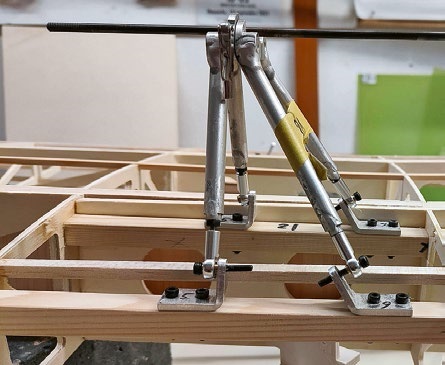
The aircraft mounts must be functionally flawless to ensure 100% success in the deployment of the satellite aircraft. The assemblies were professionally constructed using jigs.
- The so-called metallurgical work—including, in particular, aluminum brazing—was entrusted to a specialized company.
It took Bertrand nearly a year to model and refine this project, finding the best possible compromises.
To determine the scale, the Tupolev I-4 (ANT5) satellite fighter was chosen, with a wingspan of 1.90 m, to achieve the following characteristics for the carrier aircraft:
- Scale 1:6
- Wingspan 4.80 m
- Wing area: 340 dm²
To best preserve the proportions as they appeared in the 1930s, a more modern 17% root-section airfoil was chosen to ensure optimal flight characteristics, given that the root chord measures no less than 90 cm.
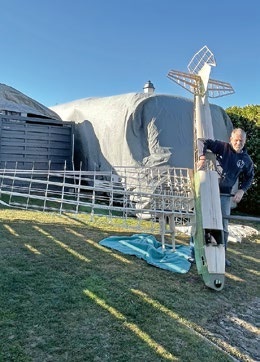
It is clear that the choice of the carrier aircraft's size and scale must allow for a satellite of reasonable size: approximately 1.90 m for the ANT5.
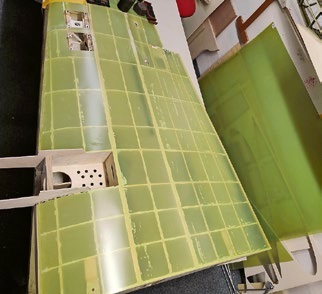
The wing, which has a very classic appearance, consists of a semi-box-section spar onto which 3-mm-thick poplar ribs and wing spar tubes are strung, while limiting the variety of materials as much as possible. Previous experience building a large 3.30-meter Hurricane highlighted the advantages of using 0.3-mm-thick epoxy sheet formwork bonded with PU adhesive, as it eliminates the need for finishing work, the time saved, and an appearance very close to that of vintage aluminum sheet metal.
The two carbon-tube wing spars measure 50 mm × 1.25 m.
The challenge of this build is particularly complex here because, in addition to the two planned 60-cm³ Fiala 4-stroke engines and the struts for the fixed landing gear, it was necessary to fabricate three three-legged aluminum trapezoids using welding jigs, each with three tabs for attachment to the wing, to ensure the secure mounting and in-flight release of the two satellite fighters.
The 3-meter-long fuselage is typical of its era: not very aerodynamic and openwork, it consists of a poplar and balsa lattice reinforced with Kevlar struts and partially covered with 0.3-mm fiberglass panels.
Two models of this sesquiplane fighter with a 1.90-meter wingspan were built. For practical reasons, they are powered by electric motors. Here again, a great deal of modeling work was required for the engine cowlings and fittings. Their all-wood, fabric-covered construction was
carried out by Richard. Not everything is finished yet, and the fighter is currently... undergoing repairs!!!!
A separate article may be devoted to the detailed construction of the Tupolev I-4 (ANT5).
Laurent Beldame
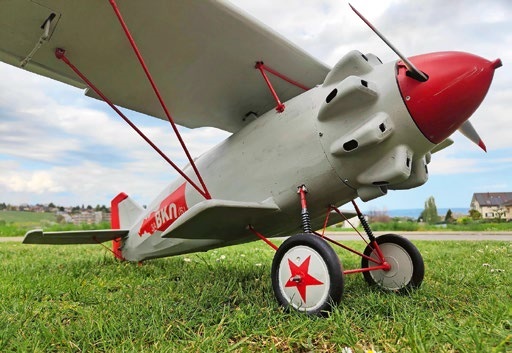
The Tupolev I-4 or AN5 satellite aircraft could be the subject of a future article all on its own...
| Wingspan with wingtip flaps | 4,790 mm |
| Length without cannons | 3,037 mm |
| Root chord | 900 mm |
| Wing chord at wingtips | 472 mm |
| Long Stab | 1230 mm |
| Upper Fin | 665 mm |
| Total Height (Wing Span) | 1043 mm |
| Engine | 2 x Fiala 60 cc |
| Weight | approx. 24 kg |
Wingspan | 1,895 mm |
Length | 1,218 mm |
Root chord | 314 mm |
Wing tip chord | 236 mm |
Long Stab | 587 mm |
Upper Fin | 316 mm |
Total Height (Wing Span) | 502 mm |
Electric | 5065 Series 435 KV electric motor |
Weight | approx. 5–6 kg |

What's New at Leomotion.com

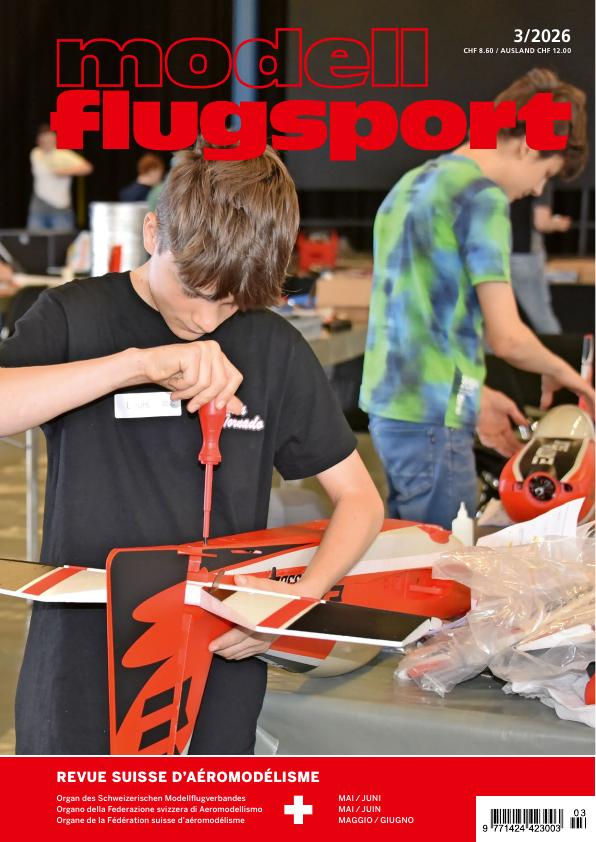
PRIDE AND GOOD IDEAS
 Markus Nussbaumer

News from HEBU

TEAM MANAGER "THIS" BOSSHARD
 Rodito Nussbaumer

ATOM, THE NEW DOUBLE-DECKER FROM CPLR
 Matthias Bosshard

INSIGHTS INTO THE HISTORY OF SEAPLANES

34th HAHNENMOOS ALPINE MODEL AIRPLANE CAMP
Res Dauwalder
CORSAIR F4U – A WARBIRD WITH A MEMORABLE LOOK
Jürgen Rosenberger, Jürgen Prinz
SUMMER FUN 2026 AT MG USTER
Martin Wunderli
F3A EUROPEAN CHAMPIONSHIPS IN ST-MACAIRE, FRANCE
Matthias Bosshard
52. 2026 ALPS CUP
 Emil Giezendanner

HORIZON HOBBY/LEMACO NEWS: MICRO OV-10 BRONCO 645 MM BY E-FLITE

TWIN TOWN PARTNERSHIP
Wolfgang Voeller
EURO CONTEST GLIDER ACRO TOUR AUSTRIA 2026

BY YOUTH, FOR YOUTH
Lorena Betschen
YOU KNOW WHAT I MEAN? 125 YEARS OF THE SWISS AERO CLUB
Emil Giezendanner
SMALL, MODEL-LIKE SAILBOATS
Res Dauwalder
TRY-OUT DAY AT MFV WETTINGEN
Urs Keller
WELCOME, NEW MEMBER!
Andrea Bolliger
FREE FLIGHT IN THE MIDDLE OF SUMMER
Urs Muntwyler
THE PC-21 STORY
Emil Giezendanner
COUPE DES ALPES – OBSERVE AND LEARN
Rodito Nussbaumer
NEWS FROM HEBU
 Julia Bucher

FROM 0 TO 100
Markus Nussbaumer
NOS REGION – A HUB FOR ELECTRIC AVIATION
Emil Giezendanner
MEMORIES
Wolfgang Völler
Have you almost forgotten about aircraft that take off and land vertically?
Emil Giezendanner
70 YEARS OF THE NIDWALDEN MODEL AIRPLANE CLUB
Martin Barmettler