
Model Aircraft Flying Around Heliports
On this warm summer day, I’m sitting at the lunch table with my crew. We’ve already flown three missions today and are looking forward to a well-deserved break between missions. We’re still having coffee when the alarm goes off. “Rega 10, fall on the Tälli via ferrata, back injury; the rescue specialist helicopter will be ready for pickup at Meiringen Airport in 10 minutes,” Rega operations control reports to us.
Six years ago, our Rega base was relocated from Gsteigwiler to Wilderswil, into the “Tiger Hall” at the former Interlaken military airfield. The old runway lies just three hundred meters north of our heliport. Today, it is sometimes used for light-aircraft flying—model aircraft.
As the engines start up, I activate the radio signal, which, among other things, turns on the rotating beacon that alerts the model aircraft builders and aerobatic pilots to our imminent departure. While the doctor gets ready in the back of the helicopter, the paramedic monitors the engine start-up. Before he climbs into the front left seat of the helicopter, he casts a scrutinizing glance into the sky to ensure that the airspace is “clear” and that all model airplanes are on the ground and no gliders or parachutes are expected in the takeoff sector.
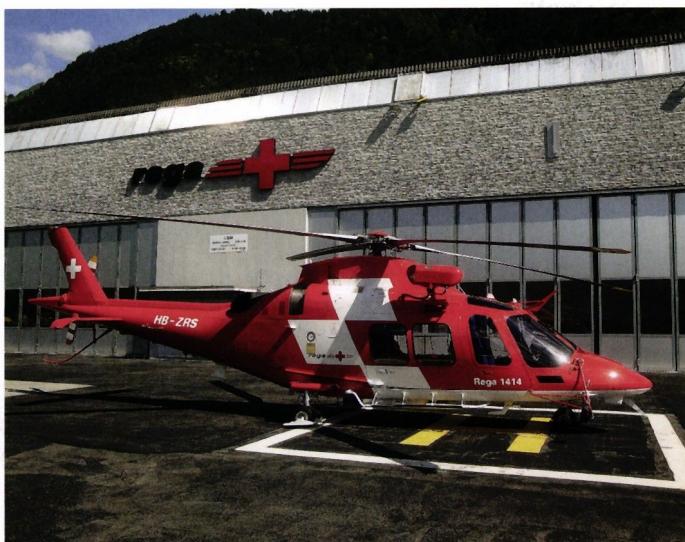
Before taking off, I perform the “Before Takeoff Check” and send a blind takeoff report on the local aviation radio frequency. I pull on the collective control— “Hover Check”—and the Da Vinci rises vertically. At an altitude of about twenty meters, I report “Decision”—meaning everything is clear to transition to forward flight.
On our departure route, we cross the large field east of the heliport. Similar to the old runway, this field also occasionally serves as a takeoff and landing strip for model aircraft enthusiasts. Among the model-aircraft enthusiasts are often people unfamiliar with the area who may not necessarily be aware of the code of conduct agreed upon between Rega and the local Interlaken model-aircraft club. We pay special attention to these model-aircraft enthusiasts and their flying creations during takeoff. Fortunately, there have never been any critical close encounters so far.
As we fly over Bönigen, I request permission from the Meiringen control tower to enter its control zone (CTR) for landing at the airfield. We greatly appreciate the cooperation with the Skyguide air traffic controllers, as they often grant us priority—for the benefit and well-being of our patients.
Seven minutes after takeoff, we depart from the Meiringen military airfield with the rescue specialist helicopter on board and fly toward the Gadmertal valley. The Rescue Specialist Helicopters (RSH) of the Swiss Alpine Club (SAC) support Rega crews during missions in challenging terrain.
Five minutes into the flight, we’re hovering in the upper third of the via ferrata, searching for the two mountaineers. Groups of two can be seen at various points along the via ferrata. However, there is no clear indication of who needs our help. Some barely notice the helicopter, while others wave friendly or simply watch us.
We systematically scan the via ferrata and spot two people in the lower section who match the description of the injured climbers. Descending, I fly a loop to find the best position to optimize the helicopter’s alignment with the wind while also ensuring a clear view of the rock face and the patient. And sure enough: one of the two is holding his arms outstretched in the air, signaling to us that they need help. If only more people knew how helpful these signals are to us air rescuers. A “no” signal—one arm extended diagonally upward and the other diagonally downward—is also very useful to us. Unfortunately, it happens all too often that we receive either no signal at all or only an ambiguous one from the people seeking help themselves.
We’ve now located the accident site. Next comes an assessment of the situation and a brief discussion of how to proceed. One thing is clear: a winch operation will be necessary. We analyze the risks. Are the patient and their companion secured? Does the RSH need to—and can they—secure themselves on site? Are there any objective hazards to people or the helicopter above this location (rocks, snow, etc.)? Are there any loose objects in the vicinity of the accident site or below it that could pose a risk to others due to the helicopter’s strong downdraft? What is the weight-to-power ratio of our aircraft? Do I have sufficient power reserve available for safe hovering at the site? Are the wind conditions acceptable? What do we do in the event of a technical malfunction at the worst possible moment? How do I approach the site to maintain a clear visual reference to the rock, position the helicopter as squarely into the wind as possible, and at the same time keep an optimal escape route open?
After assessing all these points, I fly another turn to position us optimally for the winch operation. Our paramedic has already moved to a different spot in Meiringen and is acting as the winch operator. The RSH is the first to be lowered on the winch rope to the two climbers. After finding a good anchor point, he attaches his safety sling there and reports this to me via radio. I need to know this because the helicopter is now, for a short time, effectively tethered to the rock face. Shortly thereafter, the RSH releases the winch hook and lets it swing away from him. Now the helicopter is free again. A short time later, our emergency physician also attaches herself to the winch rope and has the paramedic—or winch operator—lower her precisely to the patient’s location. Together with the paramedic, I fly to an intermediate landing site, where we wait for further information from the emergency physician. After a while, I hear the RSH’s radio call: “Rega 10 from Fritz, we’ll be ready for the winch rescue in two minutes.” We fly to the accident site, and the emergency physician is able to receive the winch hook suspended 60 meters below the helicopter. She attaches the horizontal net—in which she and the RSH have secured the patient—and herself to the winch hook and gives us the signal to take off. We gently set them both down at the staging area and fly back to the accident site to also transport the RSH and the victim’s companion to the staging area. Once there, the patient receives medical care from the emergency physician and the paramedic and is prepared for transport to the hospital. Soon the Da Vinci’s powerful turbines roar to life again, and we take off toward Interlaken. This week, a towing camp featuring large-scale models is taking place at the decommissioned Interlaken airfield. Our approach route takes us high above the airfield runway toward Interlaken Hospital. The paramedic sitting to my left tells me he sees a glider at our altitude (600 m above ground!) at the ten o’clock position. Only upon a second glance do we realize that it is a large remote-controlled model. The silhouette of the model glider is very delicate and therefore very difficult to make out from our vantage point. We’re flying at about 120 knots. At this speed, we have just five seconds to avoid an object flying 300 meters ahead of us. When I look back ahead, I get a massive scare. I realize that we’re flying straight toward a second object like that. I immediately yank the controls to the right and manage to avoid it by a hair. “My God, that thing is huge,” I hear the paramedic say over the intercom. We were really lucky. Knowing that even a single piece of clothing caught in the tail rotor can cause a helicopter to crash, I dare not imagine what the consequences of a collision with a model airplane would be. The model glider was flying at a legal altitude and under VFR conditions.
Two minutes after the incident, we land safely at the hospital. I’m slowly recovering from the “encounter” with the model glider, and although I love flying, at this point I’m glad to feel solid ground beneath my feet again.
Thanks to the highly professional care at Interlaken Hospital, our patient recovers relatively quickly from his injuries and is able to be discharged after just a few days.
To ensure that airspace around airfields and heliports can continue to be used by commercial, private, and military aircraft—as well as by model aircraft—it is important that legal and local regulations are followed. We would be pleased if model aircraft pilots in such areas also actively monitor the airspace themselves, fly with foresight, and proactively avoid approaching manned aircraft. This increases mutual acceptance and, most importantly, flight safety. ■
Gilbert Ramseier
, Helicopter
Pilot, Rega Base Wilderswil


What's New at Leomotion.com

PRIDE AND GOOD IDEAS
 Markus Nussbaumer

News from HEBU

TEAM MANAGER "THIS" BOSSHARD
 Rodito Nussbaumer

ATOM, THE NEW DOUBLE-DECKER FROM CPLR
 Matthias Bosshard

INSIGHTS INTO THE HISTORY OF SEAPLANES

34th HAHNENMOOS ALPINE MODEL AIRPLANE CAMP
Res Dauwalder
CORSAIR F4U – A WARBIRD WITH A MEMORABLE LOOK
Jürgen Rosenberger, Jürgen Prinz
SUMMER FUN 2026 AT MG USTER
Martin Wunderli
F3A EUROPEAN CHAMPIONSHIPS IN ST-MACAIRE, FRANCE
Matthias Bosshard
52. 2026 ALPS CUP
 Emil Giezendanner

HORIZON HOBBY/LEMACO NEWS: MICRO OV-10 BRONCO 645 MM BY E-FLITE

TWIN TOWN PARTNERSHIP
Wolfgang Voeller
EURO CONTEST GLIDER ACRO TOUR AUSTRIA 2026

BY YOUTH, FOR YOUTH
Lorena Betschen
YOU KNOW WHAT I MEAN? 125 YEARS OF THE SWISS AERO CLUB
Emil Giezendanner
SMALL, MODEL-LIKE SAILBOATS
Res Dauwalder
TRY-OUT DAY AT MFV WETTINGEN
Urs Keller
WELCOME, NEW MEMBER!
Andrea Bolliger
FREE FLIGHT IN THE MIDDLE OF SUMMER
Urs Muntwyler
THE PC-21 STORY
Emil Giezendanner
COUPE DES ALPES – OBSERVE AND LEARN
Rodito Nussbaumer
NEWS FROM HEBU
 Julia Bucher

FROM 0 TO 100
Markus Nussbaumer
NOS REGION – A HUB FOR ELECTRIC AVIATION
Emil Giezendanner
MEMORIES
Wolfgang Völler
Have you almost forgotten about aircraft that take off and land vertically?
Emil Giezendanner
70 YEARS OF THE NIDWALDEN MODEL AIRPLANE CLUB
Martin Barmettler