
FAI World Championships
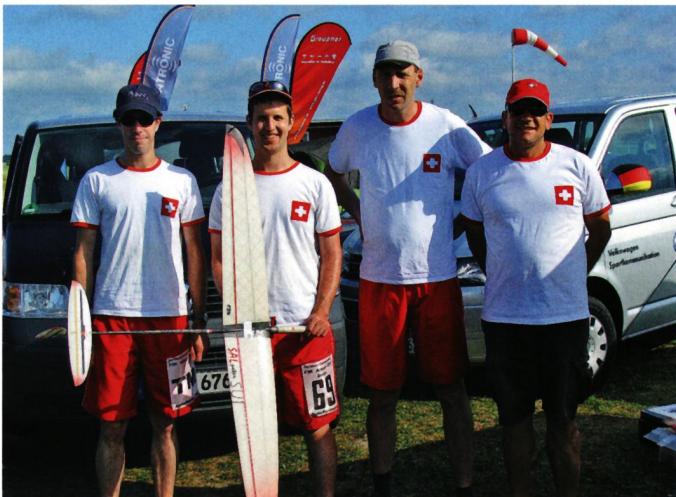
At the first World Championship for Hand-Launched Gliders in Arboga, Sweden, the Swiss team achieved an encouraging result. Reto Schmid finished in the top 10 in the preliminary round, and Reto Fiolka secured a solid spot in the fly-off at the World Championships. The level of competition was very high, clearly demonstrating that F3K is a fascinating sport.
As soon as the Swiss team was selected, the drivers—Reto Schmid, Gregor Kistler, and Reto Fiolka—began their preparations. Reto Fiolka was in the U.S. at the time on a research fellowship, but we held monthly meetings via Skype. Jan Brunner, a young but dedicated team manager, rounded out our team. Many questions remained unanswered: What would we encounter in Arboga? How strong is the competition, what kinds of models will be used, and how high will the top pilots throw? We tried to train as much as possible and compete in as many events as we could.
For the World Championship qualifier, the Nordic Open, with
over 100 participants, we decided not to use the A-class gliders. It was extremely windy, and some runs were impossible to fly. At times, we had to fly fully ballasted (400 g) just to make any headway at all. Among the favorites, Joe Wurts stood out in particular, winning the Nordic Open with ease. Reto Schmid performed very well and achieved an outstanding 8th place.
The World Championships began on Tuesday in nearly complete calm. Both Retos achieved the required 5 minutes in the first round within a weak thermal bubble—a good start. The next tasks also took place in very light conditions. In the “Steigern” task, Reto S. and Gregor were unable to reach the 2-minute mark, which resulted in Reto S.’s first significant loss of points. Reto F. made it through to Round 5 virtually unscathed and was in the top ten. But the standings were extremely tight—a few seconds lost, and you were already out of the running. This was set to change with the “Poker” task. In Poker, the pilot decides when to call their flight time, but once a time is nominated, they must achieve it—
...otherwise the flight doesn’t count. Given the high level of competition at the World Championships, it was clear to us that we had to announce 9:58. Anything else would have been a discard anyway. That was also the time Reto F. announced. However, this gamble didn’t pay off, and after 3 minutes, his model landed about 1 km away from the field. That meant he, too, had a discard result. The gamble shook up the field; some favorites missed their flight by mere seconds, and nerves were on edge. Reto F. won the last three rounds, although two collisions had him breaking a sweat again. With a 5th-place finish, he secured his spot in the Fly Off of the top 12. As a team, we finished 12th out of 27 teams. After that, we had a day off before the Fly-Off. We used the rest day to train, and an unofficial launch competition was also held. Reto F. achieved a throw height of 70.4 m. As the wind picked up, a Japanese competitor with a very dynamic throwing style even reached 76 m, which made it clear that F3K is truly a sport. The Fly-Off on Saturday took place in stronger winds and cloudy weather. Things got off to a good start for our Swiss participant; on the first task, Reto F. managed to complete the required 5 minutes. In Round 2, Tasks 1, 2, 3, and 4, virtually the entire field struggled, and some even landed outside the course, but for Joe Wurts and Reto, things looked very
Of course, we were plagued by many questions after the fly-off: Why did the timekeeper have to mess up just when things were going well for us? If we’d been on Joe’s side of the field, we probably could have pulled off the “All Up Last Down.” If we’d dropped the ballast before the final flight, the thermals might have been enough, and so on and so forth. But to make those decisions, we would have had to know in advance where the thermals were and how they would develop. Only one man on the field knew that—Joe Wurts—and that’s why he deservedly became world champion. Nevertheless, we’re very satisfied with the Swiss national team’s performance. We were able to compete at the international level, both in the preliminary competition and at the World Championships, and we were also among the leaders in technical aspects such as launch height and go-around times. And many new, talented F3K pilots are waiting in the wings in Switzerland and will significantly strengthen and shake up our scene. In short: The World Championship was an encouraging start for this young competition class.
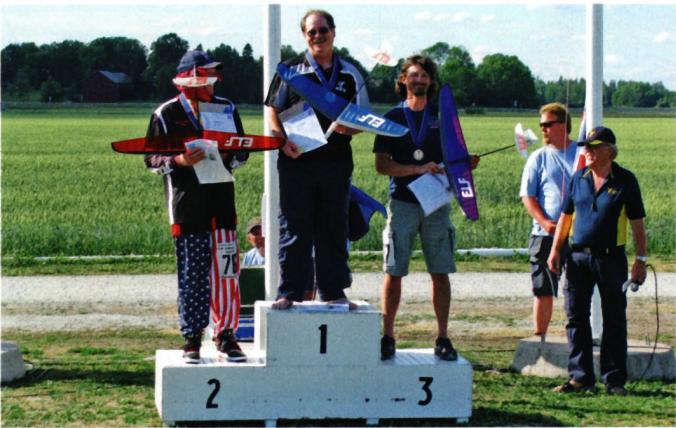


TEAM MANAGER "THIS" BOSSHARD
 Rodito Nussbaumer

F3A EUROPEAN CHAMPIONSHIPS IN ST-MACAIRE, FRANCE
 Matthias Bosshard

News from HEBU

YOU KNOW WHAT I MEAN? 125 YEARS OF THE SWISS AERO CLUB
 Emil Giezendanner

SUMMER FUN 2026 AT MG USTER
Martin Wunderli
TRY-OUT DAY AT MFV WETTINGEN
Urs Keller
52. 2026 ALPS CUP
Emil Giezendanner
BY YOUTH, FOR YOUTH
Lorena Betschen
CORSAIR F4U – A WARBIRD WITH A MEMORABLE LOOK
Jürgen Rosenberger, Jürgen Prinz
SMALL, MODEL-LIKE SAILBOATS
Res Dauwalder
What's New at Leomotion.com

ATOM, THE NEW DOUBLE-DECKER FROM CPLR
Matthias Bosshard
INSIGHTS INTO THE HISTORY OF SEAPLANES

34th HAHNENMOOS ALPINE MODEL AIRPLANE CAMP
Res Dauwalder
HORIZON HOBBY/LEMACO NEWS: MICRO OV-10 BRONCO 645 MM BY E-FLITE

COUPE DES ALPES – OBSERVE AND LEARN
Rodito Nussbaumer
PRIDE AND GOOD IDEAS
 Markus Nussbaumer

EURO CONTEST GLIDER ACRO TOUR AUSTRIA 2026

FREE FLIGHT IN THE MIDDLE OF SUMMER
Urs Muntwyler
THE PC-21 STORY
Emil Giezendanner
TWIN TOWN PARTNERSHIP
Wolfgang Voeller
WELCOME, NEW MEMBER!
Andrea Bolliger
NEWS FROM HEBU
 Julia Bucher

FROM 0 TO 100
Markus Nussbaumer
MEMORIES
Wolfgang Völler
NOS REGION – A HUB FOR ELECTRIC AVIATION
Emil Giezendanner
Have you almost forgotten about aircraft that take off and land vertically?
Emil Giezendanner
70 YEARS OF THE NIDWALDEN MODEL AIRPLANE CLUB
Martin Barmettler