
A Lance for the Spears
When launched, they are thrown like spears—the fast models in the F5B electric glider class.
This model class, which has been constantly evolving since the early 1980s and has essentially reinvented itself time and again, remains one of the most interesting competition classes even today. The two tasks to be completed in F5B share a surprising similarity with a completely different category, namely that of the DLG F3K models... This may sound astonishing, but the models in both classes—F5B and F3K—must perform two completely opposite tasks.
During the spectacular discus launch, the ultralight F3K gliders must withstand high stresses and soar to the greatest possible altitudes with thin airfoils, only to then—in a mysterious transformation!—turn into efficient thermal gliders.
It’s fascinating to see how model development over the past 20 years has managed to combine these conflicting requirements ever more perfectly in these remarkable models.
It’s much the same in F5B: In the first part of the competition task (as many 150-meter runs as possible within a time limit of 200 seconds), the gliders must be powerful, high-speed models, only to then complete a 10-minute gliding task with a precision landing in the second part. Here, too, there are two conflicting requirements for a single model.
Anyone who has followed the development of F5B from its beginnings to the present day has repeatedly marveled at the spirit of innovation, the technical and flying achievements, and the dedication and perseverance of the competitors. Numerous rule changes—some for safety reasons (multiple climbs during cross-country flights), others for fairness (energy limiters)—have made F5B the sophisticated, fair, and extremely demanding competition class it is today. Perhaps these achievements—both technical and in terms of flying skill—have become too much of a given for many model pilots; after all, electric models can now be purchased “plug-and-play.” However, we should not forget that tinkerers and those with perseverance have consistently pushed model aviation forward; this applies, among many others, to free-flight pilots, indoor flight specialists, DLG trialists, and, not least, the tireless F5B enthusiasts.
Unfortunately, participation numbers in this category are shrinking (worldwide); the significant effort required deters many model pilots. This is also reflected in the number of participants at the F5B Swiss Championship on October 12 in Cham, hosted by the Zugerland Model Flying Club, where just 6 pilots took to the air. Without wanting to sound maudlin—it’s like in music: When a type of instrument is played by fewer and fewer people and eventually not at all, then not only does the instrument disappear, but ultimately so does the knowledge and skill associated with it—a kind of extinction, so to speak.
Let me take a stand for the “spears” here: Why not visit an F5B competition again sometime? The displays are breathtaking, and once you’ve figured out the tasks, the competitions are incredibly exciting. And experienced pilots are very willing to help newcomers. Maybe it’ll inspire a few young people again...
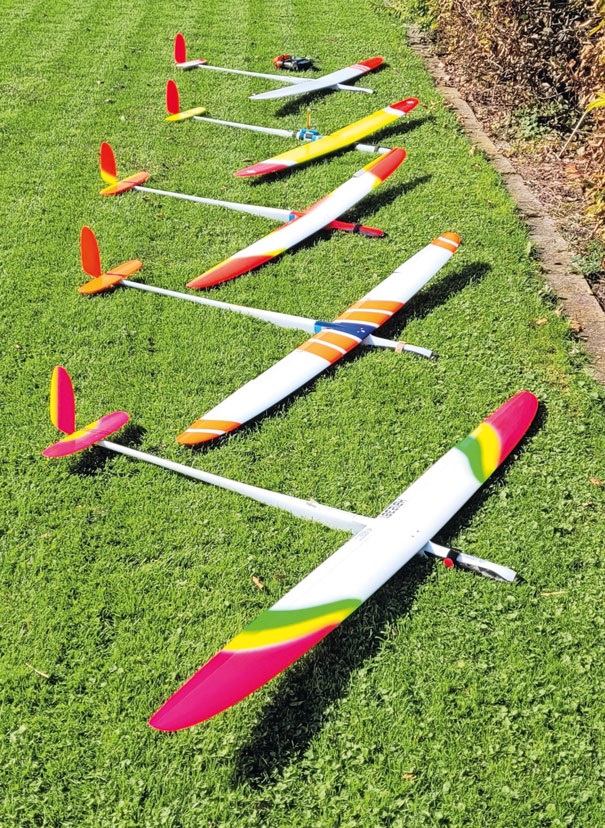
| Wingspan | 193.5 cm |
| Length | 134 cm |
| Weight | 1,550 g to 1,680 g (depending on motor setup) |
| Propeller | GM 18×23 |
| Motor | Leomotion L4031/2050 with 7:1 gearbox |
| Controller | APD HV 200A |
| Data Logger | SM Unilog with 400A shunt |
| Battery | 10S Gensace Tattu 1400 mAh V4 |
| Maximum engine power | 7,500 W at 8,500 rpm |
| Forward acceleration | 8 g; that is, after a manual launch, the model reaches an altitude of 60 m in 1.5 s and travels at 250 km/h. |
| Maximum speed | 350 km/h (not reached in competition because the vehicle is not accelerated to its full potential) |
| Minimum speed | 50 km/h at a descent rate of 1 m/s |


TEAM MANAGER "THIS" BOSSHARD
 Rodito Nussbaumer

SUMMER FUN 2026 AT MG USTER
Martin Wunderli
52. 2026 ALPS CUP
 Emil Giezendanner

ATOM, THE NEW DOUBLE-DECKER FROM CPLR
 Matthias Bosshard

INSIGHTS INTO THE HISTORY OF SEAPLANES

34th HAHNENMOOS ALPINE MODEL AIRPLANE CAMP
Res Dauwalder
CORSAIR F4U – A WARBIRD WITH A MEMORABLE LOOK
Jürgen Rosenberger, Jürgen Prinz
SMALL, MODEL-LIKE SAILBOATS
Res Dauwalder
F3A EUROPEAN CHAMPIONSHIPS IN ST-MACAIRE, FRANCE
Matthias Bosshard
What's New at Leomotion.com

HORIZON HOBBY/LEMACO NEWS: MICRO OV-10 BRONCO 645 MM BY E-FLITE

PRIDE AND GOOD IDEAS
 Markus Nussbaumer

News from HEBU

BY YOUTH, FOR YOUTH
Lorena Betschen
YOU KNOW WHAT I MEAN? 125 YEARS OF THE SWISS AERO CLUB
Emil Giezendanner
TRY-OUT DAY AT MFV WETTINGEN
Urs Keller
FREE FLIGHT IN THE MIDDLE OF SUMMER
Urs Muntwyler
THE PC-21 STORY
Emil Giezendanner
TWIN TOWN PARTNERSHIP
Wolfgang Voeller
EURO CONTEST GLIDER ACRO TOUR AUSTRIA 2026

WELCOME, NEW MEMBER!
Andrea Bolliger
COUPE DES ALPES – OBSERVE AND LEARN
Rodito Nussbaumer
NEWS FROM HEBU
 Julia Bucher

FROM 0 TO 100
Markus Nussbaumer
NOS REGION – A HUB FOR ELECTRIC AVIATION
Emil Giezendanner
MEMORIES
Wolfgang Völler
Have you almost forgotten about aircraft that take off and land vertically?
Emil Giezendanner
70 YEARS OF THE NIDWALDEN MODEL AIRPLANE CLUB
Martin Barmettler