
2022 F5J/FAI European Championships in Szeged, Hungary
F5J was flown—in a simplified form—in Eastern European countries from an early stage. It was also these countries that advocated for an official class within the CIAM (FAI).
After about a year of work by a working group of the F5-CIAM Subcommittee, a usable—though somewhat complicated—set of rules was developed. The key difference was that, instead of an energy limiter like in F5B, an altitude logger is installed. In very “simple” terms, these wonder gliders are called “THERMAL DURATION GLIDERS WITH ELECTRIC MOTOR AND ALTIMETER/MOTOR RUN TIMER (AMRT).”
Put simply: The motor may run for only 30 seconds—but it doesn’t have to. Up to an altitude of 200 m, one point is deducted per meter; above that, three points. In addition, flight time and the landing are measured.
This class quickly became a huge success. In Switzerland, I launched the first trial competition as early as 2015. To speed things up, I provided participants with loggers on loan. I repeated this several times in the following years, which certainly contributed to its rapid spread. The most important thing was that the time was simply ripe for a more modern electric flight competition class.
In my role as president of the FAI jury, I have been able to attend all of the FAI’s major F5J events (World and European Championships) to date. This has allowed me to make comparisons over a four-year period.
Even at the first FAI European Championships in Bulgaria (2018), I could easily see that not only did the competitors and team leaders still have a lot to learn, but so did the organizers. In addition, a few gaps in the regulations were discovered. The first problems arose as early as the team leaders’ meeting, when some participants tried to impose local rules on the spot. By 2019, at the World Championships in Slovakia, everything was already running much more professionally. In Szeged, Hungary (2022), a wonderful competition was carried out using the simplest of means. This cannot be praised highly enough. Flexibility and tight organization were the hallmarks of the event. No major problems, no protests, no accidents.
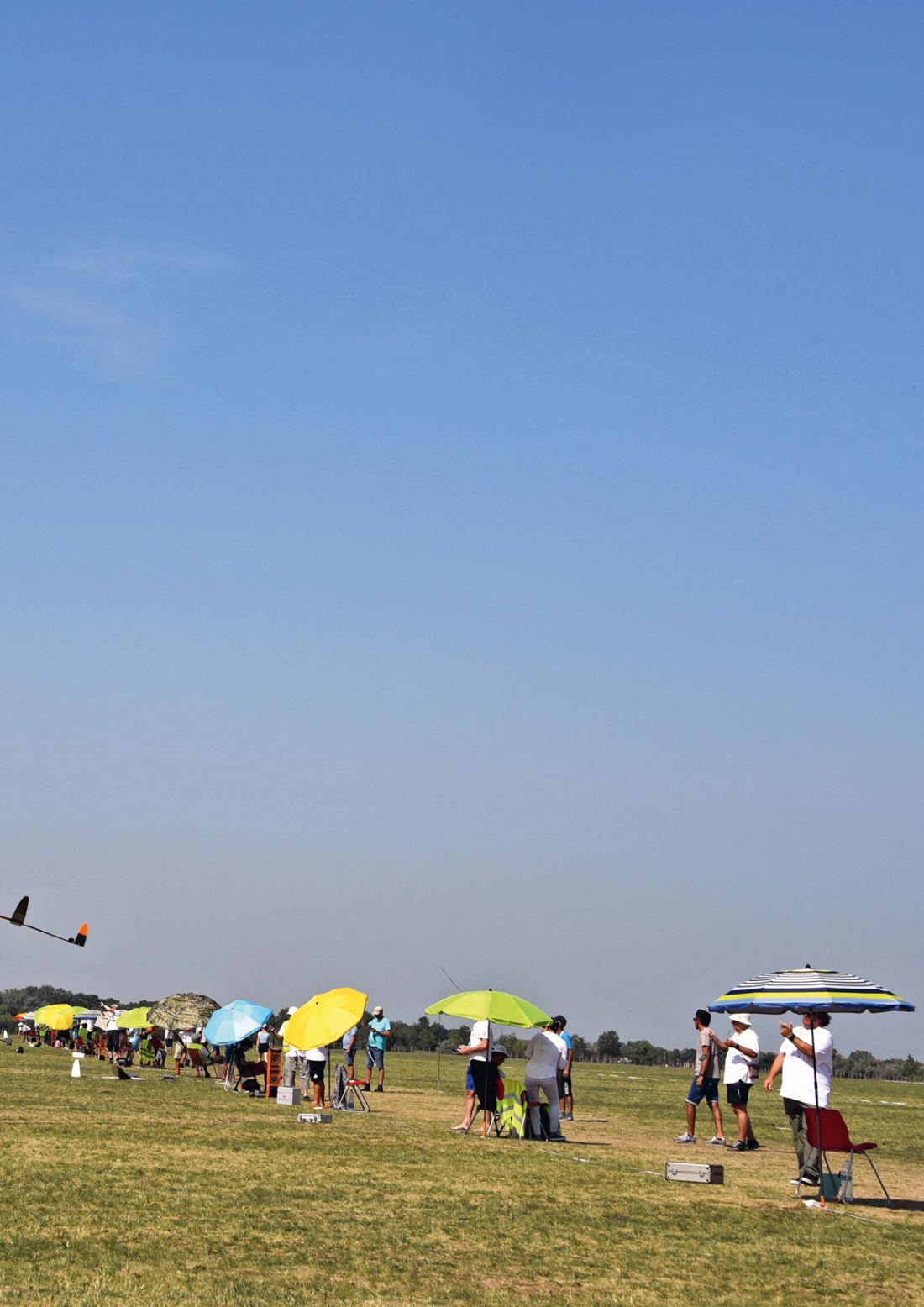
The flying field at the Szeged airfield is a dream for any aviation enthusiast—not just for us model aircraft pilots. A vast open plain.
No restricted flying areas were designated at any of the three major competitions. Flights took place over campsites, pilot tents, hangars, the food tent, etc. (Unfortunately, I let myself be talked into it in San Vittore—it had to do with the highway.) Fair monitoring would only be possible via visors or trackers, which hardly anyone would be willing to put up with. Anything else would be speculation—leading to discussions that are sometimes hostile.
In my opinion, the gearbox has had its day. Climbing like a helicopter is a thing of the past and pointless. To explore thermals, you scan the terrain at altitudes below 50 meters while applying plenty of thrust. Gearless motors allow for a high degree of dynamism. While geared motors with large propellers adjust to a specific speed, gearless motors with smaller propellers adapt to the desired speed. In addition, small propellers experience significantly less drag in the gliding position. Slow, meandering flight is mostly replaced by rapid circling and equally rapid movement from one spot to another. Furthermore, the motors and propellers are inexpensive.
I was pleasantly surprised to find that, in general, the teams were much better organized than in previous years. This made the entire process much smoother. The pilots and their team leaders were standing by at the waiting line just minutes before their runs. It was very rare for a second helper to “stray” to the pilot’s location. The German team was exemplary and perfectly organized. The Swedish team surprised everyone by finishing in 3rd place. The Swiss finished in the middle of the pack, between 30th and 52nd place (out of 72 participants)—neither good nor bad. To try to gloss this over by calling it “bad luck” would be window-dressing. Sure, with such a high level of competition, one slip-up is the absolute limit. My recommendations: Be ready and focused even earlier before a competition. No smartphones. Our junior (see pages 40 and 41) put up a good fight. It would be nice to have a second junior on the team. They could motivate each other. Our team has laid the groundwork for the future. They have to make do with training grounds that offer less-than-ideal conditions. However, this year the best athletes prevailed even on difficult terrain. Nevertheless, all four athletes have room for further improvement. I’m convinced of that. Good luck.


News from HEBU

TEAM MANAGER "THIS" BOSSHARD
 Rodito Nussbaumer

SUMMER FUN 2026 AT MG USTER
Martin Wunderli
BY YOUTH, FOR YOUTH
Lorena Betschen
SMALL, MODEL-LIKE SAILBOATS
Res Dauwalder
TRY-OUT DAY AT MFV WETTINGEN
Urs Keller
What's New at Leomotion.com

52. 2026 ALPS CUP
 Emil Giezendanner

ATOM, THE NEW DOUBLE-DECKER FROM CPLR
 Matthias Bosshard

INSIGHTS INTO THE HISTORY OF SEAPLANES

YOU KNOW WHAT I MEAN? 125 YEARS OF THE SWISS AERO CLUB
Emil Giezendanner
34th HAHNENMOOS ALPINE MODEL AIRPLANE CAMP
Res Dauwalder
CORSAIR F4U – A WARBIRD WITH A MEMORABLE LOOK
Jürgen Rosenberger, Jürgen Prinz
F3A EUROPEAN CHAMPIONSHIPS IN ST-MACAIRE, FRANCE
Matthias Bosshard
HORIZON HOBBY/LEMACO NEWS: MICRO OV-10 BRONCO 645 MM BY E-FLITE

PRIDE AND GOOD IDEAS
 Markus Nussbaumer

EURO CONTEST GLIDER ACRO TOUR AUSTRIA 2026

FREE FLIGHT IN THE MIDDLE OF SUMMER
Urs Muntwyler
THE PC-21 STORY
Emil Giezendanner
TWIN TOWN PARTNERSHIP
Wolfgang Voeller
WELCOME, NEW MEMBER!
Andrea Bolliger
COUPE DES ALPES – OBSERVE AND LEARN
Rodito Nussbaumer
NEWS FROM HEBU
 Julia Bucher

FROM 0 TO 100
Markus Nussbaumer
MEMORIES
Wolfgang Völler
NOS REGION – A HUB FOR ELECTRIC AVIATION
Emil Giezendanner
Have you almost forgotten about aircraft that take off and land vertically?
Emil Giezendanner
70 YEARS OF THE NIDWALDEN MODEL AIRPLANE CLUB
Martin Barmettler