
Promoting the Next Generation of Model Aircraft Enthusiasts as a Joint Effort Across Generations
Hardly any sports organization today can afford not to develop excellent youth mission statements and youth programs—ideally new ones with every leadership change. The “old-timers” are responsible for implementation and hands-on youth work—except in large organizations with professional youth coaches. In most cases, mission statements and programs remain nothing more than Sunday school stories, unless we adults roll up our sleeves.
The older generation is facing an increasingly serious credibility problem with us young people. Thanks to the internet and TV, we know everything these days—just not very well. We can weigh in on any topic and consider ourselves experts on everything. We’re just as capable of judging a soccer player’s skills as we are of evaluating a world-class pilot’s F3A aerobatic maneuvers. And we never miss an opportunity to comment on all of this “expertly”—and to criticize it just as much. Parents criticize their child’s teacher and, based on the latest findings in group dynamics or developmental psychology, advise her on how to treat their offspring. Rarely do we realize that young people have long since seen right through us and possess a keen sense of our contradictions and weaknesses. With almost analytical skills, they sense the disconnect between our advice and commands on the one hand and our actions on the other—or, in short, between what we say and what we do. The father who has never played competitive soccer himself nor achieved anything remarkable in aerobatics, or the mother who took a group dynamics course at the youth welfare office but snaps at her children in exasperation at every opportunity. Our ideal world then completely collapses in the eyes of our youth when it turns out that our authority is not based on social skills, ability, and achievements, but solely on age and power. This not only undermines our role as parents—worse still, it makes us vulnerable to blackmail.
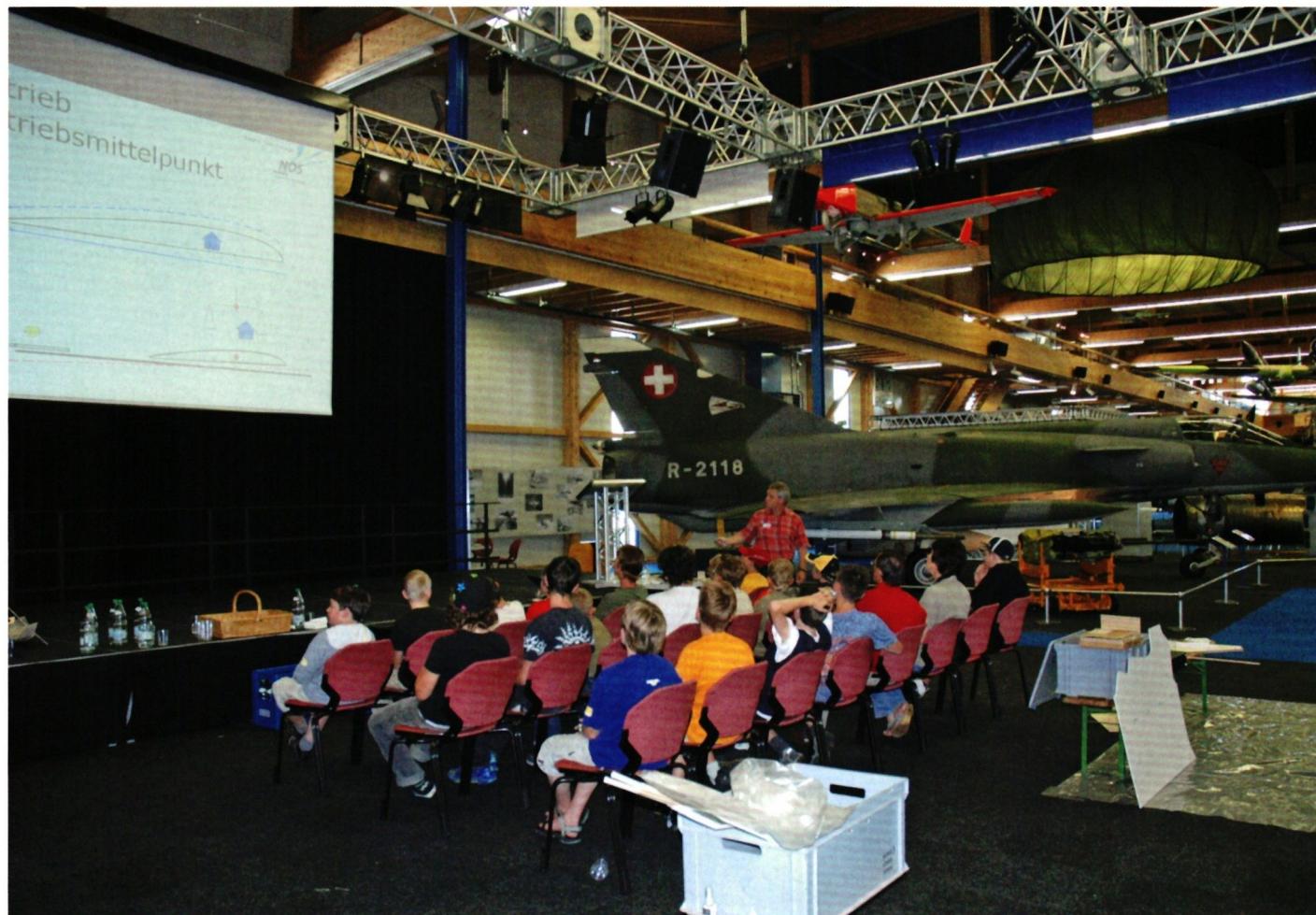
Young SilentWings 2008 at the Dübendorf Aviation Museum
For the second time, the Dübendorf Aviation Museum and the Northeast Switzerland Model Aviation Region jointly organized an electric model aircraft workshop for high school students during the first week of summer vacation.
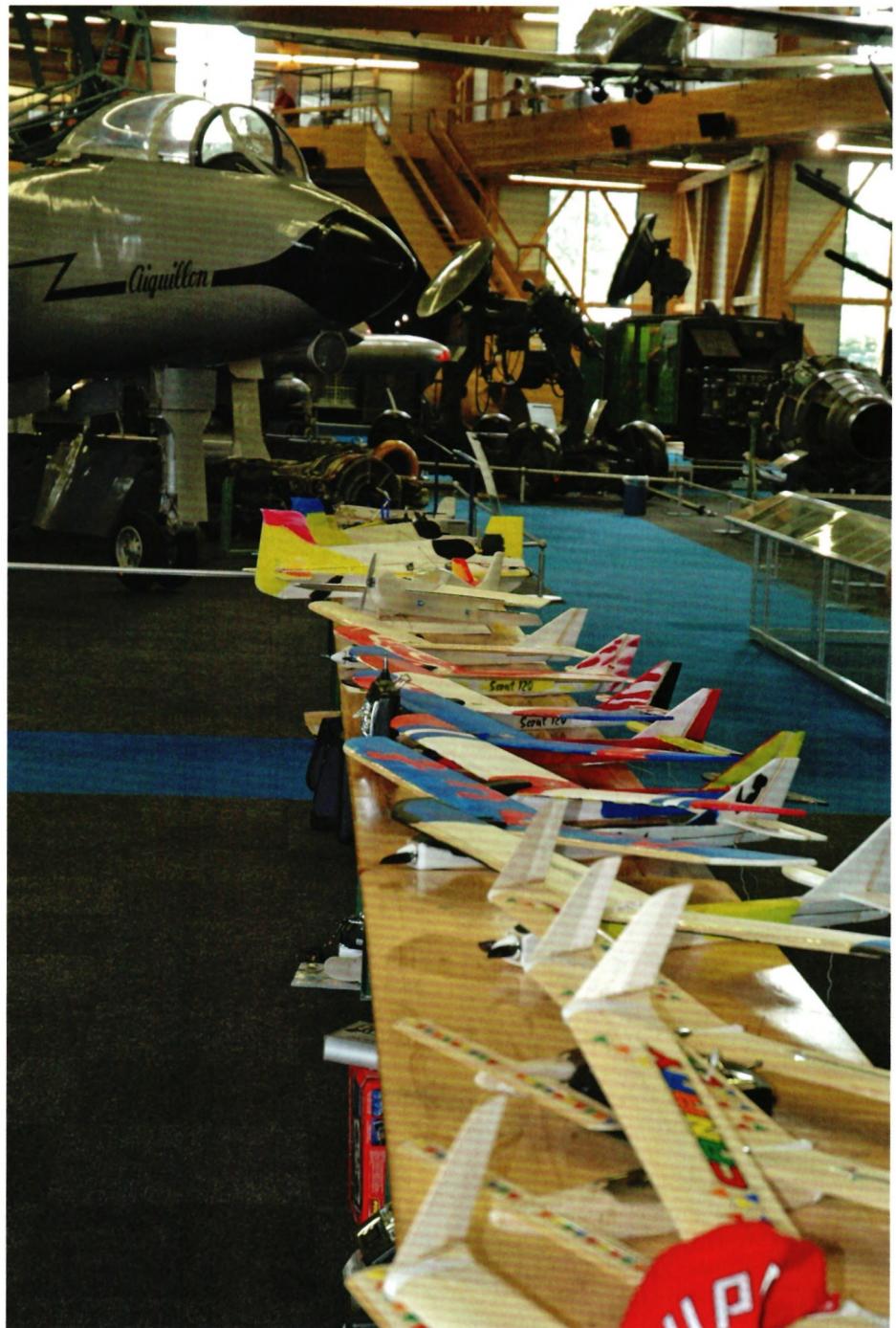
Participants were divided into two skill groups: Beginners built the Canary kit model or the Scout Depron glider. They were provided with all the necessary materials, including kits, a remote control, an electric motor, a battery, and a charger. The advanced participants designed and built an airplane out of Depron based on their own ideas and brought their own RC systems. All propulsion components, right down to the charger, were also included in the course fee. The program also featured theory sessions, a model flight simulator, and a tour of the JU 52.

Simply because adults and teens live in different worlds in their daily lives—work and careers for the former, school and education for the latter—our role as direct role models can hardly extend beyond their free time. Adults who actively shape their free time—rather than passively letting it slip away in front of screens—can serve as role models in the most unspectacular and natural way possible. This has nothing to do with grand deeds. Quite the opposite. What matters most is our attitude toward what we do. Despite the ever-increasing variety of sports and recreational activities available, this is precisely where model aviation’s great opportunity lies. The key is: Don’t just talk—show by example! The well-known seminar instructor and educator Arthur Brühlmeier once wrote:
“This also shows the educator the path to achieving lasting authority: by taking his own life’s mission seriously, by developing his own humanity.”
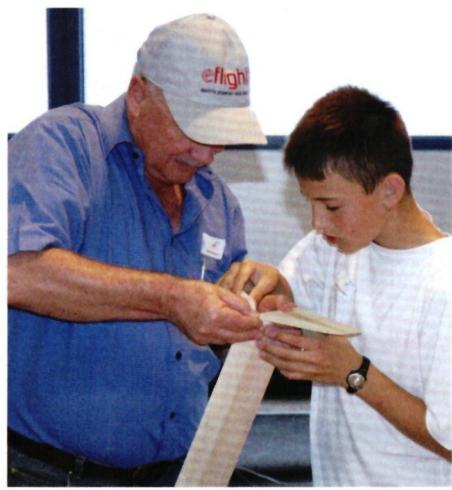
Supporting young people in model aviation is a joint effort between young people and adults. Enthusiasm and a spirit of discovery can move mountains.
In contrast to sports and recreational activities, which tend to be more athletically oriented, an increasing number of seniors are taking on important roles in practical youth development within model aviation. They bring a tremendous and invaluable wealth of professional and life experience to the table. Many of them have held leadership and instructional roles in their careers for years. This is particularly evident in a technically oriented hobby such as model aircraft flying. Based on my observations over the years, I can also confirm that these individuals rarely have to deal with disciplinary issues—they are simply natural authorities, both personally and professionally. When we adults pursue our hobby not only with our wallets but also with our hearts, minds, and craftsmanship, we project a well-rounded and thus credible image. This has always had a positive influence on young people—we adults have become “predictable” to the young.
Years ago, when the decline in the status of arts and crafts and music classes at our elementary school began to become apparent, I saw this as a great opportunity for model aircraft flying. I was almost euphoric! After all, with our high-level craftsmanship—which often borders on true artistry—we can offer a valuable complement to the school curriculum. Today, however, my former optimism has given way to disillusionment: In our model-building courses, we increasingly have to teach basic manual skills. Whereas in the past, thanks to school arts and crafts projects involving cardboard, wood, and other materials, we could assume that a young person knew how to hold a utility knife and was able to make reasonably straight cuts, today we have to teach this almost from scratch. This makes everything more laborious and makes it harder to achieve the goal of getting a finished model airborne. For this reason, we must under no circumstances neglect model-building courses at the most basic level—such as building a balsa glider. They have, so to speak, gained importance as a “foundation level” of model building. Anyone who claims that there are two “types” of model aviators today—namely, those who (still) build their own models and those who opt for ready-to-fly models—hasn’t quite grasped the situation: For every attractive ARF model—whether it’s an expensive aerobatic plane or a fantastic large glider—the owner will have to spend many hours installing the propulsion and control components. In my view, this is the most demanding kind of technical and hands-on work, and it never works without a high degree of know-how and perseverance. If there are model aviators who never take on the challenge of a repair, they’ll soon have a space problem...
Unfortunately, it’s not just the vocational subjects that are being neglected in our schools—the natural sciences are increasingly being sidelined as well. Our “educational experts” have, sadly, not yet realized that one can also learn a language through and within the natural sciences. In my view, this is a disaster for our country. This criminal one-sidedness is backfiring on our economy: the result is a shortage of technical specialists, ranging from skilled tradespeople and operators to engineers. The natural sciences and technology are great adventures and would be at least as motivating to teach in schools as the subjunctive imperfect! We still earn our money not just by shuffling money around (which often isn’t even there), but also by developing and producing industrial goods. Switzerland as a country of technical innovation—for how much longer? For model aviation, this “cultivated” lack of understanding of scientific and technical concepts is a major disadvantage. Despite (nearly) ready-to-fly models, model aviation remains a technical hobby. The more we develop it, the more demanding it becomes. This makes the transition from beginner to advanced modeler more difficult.
Youth mission statements and concepts are only useful if we adults are willing to take on the most demanding educational and upbringing responsibilities. Since we adults must always assume that young people see right through us, we must never do this simply to check off statutes and organizational goals or to advance our careers. We must commit ourselves fully and with complete conviction to this task. Supporting the next generation is a task typically shared by young people and adults. It always requires both—neither can succeed without the other.


News from HEBU

TEAM MANAGER "THIS" BOSSHARD
 Rodito Nussbaumer

YOU KNOW WHAT I MEAN? 125 YEARS OF THE SWISS AERO CLUB
 Emil Giezendanner

F3A EUROPEAN CHAMPIONSHIPS IN ST-MACAIRE, FRANCE
 Matthias Bosshard

52. 2026 ALPS CUP
Emil Giezendanner
PRIDE AND GOOD IDEAS
 Markus Nussbaumer

ATOM, THE NEW DOUBLE-DECKER FROM CPLR
Matthias Bosshard
CORSAIR F4U – A WARBIRD WITH A MEMORABLE LOOK
Jürgen Rosenberger, Jürgen Prinz
SUMMER FUN 2026 AT MG USTER
Martin Wunderli
TRY-OUT DAY AT MFV WETTINGEN
Urs Keller
TWIN TOWN PARTNERSHIP
Wolfgang Voeller
BY YOUTH, FOR YOUTH
Lorena Betschen
SMALL, MODEL-LIKE SAILBOATS
Res Dauwalder
What's New at Leomotion.com

HORIZON HOBBY/LEMACO NEWS: MICRO OV-10 BRONCO 645 MM BY E-FLITE

COUPE DES ALPES – OBSERVE AND LEARN
Rodito Nussbaumer
EURO CONTEST GLIDER ACRO TOUR AUSTRIA 2026

INSIGHTS INTO THE HISTORY OF SEAPLANES

34th HAHNENMOOS ALPINE MODEL AIRPLANE CAMP
Res Dauwalder
WELCOME, NEW MEMBER!
Andrea Bolliger
FREE FLIGHT IN THE MIDDLE OF SUMMER
Urs Muntwyler
THE PC-21 STORY
Emil Giezendanner
NEWS FROM HEBU
 Julia Bucher

FROM 0 TO 100
Markus Nussbaumer
MEMORIES
Wolfgang Völler
NOS REGION – A HUB FOR ELECTRIC AVIATION
Emil Giezendanner
Have you almost forgotten about aircraft that take off and land vertically?
Emil Giezendanner
DO YOU KNOW WHAT I MEAN IN THE LAND OF SMILES?
Emil Giezendanner