
Flyindoor 2007 at the FEVI in Locarno
The Ascona Indoor Model Aircraft Club and the Locarno Vallemaggia Model Aircraft Club, with the support of the Molinazzo Bellinzona Model Aircraft Club, have introduced a new way to enjoy flying: flying high-speed model aircraft (airplanes and helicopters) in a large indoor space.
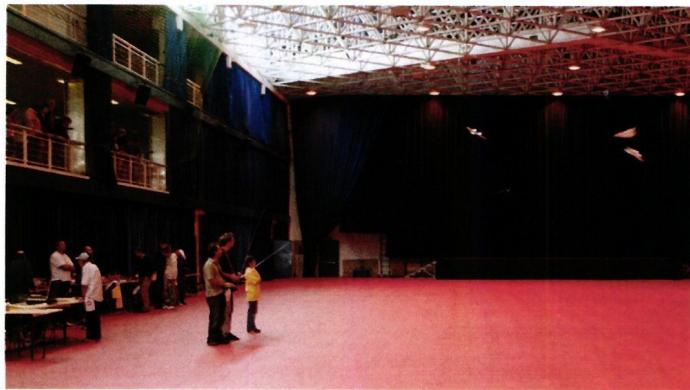
On October 20 and 21, 2007, the first major Flyindoor event was held at the FEVI building in Locarno, the only facility in Switzerland that allows for activities in an indoor space measuring 70×30×10 meters. The event, described by *La Stampa* as “a spectacle of technical marvels and breathtaking maneuvers,” featured three champions: Lucas Riva of Sigirino, 17 years old, 7th place at the 2007 3D Masters and 3rd place at the 2007 Swiss Rotorcraft Model Aircraft Championships; and Ennio Graber, the 2007 Swiss champion and 9th place at the 2007 World Helicopter Championships. Paolo Longhi, Italian champion in model aircraft flying (Freestyle discipline), was also present on Sunday. In total, about thirty pilots were active at FEVI. It was a pleasure to note the participation of many enthusiastic young model aircraft pilots, all masterfully coordinated by Nicola Del Biaggio with the help of a staff of about 15 people—members of the three groups. Noteworthy was the large turnout of spectators over the two days of flying, estimated at about 1,500 people. Special protective nets were installed for safety.
The organization and discipline demonstrated by the pilots were impeccable. The exhibition of model airplanes and helicopters, state-of-the-art remote controls, and model kits was a highlight, drawing great interest from the public.
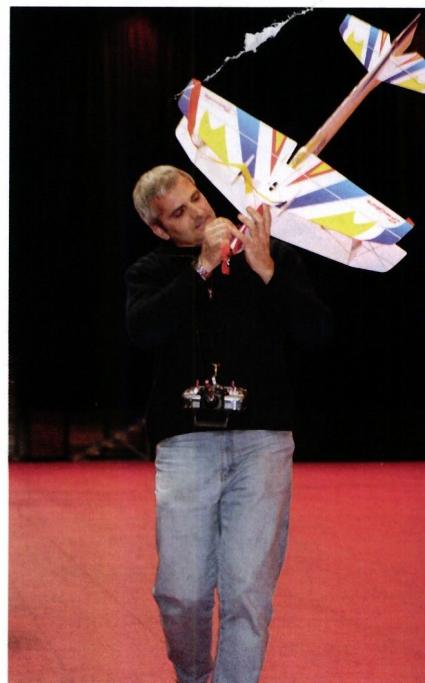
Thanks to technological advancements, the miniaturization of the aircraft and their components was evident. Polystyrene has been phased out in favor of “Depron” and “EPP,” materials that offer both lightness and significantly greater strength. The electric motors installed in today’s models produce zero emissions and ensure silent flight. The lightness of these mini-aircraft (weighing between 120 and 200 grams) is particularly noteworthy.
Experienced model aircraft enthusiast Nicola Del Biaggio highlighted the skills demonstrated by the pilots, who, in addition to flying models, engage with aerodynamics, electronics, computer science, mechanics, and materials processing techniques. For young people in particular, model aircraft building serves as a first step toward tackling
a future career in aviation. The Flyindoor event—a discipline that has been around for several years—generated a great deal of positive interest.
The flights, which took place throughout the two-day event, featured Lucas Riva’s incredibly daring maneuvers and the precision flights of Graber and Longhi. Flying together were mini hang gliders, fixed-wing model airplanes of various types and sizes, and even the white “swallows” that soared in flocks, propelled by the airflow created when a modeler waved a piece of cardboard to generate a draft.
The model aircraft community unites six groups south of the Alps into an association (FGASI), which in turn is affiliated with the Swiss Model Aircraft Federation and is therefore part of the Swiss Aero Club.
In conclusion, as I affirm that Flyindoor has a future, I congratulate today’s model aircraft enthusiasts, while reflecting on the gradual progress made over time. Model aircraft flying in Ticino began in 1936, and its slow evolution over the years has followed the actual development of technology and, in a certain sense, that of airplanes and helicopters. It began with the construction of uncontrolled gliders launched by hand; then
a compass was added to the model, and later ground-based and seaplane model aircraft were designed and built, still without any controls. It was engineer Gianni Andreoli of Mendrisio, a military pilot, who at age 19, in 1939, designed and built several small engines for model aircraft. Later, the famous Dyno 1 diesel engine was developed. In the early 1960s, the first expensive remote controls were introduced.
The original materials used were: solid wood, alder or birch plywood, and pine, fir, ash, or walnut lumber. The glue was made from casein, and Japanese paper or silk was used for the covering.
Today, model aircraft builders have new technologies at their disposal, and the future will undoubtedly hold new and fascinating discoveries.
Edgardo Rezzonico


News from HEBU

TEAM MANAGER "THIS" BOSSHARD
 Rodito Nussbaumer

SUMMER FUN 2026 AT MG USTER
Martin Wunderli
BY YOUTH, FOR YOUTH
Lorena Betschen
SMALL, MODEL-LIKE SAILBOATS
Res Dauwalder
TRY-OUT DAY AT MFV WETTINGEN
Urs Keller
What's New at Leomotion.com

52. 2026 ALPS CUP
 Emil Giezendanner

ATOM, THE NEW DOUBLE-DECKER FROM CPLR
 Matthias Bosshard

INSIGHTS INTO THE HISTORY OF SEAPLANES

YOU KNOW WHAT I MEAN? 125 YEARS OF THE SWISS AERO CLUB
Emil Giezendanner
34th HAHNENMOOS ALPINE MODEL AIRPLANE CAMP
Res Dauwalder
CORSAIR F4U – A WARBIRD WITH A MEMORABLE LOOK
Jürgen Rosenberger, Jürgen Prinz
F3A EUROPEAN CHAMPIONSHIPS IN ST-MACAIRE, FRANCE
Matthias Bosshard
HORIZON HOBBY/LEMACO NEWS: MICRO OV-10 BRONCO 645 MM BY E-FLITE

PRIDE AND GOOD IDEAS
 Markus Nussbaumer

EURO CONTEST GLIDER ACRO TOUR AUSTRIA 2026

FREE FLIGHT IN THE MIDDLE OF SUMMER
Urs Muntwyler
THE PC-21 STORY
Emil Giezendanner
TWIN TOWN PARTNERSHIP
Wolfgang Voeller
WELCOME, NEW MEMBER!
Andrea Bolliger
COUPE DES ALPES – OBSERVE AND LEARN
Rodito Nussbaumer
NEWS FROM HEBU
 Julia Bucher

FROM 0 TO 100
Markus Nussbaumer
MEMORIES
Wolfgang Völler
NOS REGION – A HUB FOR ELECTRIC AVIATION
Emil Giezendanner
Have you almost forgotten about aircraft that take off and land vertically?
Emil Giezendanner
70 YEARS OF THE NIDWALDEN MODEL AIRPLANE CLUB
Martin Barmettler